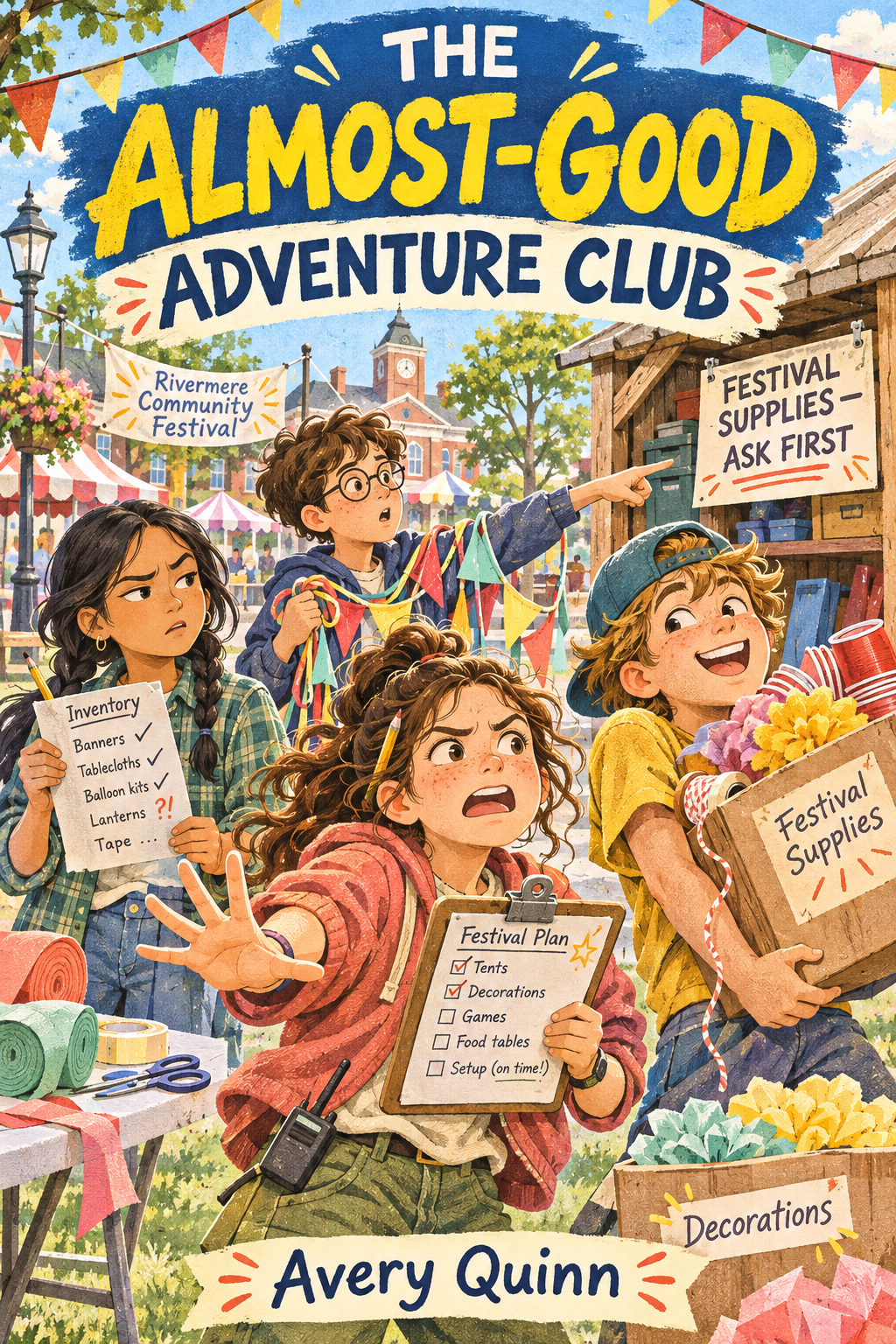
Chapter 1: The Trouble with Being Helpful
The first thing June Park learned about having a reputation was that it could arrive in a room before she did.
By the time she reached the cafeteria on Monday morning, her name was already on the whiteboard. Not in the nice section, where Ms. Delaney wrote names of students who had returned library books or helped someone find a lost mitten. June's name was under a heading that said PLEASE ASK FIRST.
She stood in the doorway with her lunchbox and stared.
"That is not a list," said a voice behind her. "That is a warning label."
Owen Bell carried a notebook against his chest. He had been in June's class since second grade. Whenever something happened at school, Owen usually knew exactly when it had happened, where it happened, and what sentence in the rules explained why it should not have happened. This was useful to teachers and unpopular with almost everyone else.
"My chairs were better," June told him.
"They were," Owen said. "The fire exit was also behind three rows of them."
"It was an assembly. Nobody was using that door."
"An exit does not stop being an exit when the room gets exciting."
June wished Owen would say something less reasonable.
On Friday, she had arranged the cafeteria chairs into a spiral for the visiting storyteller. She had imagined children leaning forward, every face turned toward the middle. The spiral looked fantastic. Then Ms. Delaney had pointed out the blocked exit, the custodian had moved the chairs back, and everybody had called it the Great Chair Disaster even though no chair had broken and no person had fallen down.
The worst part had happened after the chairs were fixed. June had gone back for her backpack and found Ms. Delaney kneeling beside the storyteller's folding case, trying to peel a paper arrow from the floor.
"Did the spiral look terrible?" June had asked.
"It looked interesting," Ms. Delaney said. "That wasn't the problem."
"Everybody keeps saying that."
"Then perhaps there's something worth understanding."
June had picked at the corner of another arrow. The tape came free, leaving a little gray rectangle of sticky dust.
"I wanted the storyteller to see that our school has ideas."
"He did see that," her teacher said. "He also needed a clear path to bring in his equipment. A good idea has to work for the people using the room, not only the person who imagines it."
June had nodded without quite hearing. In her mind the beautiful spiral had already become a story about adults who wouldn't let her do anything.
At home that night she drew the spiral again, this time with the exit marked in red. She could have shifted two rows of chairs and kept the shape. The solution was embarrassingly simple. She folded the page and stuck it beneath a stack of homework, where she wouldn't have to look at it.
Now, standing by the whiteboard on Monday, she remembered that second drawing. She didn't dislike being corrected because she thought she was always right. She disliked it because sometimes she could see how close she had come to getting things right, and nobody else seemed to notice the distance between almost and actually.
Milo Vega was already sitting at their table, turning a bent paper clip into a miniature windmill. He had earned a different sort of warning label. Last month, he'd tried to fix the loose wheel of the class supply cart without asking. The wheel had rolled off during reading time, the cart had tilted, and thirty-eight glue sticks had traveled across the floor like tiny runaway logs.
"You two are late," Milo said. "I found a way to make a paper clip spin without touching it."
"That sounds like how your last science project ended," Owen said.
"My last science project worked."
"It made a humming noise for three hours."
"A successful humming noise."
Talia Brooks arrived with a dramatic sigh and dropped into the final chair. She was the school's best speaker, which was impressive considering that two weeks earlier she had announced through the office microphone that picture day was canceled. It had not been canceled. She had heard "picture day schedule changed," decided she knew the rest, and told the entire building before anyone could stop her.
"I have important news," Talia announced.
June lifted an eyebrow. "Confirmed news?"
"Very funny. Confirmed by a paper flyer."
She flattened a bright orange sheet on the table. A drawing of a river curved across the top, under the words MAPLEHOOK RIVERLIGHT FESTIVAL: SATURDAY.
The festival was Maplehook's largest event of the year. There were food stands, student artwork, games, music, and a path of glowing battery lanterns along the river walk. People saved coins for months to buy peach pies from the church volunteers. Last year June had eaten a pie so quickly that her father called it a magic trick.
"They need volunteers," Talia said. "And they especially need help because some of the supplies are missing."
"Missing how?" Owen asked.
"Missing enough to write an urgent notice. Look."
Under VOLUNTEERS NEEDED, the flyer said: Festival organizers are reconciling supply locations after the depot roof leak. Please check in at the community center before moving or collecting materials.
"That says reconciling," Owen said. "It does not say stolen."
"I said missing," Talia answered. "You're the one who said stolen."
"I didn't say—"
"Exactly."
June read the flyer again. There was a problem in town. She had ideas. She had people. What she did not have was a chance to show that she could finish something without adults groaning before she began.
"We could volunteer," she said.
Milo made his windmill whirl. "I can fix stuff."
"I can make announcements," Talia said.
Owen looked doubtful. "I can keep track of what we actually know."
"Perfect," June said. "We make a club. Four members. One mission. Do something useful for Maplehook and change what everybody thinks about us."
"One useful thing," Owen repeated. "Not twelve impossible things."
"One spectacular useful thing," Talia corrected.
"Spectacular is not a kind of useful," Owen said.
June had already taken out a marker. She wrote names on the back of the festival flyer, then hesitated over a title.
"The Good Adventure Club," she suggested.
Milo made a face. "Sounds like a club that reminds you to chew with your mouth closed."
"The Excellent Adventure Club," Talia tried.
"Not accurate," Owen said.
June considered their four names on the paper. They weren't bad kids. They were kids who hurried, guessed, and sometimes had to apologize afterward. Being perfect was an unreasonable starting requirement.
The first club problem, naturally, was the club's name. Milo wanted the Thunderbolt Rescue Team. Talia wanted The People Who Will Eventually Be Thanked. Owen suggested Community Assistance Group, which made everybody stare at him as if he had offered to name a puppy Filing Cabinet.
"Do we have to be good at everything?" Milo asked.
"It would help," June said.
"I'm bad at folding fitted sheets," Talia admitted. "And math facts when somebody watches me."
"I lost a permission slip inside my own notebook," Owen said quietly.
June looked at him. "You?"
"It was in the back pocket. I checked every page except the pocket. Having a system doesn't mean you can't miss something."
This was alarming information about the person she planned to put in charge of checking things.
Milo had brought a shoebox of supplies from home: three binder clips, string, a tape measure, a flashlight with weak batteries, and a tiny plastic dinosaur. The dinosaur had no clear purpose, but Milo said every headquarters needed a mascot.
"You didn't bring a screwdriver?" June asked.
"My grandmother says tools belong where people know how to use them," Milo replied. "So I asked before taking anything. She said no to the screwdriver and yes to this dinosaur."
June put the dinosaur on the table, where it promptly fell over. She stood it up twice before noticing that one leg was shorter than the others.
"A club mascot that can't stand," Talia said. "That's us."
"It's a triceratops," Milo said. "And it's trying."
June laughed so hard she had to set down her pencil. She hadn't realized how much she needed that feeling. For a few minutes she wasn't the girl whose name had been put beneath a warning. She was one of four people trying to agree on what useful meant.
When they voted, the name Almost-Good won because nobody had to pretend they were already perfect. June wrote it carefully. She gave the dinosaur a pencil to lean against, and this time it stayed upright.
"That's not the same as fixing the leg," Owen pointed out.
"No," June said. "But it keeps him standing while we figure it out."
She wrote THE ALMOST-GOOD ADVENTURE CLUB.
They needed a headquarters, Milo insisted. A proper club required somewhere to put a box of equipment and, ideally, a door with a secret knock.
"Our houses already have doors," Owen said.
"Not secret ones."
"My mom doesn't let people knock secretly. She asks them to use the bell."
Talia proposed the school library until Owen pointed out that they could not rename a public building after themselves. June proposed the bench outside the gym, which turned out to be reserved for students waiting for rides. Milo proposed the tree behind the cafeteria. June reminded him that their last tree-based project had ended when a rainstorm turned their paper roof into wet confetti.
"Covered picnic table," Owen said finally. "It's on school property, visible to the recess monitor, and available before the bell if we ask."
"You make a picnic table sound like a bank vault," Talia said.
"Bank vaults don't usually have ants," Milo replied.
They began deciding what each person would do. June took the role of planner. Talia called herself public communications director and immediately asked whether that came with a microphone. Milo drew a wrench beside his name, then crossed it out because he wasn't allowed to bring tools to school without permission. Owen accepted the title of fact-checker, even though nobody else seemed eager to give him one.
"We should also have a rule about disagreeing," he said.
"We already disagree," June said. "We're excellent at it."
"A rule about doing it without leaving anybody out. Majority votes for choices. But if somebody says a plan might be unsafe, we stop and check with an adult."
June considered this. It sounded sensible and a little inconvenient, which was how Owen's best ideas usually sounded.
"Agreed," she said. "And no one gets to quit the club over a bad afternoon."
Milo raised a finger. "What about a very, very bad afternoon?"
"Then we have a meeting."
Talia drew a star in the margin. "Our meetings are going to be legendary."
They finished with a four-way fist bump. Milo's paper-clip windmill got caught on Talia's sleeve and fell into her applesauce. For several seconds no one spoke.
"First club accident," Owen announced.
"First club tradition," Milo corrected, fishing it out with his spoon. "We survive unexpected weather."
Milo grinned. "Now that's accurate."
"Almost-good?" Talia said. "People might laugh."
"They already do," June said. "This way, we get to decide why."
She drew a box for each member to sign. Owen insisted they also write a rule: ASK BEFORE MOVING ANYTHING THAT ISN'T YOURS. June allowed it because rules were easier to agree to when you hadn't yet reached the interesting part.
By lunch, they had four signatures, one flyer, and a plan to become heroes before Saturday.
They did not yet know that the festival supplies weren't the thing most likely to get lost.
Their listening skills were.
Chapter 2: A Map with Too Many Arrows
On Tuesday afternoon, the community center smelled like lemon cleaner and cinnamon rolls. June counted both as encouraging signs. A place that made cinnamon rolls probably understood ambitious plans.
On the wall beside the front desk hung a giant map of Maplehook. The town was shaped like a mitten with a crooked thumb. The river curled along its eastern edge. The old depot, which had once held train freight and now stored festival supplies, stood uphill from the community center. A branch library, recreation center, and high school surrounded the festival grounds at Riverside Park.
June took out her pencil and began drawing a smaller map in her notebook.
A little boy stood beside the center's bulletin board, looking up at a printed festival schedule. His grandfather was holding a walking cane and a bag of groceries.
"Does this tell us where the lantern walk begins?" the grandfather asked the front desk, though Ms. Salazar was still on the phone.
June hurried over. "Riverside Park! You just follow the river until the footbridge."
The grandfather smiled politely. "Which side of the river?"
June looked at the map. There were two paths, one on either bank. The footbridge connected them, but the little yellow symbols on the festival flyer were hard to read.
"The east side," she guessed.
"We need a route without stairs," the grandfather said. "My knee isn't fond of them."
Owen joined them and pointed to the accessibility note printed along the bottom edge of the schedule. "There are different routes. I think this says the step-free entrance is west. But Ms. Salazar should confirm which gate they'll open."
The grandfather thanked him. "That's exactly why we came early. We don't want to arrive on Saturday and discover we took the wrong path."
While they waited for the desk to be free, the little boy pointed at June's notebook. "Why do you have so many arrows?"
"I'm making a better map," June said.
"How do you know it's better?"
June started to answer, then stopped. The map was neater than the one on the wall. It had colored sections and a big star at the park. But she hadn't included a single symbol for stairs, noise, or places to rest.
"I don't know yet," she admitted.
When Ms. Salazar finished her call, she gave the grandfather the latest accessible-route handout and circled the correct entrance. He placed it carefully inside his grocery bag.
"Thank you," he said. "A little information now can save a lot of walking later."
June watched them leave. She put a small yellow question mark on her map, but her pencil hovered. She wanted a map that impressed people. The grandfather wanted a map that actually got him somewhere. Those were not necessarily the same kind of map.
"We can divide the town into search zones," she whispered.
"We are here to ask how to help," Owen reminded her.
"We're doing that too."
Behind the desk, a woman in a purple vest was talking into a phone. She lifted one finger to show she had noticed them. Her name tag said MS. SALAZAR, FESTIVAL COORDINATOR.
"No," Ms. Salazar told the phone. "The blue tape is for the quiet route, not the stage. That's why the labels matter. I'll send the updated location sheet after the meeting." She listened, then said, "And nothing leaves a storage room without a checked handoff."
Talia's eyes widened. "Blue tape. Updated sheet. This sounds serious."
"It sounds organized," Owen said.
Ms.…
June…
"T…
Keep reading The Almost-Good Adventure Club
You've reached the end of the free preview. Purchase this eBook for permanent access in your Novel Thunder Library, or read it with an eligible Novel Thunder subscription.
Buy eBook — $4.99