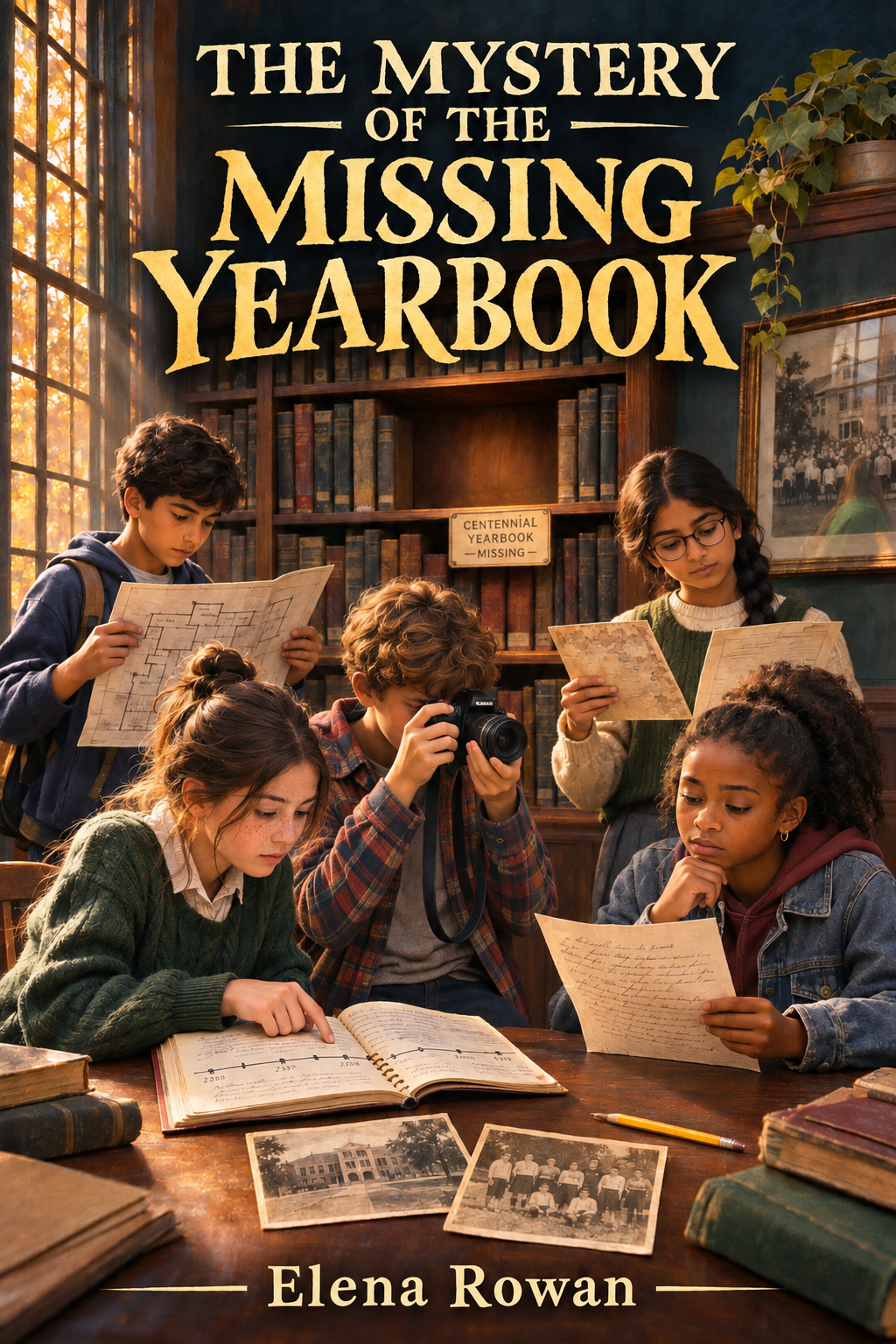
Chapter 1. The Empty Stand
On Wednesday morning, the oldest book at Briar Glen Elementary was missing. The centennial banner over its empty stand was hanging crooked.
Mira Santos noticed both things before the first bell. The banner said ONE HUNDRED YEARS OF BRIGHT IDEAS. Its last S drooped against a paper star. Beneath it, in the library’s centennial display alcove, an angled wooden stand held nothing but a rectangle of pale dust.
Mira stopped so suddenly that Theo Park nearly walked into her backpack.
“Did they move it?” he asked.
“The yearbook?” Mira leaned closer. A little museum label remained beside the stand: BRIAR GLEN, 1936. LOANED FROM THE SCHOOL ARCHIVE. “That was here yesterday.”
Theo had taken pictures after school on Tuesday for the fifth-grade news page. He always took pictures, even of lunch trays. “Maybe they’re scanning it.”
“Without moving the label?”
Across the library, Ms. Ortiz stood at the circulation desk, speaking quietly into her phone. Her eyebrows had pulled together. Then she saw the children and placed her hand over the receiver.
“Please head to class,” she said. “The alcove is closed until further notice.”
At morning meeting, their teacher, Ms. Finch, gave the news. The 1936 yearbook, one of only two known copies, could not be located. Friday’s centennial celebration would still happen, but the historical display was on hold. Dr. Chen, the principal, had begun checking the sign-out log and speaking with adults who had worked in the library.
“No one is being accused of anything,” Ms. Finch added. “Sometimes a missing item has been moved for a perfectly ordinary reason.”
That sounded reasonable. It also sounded like something grown-ups said when they were worried.
The five students at Mira’s table exchanged glances.
The five of them were not a club. They did not even agree about where to sit at lunch. Mira and Priya had worked together since second grade, though Priya had recently accused Mira of turning every group project into a list of rules. Nia could make new students talk within five minutes of meeting them; she also sometimes forgot that not everyone wanted their words recorded. Theo treated nearly every event as a possible picture. Luis could draw a hallway accurately from memory but struggled to explain a map to someone who had not seen the building.
They had been placed together for the centennial project because Ms. Finch wanted mixed skills, not five identical students. Already the arrangement had produced arguments. Theo wanted a photograph on the classroom door showing the oldest building beside the newest. Luis wanted a drawing so visitors would understand where the old building had stood. Nia wanted an audio recording of a former teacher describing how recess had changed. Priya wanted source labels on everything, including Theo's photographs. Mira had tried to combine all four suggestions into a plan so detailed that nobody had finished reading it.
Now, with the yearbook missing, those differences suddenly seemed useful.
'I'm not joining a detective agency,' Priya whispered when she caught the others looking at her.
'Nobody said detective agency,' Theo whispered back.
'You were going to,' she said.
He closed his mouth. Mira had to concentrate on Ms. Finch's explanation to keep from laughing. The situation was serious; an irreplaceable book was missing. Yet it was also the first school problem she could remember that required all five of their different ways of thinking.
During math, she drew five small boxes at the bottom of her scrap paper and wrote a question in each. For Nia: Who remembers what? For Theo: What do the photographs actually show? For Luis: Where could the cart travel? For Priya: Which statements have alternatives? For herself: What happened first?
Then she tore off the scrap and tucked it into her notebook. It was not evidence. It was only a way to start.
Nia Brooks had volunteered to interview alumni for the centennial podcast. Luis Vega had drawn the school map for visitors. Priya Shah liked to correct the instructions on science projects when they made claims they couldn’t prove. Theo had a camera. Mira owned a notebook with the words WHAT WE KNOW written across its cover.
At recess, Nia lowered her voice. “My grandmother’s coming Friday. She was a student here in the seventies. She wants to see the old books.”
“We should ask to help,” Luis said.
“Help with what?” Priya replied. “We can’t just search people’s bags.”
“No searching people,” Mira said. “We can help with the public materials. Photos. Interviews. Times.”
Theo brightened. “I took pictures yesterday. The book’s in at least three.”
“That might help establish when it was last there,” Priya said. She did not sound excited, which meant she was very excited.
After lunch they proposed a simple project to Ms. Finch: assemble a timeline from approved photographs and public interview notes, then give it to Dr. Chen. They promised not to accuse anyone, touch locked areas, or interrupt classes. Ms. Finch studied each of their faces, apparently searching for the part where this became trouble.
“You may organize evidence,” she said finally. “Any questions for adults go through me. And if someone says they don’t want to be interviewed, that is the end of it.”
Mira opened her notebook.
She wrote MISSING YEARBOOK across a fresh page, then drew two columns: OBSERVED and ASSUMED.
In the first column she wrote: The stand is empty Wednesday at 8:03 a.m.
In the second: Someone stole it.
At the last bell, she folded her notebook into her backpack. On the cover she had printed a lantern like the one stamped on the yearbook. The lines were crooked, but the light inside it was carefully drawn. She decided her job was not to rescue the school's perfect history. Her job was to find out which parts of that history were true.
She stared at the second sentence, then crossed it out.
Not yet, she thought. Not until we know.
At the end of the school day, Mira had a second problem that was not written in the ledger. Her father had promised to pick her up at four, and at 3:58 she was already watching the long hand on the clock outside the main office. He had taught her to read an analog clock when she was six, using the round yellow timer above his workbench. He repaired antique clocks for a living, and he believed every small gear mattered. If a clock lost two minutes a day, the question was not whether it was a good clock or a bad one. The question was where the time went.
When he arrived, carrying a cardboard box of spare clock parts under one arm, Mira hurried to the car. He apologized for being late. She had already calculated that he was one minute and forty-three seconds late according to the hallway clock, but she did not say so. His wristwatch read 3:59. The dashboard clock read 4:02. For the first time that afternoon, she wondered which clock had been correct.
“Do the clocks in the shop ever disagree?” she asked.
“All the time,” he said. “Otherwise I would have less work.”
“How do you know which one is right?”
“You find a reliable reference. Then you test. And if the reference is wrong, you have to admit you were measuring the wrong thing.”
At home Mira set three timepieces on the kitchen table: the small travel clock from the guest room, her father's watch, and the digital oven display. The oven ran fast. The travel clock lagged. Her father checked a trusted time signal on his phone. Mira wrote down the differences and drew three arrows, each pointing in a slightly different direction. If she called all three times exactly four o'clock, she would have been concealing a disagreement, not solving it.
Her younger brother, Mateo, sat beside her eating apple slices and asked whether she was building a time machine. She explained that a photograph marked 3:21 might not have been taken at exactly 3:21. Mateo listened, took a long bite, and announced that the mystery sounded harder than a time machine.
“It might be,” Mira admitted.
Her father was cleaning an old brass wheel with a soft brush. “If you tell a story using times,” he said, “write down which clock gave you each time.”
Mira opened the ledger and added a narrow column labeled SOURCE OF TIME. In the first row she wrote hallway wall clock. Then she crossed it out: she had only noticed the empty stand when the clock looked close to eight. She changed the entry to approximate time, based on arrival. Next to Tuesday's image she wrote camera file, device offset unknown. Her neat table looked less neat with those qualifications. It also looked less likely to betray her.
For dinner the family had rice and roasted vegetables. Mateo proposed that somebody had taken the yearbook to read at bedtime. Their father said it would be nice if every missing thing in the world had been borrowed by a careful reader. Their mother asked whether the principal knew the children were helping, and Mira explained the rules they had accepted. No locked rooms. No personal bags. No public accusations. Her mother listened carefully, then asked a different question: “And what happens if the answer points to someone you like?”
Mira did not know. It felt easier to promise she would follow evidence when she pictured an unknown person wearing a black hat. The volunteers at school were real people who remembered students' birthdays and carried folding chairs without being asked. She stared at the orange slice on her plate until her mother said that not knowing was a reasonable answer.
Before bed, Mira placed the ledger beside her homework. Beneath the final Wednesday entry she wrote a rule in small letters: A difference is not a lie until we know what caused it. She could hear her father's clocks ticking in the room across the hall, none quite in time with the others. The noise used to annoy her. Tonight it sounded like a useful warning.
Chapter 2. Five Kinds of Questions
By Wednesday afternoon, the five students had permission to examine centennial records in the public library area. They could compare documents and ask approved questions; only staff could enter secured rooms.
The library smelled of paper and lemon cleaner. Its oldest windows looked onto a courtyard planted with small red maples.
Before Ms. Ortiz brought the access sheet, the group spent ten minutes learning how easily they could disagree about something right in front of them. Luis asked everyone to sketch the reading table from memory, without looking up. Theo drew the windows larger than they were. Nia placed the circulation desk near the door, although it stood halfway along the east wall. Priya drew the table accurately but left out the folding screen altogether. Mira remembered the screen and the desk, then put the screen on the wrong side of the alcove.
'We walked past all of this three minutes ago,' Luis said, spreading the sketches on the table.
'That's embarrassing,' Theo said.
'Only if we pretend our drawings are surveys,' Priya answered.
Luis turned his map around. The neat blue lines represented walls measured from a public school floor plan, but even that plan had a limitation. It showed last year's temporary partitions in the auditorium. Mr. Das had moved them during summer cleaning.
'We should say which version it is,' Luis decided. He wrote SCHOOL PLAN, UPDATED FOR CENTENNIAL VISITOR ROUTE beneath the drawing, then added a note about the partitions.
Nia asked why details mattered when the problem was one missing book. Luis moved his pencil along the route from the library to the auditorium.
'Because if we say somebody could see through a wall, the rest of the theory doesn't matter,' he replied.
The exchange was still going when Ms. Ortiz approached with the record. The librarian had dark circles beneath her eyes. Mira suddenly imagined being the adult who had signed out a rare school artifact and then discovered it was no longer where she had left it.
'We won't make your job harder,' Mira said.
Ms. Ortiz looked surprised. 'Thank you. The way to help is to ask careful questions and let the staff handle the archive. A hundred-year-old book deserves better than a chase scene.'
Theo quietly put away the cardboard magnifying glass he had borrowed from the classroom reading corner. No one mentioned it.
“Before we do anything,” Priya said, “we need to agree on words. If somebody says they saw a person, that isn’t the same as recognizing the person.”
“That seems fussy,” Theo said.
“It is fussy,” Priya replied. “That’s why it works.”
Mira made five headings: time, place, source, certainty, and alternative explanation. Luis slid his visitor map into the middle of the table. The alcove opened into the main library. A staff workroom stood on one side; the west corridor led to the auditorium and its storage rooms. A rolling exhibit cart was normally parked behind a folding screen.
Ms. Ortiz joined them with a single sheet of paper. “I can share the access record with Dr. Chen’s permission. The yearbook was placed on the stand at 3:12 yesterday afternoon, during preparations. The display cover had been removed for mounting. It was supposed to go back on before the room was secured at four.”
“So the book wasn’t locked away,” Mira said.
“Not during setup. I wish it had been.” Ms. Ortiz did not pretend otherwise.
“Who had permission to work in the area?” Nia asked.
“School staff and three centennial volunteers. People came through carrying banners and boxes. You are not to treat that list as a list of suspects.”
Ms. Ortiz put the access sheet before them. Dr. Chen had carried the yearbook from the archive cabinet. Ms. Ortiz had made its label. Ms. Finch had hung student artwork. The volunteers were Mrs. Bell, who organized refreshments; Mr. Vale, who mounted photograph panels; and Mr. Bellamy, the celebration’s honorary history adviser.
The name Bellamy occupied the bottom of the page in beautiful blue handwriting. The family had donated the school’s first brick library room in 1936. A centennial poster in the hallway called the donor, Frederick Bellamy, THE MAN WHO GAVE BRIAR GLEN ITS BOOKS.
“Mr. Bellamy comes every year for history week,” Luis said. “He showed our class a picture of the old building.”
“Knowing somebody doesn’t prove or disprove anything,” Priya said.
Theo opened the school-approved photo folder on his tablet. His first picture, taken at 3:14 on Tuesday, showed the yearbook lying open beneath a temporary lamp. It had a faded red cover and a gold lantern stamped beneath the title. The facing page showed a crowded room of smiling children, with a caption too small to read.
“The book was still there two minutes after they set it up,” Mira said.
Theo zoomed into the next photograph. The time stamp read 3:21. The book was on the stand, now closed.
Then came a picture of the banner at 3:38. The stand was obscured by a tall cardboard tower.
“We know the last time it appears,” Mira said. “Not the time it vanished.”
“Yet,” Nia added.
A shadow passed the table. Mr. Bellamy, neat in a navy cardigan, had come to collect brochures from the front desk. He wore a silver tie pin shaped like a lantern, the old school emblem. He gave the children an approving smile.
“Junior historians,” he said. “A fine way to spend an afternoon. Though I hope the old book turns up before we need any junior detectives.”
Mira asked whether he remembered seeing it after three twenty-one. He touched his glasses.
“I left shortly after three twenty,” he said. “I was carrying nothing but the program posters. Ask Ms. Ortiz. She knows I said goodbye.”
After he left, Mira wrote down his words exactly. She did not draw a conclusion under them. The most interesting part was not that he sounded certain. It was that he had offered a way to check.
After Mr. Bellamy left the reading table, Theo wanted to follow him. He did not mean into a locked room, he explained, only far enough to see which exit he used. Priya stopped him with a look.
“What would following him prove?” she asked.
“That he went somewhere.”
“People are allowed to go somewhere.”
Theo opened his mouth, shut it, and returned to his tablet. He had been hoping the detective part would involve more motion. He had not expected it to involve so much sitting still.
Mira copied the access record into a clean table. In one column she wrote a person or object; in the second, the time; in the third, the source. Mr. Bellamy's words received a separate line from the school's records. She refused to merge two statements simply because they concerned one man. Luis added a fourth column for location, then discovered that none of them knew the exact position of the cart after the photographs ended.
“That's the biggest blank on the paper,” he said.
Ms. Ortiz overheard him. “A blank is not permission to make something up,” she said. “But it can tell you what to ask me next.”
Luis asked whether the cart had been moved for cleaning. She checked the ordinary room-use notebook, a record the children had not known existed. It said the floor around the alcove was due for a sweep Wednesday morning, after the Tuesday preparations. That answered one possibility without proving another. The cart could still have moved for many reasons.
As they packed up, Nia pointed to the word volunteer on the access sheet. “Why do we call adults who help a school volunteers instead of workers?”
“Some people are both,” Ms. Ortiz replied. “The word describes whether they were paid for this particular job. It doesn't tell you what they know or what they might do.”
“Or whether they're nice,” Theo…
“…
Keep reading The Mystery of the Missing Yearbook
You've reached the end of the free preview. Purchase this eBook for permanent access in your Novel Thunder Library, or read it with an eligible Novel Thunder subscription.
Buy eBook — $4.99