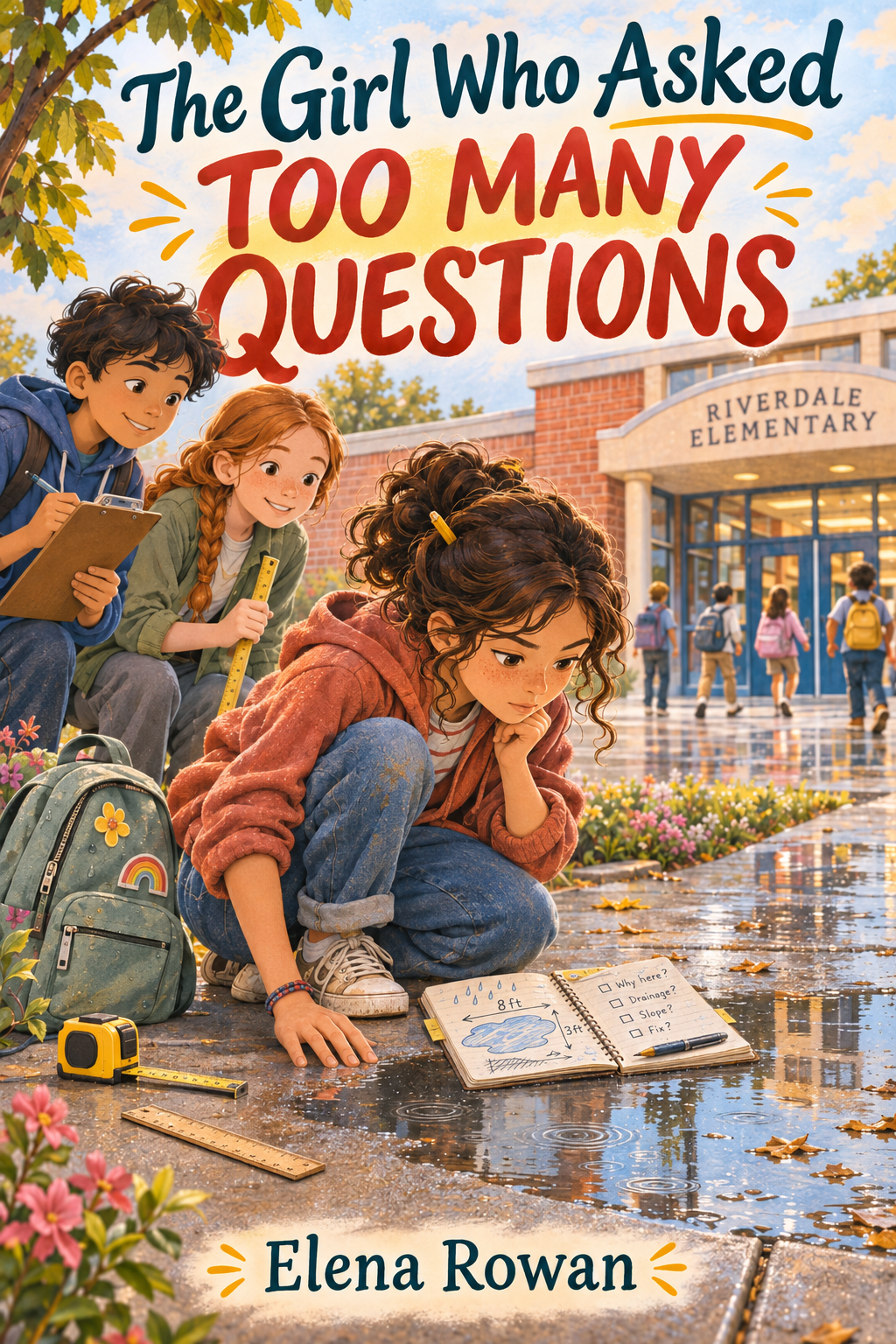
Chapter 1
The Question Jar
On the first Tuesday in September, Mina Park asked why the classroom clock was four minutes faster than the one in the hallway.
Nobody minded that question. Not at first.
Mr. Calder glanced from the clock to the doorway. “Because one of them is wrong, Mina. Open your math workbook.”
“But how do we know which one?”
“We can investigate it later.”
Mina wrote LATER on the corner of a sticky note. Under it, she drew two clocks, one with a question mark instead of hands. She already had eleven sticky notes in the pocket of her binder. The oldest asked why the cafeteria milk cartons were always wet. The newest asked why the fifth-grade drinking fountain took six seconds to become cold.
At the next table, Luis Ortega leaned across his worksheet. “You're going to need a bigger binder.”
“Or a smaller world,” Mina said.
He laughed, but Mr. Calder had started explaining decimals, so they both bent over their pages.
The trouble came at 10:17, during a lesson on rounding. Mr. Calder put 4.495 on the board and asked which digit determined the answer when rounding to the nearest hundredth. Mina raised her hand. He called on her.
“Why do we round money to two decimal places,” she asked, “if a gas station price sometimes has that little extra nine?”
A few students giggled. Mr. Calder looked tired in a way Mina had never seen in September.
“That's an interesting question, but it's not the question we're answering.”
“It's about decimals.”
“It is. And I'm trying to help twenty-seven students finish this lesson before lunch.”
Mina stared at the numbers. Mr. Calder wasn't shouting. That made it worse. She could hear the ceiling fan knocking once each time it turned.
“Could you put questions that aren't immediately relevant in a jar?” he asked after a moment. “We'll make time to look at them on Fridays.”
By afternoon, the class had a clean pickle jar from the art cupboard, a blue paper label that said QUESTION JAR, and a new routine. Mina helped cut the label. She even liked the jar. But when she dropped in a folded slip about the wet milk cartons, somebody at the back said, “There goes another one.”
That afternoon, the class tried the question jar for the first time. Mr. Calder drew three slips, read the first aloud, and smiled at the handwriting.
“Can plants tell when it's going to rain?”
“That one's mine,” Amara said. She sat so straight that Mina could see the careful part in her braids from two rows away.
“Interesting,” Mr. Calder replied. “How could we find out without asking a plant?”
Three hands went up. A plant by a window, someone suggested. Two plants, said somebody else, one watered and one not. Eden wanted to know whether plants near a window would react to light instead of weather. Mr. Calder wrote LIGHT beside WEATHER on the board.
Mina's hand was already raised, but she had four questions instead of one. Which kind of plant? How many rainy days? What counted as a reaction? Could a person mistake a leaf drooping from thirst for a warning about a storm? She pushed her hand under the desk and began writing.
Luis nudged her notebook. “You're building a whole plant courtroom.”
“I don't know how else we'd tell.”
“You could ask one question now.”
She looked at the board. Mr. Calder had written the class's guesses on one side and things they could check on the other. Mina raised her hand again.
“What would we measure?” she asked.
Mr. Calder stopped, considered, and added a third column. “That's useful. Class, what would we measure?”
For the rest of the period, they invented a small experiment they might run beside the windows. It wasn't perfect. No one could agree how a leaf should be measured. But by the bell Mina realized something startling: she had asked fewer questions out loud and learned more answers.
The plant experiment did not end when the bell rang. At recess, four children gathered around the classroom spider plant as if it were an unusual animal at the zoo. Luis held up his lunch napkin to make a miniature curtain. Eden insisted that nobody was allowed to decide the plant looked sad just because a leaf curved downward.
“Then how do you decide?” Mina asked.
“Maybe we don't decide yet,” Eden said. She pointed at a leaf with a white stripe. “You could draw the same leaf every day.”
The idea delighted Mina because it was both simple and annoying. To make an accurate drawing she needed to look carefully. She could not replace careful looking with a clever explanation. She borrowed a pencil from the art bin and copied the shape of the leaf. Luis drew the same leaf beside hers. His picture looked like a green ribbon being chased by a dog, but the stripe was in the right place.
Their classmate Owen wandered over. “Plants don't have feelings,” he announced.
“Nobody said they did,” Mina replied. “We're asking whether the leaves change before rain.”
“My uncle says his knee knows when it will rain.”
“Has anybody written down when his knee hurts and when it rains?”
Owen stared at her. “It's his knee.”
“That wasn't an insult. I just want to know.”
Owen left, carrying a face that made Mina think she had insulted two people and a knee. Luis folded the napkin and pushed it into his lunch box. “Sometimes you sound like you're cross-examining a witness.”
“I asked one thing.”
“You asked three things, and you looked disappointed he didn't have a weather station attached to his uncle.”
Mina looked down at the drawing. “So what was I supposed to say?”
“Maybe ‘That's interesting.’ Then ask whether he wants to help.”
It sounded terribly slow. She tried it when Owen returned for his forgotten water bottle. “Your uncle's knee sounds interesting,” she said. “Would you want to help us check the weather sometime?”
Owen glanced at the plant. “Maybe. My grandmother grows peppers. She says the leaves fold when they're too thirsty.”
“That could make a difference,” Mina said, and this time she meant it.
After school she sat at the bus stop beside a girl from sixth grade who had spent the whole afternoon carrying a cardboard model of a bridge. The bridge was bent in the middle, and one end had come loose from the base. Mina wanted to ask why its supports were so thin. She imagined the girl's expression if a stranger opened with a criticism.
“Did you make that?” Mina asked instead.
The girl nodded. “For science. It held six books until my brother put his backpack on it.”
“That's a lot of weight.”
“It isn't a lot of weight if the bridge is supposed to hold a backpack.” The girl smiled sadly. “We're rebuilding.”
“What's different in the new one?”
“Two extra supports, and we measured the distance between them instead of guessing.”
Mina waited until the bus arrived before writing the conversation in her notebook. Questions could be invitations, she decided, but invitations needed room for someone to answer. She drew a rectangle around that thought. She did not yet know how difficult it would be to remember when she was excited.
Afterward, she helped stack the notebooks. “I wasn't trying to slow down math yesterday,” she told Mr. Calder.
“I know.” He squared the corners of the stack. “I should have explained the problem instead of making the jar seem like a place to put you. I was worried about finishing the lesson.”
Mina studied the grain on the desktop. “Sometimes it feels as if the question is the part of me that everybody wants to put away.”
His face changed. “I'm sorry it felt that way. Your questions have value. We need a way to make room for them and for everyone else's work.”
That did not solve the puzzle in Mina's chest. It made the puzzle less lonely.
Outside the classroom, Eden waited by the lockers. “Did he give you a scientific license?”
“No. We made a schedule.”
“Much less exciting.”
“Maybe,” Mina said. “But schedules can be tested too.”
After school she walked past the low brick wall beside the playground. Near the gate, a narrow paved path sloped toward the school entrance. Water from the morning's brief rain still lay across the middle of it, although the rest of the pavement had dried. A third grader in bright orange sneakers approached the puddle, hesitated, and stepped into the grass. His shoe sank in mud.
Mina stopped. Rain had ended hours ago. The puddle was deep enough to reflect the entire doorway.
“Why does it stay there?” she whispered.
“Why does what stay where?” asked Luis, catching up to her with his backpack half unzipped.
She pointed. The third grader was scraping mud from his shoe on the curb.
“The water,” Mina said. “It doesn't have a good reason to stay.”
Luis studied the path. “Maybe it likes school.”
Mina wasn't laughing. She was looking at the slope, the drain near the parking lot, and the line of damp leaves caught against the curb.
There were at least six questions there. She had nowhere to put them.
The bus ride home gave Mina thirty-eight minutes to think about the puddle. She knew because she had timed the route twice, once when a train stopped traffic on Mercer Street and once when it didn't. Today the bus took forty-one minutes. She wrote that down too, although Luis had informed her that most people called the bus late and left it at that.
Mina shared a seat with a girl named Eden who liked to draw complicated horses along the edges of her homework. Eden noticed Mina staring at the wet cuffs of a second grader sitting ahead of them.
“Are you worried about his shoes?” Eden asked.
“I'm wondering why the school hasn't fixed that low part of the sidewalk.”
“Maybe they have bigger things to fix.”
“That doesn't mean it doesn't matter.”
“No,” Eden said, adding a bridle to her drawing. “It means you don't know what they've tried.”
Mina had been so busy asking why the water remained that she had forgotten about people who might have asked the same question before her. In her notebook she made two columns. In the first she put WHY IS IT THERE? In the second she put WHO ALREADY KNOWS ABOUT IT? The second question was somehow harder.
At home her grandfather sat at the kitchen counter peeling a tangerine into one continuous ribbon. He had moved into the little apartment over the garage last winter, after deciding that snow was less impressive when you had to shovel it alone. Mina's parents both worked late on Tuesdays, so he supervised her homework and made lunches that contained something crunchy even when she didn't want anything crunchy.
“How was school?” he asked.
“There's a question jar.”
“Does it hold answers?”
“Only questions.”
“Unbalanced piece of equipment.”
She told him what had happened during decimals. She tried to explain that Mr. Calder's voice had been perfectly calm, which somehow made the memory more embarrassing. Grandfather listened without declaring the teacher unreasonable or Mina a misunderstood genius. She had been hoping he might do one of those things.
“When I worked at the repair shop,” he said, “a customer sometimes asked why the washing machine didn't drain. I could explain a pump to him for twenty minutes. But if three other people were waiting, I had to finish the repair first.”
“So the question was wrong?”
“The timing might have been wrong. That's different.”
Mina pulled the little sticky note from her binder. LATER looked less like a punishment now, but she wasn't ready to like it.
She finished her homework and went outside with Grandfather before dark. The yard smelled of wet earth. She poured half a glass of water on the sloped concrete step leading to the back door. It ran toward the garden. Then she poured the other half into a shallow dent near the gate. The water stayed.
“That's a convincing demonstration,” Grandfather said.
“It's not a fair test,” Mina answered. “Different surfaces. Different amounts. I didn't measure.”
“Ah. The demonstration has been rejected by its own inventor.”
She laughed, then wrote down what she had actually seen, careful not to claim more. The experiment hadn't explained the school's puddle, but it had shown her how fast a person could start believing what they expected to see.
There was another question Mina did not put on the blank page. She had seen how the third grader stepped into the grass, and she wanted to know whether he had been embarrassed. Asking him directly would have been easy for her and perhaps unpleasant for him. She could already imagine his face if she walked up at the bus stop and announced that she had been studying his muddy shoe.
On Wednesday she tried asking Eden a different question. “Do you ever decide not to ask something because the other person might not want to answer?”
Eden looked up from a horse's mane. “I do it with my brother. He hates when I ask if he needs help with reading.”
“But he might need help.”
“He knows I can help. He doesn't need me to ask in front of everyone.”
Mina considered the difference between a question that produced information and a question that treated a person kindly. It had not occurred to her that the two might pull in different directions.
At dinner her mother asked her to tell everyone one thing she'd learned in school. Mina described the decimal lesson in painful detail. Her father, who worked shifts at the public library, said he had once interrupted a meeting six times to ask why a new book drop needed a special lock. He had been right about the lock. He had also made the meeting last so long that somebody missed the bus.
“Were you sorry?” Mina asked.
“I was sorry about the bus,” he said. “I still wanted an answer about the lock. The hard part was finding another way to get it.”
After dinner Mina practiced that idea with a small task. Grandfather had asked her to sort the kitchen drawer where batteries rolled among string and menus. She wanted to ask why they didn't store batteries in a separate container. Instead she emptied the drawer, lined up what she found, and asked Grandfather which items were used most often. His answer changed her plan. The batteries weren't the problem; the measuring tape was always being buried under everything else.
She placed the tape in a shallow cardboard box near the front of the drawer. Grandfather opened and closed it several times, pretending he couldn't see. When he could still find the tape, he declared the trial a success. Mina corrected him: it had succeeded for one person and one evening.
“Then we'll collect data,” he said, taking out the tape again.
Mina felt less certain and more interested. A question could begin inside her own head, but a useful answer often belonged to somebody else.
Before bed she unfolded the last page of the composition notebook her mother had bought in August. She wrote an invitation across the top: QUESTIONS OTHER PEOPLE MIGHT ASK. Then she left the page blank. For the first time that day, the empty space felt generous rather than lonely.
Chapter 2
A Problem with Shoes
Wednesday morning brought another rainstorm. This one arrived just as the buses unloaded. From the cafeteria window, Mina watched the entrance path fill with children moving in two directions: students hurrying inside and families leaving after walking younger children to the door.
A girl on crutches stopped at the puddle. Ms. Henson, the crossing aide, stepped over and guided her around the edge. The detour took them across a patch of wet grass and back onto the pavement beside the bike rack.
Mina wrote in her notebook: 8:04. Path wet. Detour onto grass. Not everyone can jump.
“Are you making a list of people?” asked Amara Brooks, dropping into the seat opposite her.
“No. Of what the water makes people do.”
Amara looked through the window. She was the kind of person who noticed when a poster was crooked and fixed it before anyone asked. “The ground is lower there. See how the sidewalk makes a little bowl?”
“That might be it.”
“Or the drain is blocked.”
“Or both,” said Mina.
At morning announcements, Principal Nouri introduced the Riverbend Community Science Challenge. Teams from grades four through six could identify a practical local problem, test possible solutions, and present a working model or a measured improvement at the November community showcase. No expensive materials were required. Each team needed an adult sponsor, a notebook, and a plan that could be tested safely.
“The best projects,” Principal Nouri said over the speaker, “begin by listening to people who face the problem.”
Mina looked at Luis across the room. He was already looking back.
At recess the three friends stood under the overhang while drizzle clicked on the metal gutter. A sign taped to the glass reminded everyone to wipe their feet.
“We could do the puddle,” Mina said.
“We could study the puddle,” Amara corrected. “We can't dig up the sidewalk.”
Luis lifted his chin toward the maintenance shed. “Maybe Mr. Benton could.”
“Not because three kids tell him to.”
“Then we get evidence,” Mina said.
They found Mr. Calder organizing paintbrushes in the classroom. He listened while Mina spoke, though she rushed and interrupted Luis twice.
“Start again,” he said. “One speaker at a time. What's the problem, exactly?”
“People have trouble using the entrance path when rain collects there,” Amara answered.
“And we want to learn why,” said Luis.
“And maybe invent a way to make the path safer without rebuilding it,” Mina added.
Mr. Calder looked toward the window. “You can apply. The project must be approved before you test anything on school property. No moving equipment, blocking routes, or directing students. You'll also need to measure something besides how annoyed people feel.”
“We can count the seconds the puddle lasts,” Mina said.
“That's a start. And Mina?”
She braced herself.
“I owe you an explanation about yesterday. Your questions aren't bad. I was trying to keep the lesson moving, and I made you feel like a problem. I'm sorry. The jar should help us save questions, not silence you.”
Mina studied the paintbrushes. A few had been left with bristles bent sideways.
“I interrupt sometimes,” she admitted.
“You do. That's something we can practice. Questions and timing both matter.”
At lunch, Mina found the boy with the orange shoes sitting with two friends. She had written out her question three different ways. Every version sounded as if she intended to examine his feet.
She sat at the end of the table and introduced herself. His name was Theo. He looked at her notebook, then at his lunch.
“I saw you go around the water yesterday,” Mina said. “I'm trying to understand how people use the entrance path. Would you rather I didn't ask?”
Theo shrugged. “What would I have to do?”
“Nothing. You can tell me to go away.”
His friends laughed. Theo didn't. “My shoes got muddy. Mom wasn't happy because she washed them Sunday.”
“Was the puddle the reason you stepped into the grass?”
“I didn't want wet socks.”
“Did the path feel blocked?”
He considered the question seriously. “Not blocked. Just gross.”
Mina wrote his exact words and then showed him the page. “Is this okay?”
“Sure,” Theo said. “Don't put my last name on a poster.”
“I won't.”
At the library table, Amara looked at the account. “You asked permission before writing. Good.”
“I didn't know if he'd answer.”
“People are allowed not to answer,” Amara said. “That's information too. It tells you your method has limits.”
Luis appeared with a bag of pretzels. “And it tells you he's not a science exhibit.”
Mina bit the inside of her cheek. She had said almost those exact words to herself the day before. Hearing them from Luis stung anyway.
“That's why I asked,” she said.
“I know. I'm proud of you for it.” He held out the pretzels like a peace offering.
The team made a rule in pencil: no names in the project notes, no photographs of children, and no interviews without permission. They crossed out a second rule after Principal Nouri explained that collecting personal stories during drop-off would create another problem for staff. A small group of students couldn't stop a busy entrance to run a survey.
The first time they tried to make a count, Mina almost spoiled it by talking. The students had been allowed to watch the approach from the cafeteria window before classes, with Ms. Ortiz nearby. She was the attendance secretary, which meant she knew when an ordinary morning had become a difficult morning long before the principal's office phone started ringing.
“Can I ask the children where they're going?” Mina asked.
“No,” Ms. Ortiz said. “You can watch where the route turns. Don't record anyone's name, face, or description. Don't stop traffic to improve your data.”
“But what if we can't tell whether someone changed direction because of water or because they saw a friend?”
“Then you can't tell. Record what you can observe, not what you wish you knew.”
Mina put a slash through the column she had labeled REASON. Luis drew a tiny sad face at the top, but Amara erased it. “People are going to see our notes,” she said. “Let's not make them look like a joke.”
At 8:02 they watched two students follow the marked detour. At 8:03 a student stopped to retie a shoe, then moved away from the low section. Luis wanted to count that as another detour. Theo said there wasn't enough information. The argument grew so intense that they missed the next person entirely.
Mina started a new line: 8:03 — OBSERVATION MISSED WHILE TEAM DISAGREED. She hated the line because it was embarrassing. She also suspected it was the most honest line in the notebook.
When they returned to class, Mr. Calder asked each group in science to describe one thing they had noticed that morning. The window garden group had found condensation on a glass jar. The recycling group had found two different kinds of bins in the same hallway. Mina held up the crossing sketch and explained that they did not know why every student had changed direction.
“Then what do you know?” Mr. Calder asked.
“Where the school had marked the alternate route. And that people used it. We haven't proved the water caused every choice.”
He wrote OBSERVATION DOES NOT ALWAYS REVEAL CAUSE on the board. Owen, who had overheard the plant discussion, raised his hand. “Could they ask everybody afterward?”
“Maybe,” Mr. Calder said. “But getting an answer has a cost. Imagine trying to question two hundred people while they're arriving at school.”
A few students groaned. Mina thought about Ms. Ortiz trying to take attendance calls while keeping the hallway orderly. She had noticed a problem outside the building, but perhaps she was creating another inside it.
That evening at dinner, Mina showed her father a diagram of the two paths. He managed the stockroom at a grocery store and sometimes arrived home with a crease in his forehead from balancing too many deliveries against…
“Y…
Keep reading The Girl Who Asked Too Many Questions
You've reached the end of the free preview. Purchase this eBook for permanent access in your Novel Thunder Library, or read it with an eligible Novel Thunder subscription.
Buy eBook — $4.99