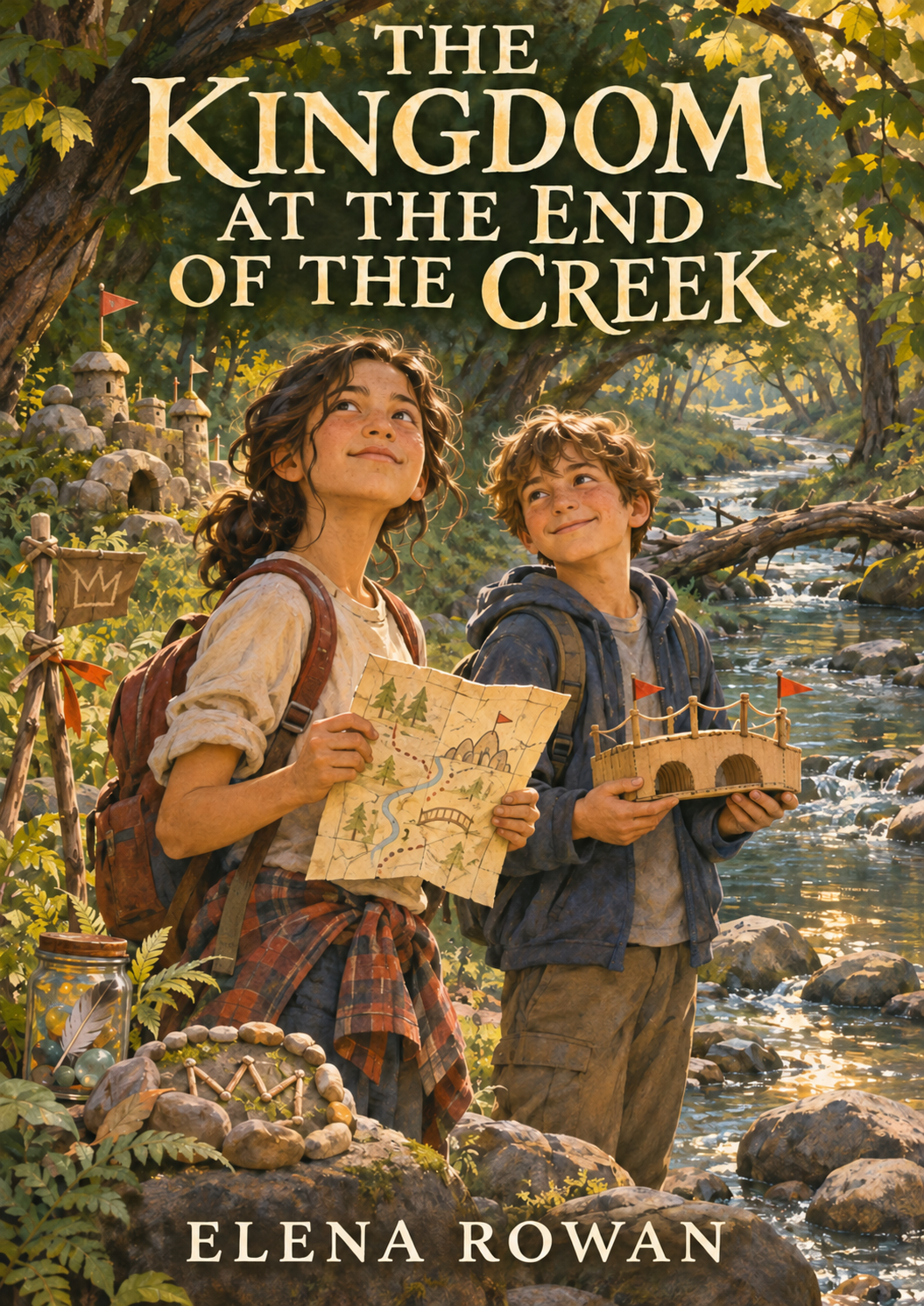
Chapter 1
The Map That Got Wet
The first time Mina Salcedo saw a kingdom, it was stuck to the bottom of her sneaker.
She had stepped into a puddle on the path behind Brackenfield Elementary, and a rectangle of soaked graph paper came up with her foot. On it, blue pencil lines curved around three crooked islands. A black star marked a bridge. Across the top, in letters too large for the page, someone had written: HERE BE DRAGONS, PROBABLY.
“Those are salamanders,” a voice said behind her. “And the bridge isn't there yet.”
Mina turned. Theo Bell, from her fifth-grade class, balanced on a fallen log with both arms out. He wore a raincoat with a missing snap and had mud on his left knee. She knew exactly three things about Theo: he could imitate the squeak of the classroom door, he lived near the creek, and he had corrected their teacher once about the number of moons around Saturn. Afterward he had apologized to the teacher and to Saturn, though only the first apology had been necessary.
“You lost a map,” Mina said.
“I was testing if the ink would run.”
“It ran.”
“Then the test succeeded.”
Mina peeled the paper from her sole. Half the eastern island had become a blue blur. She expected Theo to look upset. Instead, he squinted at the damage like an explorer receiving excellent news.
“That's the Mist,” he said. “The kingdom needed a dangerous border.”
The afternoon had slipped into the soft hour after school, when the buses were gone and the creek made more noise than the road. Mina was supposed to wait at the library for her mother's shift at the clinic to end, but the library's heating system had failed. Her mother had given her permission to walk home along the marked public path, with strict instructions not to leave it. The path followed the creek for six blocks. Theo was on the creek side of it.
“Are you allowed down there?” Mina asked.
“My dad says I can stand on the flat bank when it's dry. Not go into the water. Not after heavy rain. Today I'm on the path.” He lifted one shoe to show the gravel beneath it. “Mostly.”
Mina looked beyond him. Willow roots gripped the opposite bank. A shallow bend held bright stones under clear water. Two narrow channels curled around a little hump of land covered in reeds. It did look like a place a map could explain. It also looked like a place no map could keep still.
“What happens in your kingdom?” she asked.
Theo climbed down. “That depends. Do you want the truth or the official history?”
“Aren't they supposed to match?”
“Not in kingdoms.”
Mina laughed before she meant to. She hadn't laughed much at school that week. At home, cardboard boxes occupied the hallway while her mother sorted old receipts and talked in clipped sentences about rent. Mina had been told not to worry, which made worry feel like an assignment she was failing.
Theo rescued the map, folded it carefully into a damp square, and said, “I'm building the kingdom at the end of the creek. Actually, it's not the end. The creek keeps going under Mason Street. But that's where the path ends, and that's enough for a kingdom.”
“What's it called?”
After school she returned to the public path with permission, more to check the map than to find Theo. He was there, drawing the underside of the bridge while keeping his feet behind the safety rail. Mina showed him her geography notes. He said they should have a separate map for the sound of the creek. Mina shut her eyes. She heard a watery shuffle, a distant engine, wind in leaves, and Theo rubbing the side of his pencil against the paper. “We'd need four kinds of lines,” she said. “At least,” he replied. They tried. The map resembled a plate of noodles, and neither of them wanted to throw it away.
“I haven't found the right name.”
Mina looked at the reeds, the islands, and the gravel path with its line of pale stones. On the opposite bank, a kingfisher darted like a piece of blue paper with wings.
“Larkreach,” she said. “It sounds like somewhere you could almost get to.”
Theo went quiet. Then he opened his notebook and wrote the word so carefully it nearly filled the page.
“Larkreach,” he repeated. “We should make rules before we make a crown.”
Mina couldn't explain why that sounded like the most sensible thing anyone had said all week. She took the pencil he offered, leaned over the notebook, and drew a border around the place where the paper had blurred.
“What does the Mist do?” she asked.
Theo smiled. “Nobody knows yet.”
They walked toward Mason Street while the water moved beside them, carrying away a leaf neither of them had named.
On Monday, the students were asked to complete a survey about their favorite places in Brackenfield. The choices on the form were the playground, the pool, the library, and the sports field. Mina hovered over OTHER, then wrote the creek path. Theo, who sat two desks away, was staring at his own page. He wrote something and immediately covered it with his hand. After class they compared forms. He had also written creek path, then added, where it stops being a street and starts being a question.
“Mrs. Kwan won't know what that means,” Mina said.
“I barely know.”
He explained that when his father took him walking, they sometimes invented stories about ordinary places. A boarded storefront became the headquarters of the League of Lost Umbrellas. A crooked mailbox became the hiding place of letters nobody had sent. Their rule was that the stories had to make the walk more interesting, not make it unsafe. Mina liked the idea because she had been treating the walk home as time to be endured rather than time that could belong to her.
After lunch, the class discussed the survey results. The pool won. The creek path received two votes. Mrs. Kwan asked why the students liked the places they'd chosen. Mina couldn't explain a kingdom that barely existed, so she said she liked being near moving water. Theo said he liked that the creek had a name on the town map but didn't seem to care what people called it. A few students laughed. Mrs. Kwan said it was an interesting observation about names, and moved on.
That afternoon Mina brought a small notebook to the creek. The cover was green, with a bent corner where she'd stuffed it into her backpack. Theo had a notebook too, already half full of diagrams. They agreed that the official map would remain on paper, though they could photograph pages with parental permission so nobody could destroy the only copy by spilling juice. Mina suggested the first page should explain how the kingdom had been found. Theo said it hadn't been found; it had been started. She argued that the place itself was already there. They used both words in their first sentence: We found a bend in the creek and started a kingdom beside it.
The line made Mina happy for a reason she couldn't explain. Maybe it was the idea that starting something didn't mean pretending nothing had existed before you arrived. She drew the crooked bridge on the first page and left room beneath it for things neither of them knew yet.
On Friday the teacher set a bowl of objects on the reading table: a button, a smooth stone, a paper clip, a blue ribbon, and a key that didn't open anything in the school. Their assignment was to write a short description of an object without naming it. Mina chose the key. She wrote that it looked lonely. Mrs. Kwan asked her to describe something a reader could actually see. Mina crossed out lonely and wrote: one tooth bent sideways; rust along the round end. Somehow that felt lonelier.
Theo chose the stone. His description was four words long: A mountain, after some weather. Mina stared at it. Then she added to hers: A small door has forgotten it. Mrs. Kwan collected their pages and said they could learn from each other's different kinds of noticing. During recess, Theo walked beside Mina without saying where they were going. It was strange how quickly a person could become someone you expected to see.
“My dad says a map is an argument,” he said at last. “It says this place matters enough for a shape.”
“What does your dad do?”
“He fixes broken machines in the municipal workshops. At least until December. They're moving people around.” Theo pinched the loose snap on his coat. “The part nobody wants to say is that some of the jobs might disappear. He calls it restructuring because it sounds like a building instead of a problem.”
Mina thought about the boxes in her hallway. “My mom calls our apartment a temporary arrangement. We've lived there seven years.”
“Maybe adults have their own imaginary kingdoms.”
“Then their laws are terrible.”
At the creek they stayed on the marked gravel. Theo had brought a real ruler, a pencil, and a string. He knelt on the path and measured the distance between two cracks. Mina asked why. Theo said a kingdom needed distances, though he admitted they couldn't measure the far bank without crossing the water, which they were not permitted to do. Mina suggested they invent a unit that measured how long it took to tell a story. From the bridge to the bench was three tales if the teller was interesting, or twelve if the teller was Theo explaining moons.
Theo pretended to be offended. Then he told the story of the Blue Bird, who had flown over every river except this one because it couldn't decide whether arriving meant it must stay. Mina offered an ending in which the bird landed for one day and discovered that a place could matter without becoming a prison. Theo said that wasn't a very exciting ending. Mina said it was an ending they might need.
On the way home they passed the shuttered hardware store. A poster on its window promised SOMETHING NEW COMING SOON. Mina had seen it for months. Nothing new had come. She wondered whether an empty building could make a promise. That evening she drew the hardware store on the edge of her notebook map and labeled it THE HOUSE OF UNFINISHED SIGNS. The next day Theo changed the sign to read SOMETHING NEW COMING WHEN IT'S READY, which made her laugh so loudly her mother called from the kitchen to ask what had happened.
“Nothing,” Mina said, and stopped herself. “Something good.”
Mina's first official job in Larkreach was Keeper of the Blank Page. Theo said a keeper needed keys. Mina said that would defeat the point of the page, which belonged to anyone who could think of something worth adding. They negotiated a compromise: the key would be an ordinary pencil, and no one could keep it after using it. They drew the pencil on the inside cover and wrote its location as wherever someone was willing to share.
At school, Mina kept thinking about the blank page. During a writing exercise, she was told to invent a character who wanted something difficult. She made a child who tried to collect every falling leaf so autumn wouldn't end. By the final paragraph the child had filled an entire shed but could no longer get outside to see the trees. Mina didn't know how to finish the story. She left the child standing beside the shed with one hand on the door.
Mrs. Kwan wrote a note on the draft: You have found the problem. What can your character choose? Mina stared at the question through the afternoon. At the creek she asked Theo if a character could choose to make a mistake on purpose. Theo said of course, provided there was a reason. Mina went home and gave her leaf collector a new decision. The child opened the shed, let the wind scatter the leaves, and kept just one because it had a hole shaped like a star.
The story won no prizes. It didn't need to. Mina showed Theo the ending and he said Larkreach should have a Festival of Things Nobody Can Keep. Mina said festivals sounded too much like homework if they needed organizing. He agreed to make it a festival that happened whenever someone noticed it was happening. They found three yellow leaves caught in a puddle beside the path. Nobody collected them.
The next morning, Mina tried to explain the kingdom to her best friend from fourth grade, Celia, who had started sitting with a new group at lunch. She said there was a place down by the creek with islands that weren't really islands, a bird flag that wasn't yet a flag, and a map that was better because it had gotten wet. Celia asked whether they were building a fort. Mina said they were building something without walls. Celia smiled politely and changed the subject to the school dance committee. Mina realized there wasn't a rule requiring everyone to love the same idea.
During their geography lesson Mrs. Kwan unfolded a map of the state. The room filled with the soft crackle of paper. She asked them to name symbols, then discussed what the map couldn't show: the sound of a street, who lived in a house, whether a person felt at home. Mina raised her hand and asked why maps were trusted at all if they left so much out. Mrs. Kwan said they were useful because they were made for particular purposes. A bus map could get you to school; it wasn't meant to describe the people riding the bus. Mina copied that thought at the top of her page in large letters.
Chapter 2
The Four Laws of Larkreach
By Thursday, Larkreach had a flag, two citizens, and a legal argument.
The flag was a yellow scrap from Theo's father's old dish towel. Mina had drawn a small black bird above a blue zigzag. They were not allowed to tie it to a living tree, so Theo clipped it to the strap of his backpack whenever they visited the creek. The citizens were Mina and Theo, although Theo argued that an earthworm counted as a visitor.
The legal argument was about crowns.
“A kingdom has to have somebody in charge,” Theo insisted.
“Then we're not a kingdom,” Mina said.
“We already wrote the word on the map.”
“Maps can be wrong. Yours said there was a bridge.”
Theo tapped his pencil against his lip. “What if the crown belongs to the place, not a person?”
That settled it. They constructed a crown out of folded paper and kept it in a biscuit tin at Theo's house, safe from rain. Larkreach would have no king or queen. Its citizens would take turns speaking for the kingdom, and every important decision would need both of them to agree.
The first treaty was written at the library because it was too windy outside to keep the paper still. Mina and Theo claimed a table near the children's biographies. They spread out three maps, a handful of colored pencils, and the yellow flag. Theo tried to make a royal seal by pressing an eraser into a puddle of glue. The result resembled a squashed spider and stuck to his thumb.
“Law one,” Mina said. “Nobody gets to own the water.”
“Obviously,” Theo said, until she asked whether the imaginary citizens could divert it to fill a moat. He thought for a while. “No. The creek is older than the kingdom.”
“Law two. No living thing gets hurt for a game.” They included insects, worms, fish, branches still growing on trees, and birds too quick to identify. The rule seemed excessive until Theo pointed out that a pretend army could do genuine damage if people weren't careful.
For the third law, they considered a rule about honesty. Theo objected that the whole place was made up. Mina argued that pretending was different from lying. You could pretend a stone was a castle without telling a real person that something had happened when it hadn't. They agreed: When you make a claim about the real creek, check it. When you make a story about Larkreach, label it as a story. The difference mattered even if nobody outside the library ever read the laws.
They were debating the fourth when a little boy stopped at the table and asked if the yellow cloth was a pirate flag. Theo opened his mouth to explain kingdoms, citizens, and treaties. Mina answered, “It's a bird flag. We're still working out what the bird means.” The boy nodded gravely. “Maybe it means nobody has to be brave every day.” He ran off to his father before they could ask his name.
Mina wrote that sentence in her notebook without putting it into the laws. Some ideas deserved a space of their own. They finally decided that the fourth law would protect the right to leave and return. Theo called it the Open Gate Rule. Mina suggested the word welcome, then scratched it out. An open gate didn't require everyone to be cheerful. It only meant there was room.
They drafted the laws on the back of a school spelling sheet.
First: nothing living belongs to Larkreach. Not birds, worms, or people. You can visit; you cannot be collected.
Second: no one crosses a boundary without permission. The creek was a boundary they could admire from the path and the approved flat bank, not a dare to jump.
Third: an argument must be answered with three truths and one offer. A truth could be uncomfortable. An offer had to be something the speaker could actually do.
Fourth: anything borrowed from the ordinary world must go home by dusk. This included pencils, snacks, and Theo's bright orange tape measure.
“Do worries count as borrowed?” Mina asked.
Theo thought about it. “Maybe worries are visitors.”
“Can we send them home?”
“Not if they live with you.”
She drew a fifth line and erased it. The creek needed fewer laws than her classroom already had.
At home, Mina found her mother standing in front of the hall closet with a tape measure. She was measuring their tallest bookcase. There was no moving truck; no new apartment had been chosen. Still, the sight made Mina's stomach feel hollow. She took off her coat slowly.
“Are we leaving?”
Her mother lowered the tape. “I don't know yet. The landlord may sell the building. We're looking at options, not packing our lives into boxes tonight.”
“Then why are the boxes here?”
“Because I got nervous and tried to solve every problem before there…
Min…
Keep reading The Kingdom at the End of the Creek
You've reached the end of the free preview. Purchase this eBook for permanent access in your Novel Thunder Library, or read it with an eligible Novel Thunder subscription.
Buy eBook — $4.99