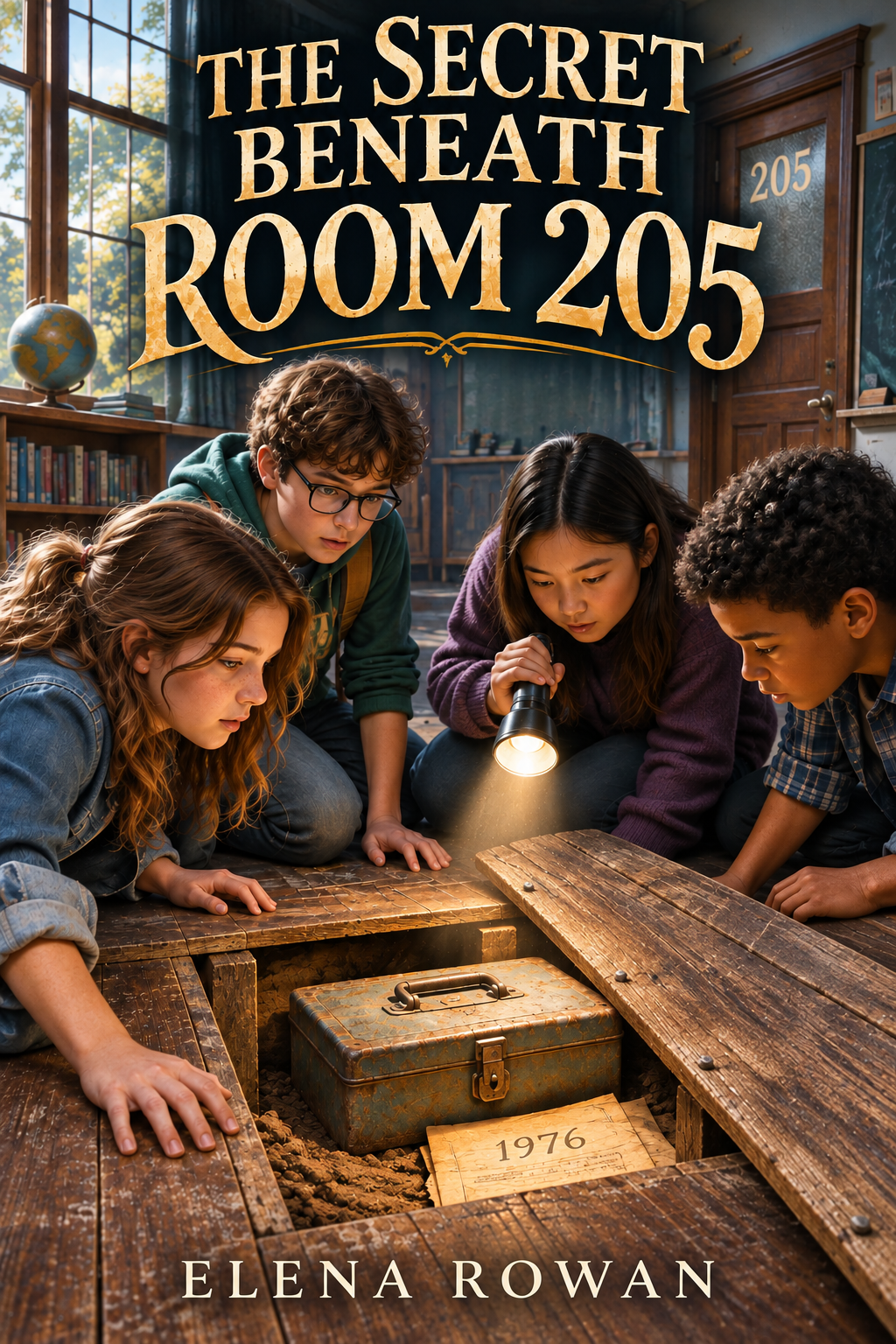
Chapter 1: The Sound Under the Floor
The first clue was a sound that did not belong in a classroom.
It was not the squeal of a marker or the rattle of the air conditioner. It was a dull, hollow clang from the far corner of Room 205, where a carpenter named Ms. Weller had lifted a damaged square of flooring.
Mina Patel heard it from the doorway. So did Theo Ramos, who nearly walked into her backpack.
“Treasure,” Theo whispered.
“Pipe,” Mina said. “Or an old lunch box. We don't know.”
The four members of the fifth-grade history team had been sent upstairs by their teacher to carry books into the temporary classroom. Renovations had emptied the west hallway of Alderbrook Elementary. Every doorway was covered with protective plastic, and blue tape marked places students were not allowed to cross.
June Park stopped before the tape. “We aren't supposed to go in.”
“We're not in,” said Kit Okafor, carefully keeping both sneakers behind the line. Kit held a cardboard box of dictionaries against his chest. “We're observing.”
Ms. Weller crouched beside the open floor panel. She was wearing gloves and safety glasses. She slid something rectangular onto a clean piece of plywood. Its metal lid was the color of pencil lead. A narrow lock hung from its front.
“What's that?” Theo asked.
“Something that needs to stay right here until the principal sees it,” Ms. Weller replied. She waved them farther back. “Please take your books to the room across the hall.”
Mina obeyed, though she looked over her shoulder twice. The box had been tucked below the subfloor, not dropped by accident. Someone had hidden it.
By lunch, students were saying it contained stolen gold, a lost report card, and a snake skeleton. Theo had contributed the gold theory before hearing the others.
“That's exactly the problem,” June told him at their usual cafeteria table. “A story spreads, and everyone adds something.”
Theo stirred his rice. “I said maybe gold.”
“People didn't hear maybe.”
Kit pulled a small notebook from his pocket. On the cover he had written ROOM 205 in block letters. Underneath, he drew two columns: WHAT WE KNOW and WHAT WE THINK.
In the first column, he wrote: metal box, locked, under floor. In the second, he put: treasure? snake? stolen something?
“Cross out the snakes,” Mina suggested.
“We haven't proved there aren't snakes,” Kit said solemnly. Then he crossed it out.
Their teacher, Ms. Ibarra, came to the table with a stack of permission slips for a local-history project. “I hear you've discovered the most popular object in school,” she said.
“We didn't discover it,” Mina replied. “Ms. Weller did.”
“Good correction. Principal Ellis is arranging for the box to be opened in the office with a district facilities employee. If it contains historical material, we'll ask the district archivist what the class may study.”
“Can we be there?” June asked.
“Not for the opening. But you might be able to examine copies later.”
Theo looked disappointed. Mina felt something else: relief. Old objects could be fragile, and if the lock broke, no one should be able to accuse the four of damaging it.
That afternoon, the class learned how quickly a small fact could turn into a large story.
Ms. Ibarra wrote three sentences on the whiteboard. The first read: A metal box was found during construction. The second read: A metal box full of valuables was found during construction. The third read: Someone hid stolen valuables under Room 205.
“Which sentence can we support?” she asked.
Nearly every hand rose for the first. Theo's hand went halfway up for the second, then dropped when June looked at him.
“I wasn't voting,” he murmured. “I was stretching.”
Ms. Ibarra smiled but didn't rescue him. She handed each table a photograph of an ordinary object: a bent bicycle wheel, a fallen birdhouse, or a broken window. The students had five minutes to write observations separately from explanations.
Mina's group received the broken window. The glass had scattered onto a carpet. Kit observed that some pieces were large, others small. June noted a curtain caught on the sill. Theo wrote, A baseball flew through it, and then drew a neat line through baseball.
“It might have,” he said. “But the picture doesn't show the ball.”
“Exactly,” Ms. Ibarra said, stopping beside their table. “A useful theory tells you what evidence to look for. An unsupported claim tells everyone the answer before the search begins.”
By the end of the lesson, their paper contained more questions than answers. Mina liked it that way. What bothered her was how many classmates seemed disappointed that the box might contain only paper.
At recess, she found two fourth graders standing near the closed west hallway. One child had convinced the other that the box belonged to an expelled principal who had vanished. The second child wanted to know whether anyone had checked for fingerprints.
“There's no evidence for any of that,” Mina said.
The first fourth grader shrugged. “It's more interesting, though.”
“Not to somebody whose real name gets dragged into it.”
She said the words before she understood why they mattered so much. The fourth graders wandered away, and she stood looking at the yellow construction tape. She had been treating the hidden box as a puzzle. It might also belong to people who were still alive.
On the bus, Mina took the window seat and watched familiar streets slip past. The brick bakery, the dry cleaner with the flickering sign, and the public library passed in reverse order from the morning. None of the buildings looked particularly old until she imagined children walking by them fifty years earlier. Some trees might have been smaller then. The bakery could have had another name. A child from 1976 might have ridden a bus over the same bridge.
When she got home, she searched for photographs of Alderbrook on the public school website. She found a picture of the building before the newer gym was added. Windows that now overlooked the cafeteria had once faced a courtyard. The upstairs library occupied the space behind Room 205, although the old caption did not explain how the rooms had been connected.
She sent the picture to Kit.
Is this evidence? she typed.
It proves the layout was different, he replied. Not why.
Mina copied the distinction into her notebook. She drew the old windows, then marked the places she was uncertain. At supper she asked her father whether a building could remember something its people had forgotten.
“Buildings don't remember,” he said. “They keep marks. The marks need someone patient enough to read them.”
Arjun interrupted to ask whether the school had secret tunnels.
“Probably not,” Mina said.
“Probably is not definitely.”
She pointed her fork at him. “You're getting good at this.”
Later, just before bedtime, Kit sent a picture of the three-column notebook. Under THINGS WE KNOW, he had written that the box existed, that it had a lock, and that adults were securing it. Under THINGS WE THINK, he had written that it was hidden deliberately. Under THINGS TO CHECK, the page was already full.
Mina added one more question in her own notebook: If someone thought these papers mattered enough to hide, what were they afraid would happen if the papers were lost?
Mina had a rule about questions. A question was useful until someone pretended that the answer was already known. At home, her father sometimes told her that rules were easy to follow when nobody challenged them. He said it while measuring rice for dinner, so she was never certain whether he meant history class or cooking.
That evening she tried to draw the section of floor she had seen. She placed the door on the wrong wall twice, erased the pencil grooves until the paper softened, and finally asked herself why she was trying to make a perfect drawing from a two-second look. She wrote MEMORY, NOT MEASUREMENT beneath the sketch. It felt less impressive than an accurate plan, but it was true.
Her little brother Arjun leaned over her elbow. “Is the box full of ghosts?”
“That's not how boxes work.”
“You don't know that.”
“I know ghosts have never been found in a metal box.”
He made a face that suggested he regarded this as a failure of research.
Their mother listened while cutting apples for the next morning. “You sound excited,” she said.
“I am. But everyone at school is already inventing things.”
“Then maybe the exciting part will be finding out which things are real.”
Mina turned over her drawing. On the back she made a list: ask how the opening was documented; ask whether anyone photographed the floor before removing the box; ask who gets to decide what historical material the class can see. She almost added ask who hid it, but that question belonged at the end, not the beginning.
Across town, Theo was having a harder evening. His father had asked about the treasure rumor, and Theo had made the mistake of saying that he was practically leading an investigation. His older cousin, visiting for dinner, wanted proof. Theo had none. He had a description of a box, four friends, and an excellent theory about gold that was beginning to embarrass him.
He opened the group chat and typed, The lid might have a map. Then he deleted it.
June had sent a different message: Tomorrow let's agree on what counts as a source. Kit answered with a photograph of the notebook's two columns and a third, newly labeled WHAT WE NEED TO CHECK.
Theo stared at the photograph. A third column gave him somewhere to put a theory without turning it into a fact. He wrote, Could the box be connected to the old library? He remembered the empty bookcases in the renovation photographs posted outside the office. That was at least a question connected to something he had seen.
The next morning the four met by the bicycle racks before the first bell. The air smelled of damp leaves. June brought a pack of colored index cards: blue for things witnessed, yellow for things remembered later, white for documents, and red for claims that might hurt somebody if repeated without care.
“Red seems dramatic,” Theo said.
“Good,” June replied. “Maybe you'll notice it.”
Kit added a small star to any card that had a date. Mina suggested they keep corrections instead of erasing mistakes. Theo wanted to know whether that meant preserving his snake theory forever.
“Maybe,” said June.
“Then history is cruel.”
Mina had another reason to care about being precise. In September, she had blamed a missing class-library book on a boy named Caleb.
The next afternoon she found Caleb near the pencil sharpener and asked whether he wanted to help compare a public school photograph with the current building. He studied both images, then pointed out that the stairs had probably been moved. Mina almost insisted they were the same before realizing the windows did not line up. She thanked him and added the possibility to her notes.
“Is that your mystery project?” he asked.
“Part of it. We mostly don't know things yet.”
“Then why are people already saying somebody stole the box?”
“Because it's easier to tell a story than check it.”
Caleb tucked his pencil behind his ear. “It's also easier to believe one.”
After class she told the team about her mistake with the lost book. Theo admitted he'd believed the same rumor. June had heard it but never asked Caleb. Kit simply said, “I didn't know.” The confession helped them make a rule about how they would handle disagreement: no question would be settled by the loudest voice. When evidence was missing, they would mark it missing instead of letting the group pick a favorite answer.
After school, Mina returned to the hall for her forgotten water bottle. Room 205's door was closed. The floor was covered again with temporary plywood, and a notice read CONSTRUCTION AREA—STAFF ONLY.
She peered through the narrow glass pane, remembering the clang. There was one fact she had not yet put in Kit's notebook. The box had been deliberately placed beneath a floor that had not been opened in years.
Who would hide something at school, then leave it there for half a century?
Chapter 2: Four Names on the Lid
The following afternoon, Ms. Ibarra gathered the four students at the classroom reading table. Principal Ellis joined them with a woman carrying a flat document case.
“This is Dr. Amara Sen, the district archivist,” the principal said. “She handles historical records, not student grades or private files. What was found yesterday appears to be a small collection of personal letters.”
Dr. Sen set photographs on the table. The first showed the metal box open. The second showed its underside, where someone had scratched four initials into the paint: N, E, L, and R.
“The facilities office used a locksmith,” Dr. Sen explained. “I photographed the contents where they were opened, then placed each item in a protective sleeve. You may work from scans. The originals stay with the district.”
Inside had been nine letters, a folded drawing, and a small envelope marked FOR THE PERSON WHO FINDS THIS. All were dated in the spring of 1976.
“Fifty years ago,” June said.
“Exactly fifty,” said Mina. “This year is 2026.”
Dr. Sen passed out printed copies of the shortest letter. Its handwriting tilted sharply to the right.
May 21, 1976
If anyone finds this, please don't decide that Nora gave up. Ask to see the receiving book. The number is 417. Everybody keeps saying we changed our minds, but we did not.
—Elise
Theo read the note twice. “Who's Nora?”
“We don't know yet,” Dr. Sen answered.
“What did they change their minds about?” Kit asked.
The initials bothered Kit more than they bothered anyone else. Four marks on a lid looked conclusive when four names appeared in the letters. But the initials had no dates. Someone might have scratched them when the box was made, or decades afterward. He told Dr. Sen so before their next session, expecting her to point out a simple way to check.
Instead, she asked, “What would a scratch tell you about its own age?”
“Nothing by itself,” he admitted.
“Exactly. We'll preserve what we can observe and resist adding a story to it.”
The archivist had brought larger scans of three folded pages. She showed them the thin line where paper had torn along a crease. One part of an address was illegible. On her typed transcript she had placed a question mark inside square brackets.
Principal Ellis laid out rules: the students could use digitized public board minutes, old newspapers in the town library, and interviews with adults who agreed to talk. They could not enter storage rooms on their own, take originals home, or request private student records. Dr. Sen would review anything the group wanted to publish.
“You may discover a mistake in a public record,” he said. “That doesn't give you permission to accuse someone of lying without evidence.”
Theo shifted in his chair, as if the principal had heard his lunchroom theory.
Dr. Sen unfolded the drawing. It showed a room with shelves drawn in bright orange pencil. A sign above the doorway said READING ROOM FOR EVERYONE. A ramp led to the front entrance, and a small figure pushed a wheeled book cart through the door.
“Room 205 used to be the school's library,” Ms. Ibarra said. “It moved downstairs after renovations in the eighties.”
Mina studied the drawing. A dotted line ran from the library doorway to a room labeled OFFICE. Near the bottom, someone had written: If they say we withdrew it, look where the forms go when they don't fit.
“That sounds like a clue,” Kit said.
“Or something that made perfect sense to its writer,” June replied. “We shouldn't assume it's a puzzle for us.”
Dr. Sen smiled. “That's historical thinking.”
The other letters named four children: Nora Bell, Elise Price, Luis Ortega, and Ruth Carter. They had wanted their school library kept open during a district budget cut. A public board summary from May 1976 said the students had withdrawn their request before the final vote.
June pointed to the scratched letters. “N, E, L, R. All four of them.”
“Then why leave the box?” Theo asked.
Mina touched the photocopy, not the original. “Maybe because nobody believed them.”
At a follow-up session the next day, Dr. Sen returned with a digital magnifier and a question that changed the team’s plans.
“Suppose I gave you one hour with the…
“Every…
Keep reading The Secret Beneath Room 205
You've reached the end of the free preview. Purchase this eBook for permanent access in your Novel Thunder Library, or read it with an eligible Novel Thunder subscription.
Buy eBook — $4.99