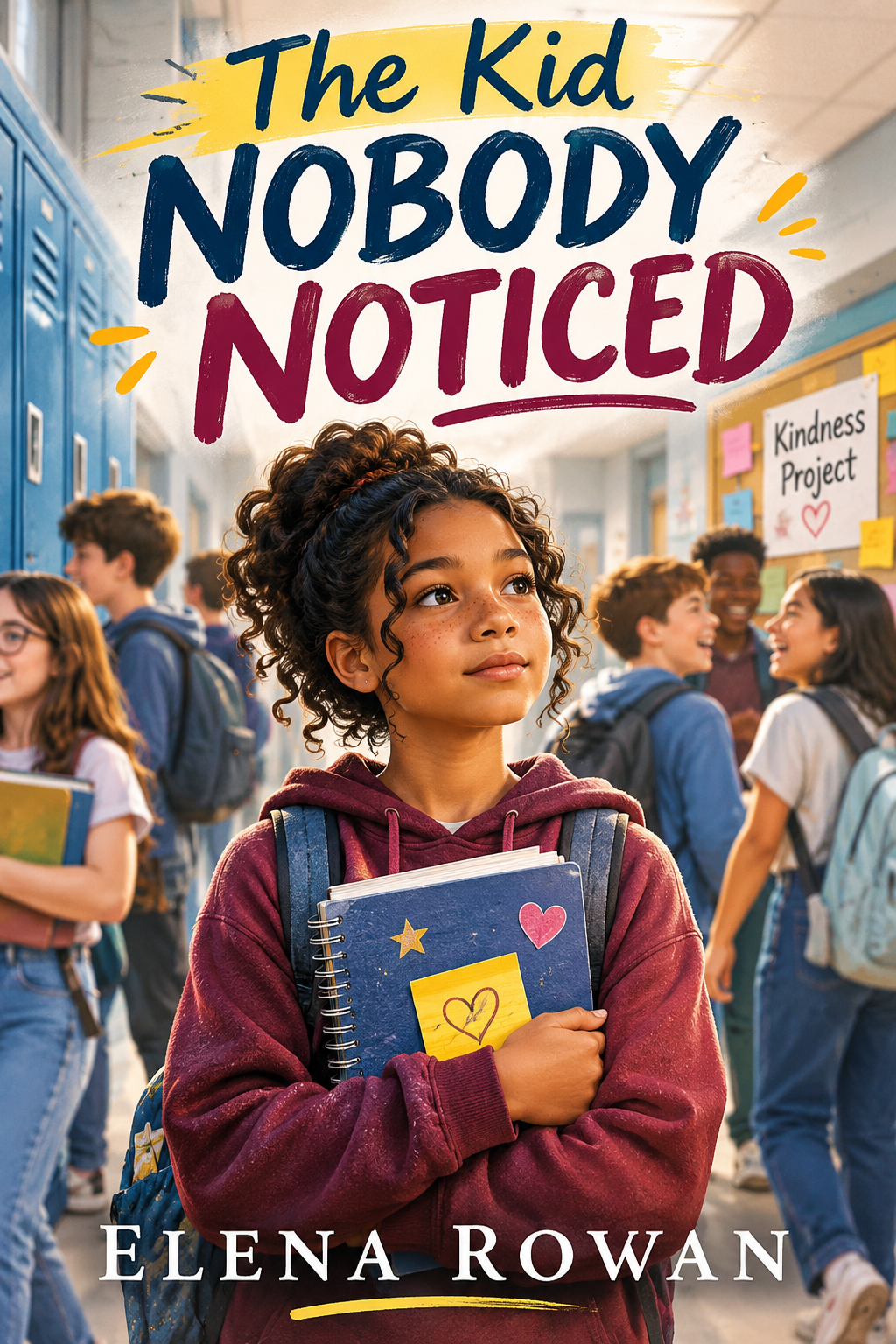
Chapter One: The Empty Space
On the first Monday of October, Mira Bell learned that a person could be present and missing at the same time.
She learned it at 8:17 a.m., when Ms. Alvarez counted the students in Room 205. She pointed at each desk with the cap of her purple marker.
“Twenty-three, twenty-four, twenty-five. Everyone's here.”
Mira sat behind the pencil sharpener with her hand halfway up. She had arrived early, as always. She had hung her wet jacket on the hook marked BELL and placed her reading book in the corner of her desk. She was so clearly there that she almost laughed.
Almost.
“Ms. Alvarez?” she said.
The teacher turned. “Yes, Mira?”
“You counted me twice. When you went back for the window row.”
Ms. Alvarez checked her chart. “Oh! You're right. Good catch. Twenty-four, then.” She smiled and returned to the board.
The count was corrected. The strange feeling was not.
At recess, the four-square game filled before Mira reached the blacktop. She stood near the painted line while the players argued about a bounce.
“You can be next,” said Jo Park, who had been Mira's best friend since second grade.
Then a basketball rolled between them. Jo chased it, joined a different game, and never returned.
Mira could have called after her. She could have crossed the blacktop and asked to play. Instead she put her hands into the sleeves of her sweatshirt and watched the yellow leaves blow against the fence.
That was part of the problem, she knew. If being noticed were a science fair experiment, she would be the scientist who never turned the machine on.
A few minutes later, at recess, Mira sat at the end of the low brick wall near the basketball court. She had meant to ask Jo whether they could practice their spelling words together. But Jo was already in the middle of a four-square game, shouting a rule about corner shots. Mira counted the cracks in the pavement instead. There were eleven near her shoes and one that looked like a lightning bolt.
A first grader wandered past with a mitten dangling from his coat sleeve. He stopped and asked, “Is this where you line up for lunch?”
“Not until eleven thirty,” Mira said. “First graders line up by the yellow door.”
“Oh.” He turned in a slow circle, searching for a yellow door among three brown ones.
Mira stood and pointed. “That one. With the sun painted beside it.”
The boy thanked her and ran toward it. He did not ask her name, and that was fine. For several minutes, Mira felt useful. Then she wondered why being helpful to a stranger seemed easier than saying one ordinary sentence to a friend.
At lunch she sat beside a new boy, Mateo Reyes, because the seat across from Jo was taken. Mateo kept checking a folded paper under his tray. When the cafeteria grew loud, he covered one ear with his shoulder.
“Is that the lunch menu?” Mira asked.
He folded the paper so fast the corner tore. “No.”
“Sorry.”
He nodded without looking at her.
Across the room a girl named Nia Brooks carried her lunch to the recycling bins. She tipped a milk carton, missed the opening, and splashed her sleeve. Two boys laughed. Nia laughed too, a quick bright laugh that sounded a little too loud.
No one offered her a napkin. Mira had three in her pocket from breakfast, but by the time she decided to stand, Nia had walked away.
At home she told her mother that fifth grade felt like a game where everyone else had been handed the rules. Her mother was chopping carrots. She set down the knife before answering.
“Did somebody say you couldn't join?”
“No. That's the thing. Nobody says anything.”
Her mother waited.
“If someone is mean, you can tell them to stop. But what do you tell someone who just doesn't remember to look your way?”
“You could tell them what you want,” her mother said. “That doesn't always work the first time.”
Mira opened the refrigerator and stared at the orange juice without taking it out. She wanted a more complicated answer, preferably one that included a map and exact instructions. Her mother only asked whether she wanted to set the table.
Mira placed four plates around three chairs and the stool where her little brother, Owen, sat when he visited from his after-school club. The fourth plate was for her father, whose bus route finished late on Mondays. Seeing an empty chair made her think about the count in Room 205. A space did not always mean somebody was missing. Sometimes it meant somebody was expected.
She was not sure whether that thought made her feel better. She wrote it on a clean page of her notebook anyway.
After helping set the table, Mira opened the blue notebook she used for things she didn't want to forget. The first page held a list called POSSIBLE INVENTIONS. One was a backpack that reminded you when your homework was inside it. Another was a shoe that could find its own missing partner.
She turned to a blank page.
THINGS PEOPLE DID NOT SEE, she wrote.
Then she stopped. The title looked like the beginning of a detective report. Mateo had seemed upset; that didn't mean she knew why. Nia had spilled milk; that didn't mean she needed someone writing about her.
Mira crossed out the heading.
THINGS I COULD HAVE DONE.
1. Ask Jo again instead of waiting. 2. Offer Mateo a quieter place to sit, if he wants one. 3. Hand Nia a napkin before deciding it's too late.
Her mother knocked on the open door. “Writing a story?”
“Maybe.”
“Good maybe or terrible maybe?”
“Undecided maybe.”
Her mother nodded like that was a perfectly normal answer. “Dinner in twenty.”
After she left, Mira looked at the list. None of the things required becoming funny or loud or suddenly excellent at four-square. They required doing something before the moment disappeared.
She tore a square from the back of her notebook and wrote: IF YOU NEED A PARTNER FOR THE MAP PROJECT, I CAN HELP. She folded it and placed it in her pencil case.
It was a tiny piece of paper. Still, Mira had the feeling she had put something important inside.
Mira's father came home at seven-forty, carrying the damp smell of the bus garage on his jacket. Owen rushed to tell him that a pirate ship had been discovered in the family kitchen. Mira was putting the last fork in the dishwasher when Dad asked about her day.
“Regular,” she said.
“That can mean about six different things.”
“Then pick the boring one.”
Dad crouched to inspect Owen's pirate drawing, which had somehow acquired wheels and a flag shaped like a sandwich. When he stood, Mira had escaped to the hallway. She disliked how quickly her feelings seemed to become a family meeting. She also disliked how relieved she felt when someone asked.
A little later, Dad knocked on her bedroom door with a clean bus timetable. On the reverse was an empty grid, the kind drivers used to mark stops during route changes. “For your inventions,” he said. “You always need graph paper.”
“Thank you.”
He did not leave immediately. “You know how passengers sometimes think I didn't see them waiting?”
Mira glanced up. “Did you?”
“Sometimes I truly didn't. Sometimes I saw them too late to pull over safely. Sometimes they stood behind the shelter instead of at the curb.” He tapped the timetable. “Those are three different problems, even though they feel the same to the person waiting.”
“Are you telling me to stand at the curb?”
“I’m saying I can't figure out which problem it is from behind the steering wheel. I have to pay attention. And sometimes the passenger has to wave.”
After he left, Mira drew three columns on the paper: NOT SEEN, SEEN TOO LATE, and DID NOT ASK. She immediately wanted to add names. She put the pencil down instead. The columns looked useful, but people did not always fit inside a rectangle.
The next morning would be map-project day. She could keep waiting for Jo to choose her, or she could ask somebody herself. The thought made her stomach go tight, as if she were about to make a speech. She practiced one sentence under her breath while Owen played astronaut in the hallway.
“Do you want to work together?”
Owen poked his head into her room. “With me?”
“Not you. Someone from school.”
“Oh.” He considered this. “You should ask before they launch without you.”
“That's not how school projects work.”
“Maybe it should be.”
At bedtime, Mira placed the folded paper next to her pencil case. She had written an offer, but she decided she would not push it across a desk and then pretend it had appeared by magic. She would say the words out loud. She might receive a no. Either way, the next day would have an answer, which was more than she had today.
Chapter Two: A Note Without a Name
Tuesday's map project began with Ms. Alvarez announcing that no one would work alone.
“Local history is a team sport today,” she said. “Your pair will choose a place in our town and explain how it changed over time. You will interview someone or use a reliable source, and you will tell us where your facts came from.”
Twenty-four chairs scraped across the floor.
Mira watched Jo turn toward Tessa Lin. They were already whispering about the old train station. It was not betrayal. It was simply fast. Other pairs formed while Mira was still deciding whether to move.
Mateo sat beside the bookshelf with his pencil balanced across his fingers. He had transferred to Westbrook Elementary in September. People knew he drew good dragons, that he never volunteered to read out loud, and not much else.
Mira took her paper from her pencil case, but its message was wrong now. It said she could help. She could ask instead.
“Do you want to work together?” she said.
Mateo looked up. “On what?”
“The project.”
“Oh.” He considered it. “Can we do the footbridge? My grandpa says it used to be wood.”
“That would be good.”
They were a pair. The ceiling did not crack open. Nobody applauded. Mira felt foolish for having made the question into such a large thing.
At independent reading time, she noticed Ellis Ward staring at his blank science log. Ellis was the sort of student who had an answer ready before most teachers finished asking a question. Today he kept erasing the date.
Mira whispered, “You can borrow my ruler.”
He glanced at her, surprised. “I have one.”
“Okay.”
“Thanks, though.”
The conversation lasted five seconds. It was enough to make Mira reconsider the note in her pencil case. A kindness offer could be wrong, or unnecessary, or simply refused. That did not mean asking was dangerous.
She wrote a new note during dismissal: SOMEONE HAS EXTRA COLORED PENCILS FOR ANYONE WHO NEEDS THEM. ASK AT DESK 18.
She placed it on the corner of the supply shelf. Desk 18 was hers. The note lasted less than a minute before someone picked it up.
“Who wrote this?” called Priya Shah, the class materials captain.
Mira stared hard at a zipper on her backpack.
Priya read it again. “This is actually useful. The green pencil set is missing half its colors.”
“Don't leave loose papers on the shelf,” Ms. Alvarez said without looking up from her dismissal list. “Put them in the basket or they'll vanish.”
Priya slid the note under the transparent front of the supply basket. “Then it's a supply sign.”
The next morning, Ms. Alvarez gave the pairs a checklist. Every project needed a map, three facts with sources, a drawing or photograph, and two people who could explain the work. “Notice the last part,” she said, tapping the board. “Two people. Not one person with an assistant who holds the poster.”
Mira liked checklists. They stayed the same no matter how loudly people talked. Her partner, Mateo, read the list and circled the drawing requirement.
“Can I do that?” he asked.
“Sure. I'm good with source cards.”
“What if I want to do a source card too?”
Mira looked up. She had almost assigned the jobs without asking. “Then we both can.”
They tried the school library catalog. The town history book was checked out. The website they found showed a picture of Marsh Creek but did not say when it had been taken. Mateo zoomed in and pointed to the bridge railing.
“That's the old one,” he said. “My grandpa told me about it.”
“How do you know it isn't just a different angle?”
“The posts are wood. The new bridge has metal rails. We can ask him, but we should still find a date.”
Mira wrote POSSIBLE SOURCE, CHECK DATE on the top of a card. She was relieved that Mateo cared about getting it right. She had mistaken his quiet voice for uncertainty.
During lunch, Nia dropped a grape from her tray. It rolled under the table. Before Mira could retrieve it, Nia caught her sleeve.
“Don't. I'm not eating a floor grape.”
“I was going to put it in the trash.”
“I know.” Nia smiled. “You make a rescue plan for everything.”
Mira laughed, then stopped. The comment had not sounded cruel, but it followed her back to class. She did make plans. When she saw a problem, her brain rushed ahead to the cleanest solution. It was harder to stop and ask whether somebody wanted that solution.
After school she brought her map research to the kitchen. Owen leaned over the table and added a pirate ship to the creek.
“There aren't pirates in town history,” Mira said.
“Maybe the map forgot them.”
Mira almost erased the ship. Instead she asked him to draw it on the back. It was not a fact for the project, but it was his contribution to the afternoon, and he was proud of it.
On Wednesday three classmates borrowed pencils from…
M…
Keep reading The Kid Nobody Noticed
You've reached the end of the free preview. Purchase this eBook for permanent access in your Novel Thunder Library, or read it with an eligible Novel Thunder subscription.
Buy eBook — $4.99