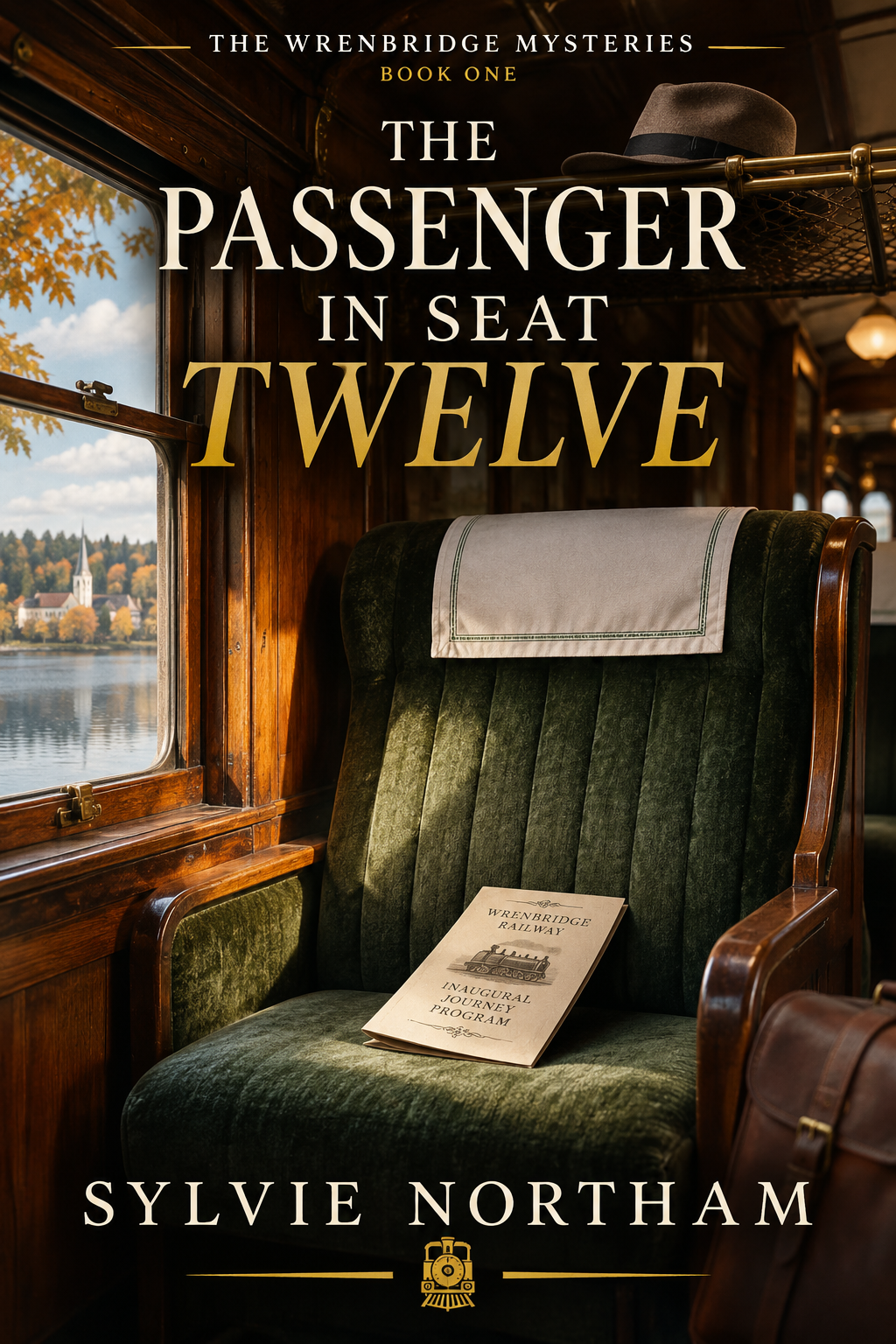
CHAPTER ONE
The Kind of Day That Looks Safe
The morning the man in seat twelve was murdered, the lake was the color of old silver, and the people of Wrenbridge were dressed as though they had been invited to the opening of a respectable future.
There were new coats on the station platform, shoes that had never met cinders, and flowers wired to the iron railings of a building whose paint still smelled pleasantly sharp. A brass band had found a patch of sun beneath the station clock. Someone had arranged little paper flags along the fence, although the flags were already bending in the breeze off the water.
Nell Mercer stood beside a wastebasket, watching a man in a silk tie try to remove a strip of blue painter's tape from the bottom of his shoe. It was the kind of detail her father would once have written in the margin of an article and then, more likely than not, deleted. A town wished to look splendid on the morning of its own celebration. It did not necessarily wish to be seen trying.
“Are you working,” Owen asked, “or judging the footwear?”
Nell looked at her brother. He had a camera against his chest and a second hanging at his hip, both covered with small, practical strips of black tape where the manufacturer's silver lettering had once been. His hair had been combed with unusual attention. This was the single concession he'd made to formal occasion.
“Both,” she said. “Can you do both?”
“Not while wearing a tie.”
“You're not wearing one.”
“Exactly.”
He held out a paper cup. The coffee was hot enough to make her change hands twice. Their mother had supplied the coffee in a thermos and had also supplied an opinion on the Chronicle's coverage of the railway opening. The opinion, briefly stated, was that they ought to print something hopeful for a change.
Nell had promised to try.
Three years after Graham Mercer's death, his newspaper was still teaching his children the distinction between necessary expenses and expenses that had become necessary through habit. The Wrenbridge Chronicle now occupied two rooms above a locksmith's shop. Nell edited it, wrote most of it, sold advertising when the advertisements failed to sell themselves, and sometimes delivered copies to the post office with the back of her coat damp from the rain. Owen took photographs and reported on anything that required a measurement, a map, or the patience to notice the same thing twice.
The railway was their largest local story of the year. It had been closed to passengers for thirty-two years, its tracks maintained just sufficiently to let freight move along an inland spur. Then the Wrenbridge Heritage Trust had put together a restoration campaign, a developer named Malcolm Vane had written a magnificent check, and the old station began to shine again in a way that seemed to promise a clean ledger and a new beginning.
Nell was suspicious of clean beginnings. She had done the accounts for a newspaper too long.
The old station had once marked the border between the prosperous end of Wrenbridge and the rest of it. On one side lay the mercantile buildings, the old bank with its carved stone cornice, and the church whose clock had been keeping different time from the depot since Nell was a child. On the other stood the warehouses and repair shops, their windows boarded or converted into apartments, and the narrow streets that bent down toward the water. Restoring the train had required the town to look in both directions. Some of the volunteers were people whose grandparents remembered buying tickets from this very platform. Others had arrived five years earlier and wanted an attraction that might bring customers to their restaurants.
Nell liked the mixture. She disliked the habit of pretending it had been effortless.
At the ceremony's registration table a girl with a camera asked whether she could photograph the Chronicle photographer. Owen agreed so solemnly that the girl laughed. A young volunteer named Talia Reed was checking names against a seating list, her forefinger moving down the paper in quick little hops. She worked part time at Anchor House, where Evelyn had recently entrusted her with organizing public records and donor thank-you letters. Talia wore a blue lanyard and had ink on one thumb.
“Miss Mercer,” she called, “the Trust wants to know whether you're interviewing passengers before boarding or during the ride.”
“Both, if they'll talk.”
“Evelyn says it would be good if people knew the restoration wasn't all one man's money.”
“She's right.”
“Mr. Vane's people want you to remember the size of his gift.”
“They're right too,” Nell said. “That's why figures should be checked.”
Talia grinned, pleased at finding someone who would not ask her to choose a side. She handed Nell a press packet with an unfolded route diagram, a photograph of the original platform from 1921, and a sheet identifying the restored cars. At the bottom was a note acknowledging the volunteers who had cleaned the railway's brass fittings by hand. Owen pointed at one of the names, an eighty-year-old man who had apprenticed in the station machine shop when he was fifteen.
“Can we talk to him later?” he asked.
“If he doesn't get overwhelmed,” Talia said. “He's been telling the same story about a winter train since breakfast. It's a good story, but I'm worried he'll wear it out.”
Nell tucked the packet under her arm. She meant to interview the old machinist on the return journey. It was one of the small intentions that would survive a tragedy only as a reminder of how much the day had once promised.
Through the station windows she could see a row of children pressing their hands against the glass to watch the locomotive. Their teacher, who had brought them as part of a history project, was trying to persuade them that the smoke and steam were less interesting than the mechanics. Nell caught herself smiling. Whatever happened to the finances of the railway, those children had experienced a real train in a town where it had previously been a story told by their grandparents. That fact deserved its own paragraph. She would write it later, when she could bear to think about the morning as more than the beginning of a crime.
“Before you ask,” Owen said, “I've photographed the band, the timetable, the platform, the boilerplate about the boiler, and a boy who dropped a hot dog into his father's shoe.”
“Which one goes on the front page?”
“Depends on the speech.”
A laugh escaped her. Beyond his shoulder a man in a gray overcoat was directing two volunteers toward the train. He had the bright impatience of someone who believed that a thing done briskly was the same as a thing done well. Adrian Pike, operations director for the newly restored Wrenbridge Lakeshore Railway, had spent the preceding month answering Nell's questions about inspection certificates with increasing emphasis on how much effort the project had required.
Adrian now lifted a hand to her, evidently deciding that public celebration was an occasion on which even troublesome editors should be greeted. Nell waved back.
The train stood beside the platform in a long, dark line. Engine 214, freshly painted black and green, wore a wreath beneath its headlamp. Behind it came a short utility and baggage car bearing the name MARTEN, then the cream-windowed passenger coach HERON, the second coach JUNIPER, and, at the rear, a rounded observation carriage called OSPREY. The names were reproduced in gold leaf and had the faintly grand air of old hotels. The cars were not identical in age. The railway had assembled them from different collections over several years, and their interiors remained a small museum of compromises.
Owen had noticed those differences already. He pointed toward the first passenger coach.
“Look at the doors. New release handles, old brass escutcheons. They're doing it sensibly. That front vestibule leads into Marten.”
“For passengers?”
“Staff use, mostly. The diagram in the press kit says it's part of the emergency route. They can't lock it against people going through.”
Nell made a note. It was the kind of ordinary fact that would help her write four interesting sentences about a restored railway instead of four admiring sentences about paint.
At the foot of the station steps, a woman in a fitted green jacket was speaking to Malcolm Vane. Nell recognized her as Evelyn Hart, treasurer of the Heritage Trust and unofficial keeper of everything Wrenbridge considered historically significant. Evelyn was fifty-two, with a calm face and a voice that could quiet a contentious public meeting without seeming to rise. A blue silk scarf lay around her neck, one end tucked under the lapel of her jacket.
Vane, by contrast, seemed to require attention as naturally as breathing. He was a large man with silver hair and a red leather dispatch portfolio tucked beneath one arm. The portfolio looked old, its corners darkened by use, its brass fittings polished. Vane leaned toward Evelyn and said something Nell could not hear. Evelyn's expression did not change, but one hand closed around the knot of her scarf.
“There's your donor,” Owen said.
“There's my interview.”
“Those aren't the same thing?”
“Not if I'm fortunate.”
They crossed the platform together. Vane spotted Nell before she reached him. His smile was quick and practiced, the kind that said the world had pleased him by turning out another person with whom he could be photographed.
“Miss Mercer. You'll have to be kind to us today.”
“I'm usually accurate.”
He laughed. “A more expensive kindness. Are you riding?”
“Coach Heron. So is Owen.”
“Good. You should see the turn after Mariner's Bend. Best view of the water in the county, and almost no one knows it exists.”
Evelyn supplied a mild correction. “Not quite no one, Malcolm. The fishing families have known it for a century.”
“And never thought to sell tickets,” Vane said, still smiling. “An opportunity missed.”
Nell asked about the restored bridge and the final costs. Vane gave her numbers that sounded impressively rounded. When she asked how the Trust had resolved the ownership of the strip of marsh beside Bellwether Siding, he stopped smiling quite so broadly.
“Land questions are in the proper hands.”
“Whose?”
“The hands that will sign them.” His eyes moved for an instant to Evelyn. “There is something I intend to put in writing today. You'll have a much better story when it's done.”
Evelyn said, “The guests are waiting for the ribbon, Malcolm.”
Vane nodded as if she'd reminded him of a favor he was doing the town. He turned away with his portfolio. Evelyn remained a moment longer.
“You won't make the entire article about the marsh, I hope,” she said.
“Is there a reason I should?”
“It's the opening of a railway, Nell. Sometimes people do accomplish what they set out to do.”
Nell looked at the neat green cuffs of Evelyn's jacket and at the blue scarf, folded with such care it might have been part of a uniform.
“I hope this is one of those times.”
Evelyn thanked her for coming. As she moved away, a volunteer called out a question about the event programs. Evelyn stopped, took a little bundle of cream-colored cards from a tote bag, and showed the girl which ones belonged to the seated guests. The cards were thick, with a deckled edge and a drawing of the old station printed in slate-blue ink.
Nell glanced toward the waiting train. The band had begun a march, and a line of people was forming beside the coach doors. She could see a photographer leaning backward to capture the locomotive and almost stepping into a patch of spilled coffee.
There was a speech. There would be a ribbon. The train would travel thirteen miles, turn at Grayhaven Point, and bring everyone home in time for lunch. It was a modest promise for a town that had recently made too many grand ones.
Owen raised his camera. Through the viewfinder he caught Malcolm Vane on the platform, red portfolio under his arm, and Evelyn Hart just behind him, holding out one of the cream programs. The sunlight made the brass clasp of the portfolio shine.
“Got him,” Owen said.
Nell thought he meant the photograph.
Later, when she was forced to reconstruct every movement on that platform, she would remember the small, decisive sound of the shutter and wish she had asked Owen to take one more picture.
CHAPTER TWO
The Seat by the Window
The man assigned to seat twelve was dissatisfied with the view.
That was the first thing Nell noticed once the passengers had boarded Heron. Malcolm Vane stood in the aisle staring at the right-hand window, beyond which the station canopy obscured most of the sky. The train's host, an exhausted young woman in a burgundy vest, explained that when they reached the lake the opposite side would have the better view, but that the carriage would turn at Grayhaven and the arrangement would reverse on the journey home.
“I paid for the railway,” Vane said pleasantly. “I might have expected the railway to face the other way.”
People laughed because he was the man who had paid for the railway and because no one wanted to begin a festive outing by taking him literally.
His seat was on the right, beside the window. His assistant, Sabine Kells, occupied the adjacent aisle seat, number eleven. Sabine wore a black coat that looked as though it had been chosen for its ability to disappear into the background. She was keeping a small notebook open on her lap, but Nell saw no sign that she was taking notes.
Across the aisle and two rows nearer the front sat Evelyn Hart, in seat eight. The green jacket and blue scarf were easy to identify. Hester Pritchard, the elderly volunteer historian assigned seat seven, leaned toward Evelyn to ask whether the refreshments would be served before or after Bellwether Siding.
“At the discretion of an overworked young man with a trolley,” Evelyn replied. “Have patience.”
Nell's own seat, nineteen, was toward the back. Owen occupied twenty and immediately tested how far he could open the window before finding the small brass label that politely requested he open it no farther. From there he had a clear view down the center aisle toward the front vestibule.
“This coach wasn't designed for modern cameras,” he said.
“It wasn't designed for you, either.”
He pointed to the program on her lap. Beneath the illustration of the station was a short schedule in blue ink. The train would slow at Mariner's Bend at approximately ten seventeen for a view of the lakeshore; Alder Tunnel came immediately after. Passengers were advised to remain seated or steady themselves against a fixed support. Bellwether Siding, where the line still had to admit an occasional freight movement, was listed as a brief operating pause at ten twenty-three.
“Five minutes of scenery, a tunnel and a stop,” Owen said. “We could do the whole journey with our eyes closed.”
“And write about what?”
“The people who thought nobody would notice.”
In front of them sat Daniel Rusk, the contractor whose crew had replaced the rotting timbers beneath several platforms and repaired the roof of the baggage car. He had rolled his program into a tube and was tapping it against one knee. His left boot was caked with dried mud despite the new gravel on the platform.
Nell asked how the work had gone. He said, “Finished on time. More or less. Whether everyone gets paid on time is another question.”
“Is that a question for the Trust?”
“It's a question for people who sign checks.” His eyes flicked toward Vane. “I'd rather not put it in the paper yet.”
Nell made a mental note that “yet” was rarely a word used by someone who had reached the end of an argument.
Two rows farther back, Claire Vane sat alone, her knees angled toward the aisle. Malcolm's daughter was a lawyer for a regional conservation organization and had been photographed at more than one public hearing objecting to developments sponsored by her father. Their resemblance was unmistakable in the brow and the set of the mouth. When Malcolm turned to speak to a local councilman, she lowered her eyes to a folded sheet of paper in her hand.
The photographer Wesley Finch, a thin young man with an elaborate camera harness, moved between the cars collecting clips for a documentary short. A small indicator on his recording device blinked red. He asked Nell whether the Chronicle would consider linking to his film once it was finished. She said that depended on whether it contained interviews or merely music over a drone shot of the lake.
“Both,” he said cheerfully. “But mostly interviews.”
The train gave a gentle knock as the locomotive took up the slack. Outside, the brass band struggled with the final measure of its march. People on the platform raised their hands. At ten oh two the car began to move.
The first minutes were full of the ceremony of departure. Everyone looked out even when there was nothing to see beyond the familiar backs of buildings. The old station slipped away, followed by the grain silos, the hardware yard, and a stand of cottonwoods that had already begun losing their leaves. When a child on a road bridge waved a red mitten, half the passengers waved back.
Behind Nell, the new steel joints made a different sound from the older pieces of track. Owen could hear the change through the seat and told her what he thought it meant: replacement sleepers near the town limits, older but sound rail farther toward the water. She made him explain the distinction twice, partly because it interested her and partly because it would give her a way to describe the journey without relying on the word “nostalgia.”
Claire Vane had not wanted to come. Nell could tell from the expression Claire wore when her father spoke about progress in the second paragraph of his little moving speech. The lawyer's hand remained on the folded sheet of easement instructions she had brought aboard. She seemed less worried that someone would look at the paper than that she might be persuaded to use it.
At ten eleven Malcolm turned around in his seat and called to her. “Claire. Come see the water from up here.”
“I can see it from here.”
“You haven't seen the bend yet.”
“I have,” she replied. “I grew up here.”
There was a soft ripple of amused discomfort around them. Malcolm's smile held, but his eyes narrowed. He turned back to Sabine and began speaking more quietly. Nell watched Claire fold her sheet into fourths and put it away. It was a tiny, stubborn act of refusal, not the dramatic scene an onlooker might later remember.
A little farther ahead a volunteer in the aisle passed out illustrated cards showing how the train cars had been restored. The children on the platform had been given cheaper paper copies; the passengers received thick cream ones with old photographs and captions. Evelyn helped the volunteer gather a dropped stack. She stooped to retrieve one from beneath a seat, rose, and smoothed the blue scarf over her shoulder.
Hester Pritchard told her she should sit down and enjoy her own work. Evelyn answered that she would when every guest had a program. She had the manner of someone whose attention was both generous and exacting. When the volunteer asked where to place the extras, Evelyn pointed to a tote beside her feet, where she had several other materials ready for the speeches at Grayhaven.
Nell saw Malcolm turn his program over once or twice. There was no reason to pay attention to the movement. Guests often read the back of printed material, looking for a schedule, a price, or a name they recognized. But Sabine watched him with a different intensity. She leaned toward him. He covered the card briefly with one hand, then slipped it under his program, a quick, private motion almost obscured by the armrest.
“Are you going to ask him about the marsh again?” Owen murmured.
“Not while we're moving.”
“Your restraint is historic.”
“Record it in the archives.”
Their exchange distracted Nell from Vane. It was only afterward that she remembered the small movement of his hand over the card. Had she seen the note then? She could never be certain. She had seen something that seemed like a program being straightened. Knowing what the card contained later did not give her permission to rewrite the earlier observation into certainty.
Owen's camera beeped once as it saved the last of a burst. He checked the battery level and the time. He had learned to protect original files years earlier, when a customer accused him of changing a photograph to hide a building defect. The accusation had been false, but proving it had required logs and a timestamp. Since then he had been careful with clocks. Nell sometimes teased him about the ritual. She did not yet know that it would matter more than any of the polished speeches on the train.
Malcolm Vane had a talent for turning the private event into a public performance. He stood once to point out where a new walking trail…
Clair…
Keep reading The Passenger in Seat Twelve
You've reached the end of the free preview. Purchase this eBook for permanent access in your Novel Thunder Library, or read it with an eligible Novel Thunder subscription.
Buy eBook — $2.99