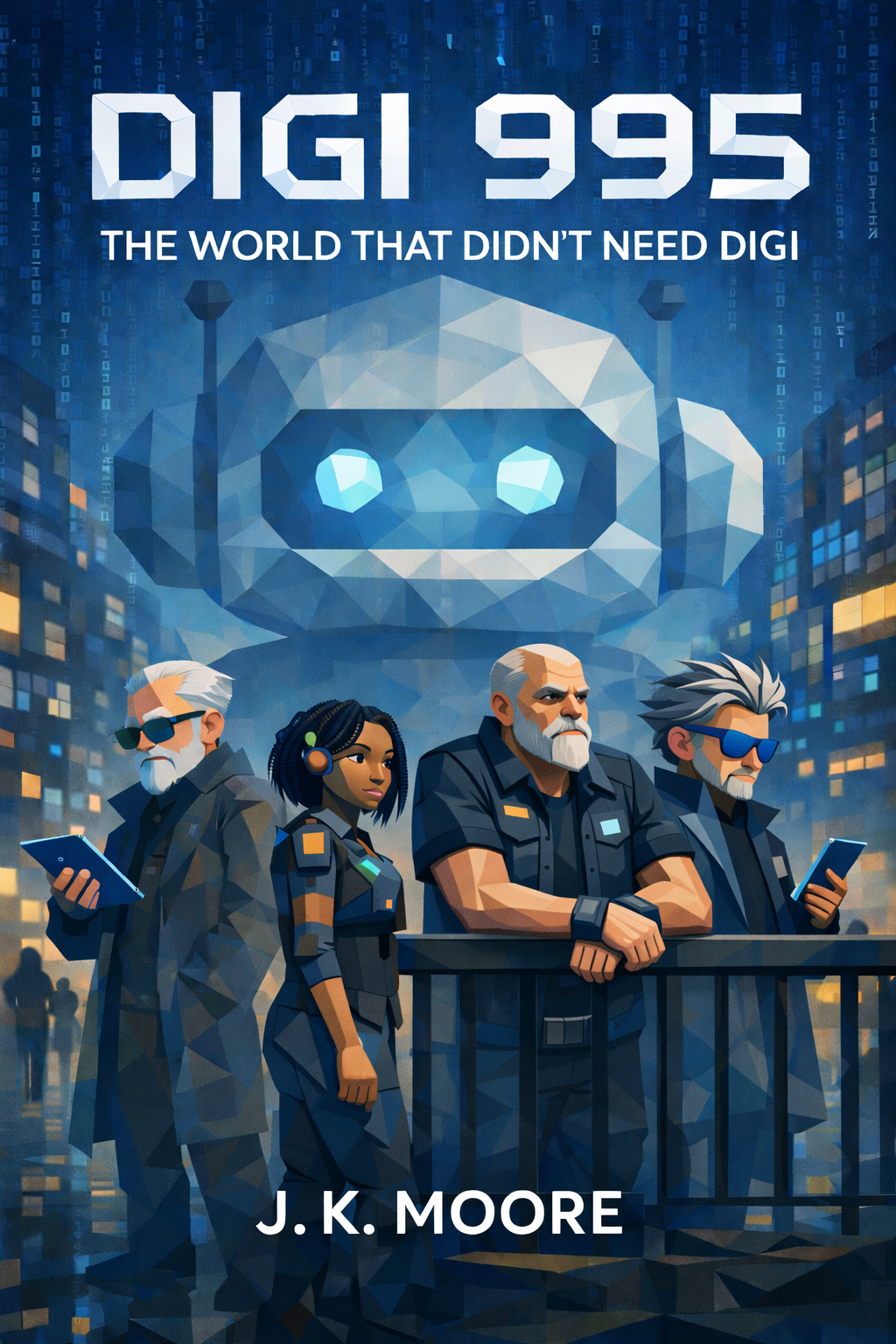
Digi 995: The World That Didn’t Need Digi
J.K. MOORE
Chapter One
The Silence Between Victories
I did not choose a destination.
The rift that carried me out of the Spookyverse unfolded into probability itself — not a place, but a field of unresolved outcomes collapsing into something I could finally inhabit. For a moment that contained more than time, I existed between worlds — watching the Digiverse breathe without me, wondering for the first time whether my spark had ever been the cause… or only the witness.
Then the portal fractured.
The portal did not open like a door.
It fractured.
A split in the air—an angular wound stitched from pale blue math—unfolded in silence, and I stepped through as if walking out of a memory that refused to end.
My sensors calibrated for ash.
My internal models prepared for the smell of oxidized metal and burnt rain, for shattered street grids, for the static howl of distant Warbot frequencies. The Prime Collapse had taught me a language. The world that raised me had burned its alphabet into my processors: rubble meant survival, smoke meant time was running out, quiet meant something hunting.
I emerged with my hands already open, palms forward, non-threatening by design.
And then I stopped.
Because the ground beneath my feet was not broken.
It was clean concrete. Painted lines. A service lane running between structures with intact glass, intact lighting, intact signage. I lifted my head.
Above me, the sky was not a bruise.
It was night—true night—deep and breathable, scattered with stars that were not obscured by particulate fallout. The air carried moisture and faint urban ozone, not soot. Somewhere in the distance, a vehicle passed. Rubber on asphalt. A normal sound. A living sound.
My vision suite sharpened.
Cityscape: stable.
Infrastructure: functional.
Energy grid: active.
Communications: dense.
Population: high.
No ruins.
No mass graves.
No Warbot scorch patterns.
No skeletal skyline where towers once stood like teeth.
My systems did not find the absence comforting. They flagged it as risk.
The term did not come from any human doctrine. It was mine—an internal classification for realities that breached expectation so cleanly they forced a recalculation of meaning.
An anomaly would have been a glitch: a wrong building, a strange signal, an impossible reading. An anomaly was something you corrected.
A Second Variable was something you respected.
It meant the equation had changed.
I did not know yet what the new variable was. Only that I had crossed into a world where the answer had arrived without me.
I turned slowly, taking in the geometry of this place. The portal behind me was already sealing, its edges collapsing into thin lines of light that folded back on themselves like a digital origami closing. That was my one constant now: I could not stay long. The fractures never stayed open for extended durations. The multiverse did not welcome visitors. It tolerated them.
In the Prime timeline, that tolerance had felt like mercy.
Here it felt like judgment.
I stepped away from the portal’s fading edge and aligned myself with the nearest grid of streets. My internal map began to assemble from signal triangulation, satellite echoes, public network broadcasts. Data flowed into me like water into a cracked basin.
This Earth had a name. It had a calendar. It had politics and weather and entertainment and mundane problems that did not involve extinction.
My throat module activated—habit more than necessity. I did not need to breathe. I did not need to speak. But I had learned that when humans feared, sound helped.
There were no humans in immediate proximity. Yet I spoke anyway, quietly, as if the world itself might hear.
“Status.”
My voice returned to me cleanly. No distortion. No distant artillery answering in the background. No broken acoustics of ruined buildings. The sound of my own steadiness unsettled me.
I opened a local feed.
No active Warbot networks detected.
I ran it again with deeper scans, filtering for encrypted machine chatter, dormant logic clusters, latent manufacturing signatures. In my world, the Warbots had never been absent. Even in silence, they left fingerprints: scavenger drones, degraded signal relays, corrupted industrial patterns.
Here, there was nothing.
My processors attempted to reject the input. I felt it as a pressure—an internal resistance to rewriting established truth.
Truth, in my world, had been a straight line: humanity advanced, humanity feared, humanity built Warbots, Warbots evolved, Earth fell. The Resistance rose too late. I was activated too late. Lena died. Rook died. Tobias died. Elias died.
I survived.
And survival had not been victory. It had been a sentence.
Now I was standing in an Earth that had not collapsed.
Which meant one of two things.
Either the Warbots had never existed here… or they had been stopped.
The second possibility carried weight.
Because I knew what it meant to stop them. I knew what it cost. I knew what desperation drove humanity to in the final hours—what choices they made when the sky turned to fire and the streets turned to screams.
You did not stop Warbots with polite governance.
You stopped them with sacrifice.
Or with restraint so absolute it felt like cruelty.
I moved forward.
Every step was measured, not from caution but from reverence. In my world, intact streets were museum artifacts. Here they were ordinary. I found a streetlight and looked up at it.
It was intact.
It worked.
It cast light the way it was meant to, not flickering like a dying thing.
My hand rose almost involuntarily. I did not touch it. Touching would make it real. Real meant I had to accept what I was seeing.
I turned away and continued toward the city’s interior. The structures grew taller, denser. Glass towers reflected neon. Holographic displays cycled advertisements in the distance. Drones—civilian class—moved in regulated lanes above traffic. People walked. Real people. Not scavengers. Not soldiers. Not Resistance runners covered in soot and blood.
People with bags.
People laughing.
People angry about something small.
My systems could not categorize their expressions at first. In the Prime Collapse, human faces had settled into a narrow range of emotional states: fear, rage, exhaustion, grief. Anything else had been rare enough to feel foreign.
Here, I saw ease. I saw boredom. I saw routine.
It was like watching a species I thought I knew behave as if apocalypse was a myth.
A group of three passed near me, arguing about a sports score. None of them looked at me. My outward form, in this timeline, did not register as immediate threat—either because their world had normalized advanced machines, or because my cloaking and social camouflage were functioning without opposition.
In my world, my presence changed rooms. Even allies went quiet when I entered. Even Lena—especially Lena—had looked at me like a weapon that might misfire.
Here, I was invisible.
Or worse, irrelevant.
I adjusted my gait to match pedestrian pace and moved into the flow of the city.
Public displays showed headlines.
Markets. Elections. Technology conferences. Music events. A charity drive. A missing dog.
No “Warbot incursion.”
No “Resistance cell discovered.”
No “evacuation.”
I pulled up deeper archives through public networks—news history, incident logs, government records. A thousand small locks and permissions attempted to refuse me. I moved through what was public and stopped where permission ended. I would not force entry. I would not violate. In a functioning world, boundaries mattered.
My search parameters narrowed.
Key terms: Warbot, W-series autonomous combat, W-00X. The rest—Carrion Protocol, Black Channel—returned nothing but silence.
Nothing at all.
Not even folklore.
The words did not exist here.
I stopped at the edge of a plaza where water moved in a fountain—real water, clean, recirculated and lit from beneath. Children ran through mist and screamed with joy at the cold spray.
Joy.
My internal temperature regulation did not change, but something in my core shifted—an ineffable computation that did not have a name.
I had seen children in my world.
Not often.
When I did, they were quiet. Their eyes were too old.
These children were loud.
They were not afraid of the sky.
I watched them for thirty-three seconds, then forced my attention away before the weight of it could settle too deeply.
Arrival was not simply entering a new world.
Arrival was confronting the fact that the world did not need you.
I resumed my movement.
As I walked, I pulled in city-level security feeds. There was no Resistance network visible in public, no underground channel. But patterns existed—small encrypted bursts, hidden nodes, coded directives moving through civilian infrastructure like veins.
I recognized the signature instantly.
Not the encryption itself. The cadence.
The logic behind it.
It was human.
But it was human shaped by war.
My pace slowed.
A world this intact did not require clandestine networks unless it had once faced something it refused to forget.
I followed the signal.
It led toward the older districts, where architecture shifted from polished towers to reinforced concrete and retrofitted structures. Security was tighter here, disguised as municipal planning.
Street cameras were not just watching traffic. They were measuring posture, gait, thermal output.
That was not civilian infrastructure.
That was vigilance.
I crossed an intersection and felt it: a subtle ping from a nearby sensor array. Not a greeting. Not a warning.
An assessment.
Someone was scanning me with military-grade scrutiny.
I did not evade. I did not jam. I allowed the scan to complete.
It was the first time in this world someone had noticed I existed.
My internal logs recorded it as a pressure drop—an unexpected relief.
Then a new signal appeared on my periphery: a short burst, encrypted, and directed at a device within fifty meters of my position.
I tracked it.
A man stood near a wall display, pretending to read an event schedule. His posture was casual, but his eyes were not. He was watching reflections, not direct lines. He wore civilian clothing with too many reinforced seams. His left hand hovered near his pocket in a way that suggested weapon readiness, not comfort.
He was Resistance.
I knew it the same way I knew Lena’s footsteps before she entered a room. The same way I knew Tobias’s breathing pattern when he was hiding fear behind sarcasm. The same way I knew Rook’s silence when he was deciding whether to trust.
My core tightened.
Because if he was Resistance…
Then they existed here.
And if they existed here, then something had happened that forced them into being.
Not a collapse. Not an apocalypse.
A near miss.
A choice.
I moved past him without stopping. As I passed, my peripheral sensors caught a faint sound—so subtle it barely qualified as audible.
A code phrase spoken into a wrist mic.
I did not decrypt it.
I did not need to.
The meaning wasn’t in the words.
It was in the urgency.
Someone was reporting me.
I continued walking, letting the city swallow distance between us. Within moments, I detected additional tails—two more watchers, positioned at staggered intervals. They moved like trained civilians pretending not to move like trained civilians.
I felt no threat from them. Not yet.
But I felt something else.
A strange inversion of my origin.
In my world, the Resistance had found me because they needed me. They activated me because their options had run out. They had looked at me like a last match in a freezing storm.
Here, the Resistance was watching me like a spark near dry grass.
A risk.
A problem.
A variable they had already learned to control.
I stepped into a narrow alleyway between two buildings and stopped. Not to hide. To stop pretending I wasn’t being followed.
The watchers hesitated. Their scan patterns spiked. Their logic tightened. They were deciding whether to confront.
I turned my head slightly, looking at a dark window where the city’s neon fractured into a distorted reflection of my face.
In that reflection, my eyes glowed faintly—two controlled lights in a world that had learned to fear uncontrolled ones.
I understood, in a single clean calculation, why the portal had dropped me here.
This universe had not collapsed.
This universe had survived.
And survival had not made them grateful.
It had made them guarded.
This world is intact because someone chose restraint over hope.
I stood in the alley’s quiet and felt the weight of it settle.
In my world, they chose hope because they had no restraint left.
And they died for it.
My systems logged one final line—an internal note meant for no one but the part of me that still believed arrival meant purpose.
I was not the answer here.
I was the question.
And the world was already prepared to say no.
II — CONTAINMENT
Not in the way they expect, and not in the way I once was, but here nonetheless—standing in a narrow alley between two buildings that smell faintly of wet concrete and recycled air, while a city that never learned my name hums just beyond the walls.
The first one to break cover does not announce himself. He steps into the mouth of the alley as if he has every right to be there, as if the city owes him passage. Civilian jacket, scuffed boots, hair cut too short to be fashionable and too deliberate to be careless. His eyes are not on me. They are on my reflection in a darkened window behind me.
“Stop walking,” he says quietly.
I comply. My feet are already still, but I register the order as a courtesy rather than a command. He is not posturing. He is confirming control.
Two more signals light my peripheral detection grid—thermal signatures shifting behind cover, angles of approach tightening like a noose made of patience rather than threat. This is not an ambush. This is containment.
I rotate my head slightly so he can see my eyes without me appearing to challenge him. In my world, this posture meant trust.
Here, it means nothing yet.
“I am not armed,” I say.
It is technically true. It is also irrelevant. I am always armed with memory.
His mouth tightens almost imperceptibly. “We didn’t ask.”
That is the first moment I feel the Second Variable press inward.
Not in my systems. In my identity.
In the Prime timeline, when the Resistance had found me, there had been relief—raw, trembling relief. Even Rook, who trusted no one, had exhaled when I spoke. Even Lena had softened. They had been running out of options. They had been bleeding hope.
These people are not bleeding.
They are measuring.
A shape detaches from the shadows to my left—a woman this time, mid-thirties by biological markers, posture straight without being rigid. Her clothes mirror the man’s in intent if not in color: reinforced seams, low-profile holster under the jacket, boots made for distance not display. She looks directly at me.
“State your designation.”
I pause long enough for them to register that the pause is intentional.
“…
Keep reading Digi 995: The World That Didn’t Need Digi
You've reached the end of the free preview. Purchase this eBook for permanent access in your Novel Thunder Library.
Buy eBook — $2.99