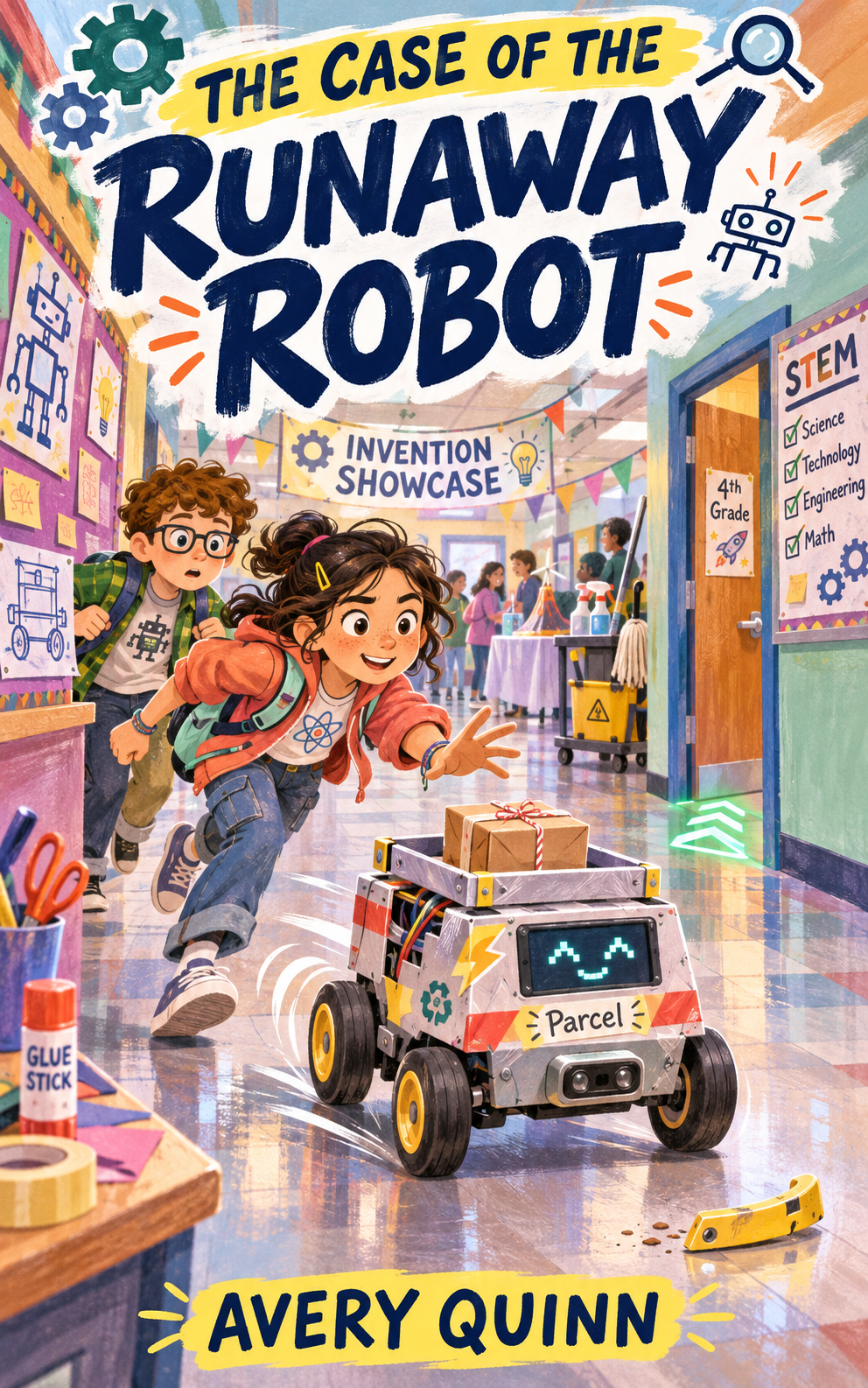
Chapter 1: One Robot, Zero Sandwiches
At 8:14 on Wednesday morning, the robot was doing exactly what it was supposed to do.
That made its sudden decision to eat a paper napkin even more surprising.
“Stop!” said Tessa Bell.
Her best friend, Malik Reyes, pressed the square red button on the remote. The little robot froze with a corner of napkin poking out from under its front wheel.
“It isn't eating,” Malik said. “It's collecting floor decorations.”
“There aren't supposed to be floor decorations.”
“Then the napkin is breaking school rules.”
Tessa crouched beside the robot and pulled the napkin free. Its name was Parcel, written in blue letters across its yellow plastic shell. Under the shell were two motors, a battery, a tiny computer, and a downward-facing camera. On top sat a tray big enough for a folder, or one very carefully balanced sandwich.
Parcel had never carried a sandwich. Principal Weller had made that point four times.
“No food,” Tessa recited. “No stairs. No students in its path. No running it without an adult.”
“And no being eaten by it,” Malik added.
Their fourth-grade classroom smelled like glue sticks and the wet mittens someone had left on the radiator. Wednesday was the invention showcase, and every class had something to demonstrate. Fifth grade had built a model bridge. Third grade had designed cardboard water filters. Fourth grade had a robot that could deliver messages from one supervised station to another.
On Monday, Parcel had not been the sort of invention anyone would put on a poster.
It had been a yellow box lying on its side, with one wheel spinning in the air and another wheel refusing to spin at all. Malik had named the problem “a strong opinion about left turns.” Harper had named it “junk.” Tessa had called it “two problems, which are easier than one mysterious problem.”
Their invention project had started in September, when Ms. Ibarra announced that this year's showcase had to solve a real problem at school. Not a pretend problem, like how to turn a pencil into a tiny boat. Something a person had actually noticed.
The class filled the board with suggestions. The library needed more bookmarks. The gym needed fewer lost sweatshirts. The office needed a way to send folders to the library without asking a student to miss a lesson. That last problem was the winner, partly because it sounded useful and partly because everybody wanted to build something that moved.
Tessa had imagined an invention like the ones in videos: smooth, shiny, and ready for applause. Instead, the class received a tub of donated parts. There were batteries, wheels, wires, a plastic tray, and a tiny computer that looked very unimpressed by being rescued from a cardboard box.
“Can we call it a robot yet?” Eli had asked.
“When it does one thing because of instructions,” Malik had said.
“So my little brother is a robot?”
“No,” Ms. Ibarra had said. “Please don't test that theory at home.”
The first week, the wheels turned in opposite directions. The second week, the bumper sensor worked only when someone pressed it very hard with a pencil. The third week, they finally made the machine roll in a straight line. It went straight for six inches and then bumped a shoe.
Tessa had begun carrying a notebook because there were too many tiny discoveries to keep in her head. A wheel made a different sound when its screw was loose. A battery that looked full on a sticker might not be charged. A route that worked with nobody walking nearby could fail the minute a real person carried a box across it.
The most important discovery, though, was that her friend and she didn't think the same way.
Malik could look at a program full of short instructions and see where it might go wrong. He liked to imagine what the robot would do next. Tessa liked to imagine what a person would see. Would the librarian know when the folder had arrived? Could the robot get stuck behind a chair? What if the camera read the wrong floor square?
“You think of problems before we even have them,” Malik complained once.
“Some people call that planning.”
“Some people call that worrying in advance.”
Their biggest disagreement had come over a little instruction labeled RECOVER. Malik wanted Parcel to keep trying if a tag was blurry. The robot could move a few inches and look again. Tessa wanted it to stop immediately because the school hallway was not a place to guess.
Ms. Ibarra had listened to both of them. Then she drew a line across the board.
“Above this line are things we can try safely on the classroom test mat,” she said. “Below it are things we might do around real people. The rules will be different.”
Tessa remembered that line now. They had tested the recovery movement on the classroom mat, and it had helped. A square partly covered by tape became readable when Parcel rolled forward a little. They had cheered. Nobody had asked what the same movement might do near a staff doorway.
She watched Parcel hum along the empty hall and felt a little pinch of worry. Her notebook said the camera needed a clear view and the route had to stay inside the cones. Both facts were true. They were also the sort of facts that were easy to forget when everything worked.
“Your thinking face is back,” Malik told her.
“What face?”
“The one where your eyebrows try to solve a puzzle without asking the rest of you.”
She made her eyebrows go up and down. “Better?”
“Terrifying. Please stop.”
When Ms. Ibarra checked the cone at the crossing, Tessa followed her. The doorway beyond it led to the gym supply alcove, a place students could look at but not enter. Mr. Vale had been moving furniture for the showcase, and he had placed a sign there: STAFF ACCESS ONLY.
“Will Parcel ever go that way?” Tessa asked.
“Not during today's demonstration,” Ms. Ibarra said. “The crossing is only for staff moving equipment. We'll pause the robot whenever it is open.”
Tessa nodded and wrote BOUNDARY in her notebook. It was a useful word. She liked the way it made an invisible rule sound solid.
The trouble with building something in a classroom was that every surface belonged to at least three other things. Parcel's charging station shared a counter with the class's paper-recycling bin. Its spare wheels lived in a shoebox that once held spelling cards. A sign above the sink said WASH YOUR HANDS, which Malik claimed was also excellent advice for anyone touching a circuit board.
Before the showcase, Ms. Ibarra had given the team one last chance to explain their design without using the words awesome or magic. Four students had built Parcel, and every one of them had a different explanation for what mattered most.
“It's the wheels,” Eli said. “Without wheels it is a fancy lunchbox.”
“The scanner,” Harper said. “Without the scanner, it drives into every wall.”
“The program,” Malik said. “Without instructions, all its parts are a collection of expensive mistakes.”
Tessa thought about the long strip of blue tape they had measured, peeled up, and measured again. “It's the map,” she said. “If we don't agree where it's allowed to go, we can't tell when something goes wrong.”
Ms. Ibarra nodded at each answer. “Good. Now explain what the robot does when it doesn't know.”
That question turned the group silent. The room smelled of glue sticks, pencil shavings, and wet mittens steaming on the radiator. Somewhere behind Tessa, a classmate was trying to convince a paper bridge not to collapse.
Malik tapped the code on his tablet. “It checks again.”
“And after that?”
“It tries the safe branch.”
“Which means?”
“A direction the sensors say is clear,” he answered.
Ms. Ibarra tilted her head. “I asked what happens when it doesn't know where it is. Knowing the floor ahead is empty isn't the same as knowing the correct destination.”
Tessa caught the difference immediately. The hall could be empty all the way to the principal's office. That wouldn't mean a package for the library belonged there.
“Maybe it should stop,” she said.
Malik looked wounded. “If it stops for every question, it won't deliver anything.”
“Then make it ask a better question,” Harper said. “Our robot is supposed to help people, not surprise them.”
They wrote UNKNOWN LOCATION? on the whiteboard. Underneath, Tessa added CHECK TAG, CHECK ROUTE, STOP IF THEY DISAGREE. Malik circled the last instruction but did not add it to the showcase program. Their demonstration was scheduled for that morning, and changing a working program just before an audience arrived felt risky.
“We've tested it twenty times,” he said.
“Twenty times with everything where it belongs,” Tessa replied.
He looked at the marker card lying on their desk. Its corners were reinforced with clear tape. It seemed so ordinary that she felt silly worrying about it. A little paper square hardly looked powerful enough to change the course of a robot.
Then Ms. Ibarra asked the class to clean up, and everyone had to choose which unfinished question to leave for later.
Tessa put the marker in its folder and zipped the folder shut. If the demonstration worked, she promised herself, she would ask about the stop rule again. If the demonstration failed, they would have a much bigger question.
At the door, Eli held up a folded paper sign that read PARCEL: THE FUTURE OF DELIVERY. The word FUTURE was so large that the last E curled down the edge.
“Does the future need a napkin?” he asked.
“Apparently,” Malik said. “But only if it's on the floor.”
They all laughed, and for a moment their invention felt like something the whole team understood.
Back at the dock, Malik had arranged three little drawings on the table: a camera, a pair of wheels, and a stop sign.
“Behold,” he announced, “the three parts of our genius: know where you are, move, and don't hit stuff.”
“Four parts,” Tessa corrected. “Know where you're allowed to be.”
Malik added a tiny fence to the drawing. He made the fence look like a castle wall.
“We're delivering papers to a library,” she said. “Not attacking a fortress.”
“A library can be a fortress if the overdue fines are high enough.”
She laughed. They had been working on Parcel for weeks, and laughter was the sound their project made when it wasn't making a wheel squeak. It would be strange, Tessa thought, if all of that effort ended in a disaster.
She put the thought aside. They had a showcase to prepare for, and the robot was waiting.
There was still one small problem before the final test: the green folder did not sit flat.
Parcel's tray had a shallow lip around the edge. It held notebooks nicely but let a thin folder slide if the robot stopped too sharply. Tessa had watched that happen on Tuesday. The papers had spilled across the floor like giant white leaves. Malik had said the floor was reading the folder, which was funny until they had to collect every sheet.
“Can we attach a clip?” Tessa asked.
“Not a metal one,” Malik said. “It could snag the tray.”
Harper brought over two strips of soft hook-and-loop tape from the craft box. With Ms. Ibarra's approval, they attached one strip to the underside of the practice folder and one to the tray. It held when they nudged it. It also came free when Tessa lifted the folder with both hands.
“What happens if the robot stops suddenly?” she asked.
“Try it on the mat,” their teacher said.
They placed the powered-off robot on the classroom test mat and tilted the tray gently by hand. The folder stayed put. Tessa wrote down the result. Then she noticed a corner of plastic not sitting quite flush with the body.
“Is this piece supposed to wiggle?”
Malik pressed the yellow corner guard until it clicked. “It's a snap-on bumper cover. It keeps the tray edge from scratching things.”
“Can it fall off?”
“Probably if it hits something hard enough. But the bumper sensor is supposed to stop it before that.”
Tessa ran her finger along the slight scratch in the guard. Malik had made it while fastening a screw. He called the scratch a design signature.
“More like your handwriting,” she said.
“My handwriting is beautiful.”
“Your handwriting looks like a worm arguing with another worm.”
He laughed and added a note to the maintenance checklist: CHECK GUARDS BEFORE DEMONSTRATION.
She wanted to add five more checks. The list already covered the battery, sensors, camera, wheel screws, route codes, and wireless signal. It was hard to imagine anything outside those boxes going wrong. At last she shut her notebook. Ms. Ibarra was looking at the clock, and a hallway robot that never left the classroom would be a fairly disappointing invention.
When the folder was secured again, Tessa glanced at her classmates. Harper was arranging the display cards. Eli was practicing his welcome speech under his breath. Owen was carrying extra pencils. Malik had one finger above the START button, waiting for their teacher's signal.
Tessa felt suddenly grateful. No one person had made Parcel. The robot held a little bit of work from everyone in the class, even the students who insisted they didn't like machines. Finding out what it could do had taken patience; showing it to other people would take a different sort of courage.
“Ready?” Malik asked.
This time Tessa said yes without looking at the checklist. She trusted the work they'd already done—and the adults waiting at the hall boundary—to keep the test within its limits.
Tessa had made the route cards. Malik had written most of the code. Their classmates had helped with the wheels, tray, testing, decorations, and a name vote that ended with Parcel beating Sir Beeps-a-Lot by one vote.
Today, the fourth-grade team had permission to demonstrate Parcel in the closed east hallway. Blue floor squares marked the approved route. Each square had a black-and-white code that Parcel's camera could read. The robot followed a stored list of stations, slowed down before corners, and stopped when its bumper or distance sensor detected something too close.
Ms. Ibarra, their teacher, stood at the hallway door with her clipboard. “Final test only. The…
“Sta…
Keep reading The Case of the Runaway Robot
You've reached the end of the free preview. Purchase this eBook for permanent access in your Novel Thunder Library, or read it with an eligible Novel Thunder subscription.
Buy eBook — $4.99