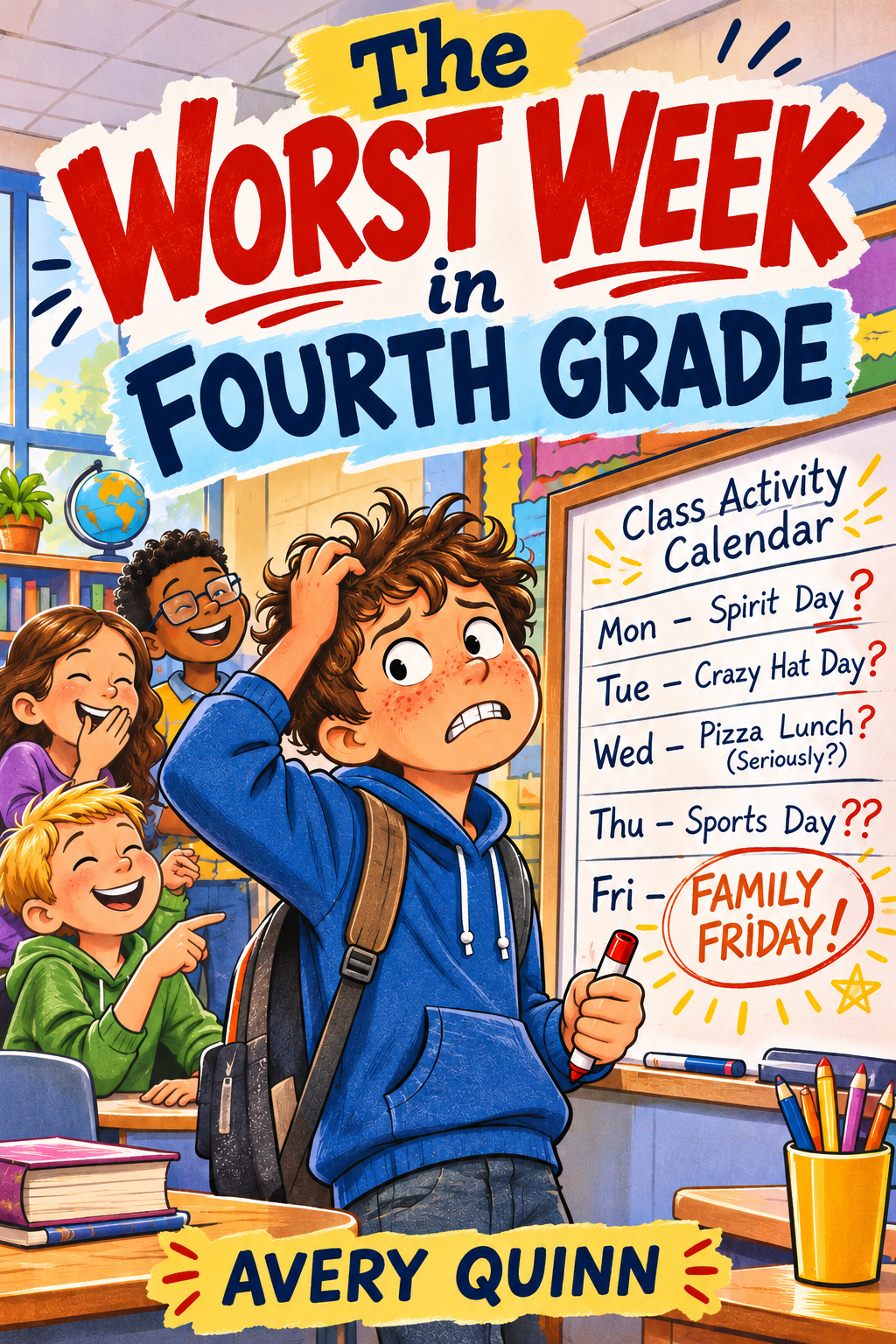
Chapter 1: The Job Nobody Wanted
Monday
On Monday morning, the most dangerous thing in Room 14 was a sheet of paper.
Not the science scissors. Not the leaning tower of library books beside the windowsill. Not even the classroom hamster, who had once escaped into Mr. Patel's shoe during a fire drill.
A sheet of paper.
I know this because, by Friday afternoon, I would be wishing someone had locked that paper in a cabinet, preferably one that required two keys and a responsible adult.
My name is Milo Serrano. I am nine years old, I am excellent at making my friend Raf laugh while he's drinking water, and until this particular Monday I had never seriously injured a week.
The paper was sitting on Ms. Kwan's desk. At the top, in careful blue letters, it said FOURTH-GRADE FAMILY FRIDAY: ACTIVITY PLAN. Under that was a list of times, materials, and little boxes that needed checking. There was an entire section about permission slips. I glanced at it as I put my homework in the tray.
"That looks exhausting," I said.
"Good morning to you, too," Ms. Kwan replied.
She wore purple sneakers, which meant she could cross our classroom faster than anyone, including children pretending not to hear her. She was taping a large blank calendar to the side wall.
"We're going to need someone to maintain the class activity calendar this week," she said. "Would you like to volunteer?"
"I said it looks exhausting. That's different from wanting to do it."
"Fair distinction," she said, smiling.
By eight forty, though, volunteering had begun to look like an amazing idea.
The problem was a sentence my older sister, Marisol, had said at breakfast. She hadn't even said it in a mean voice, which made it worse.
"Milo's fun," she told our mom when I accidentally balanced a spoon on my nose. "But don't ask him to keep track of anything."
Mom raised an eyebrow. "He kept track of the recycling last week."
"He kept track of it until Wednesday," Marisol said. "Then he turned the reminder note into a paper airplane."
That was true, but it was an exceptionally good paper airplane.
I had made everyone laugh, and for a minute I laughed too. Afterward the sentence stayed in my head like gum under a desk. Fun, but not useful. Funny, but not responsible. The kind of kid adults liked until an important job needed doing.
Now Ms. Kwan was explaining the calendar position. We were putting on a small Family Friday event to show our families what we'd been learning about how ordinary objects hold stories. There would be three stations: a neighborhood map, a collection of object stories, and a listening corner where visitors could hear short interviews. Every student had a job. Everyone would help set up on Thursday. The event was on Friday from two to three in the afternoon.
"The calendar manager will post daily reminders from my approved activity plan," Ms. Kwan said. "You'll mark what has been completed and report any questions to me. The calendar is not a place to invent new activities."
I raised my hand so quickly my elbow hit my pencil pouch.
"Milo?"
"I'll do it."
Across the room, Raf turned around. His expression said, Are you sure? His eyebrows had a whole language.
"Excellent," Ms. Kwan said. "What made you decide?"
"I would like to become a person who can be trusted with boxes."
Raf snorted.
The class laughed, but I did not let the laugh spoil the moment. Ms. Kwan handed me a clipboard with the official plan and a bright green folder labeled REFERENCE COPY. She pointed to a line at the bottom: IF SOMETHING IS UNCLEAR, ASK BEFORE POSTING.
"Read that part," she said.
"If something is unclear, ask before posting."
"And what do you do if something is unclear?"
"Use my incredible powers of observation?"
"Ask before posting."
"Right. Also that."
Before I was allowed near the blue marker, Ms. Kwan showed me the little pockets beneath the calendar. One was marked TO VERIFY and one was marked APPROVED. She slid the official plan into APPROVED and handed me a blank strip of yellow paper.
"If somebody suggests a change, where should it go?" she asked.
"In the calendar, if it's a particularly excellent change?"
"Try again."
"To verify."
"Exactly. We can welcome ideas without announcing them as facts."
I nodded with what I hoped was the thoughtful expression of a person who could be trusted with office supplies. Inside, I was wondering whether I could draw a little mascot for our calendar. A pencil wearing sunglasses, perhaps. Or a calendar square with arms and legs.
Ms. Kwan opened the reference folder and showed me a page of signatures from students who had agreed to their station roles. June had chosen captions because she liked drawing and checking details. Imani had chosen interviews because she listened carefully. Samira had chosen accessibility and welcome signs because she noticed when instructions confused people. Eli had chosen models. Raf had chosen audio because he had helped his older cousin edit a family video.
"People have different skills," Ms. Kwan said. "Your job touches all of them. That's why accuracy matters."
It was the first time I understood that a calendar could be connected to somebody else's work. I wasn't just making an attractive row of days. I was telling classmates when to prepare and what to expect.
On the surface, that sounded easy. Underneath it sounded like the kind of responsibility that belonged to a student with neat handwriting and a face that didn't accidentally look amused. I thought of Tessa. She would probably copy the plan correctly in half the time.
"Are you sure I can do this?" I asked.
Ms. Kwan looked at me with a steady expression. "I wouldn't give you a task I thought was impossible. But I will expect you to ask questions. Being willing to learn is part of being ready."
The word willing stuck with me. She hadn't said I already knew everything. She hadn't promised I would be perfect. It was more like being invited onto a team when you were still learning the rules.
For about ten minutes, I was proud of that. Then I saw the blank squares and thought about how much more exciting I could make them.
The class calendar had five columns, one for each day. Tessa Brooks, who sat beside it, leaned over to see the clipboard. Tessa enjoyed details in a way I enjoyed cheese crackers. Her pencil case had three compartments and her handwriting looked printed by a machine with excellent manners.
"You should copy the activity names exactly," she told me. "And put the times beside them."
"I know what a calendar does."
"I didn't say you didn't."
"Your face said something close."
"My face is reading the instructions," Tessa said, returning to her math.
We had a short lesson in the morning about what we could show during Family Friday. Ms. Kwan asked each group to think about the difference between an object and its story. A photograph of a bench was only a picture until someone explained who sat there or why the bench mattered. A map was only a collection of streets until we asked how people moved between them. I wrote these ideas in my notebook, because for once I could see how schoolwork might connect to something outside a worksheet.
Samira said an old recipe could show how families passed down knowledge. June said a sketch could capture a place before it changed. Eli said a model could reveal how something was built. When Ms. Kwan asked me what a calendar could show, I answered, "Whether we're late." Everybody laughed. Then she waited, and I added, "It can show what we planned to do and how the pieces fit together."
"Exactly," she said. "The calendar helps us follow the sequence. That's why we need it to be reliable."
I liked hearing my answer called right. For the rest of the morning I carried my clipboard with extra care, keeping the pages from curling at the corners. I hadn't yet learned that carrying a plan carefully and using it carefully were two separate skills.
The first thing I learned about running a calendar was that people asked questions before I had finished learning the answers.
On my way to the pencil sharpener, Oscar wanted to know whether a photograph of his family's bakery was an object or a story. Samira asked if a recipe card counted even though her aunt had written it in another language. Eli wanted to know how much a model bridge could weigh before it became a school building instead of a school project.
I made three little columns on the back of my clipboard: QUESTION, ANSWER, PERSON TO ASK. The third column stayed empty because I was enjoying the second column too much.
"A bakery photograph is an object that helps tell a story," I told Oscar.
"What if I bring bread too?"
"Then it's a snack that helps tell a story."
Oscar looked delighted. This was the dangerous part of being funny. A joke could leave my mouth and become a plan before I even decided whether I meant it.
Samira held up the recipe card. "My aunt says I should ask before I share it. It's hers."
"That's respectful," I said. "You should definitely ask."
"And will there be translation help?"
I hesitated. The official plan said students could translate or explain familiar words, with families' permission. I couldn't remember exactly how the sentence was written.
"Probably," I said, which was not the same as checking.
Samira's eyebrows gathered. "Probably what?"
"Probably we can write explanations under the words."
"Okay. I'll wait before I put it on the board."
She walked away with her card, protecting it between both palms as though it were fragile glass.
I looked at the empty third column. I wrote MS. KWAN across the top and underlined it. It seemed sensible. It also made the page look less like a list of things I didn't know.
During independent reading, I heard two students discussing the calendar from the next table. They thought I would be choosing which family stories were good enough for Friday. I opened my mouth to explain that Ms. Kwan would help us choose with everyone's permission, but then I heard my name in the sentence.
"Milo decides," one of them said.
I liked that much more than I should have.
A moment later June came over with her notebook. She was small and quiet and had a way of standing very still until someone noticed she wanted to speak.
"Did you decide where the creek map goes?" she asked.
"Not yet. Why?"
"Because the map has to be near the door if visitors are supposed to understand where the bridge is. Otherwise they'll see a bridge with no creek."
I tried to picture the room from the point of view of someone entering it for the first time. Every desk looked normal to me because I had sat in this classroom since August. To a visitor, the room would be a forest of tables and paper.
"Could you draw a floor plan?" I asked.
June looked surprised. Then she nodded. "I could draw one with arrows."
"Great. Don't move anything yet. We need approval."
Her smile was tiny, but it was real.
When she left, I put a check beside PERSON TO ASK. At least once that morning, I'd remembered the difference between having an idea and announcing a decision.
At recess, I told Raf I had a plan to make the calendar memorable.
"It's a calendar," he said while trying to kick a pebble between two cracks. "People just need to know what happens when."
"Exactly. But what if they also enjoyed knowing? What if Wednesday had a dramatic title? What if Thursday sounded exciting?"
"What if Wednesday happened on Wednesday?"
"You have no vision."
Raf kicked the pebble too hard. It skipped into the grass and disappeared.
Back inside, Ms. Kwan was helping June Okafor tape a drawing to the display board. June had moved to Birchbank Elementary only three weeks ago. She drew detailed pictures of streets and buildings but spoke quietly enough that sometimes people leaned toward her to hear. The drawing showed the old clock above the community market, including the little crack in its stone frame.
"We're going to feature these at the neighborhood station," Ms. Kwan told June. "Would you mind checking that the captions are accurate?"
June nodded.
I felt a quick, inconvenient pinch of envy. June already had a real responsibility. I had a clipboard, which was nice, but mostly I copied things other people had decided.
At the end of the day, I stood in front of the calendar with a blue marker. Monday: ASSIGN ROLES. Tuesday: PARTNER INTERVIEW PRACTICE. Wednesday: OBJECT STORY SORT AND DISPLAY CHECK. Thursday: CLASSROOM WALK-THROUGH AND SETUP. Friday: FAMILY FRIDAY, 2:00–3:00.
Those were the approved headings. I copied them all. Then I stepped back. The calendar looked so plain it could have fallen asleep.
I added, underneath Monday, WE ARE OFFICIALLY IN BUSINESS!
Ms. Kwan passed the wall on her way to the door. She looked at the calendar, then at me.
"The extra sentence is harmless," she said. "But keep the actual reminders exact. There'll be a brief update to tomorrow's plan in the morning. Wait for it before adding details."
"Understood," I said.
I meant it. I really did.
That night, while Marisol was explaining that she needed the kitchen table for a project, I told Mom about my job. Mom was wearing her transit-depot jacket. She worked early shifts on city buses and sometimes couldn't attend things at school, but she always listened when we talked at dinner.
"Managing a calendar is about people depending on what you write," she said.
"I know. I'm a dependable calendar professional."
"Then check your information twice, professional."
Marisol glanced up. "He could write that on a paper airplane."
I smiled because everybody was looking at me, and I was good…
Keep reading The Worst Week in Fourth Grade
You've reached the end of the free preview. Purchase this eBook for permanent access in your Novel Thunder Library, or read it with an eligible Novel Thunder subscription.
Buy eBook — $4.99