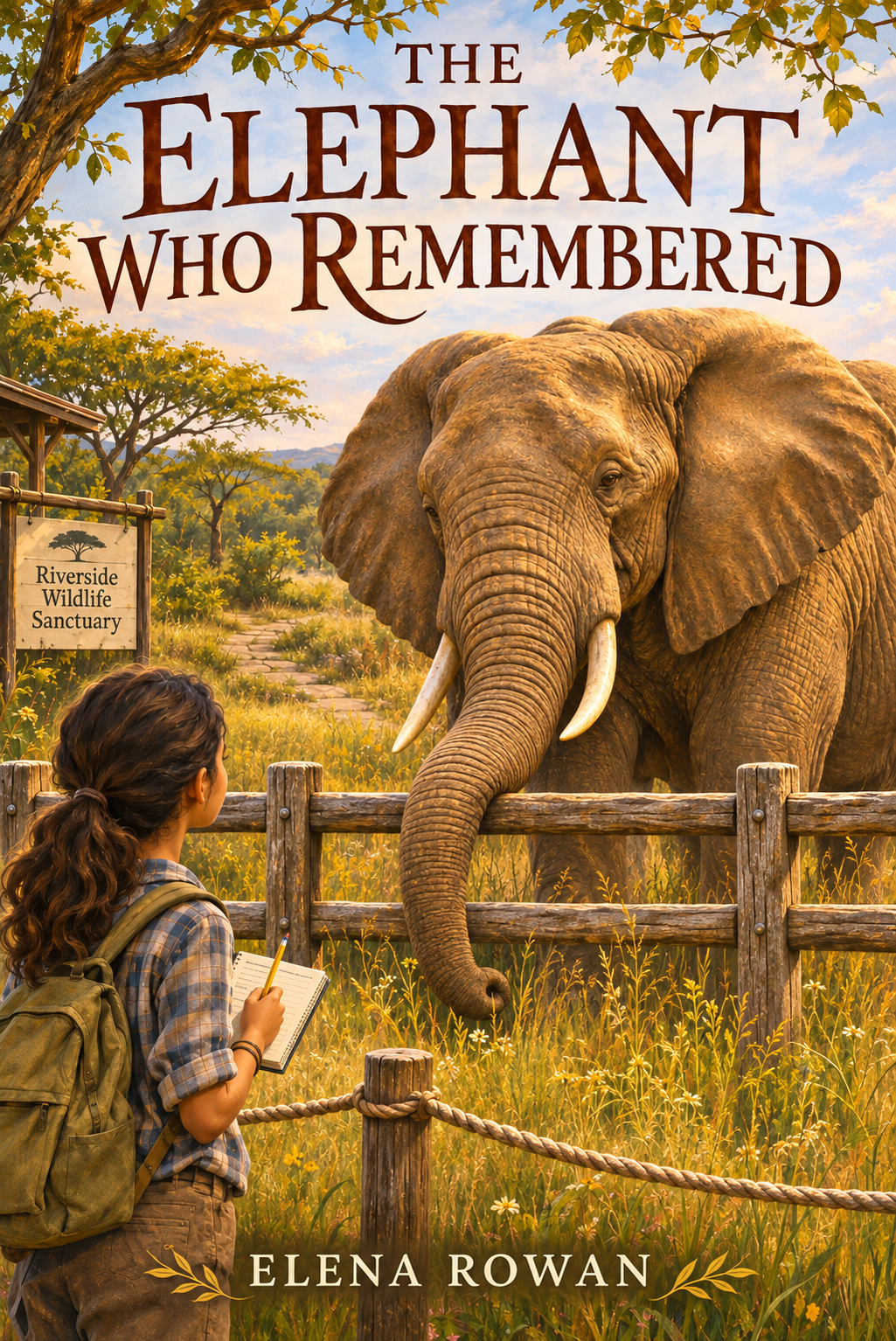
The Place Beyond the Fence
The first thing Maya Ortiz learned about elephants was that a fence could be a kind of promise.
“On this side,” said Dr. Leena Shah, stopping the group beside a painted yellow line, “we make observations. On that side, the elephants make choices. Nobody crosses the line without authorization, and no youth volunteer enters an elephant habitat. Ever.”
Six fifth graders nodded beneath the wide roof of the observation shelter. Beyond the double barriers, an Asian elephant stood in a pasture scattered with oak leaves. She was gray as rainwater, with pink-speckled skin along her ears and trunk. Her name, according to the wooden sign, was Meena.
“Does she know we're here?” whispered Theo Bell.
“Probably,” Maya whispered back. “We're not exactly quiet.”
Dr. Shah heard. “She may notice sound, scent, or movement. But we won't pretend to know exactly what she's thinking.”
That was the second thing Maya learned.
At school, Maya's science notebook was famous for two reasons. She wrote down everything, and she wrote it down so small that her teacher needed reading glasses to check it. Maya had signed up for the six-week youth stewardship program at Pine Hollow Elephant Refuge because the flyer promised real field observations, not because she expected to touch an elephant. Her mother had made her read the safety rules twice anyway.
Pine Hollow occupied a broad valley in eastern Tennessee. Forest climbed the ridges, and the elephant habitats covered meadows, wooded areas, and open ground where staff sometimes placed browsing branches. The elephants were not on display for a crowd. There were few visitors, and even the student group had to stay in designated observation locations with the educators.
Dr. Shah introduced the refuge's three residents. Meena was an older Asian elephant who had arrived four years earlier. Priya, also an Asian elephant, lived in an adjoining habitat and could choose when to spend time near a shared boundary. A third elephant, Kavi, was being monitored in another section. The staff managed access between areas according to each animal's needs and relationships.
“Elephants aren't projects,” Dr. Shah said. “You may help us maintain trails outside the habitats, organize educational materials, and record approved observations. Our caregivers and veterinary team make animal-care decisions.”
Before the group could use the binoculars, Jonah handed out laminated cards showing what not to record. One card described an elephant as cheerful because its ears were moving. Another called an animal stubborn because it stopped walking. Maya noticed how easily the cards sounded like stories.
“Sometimes an observation needs a measurement,” Jonah said. “If you write ‘a long time,’ how long is that?”
“Longer than a short time,” Theo offered.
“Technically true and completely useless.”
Jonah handed Maya a small stopwatch. Her thumb hovered over the button as Meena shifted her weight near the trees. Maya wanted to start recording everything immediately, but Jonah pointed to the shelter's posted viewing schedule. Their task had a beginning and an end, and they were not supposed to pursue the animals beyond the designated viewpoint to get more data.
“That sounds like we'll miss things,” Maya said.
“We will,” Jonah replied. “Every observation method has limits. A good scientist describes those limits.”
There were rules printed on the shelter wall in letters large enough to read from the bus parking area. Maya read them while the other students argued over which binoculars had the clearest view. No food near the observation fence. No flash photography. No attempts to get the animals' attention. Remain with the group. She had expected warnings that sounded like warnings at a swimming pool. These seemed designed to keep the people from becoming the most important part of the afternoon.
Across the valley a wind stirred the higher branches, but the grass below barely moved. Maya raised the binoculars and discovered a startling problem: the elephant filled the lenses so completely that she could not tell where Meena was standing. She lowered them, found the open patch of meadow with her eyes, and tried again. Now she could see the distance between the elephant and the old trees.
"That's called finding your reference point," Jonah said, noticing her struggle. "Where is the subject relative to something you can identify again tomorrow?"
"The three-post fence section," Maya said.
"Good. Unless somebody repairs the fence."
"Then I'll draw the trees."
"Also good. Unless a storm knocks one down."
Maya frowned at him. Jonah laughed. "You can use more than one landmark. The trick isn't to find a perfect measurement. The trick is to tell the next person how you made yours."
Theo had been assigned to record weather. He wrote COLD, then crossed it out and wrote SIXTY-THREE DEGREES, which he read from the thermometer mounted beneath the shelter roof. Another student, Lila Chen, was drawing a quick map. She had placed the north boundary on the lower edge of her paper because that was the direction she happened to be facing.
"North goes at the top," Theo informed her.
"Not unless I say it does," Lila replied, and added a large arrow marked N.
Maya liked that answer. A map did not have to look a certain way to be useful. It only had to tell the truth about its directions.
At the far edge of the pasture Meena lifted her trunk. Maya almost wrote SNIFFING FOR SOMEONE. Instead she copied the action exactly: TRUNK RAISED ABOVE SHOULDER FOR ABOUT EIGHT SECONDS. She could not tell which scents reached an elephant at that distance. The forest might smell of wet leaves, the grounds crew's equipment, or something beyond human notice.
By the end of the practice period, Maya's page looked disappointingly ordinary. A time. A temperature. A sketch of posts and trees. No startling insight. Theo's page was much more colorful. Lila's map was beautiful. Maya feared hers would seem as plain as the green wheelbarrow.
"May I compare mine with Lila's?" she asked Jonah.
"Ask Lila. Then agree what you were both trying to record."
The two girls sat on opposite ends of the shelter bench. Lila had sketched a low slope Maya had not noticed. Maya had timed a stop Lila had marked with a star. Together they saw more than either had alone, and still they had not seen the same thing. It struck Maya as a practical reason for teamwork, better than the slogans on the school cafeteria wall.
When Meena moved behind the trees, the students' binoculars could no longer follow her. Theo suggested they walk to the far gate for a better angle. Jonah said no before Theo finished explaining.
"But we'd still be outside," Theo protested.
"The approved viewing area is here. There are reasons beyond whether you can see a fence. A service road can have vehicles, and an animal needs places where it isn't watched."
Theo looked genuinely surprised. "She wants privacy?"
"I can't tell you what she wants in human words," Jonah said. "I can tell you the care plan includes opportunities to move out of view. That's part of providing choice."
Maya underlined choice twice. She had never considered that a science project might be improved by the things the observer was not allowed to see.
The word scientist made Maya sit straighter. She was eleven and sometimes forgot her locker combination. Being called a scientist seemed premature. But perhaps he meant it as a responsibility rather than a prize.
The group practiced describing a stationary wheelbarrow. One student wrote OLD. Another wrote BROKEN. Maya wrote GREEN WHEELBARROW WITH ONE HANDLE WRAPPED IN BLACK TAPE. Nobody knew whether it worked until an authorized staff member wheeled it away.
“I thought it was broken,” Theo said.
“You inferred it,” Jonah corrected gently.
Maya repeated inferred to herself. It was a useful word for the space between a sight and a story.
Maya liked the clarity. It was better than being told she could do anything if she cared enough.
At eleven fifteen, after training on binoculars and observation sheets, Maya saw Meena begin walking along the far meadow. She did not hurry. Her trunk swept near the grass; once, she stopped to pull at a leafy branch. Then she turned toward a wooded corner where a weathered service gate stood behind a second barrier.
The corner looked forgotten. Weeds had climbed around the outer rail, and a narrow path beyond it disappeared beneath shrubs. Meena approached the inside fence, paused, and stood there facing the trees.
“Why does she keep looking over there?” Theo asked.
“Does she?” Maya said.
They had only been watching for twenty minutes. One visit was not a pattern.
When the orientation group returned to the education barn, the other students crowded around a display case of elephant footprints cast in plaster. Maya lingered over the safety diagram instead. Two barriers separated the viewing shelter from the habitat. A maintenance road ran between them, with access reserved for trained personnel. The diagram also showed a shaded section labeled ANIMAL-ONLY RETREAT.
"Why does a retreat need a sign if people aren't allowed there anyway?" she asked.
Dr. Shah explained that staff used plans, signs, and procedures to prevent even well-intentioned mistakes. A visiting contractor might not know which gate led where. A volunteer might mistake an equipment path for a public trail. The diagram made the rule visible before someone acted.
"Can you teach an elephant to follow the rules?" Theo asked.
"Caregivers can train voluntary behaviors that help with examinations and treatment," Dr. Shah said. "But we don't depend on an elephant obeying a human command for a person's safety. We build safety into the system."
She showed a photograph of a protected-contact station where trained staff could request certain cooperative movements across a secure barrier. A photograph was all the group would see; the students would not attend a handling session.
Maya wrote the phrase protected contact and circled it. She had never seen a television program that talked about barriers with the same respect it gave elephants. On television, a person seemed impressive if an enormous animal allowed them close. At Pine Hollow, the impressive thing was how carefully people prevented a dangerous encounter from becoming possible.
After lunch, the stewardship group worked on a public trail far from any elephant habitat. They counted trail markers and checked that informational signs were readable. Two adults supervised, and Jonah carried the radio that connected him with the front office. Owen found a sign partly hidden behind a bush. He wanted to pull the branches away, but Jonah asked him to stop.
"We don't change plants or equipment without checking whose job it is," he said. "Record the sign and the obstruction. Grounds staff will decide what to do."
"Even a bush?" Owen asked.
"Especially if you don't know why it's there."
Maya wrote the sign number on the work sheet. She realized a notebook could be useful without containing an emergency or a discovery. It could simply help the right person find the right place later.
On the bus home, she tried to explain the day to her mother. She talked about the viewing shelter, Meena's trunk, the gate, and Jonah refusing to let them trim the bush. Her mother listened while the road bent through low wooded hills.
"So what did you do?" she asked.
Maya considered telling her about the elephant's long pause. It felt like the important event. But she said, "We learned how to see something without deciding what it meant. Then we reported a hidden sign."
"That sounds like work," her mother said.
"It was," Maya answered, smiling.
Meena remained near the corner long enough for Maya to sketch the position of her feet against the posts. Then she turned, walked toward the main pasture, and began dusting herself with loose soil.
Maya opened her notebook. She wrote the date, the time, the weather, and the location. Beneath those facts, she left a blank line labeled POSSIBLE EXPLANATION.
She could think of six explanations immediately. Instead of writing any of them, she drew a small question mark.
Before the group left the learning center, Jonah set three items on a table: a feather, a small stone, and a photograph of muddy ground. He asked everyone to describe what they could observe without telling a story about how the items got there.
Theo said the feather belonged to a hawk. Lila pointed out that they could see its color and shape, but nobody had identified the bird. Owen said the muddy marks looked like tire tracks. Jonah asked what other things could make parallel lines in wet earth. The students offered a wagon, a wheelbarrow, and the narrow ridges of a rake.
Maya waited until the others finished. The photograph showed a puddle with three shallow grooves running away from it. She wrote that one groove was darker than the others. She did not write that anything had traveled through it.
"You look disappointed," Jonah said when he collected the sheets.
"I wanted to be the one who figured out the photograph."
"You figured out what you could actually see. That's a different accomplishment."
On the bulletin board beside the door, a notice explained that staff had canceled one public walking route because fallen branches had damaged a sign. Maya had noticed the sign earlier but hadn't understood why it mattered. A visitor might take the wrong turn; a driver might stop where maintenance vehicles needed access. Reporting a small problem could keep somebody else from having a large one.
Outdoors, the wind pressed against the observation shelter. Meena was beyond the trees, invisible from the children's approved viewing place. For several minutes Maya's pencil stayed still. She was learning that a blank observation line meant nothing had been recorded, not that nothing had happened.
At the end of the session, Lila compared their sheets. "Mine has all these words crossed out."
"So does mine," Maya said.
"Maybe crossing something out is part of getting it right."
Maya folded the sheet into her folder without erasing the mistakes. She wanted to remember what it had felt like to make them.
When the group returned to the education barn, Dr. Shah collected the observation sheets. Maya kept looking toward the trees.
“What did you notice?” Dr. Shah asked.
“A gate,” Maya said. “Or maybe the area past it.”
Just before pickup, Jonah asked each student to describe one thing that had surprised them. Theo said elephants could disappear behind trees even when they were enormous. Lila said a map could be useful with north at the bottom if it had a clear arrow. Owen said nobody was allowed to make the elephant wave for a photograph.
Maya said, "I didn't expect that doing less could be part of helping."
"What do you mean?" Dr. Shah asked.
"Not moving closer. Not calling to her. Not guessing."
Dr. Shah looked across the yard toward the shelter. "Restraint matters when you're working around animals. We owe them more than our good intentions."
On the drive out, Maya spotted the public-trail sign they'd reported, still partly hidden by the branch. She almost felt disappointed that it hadn't been fixed immediately. Then she remembered the facilities team had other responsibilities and that a report was not an order. She wrote down the sign number one last time, so she could check whether the correction appeared during a future scheduled visit.
“What did Meena do?”
Maya read the sentence she had written: “Walked to the northeast boundary. Stood near the gate for approximately four minutes. Then left.”
Dr. Shah smiled. “That's a useful sentence.”
It wasn't a dramatic compliment. Maya treasured it anyway.
A Notebook with Two Columns
At home, Maya turned the dining table into a weather station.
She spread out her stewardship folder, a county map, three colored pencils, and the notebook her father had given her before moving to Kentucky for work. Its cover said KEEP ASKING BETTER QUESTIONS. Maya had first thought the words were a challenge. Now she wondered whether they were permission.
Her mother, a city bus mechanic who could identify a bad bearing by sound, set a bowl of soup beside the map.
“Are you planning to annex Tennessee?” she asked.
“I'm planning not to make things up.”
“A valuable plan.”
Maya explained the gate. She described Meena's walk, her pause, and the way Theo had called it a habit after seeing it once.
“Maybe Meena used to live beyond the…
The…
Th…
Keep reading The Elephant Who Remembered
You've reached the end of the free preview. Purchase this eBook for permanent access in your Novel Thunder Library, or read it with an eligible Novel Thunder subscription.
Buy eBook — $4.99