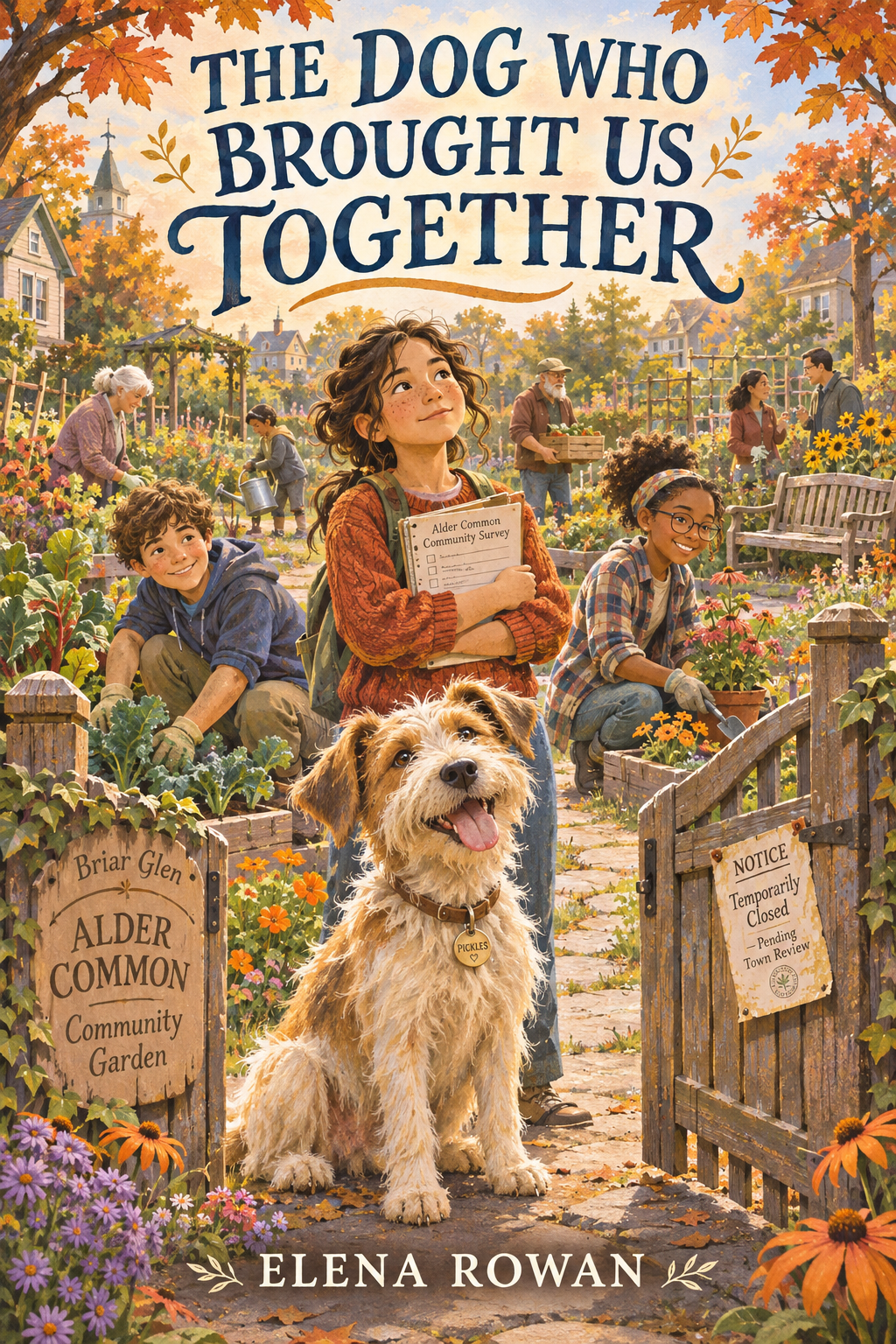
Chapter 1
The Dog in the Rain
The first thing Maya Ortiz learned about Alder Street was that the rain had opinions. It came sideways across the sidewalk, rattled against the apartment windows, and found the one gap between her hood and her neck.
The second thing she learned was that somebody's dog was loose.
He appeared from between two parked cars, low to the ground and moving fast. His ears flapped like wet envelopes. A red leash trailed behind him, slapping the pavement. For one wild second Maya thought he would run straight into traffic.
“Hey!” she shouted.
The dog stopped. A delivery van rolled past, tires hissing. He turned his head toward her, then backed away.
Maya had moved to Briar Glen eleven days earlier. She knew the route from their apartment to Willow Ridge Elementary, the smell of the laundromat downstairs, and exactly how long it took her mother to get off the late bus after work. She did not know any dogs, or any people she could ask for help.
She crouched by the curb. “I'm not chasing you. That's my whole plan.”
The dog shook himself, sending water in every direction. Around his collar hung a brass tag shaped like a leaf. Maya could not read it from where she stood.
A man carrying grocery bags stepped out of the corner market. “Don't grab a frightened dog,” he called. “He'll bolt.”
“I wasn't going to.” Maya put her hands on her knees. “Do you know whose he is?”
“Can't say I do.” He set one bag down and pulled a packet of crackers from his coat pocket. “But he seems to know what's in here.”
“Are those for dogs?”
“Plain crackers. Not exactly a feast.” He checked the ingredients before offering one small piece on his open palm. The dog crept forward, sniffed, then took it.
Maya moved carefully enough to see the phone number on the tag: 555-0146. Above it was a name: PICKLES.
“Pickles?” she said. The dog sneezed.
The man laughed. “A serious name for a serious fellow.”
Maya copied the number into the notes app on her mother's old phone, which worked on Wi-Fi but could not make regular calls. “I need a phone that calls.”
“Mine does.” He picked up his shopping. “I'm Mr. Bell. I run the shop on the corner. Come inside, where we can both be dry.”
Maya hesitated. Her mother had rules about following strangers. So did she. She stayed outside the open shop door where she could see the street, and Mr. Bell brought his phone to the threshold.
The call went to voicemail. A tired woman's voice said, “This is Mrs. Cho. Leave a message.”
Mr. Bell explained that they had found Pickles outside his market. Maya gave the location and her name. They agreed to wait near the door, not take the dog anywhere without speaking to his owner.
Pickles settled on a dry square of cardboard just inside the doorway. He looked at Maya as though he had decided something about her.
She looked back. “You picked the wrong person for a tour guide.”
Across the street, behind a rusting iron fence, rainwater ran between rows of raised garden beds. A painted wooden sign said ALDER COMMON GARDEN. Someone had attached a sheet of white paper to it with plastic sleeves and tape. Even from the sidewalk, Maya could make out the largest words: NOTICE OF PROPOSED CLOSURE.
She had passed the garden all week without noticing it. Now, while she waited with a dog named Pickles, she couldn't stop looking.
Mr. Bell returned with a cup of water. “He might not drink it,” he said. “At least we've offered.”
Maya set the cup down and watched the dog sniff it twice before taking a few noisy laps. Above them, the awning clicked in the wind. For the first time since coming to Briar Glen, Maya had somewhere she had chosen to stay, rather than somewhere her mother had told her to go.
“You live around here?” Mr. Bell asked.
“Up the block. The building with the green door.”
“Old Turner place. They fixed that door last summer.”
Maya had never thought of her apartment building as a place with a history. She knew it as two staircases, the smell of fresh paint, and a radiator that clicked all night.
“Does everybody know everybody here?” she asked.
“Not even close.” Mr. Bell folded his arms. “People think because they've seen someone in a line at the store, they know them. Seeing isn't the same thing.”
Maya felt a little ridiculous being checked on so carefully in front of Mr. Bell. He seemed not to notice. He was watching the crossing where a pedestrian had to step around a tipped garbage can. He walked out, righted it, and returned without saying anything about helping the neighborhood. She wondered if he would ever have mentioned the can if she hadn't seen him move it.
The dog pressed his warm nose against her hand. “You are a lot of trouble,” Maya informed him. He responded by yawning, showing tiny white teeth. The world felt almost normal for one minute, which made the strange new street seem less strange.
While they waited outside the market, Maya discovered that a lost dog could turn an ordinary sidewalk into a place where strangers spoke to each other. A woman with a folded umbrella offered a dry towel from her shopping bag. Mr. Bell accepted it after Maya asked whether the woman minded getting it muddy. A teenager on a bicycle stopped to say he'd seen the dog race past the bus shelter, where a man had tried to grab the trailing leash and nearly fallen into the road.
“Did anyone get hurt?” Maya asked.
“No. But he was fast.” The teenager watched Pickles drink. “You should name him Rocket.”
“He has a name,” Maya said. “We're waiting for his person.”
The teenager nodded and rode away. Two minutes later the woman with the towel returned to ask whether the owner had been found. When Maya told her they had spoken by phone, she smiled and continued down the block.
Mr. Bell looked at the small cluster of damp crackers beside the curb. “People are quick to notice a dog,” he said. “They don't always notice the rest of the street.”
Maya glanced at the abandoned paper cup near the storm drain. She picked it up after putting on a spare glove from her backpack and carried it to the market's outdoor bin. The gesture made her feel important until Mr. Bell warned her not to touch unknown litter without an adult's guidance. He was right; she knew that too. Helping required attention, not just enthusiasm.
“Are you going to tell my mother I tried to rescue a paper cup?” she asked.
“Only if the cup tries to run into traffic.”
She grinned. She had spent eleven days answering questions about where she had moved from, why she had moved, and whether she liked the new school. Mr. Bell had not asked any of those questions. He had talked to her as if she belonged on the sidewalk with everybody else. It was a tiny feeling, and because it was tiny she was afraid to trust it.
The first bell from the nearby church sounded the hour. Maya watched a city bus pull into the stop, kneel to the curb, and release its passengers. A woman stepped down with a walker and waited until a cyclist moved away from the ramp. The bus pulled off with a hiss. A man hurried toward the market carrying a cardboard tray of drinks. At the crossing, he looked both ways twice. Maya had been here often enough to know the smell of the laundromat, yet she had never watched how many different people needed the same few feet of pavement.
She asked Mr. Bell who owned the garden across the street. He told her the city did, though volunteers looked after it. He didn't know every rule, he said, and anybody who wanted the exact answer should ask the parks office. When Maya asked why the sign announced a proposed closure, he nodded toward the uneven path just visible through the gate.
“Things need maintaining,” he said. “Sometimes people disagree about who does it and who pays.”
Maya thought of the radiator in their apartment. The landlord had promised to fix its knocking sound, but the appointment kept getting delayed. At eleven, she already understood that saying something should be repaired was not the same as making it happen.
The owner was on her way. The bus was gone. The garden gate shuddered in a gust. It seemed strange that the whole world could keep moving while Maya stayed beside a small brown dog, waiting for a woman she had never met. But she had made a useful choice, and the choice had brought her to this spot. When her mother came up the block, Maya raised a hand and saw the worried expression on Mom's face soften.
“That's him?” Mom asked.
“That's him. He's safe for now.”
Mom crouched a few feet away. “You've done the right thing by staying put and getting help.”
Maya watched Pickles press his nose against the edge of the cardboard. For the first time since the move, she thought she might have something to tell Zuri that wasn't simply how much she missed her.
Chapter 2
The Name on the Tag
Mrs. Cho arrived twenty minutes later in a yellow raincoat, walking so quickly that her umbrella turned inside out.
“Pickles!” she cried.
The dog sprang up. His leash caught on the corner of the cardboard, and Maya freed it before he could trip. Mrs. Cho knelt right on the wet concrete and let him push his face into her coat.
“Where did you find him?” she asked.
“Near the curb,” Maya said. “He almost ran into the road.”
Mrs. Cho closed her eyes briefly. “The gate latch at the garden doesn't hold in the wind. I thought he was behind me. Then he wasn't.”
Mr. Bell gave her the leash. “A sturdier clip might help.”
“A sturdier clip and a sturdier brain,” Mrs. Cho said, giving Pickles an affectionate scratch. “Mine, not his.”
She thanked Maya twice and asked whether Maya's family would be comfortable with her having a small thank-you gift from the garden: a bag of late-season apples.
“There's a garden?” Maya asked, immediately wishing she hadn't. The sign was right there.
“Until December, perhaps.” Mrs. Cho looked across the street. “The parks department owns the land. The city says it can't keep paying for repairs and insurance unless we put together a realistic plan.”
“Can they do that?” Maya asked.
“They can review how public land is used. They haven't made a final decision.” Mrs. Cho rubbed Pickles's ear. “There's a meeting three weeks from Thursday. People have plenty to say about the place, but they haven't agreed on what to do.”
Maya had heard grown-ups say things like plenty to say before. Usually it meant an argument nobody wanted to describe.
Mrs. Cho nodded toward the garden. “Walk through with me tomorrow, if your parent says yes. It's open to everyone during posted hours.”
At home, Maya explained everything while her mother warmed leftover rice and beans on the stove. Their apartment smelled of onions, damp socks, and the lavender soap her mother brought from the clinic.
“You did right not going anywhere with somebody you don't know,” Mom said. “And you did right calling for help. But you're not responsible for wandering dogs by yourself.”
“I know.”
“Do you want to visit the garden?”
“Maybe.” Maya made a pattern in the condensation on her glass. “They might close it.”
Mom turned down the burner. “A public meeting, huh? There's usually more behind a sign than the sign tells you.”
Maya pictured the square of garden behind its iron fence. At her old school, a group of friends had already claimed the same table for lunch every day. Here, she ate with a different group each time, afraid of sitting down where she didn't belong.
“Would you come with me?” she asked.
“Tomorrow I can stop in after my shift. We can meet at the gate at four.”
That night Maya looked up the notice on the city's website. The page was plain and stubbornly full of words. It gave an address, a meeting time, and a sentence about deferred maintenance. A link labeled COST ESTIMATE would not open on her phone.
She wrote the date on a scrap of paper and taped it above her desk. Three Thursdays away.
Then she wrote another note below it: ASK WHAT'S BROKEN.
It did not look like much of a plan. It was the first plan she'd made since moving that did not involve counting days until she could visit her old neighborhood.
Maya thought about her social studies notebook. A place did not serve everyone just because it had a nice sign. She walked home with a new question and the uncomfortable knowledge that a person could be right about a problem even if you disliked the way he said it.
At dinner, Maya tried to explain the notice to her mother before the pasta had cooled. She said the city wanted to close the garden, that Mrs. Cho was worried, and that Mr. Bell had complained about the sidewalk. When she finished, Mom put down her fork.
“Do you want to help because you like the garden,” she asked, “or because you like having people to talk to?”
“Both. Is that bad?”
“No. It's useful to know what matters to you. But the garden's future can't be decided by whether you're lonely.”
Maya pushed a pea around her plate. She hadn't expected the word lonely to come up so plainly. “I'm not lonely all the time.”
“I know.” Mom took another bite and waited.
“Sometimes I don't know what everybody else already knows,” Maya admitted. “They know which teacher is strict and which bus is late and which kids have been friends forever. I don't even know where the good swings are.”
“Do you want to call Zuri tonight?”
“I did yesterday. She had to go to soccer.”
Her mother nodded. “New friendships and old friendships don't have to compete. There's room for both.”
Maya imagined the narrow apartment they had lived in before, its noisy pipes and its view of the train tracks. She had wanted a larger bedroom. Now she had one and felt smaller in it.
After dinner they walked past the garden together. Her mother read the notice slowly. She pointed out the date of the hearing and the office where comments could be submitted. “This is a proposed action,” she said. “That means a decision hasn't been made yet.”
“Could they just change their minds?”
“They could. They might also have reasons we haven't heard. We need to read the report.”
Maya stared through the fence. A silver watering can lay on its side near the shed. The beds were untidy, but she could imagine how they looked in summer. She thought about putting her name down to help, then hesitated. She was eleven. Adults could sit in rooms and make decisions. What could she do besides hold a rake?
“Ask a clear question,” Mom said when Maya told her that. “Read a document. Listen when people answer. Those are real things.”
Maya took out her notebook under the streetlight. On the first page she wrote the date. Beneath it she wrote: Who uses the garden? Who can't? What exactly does it need? She left a space at the bottom for answers that might not fit her questions.
At home, she propped the notebook open beside the photograph of her old class. For the first time in eleven days, she looked at both without deciding which one belonged more to her.
“Do you miss your friends tonight?” she asked.
“Of course.”
“Even after an interesting afternoon?”
“Especially after. I want to tell them, and they're not here.”
Mom leaned against the counter. She admitted that she sometimes felt the same way at her new job. The people were kind, but she still reached for the phone to ask an old coworker how to do a familiar task. Moving had not made her forget the people who helped her learn her old routines.
“I thought you loved the new job,” Maya said.
They ate without turning on the television. Maya described the garden sign, and Mom asked her to repeat the exact wording she remembered. When Maya admitted she had only seen the large letters, Mom suggested they read it properly on their next walk. A headline could announce a problem without explaining its cause.
Maya unfolded the paper napkin she had used at the market to note the dog's tag number. She no longer needed it. The owner had been contacted and the dog was going home. Still, she didn't throw it away. She placed it in the back pocket of her notebook, beside an old ticket stub from the train that had taken her and Zuri to the museum last spring.
Before bed, she sent Zuri a message about the dog. She included no photograph because she hadn't asked Mrs. Cho for permission to take one, and she didn't want to make the frightened animal into a joke. Zuri replied with several excited questions and a picture of the science project she was building. They traded messages for a few minutes and then said good night.
Maya slid into bed and listened to a car roll past outside. The rain had stopped. Someone was talking in the hallway, then laughing at something she couldn't hear. Several weeks earlier she would have pressed her pillow over her ears. Tonight she wondered whose voice it was. Tomorrow she might ask.
Chapter 3
The Invitation
On Friday, with her mother’s permission, Maya returned to Alder Common Garden. The rain had stopped, but its work remained in the ruts along the path.
Mrs. Cho's invitation to visit the garden left Maya with a practical problem. She had never joined anything in Briar Glen. At her old school, Zuri usually decided which club they would try, and Maya followed, grateful not to…
On…
Keep reading The Dog Who Brought Us Together
You've reached the end of the free preview. Purchase this eBook for permanent access in your Novel Thunder Library, or read it with an eligible Novel Thunder subscription.
Buy eBook — $4.99