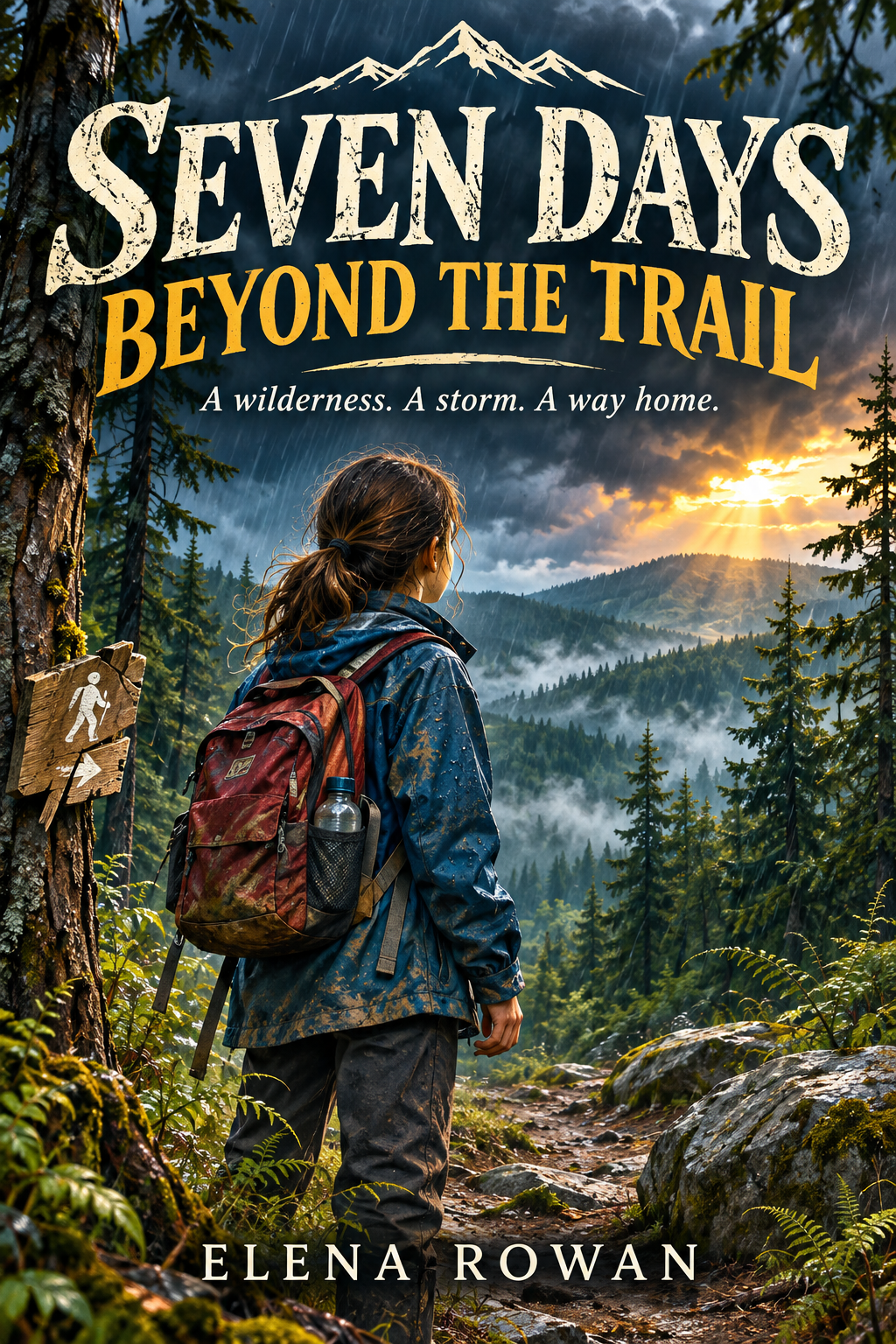
Chapter 1
The Last Blue Marker
On the morning of the hike, Mara Bell checked her backpack three times and still managed to forget the one thing she meant to remember: a pencil.
She had a notebook. She had a rain shell folded into a tight blue square, an orange emergency poncho, two granola bars, a peanut-butter sandwich, a full water bottle, and a small filter her aunt had shown her how to use. She had a whistle on her pack strap, a headlamp with fresh batteries, and a paper map of Grayling Ridge County Forest. She had a pencil-shaped space where the pencil should have been.
At the trailhead, her best friend, Jo Alvarez, watched her search the bottom of the pack.
Mara wrote the difference in her head because she'd forgotten her pencil. Worn path. Blue diamonds. People together. She imagined telling her father she remembered every word. She had no way of knowing how much that would matter before the day ended.
Now, as the group began hiking, she noticed how much bigger a forest seemed than it did through a bus window. The trees didn't make neat rows. Small paths went nowhere. A patch of bright moss could look like a trail marker if you were already hoping to see one. The ranger pointed out where the maintained trail was worn pale by boots and where a deer track slipped away through brush. They looked similar for three steps and nothing alike after ten.
She'd rolled her eyes, not because he was wrong, but because he was her father and she was ten.
Her father had looked at her for a moment. “Knowing while you're in a warm kitchen isn't the same as remembering while you're scared.”
“I know.”
“Unless where you are is dangerous.”
“Stop and stay put,” Mara had recited.
He had knelt at the kitchen table and spread her equipment out as if it were a puzzle he didn't trust. “Whistle is attached to the shoulder strap,” he'd said. “Phone stays off to save the battery unless you need it. And if you're separated—”
Jo had laughed, then pointed to a farm gate where a muddy dog watched them pass. The two of them invented a name for it—Sir Puddles—and argued about whether it could outrun the bus. By the time they reached the trailhead, Mara had forgotten how nervous she'd been when her father zipped her rain shell into the pack that morning.
“Your dragon has a respiratory problem.”
“Or a dragon sleeping under the bridge.”
“Cloud touching the ground,” Mara said. She knew that much from science.
“Look,” Jo had said when the bus crossed the river. “Mist.”
The school bus had smelled of damp sweatshirts and apple slices. Mara had taken the window seat so she could look at the trees on the way in. Jo had sat beside her with a folded field guide, although the guide belonged to the library and Jo mostly used it to press the leaves she collected on the sidewalk.
“Are you looking for the bear spray you told me not to bring?” Jo asked.
“We were never bringing bear spray.”
“That's why it was a good joke.”
Mara found a receipt and a peppermint wrapper. No pencil. She could have asked Jo for one, but she had already asked Jo to remind her about her lunch, and the thought of asking a second favor made her ears warm.
Beyond the parking lot, a board showed four trails in four colors. The fifth-grade outdoor science club would take the blue-marked Fern Loop. Six miles was the official distance, though their ranger guide said they would turn around at the old survey overlook if the weather changed. It was the last Saturday in September. The maples on the far side of the valley had begun to turn, and the spruce trees stayed dark and watchful between them.
Ranger Celia Torres stood beside the board with the other adult volunteers, Mr. Voss and Mara's teacher, Ms. Patel. Torres wore a radio on her shoulder and a bright lime vest. She asked the students to gather close enough to hear without raising her voice.
“Today's forecast says scattered showers possible after two,” she said. “We plan to be back well before that. Forecasts are not promises. If I call a turnaround, we turn around. Nobody hangs back without telling an adult. The person at the rear is Mr. Voss, and the person at the front is me.”
She made them count off. Twelve children. Three adults. Mara was number seven, which felt like a good number because it was ordinary and not a number anybody would remember.
Torres lifted a whistle. “One long blast means stop and listen. Three short blasts means someone needs help. You may hear us use them in practice. Don't treat them as a game.”
She asked what to do if someone became separated. Half the students raised their hands. Mara raised hers late.
“Stop,” said Andre, who always answered first. “Don't just keep walking.”
“Make yourself easy to find,” said Jo.
“Ask someone before you go to the bathroom,” said a boy behind them.
“Also true,” Torres replied, and the group laughed. “A lost person can become harder to find each time they move. There are exceptions if you're in immediate danger. Otherwise, stop, assess, signal, and stay in a safe place. If you have phone service, contact emergency help.”
Mara had heard a version of this from Aunt Elise, who led weekend hikes at a nature center. Elise's exact words had been, “Wilderness isn't impressed by confidence. It rewards noticing.” Mara loved that line, although she had never told her aunt so.
The climb began gently. Ferns brushed their boots. Jo invented names for mushrooms they were forbidden to touch. Mara noted the first blue diamond on a beech tree and then the next. The club studied erosion at a washout, water moving through moss, and the difference between animal tracks and the marks left by a bicycle tire.
At eleven forty, the woods grew strangely dim. Wind moved across the treetops in waves. Torres listened to her radio. Her expression changed only a little, but Mara noticed.
“We're heading back,” the ranger said. “The cells are developing faster than expected.”
They ate standing up beside a sheltered bend while the adults checked the count. Mara took two bites of her sandwich and wrapped the rest. The first rain was thin as thread.
Twenty minutes later, rain hammered the leaves. The group followed the blue markers downhill, with Torres picking careful footing around slick roots. A branch crashed somewhere off the trail. Everyone stopped. Mr. Voss called the numbers, and each child answered.
Mara shouted, “Seven!” Her voice was swallowed by the next gust.
“Close up,” Ms. Patel said from behind her. “Eyes on the person ahead.”
A narrow section of trail skirted a brushy slope. The path itself was solid, but water was pouring across it from the uphill side. A loose strap on Mara's pack snagged a branch, turning her sideways. She felt the tug and pulled back. The strap slipped free. Her notebook fell out of the side pocket and skidded into the ferns.
“Leave it!” Jo called from two steps ahead.
Mara knew that was the right answer. She knew it in the same quick, complete way she knew three times six was eighteen.
But the notebook was the one she had filled with drawings all summer. Aunt Elise had written the first page. Mara reached for it without telling anyone.
Her foot touched what looked like a dark patch of soil beneath the ferns. It was loose gravel washed over a steep cut. The ground shifted. Mara slid on one knee, grabbed at a root, missed, and tumbled through a screen of wet branches.
The fall was short enough that she never had time to scream properly, and long enough that it seemed to contain a whole minute. Her shoulder struck soft dirt. Her pack hit a stone. She slid again and came to a stop against a fallen log.
Above her, the trail was invisible behind leaves and rain. Mara tried to shout. A crack of thunder landed over the forest. She tasted mud.
“Jo!” she yelled. “Ms. Patel!”
There was no answer she could hear.
She took a breath and reached for the whistle on her strap. It was still there. She blew three sharp notes, waited, and blew again.
Far above, voices called numbers. Or perhaps it was the wind scraping through the trees. Mara stood too quickly. Her right ankle hurt, and the ground slid under her other foot. She sat down hard.
“Stop,” she told herself aloud.
She had slipped off a trail in a forest full of people who knew she was there. The most important thing, she thought, was to climb back to them. She looked at the wet slope and felt fear narrow the world until it contained only that idea.
Then a second branch fell somewhere nearby, and she saw a thin stream of muddy water spilling down the line she would have climbed. She couldn't tell where the solid earth ended.
Mara gripped the whistle. She blew again. The rain answered.
Chapter 2
The Place She Stopped
Mara waited for her breathing to slow enough that she could hear separate sounds again. Rain on broad leaves. Rain on needles. Her own jacket rubbing against the log. The trickle of water through the cut. Not footsteps. Not voices.
She had landed on a shelf of soil below the trail. Beyond it, the ground dropped into a narrow, wooded basin. The shelf was no larger than her bedroom. The log behind her, bigger around than she could reach, had likely fallen years earlier. Young spruce trees had grown near its roots.
She tried her ankle carefully. It could hold some weight, but turning it sent a bright ache up her leg. Her left palm had a scrape, with bits of grit trapped in it. She was shaken but could move her fingers and toes. She did not have a good reason to test the steep bank again.
She realized that was the point of the whistle. She could tell the woods the same thing much louder.
“I am here,” she whispered, though nobody heard.
She chose a place against the side of the log where wind did not strike her face as hard. Her phone was tucked inside a sandwich bag in the driest pocket of her pack. She left it there until she could make a careful assessment. The wind kept moving through the branches, and she listened for voices beneath it.
That sentence did not take away the fear. It did something smaller. It gave the fear a boundary. She could wait for a count. She could blow three signals. She could stay out of the little drainage line where water was gathering. She was allowed to do only those things, and for the next few minutes she felt grateful that the list was short.
“Somebody knows I am missing,” she said. “They counted us.”
Then she looked at the ground directly downhill. It was slick with dark mud, interrupted by stones half-hidden under soaked leaves. She pictured slipping, twisting her ankle, and making herself harder to find. She had already learned what the forest could do in a few seconds of bad footing. She stayed where she was.
She could hear the storm crossing the forest in gusts. Rain struck the broad leaves first, and then the sound arrived lower down as drops fell from leaf to leaf. Somewhere beyond the slope there was a constant rushing. She thought of the creek beside the trail. She thought of following it. Water went somewhere, didn't it? Roads and houses had water too.
She took her pack off and set it beside her left boot. She was afraid that if she stopped touching the pack she would leave it behind. She said the list out loud: rain shell, poncho, whistle, water, food. Then she counted again, slower. Her fingers kept wanting to move too fast, as if counting could hurry an adult into view.
For a while, Mara tried to make the forest behave like the map at the trailhead. On the map, the blue trail was a smooth loop with a little finger of water at the bottom. Here, the ground folded into humps and dips she couldn't have drawn even if she had found her missing pencil. A fallen tree might have been the same one she passed earlier. It might not. She could not see the sun through the cloud cover.
The school had practiced something called STOP. Stop. Think. Observe. Plan. The words sounded like words on a poster until she had to choose what they meant.
Stop was obvious. Think was harder.
What did she know? She had left the Fern Loop at the narrow washed section after the survey overlook. The group had already started back. The adults knew the route. It was not dark yet, though the storm made it look like evening. She had food, water, and a way to call attention. She took out her phone. One corner of the screen was cracked from the fall, but the display worked. No signal. Thirty-eight percent battery.
She tried an emergency call once. The screen searched, then reported that it could not connect. She turned on battery-saving mode, powered the phone down, and returned it to its bag. The battery might matter later.
“Observe,” she whispered.
Water was running across the shelf toward the basin. The log was above the water's path. A few yards from the log, beneath a close group of shorter spruce trees, there was a patch of ground with more needles than mud. It was not dry. Nothing was dry. But the trees broke the force of the wind, and the patch lay away from the steepest section of the bank.
A low rumble rolled overhead. Mara remembered the thunder safety talk. There was no safe outdoor place when lightning was close. She should have been back inside a building. Now she had to reduce danger where she was, not imagine the forest was safe because she picked a tree. She moved away from the big isolated trunk and the running water, toward the lower, close-growing trees. She sat on her pack instead of sprawling on the wet soil and kept her feet together while the nearest thunder passed.
She wanted to cry. She wanted to be angry at the notebook. She wanted to be an entirely different person who would not have stepped off the path.
For a while she managed all three, quietly.
When the thunder moved farther away, she blew her whistle again: three short blasts, a pause, three more. She listened until her ears hurt. At last she thought she heard one long whistle from above, but the rain blurred its direction. She answered at once.
The daylight shifted slowly enough that Mara almost missed it. A patch of brightness crept across the bark and disappeared. She had been watching the same crooked root for so long that she could have drawn it with her eyes shut. Back in her classroom, Ms. Patel had asked everyone to describe the difference between observing and guessing. An observation was something you could check. A guess might be useful, but you had to label it as a guess. Mara's observation was that the rain had become lighter. Her guess was that the adults might soon reach her. She wanted the second one to be a fact.
She tried to inventory her belongings without taking them all out. Her pack was wet outside, damp inside. The sandwich, wrapped in a reusable bag, had been flattened but not spoiled. One bar was broken into three pieces. Her water bottle still held more than half its water. The headlamp worked. The whistle was on a short cord secured to her strap. She pulled it once to make sure the clip held.
She ate part of the sandwich, although her stomach seemed too small for food. She had expected that being lost would make her brave or terrified, one feeling at a time. Instead she felt hungry while frightened, sleepy while listening, and embarrassed about being separated from her class. She imagined Jo telling everyone that Mara had slipped. She imagined someone asking why she had been behind the line. These thoughts went in circles. She could not solve them from a shelf of mud.
When a gust lifted her poncho, she caught a corner before it blew into the trees. She laid a flat stone on its edge. The fabric snapped once and went still. Mara looked at the orange shape against the dark ground. Bright color, she thought, is a kind of message. But only if someone can see it. She moved a few fallen twigs that covered the brightest part. Then she stopped, remembering that even a small change of position could put her closer to the drop. The safe space was not a room with walls. It was a decision she would have to keep making.
A distant crack sounded from above. She raised her face. No voice followed, and she could not tell whether it had been a branch or a boot on wood. She blew her whistle in a pattern of three, paused to listen, and tried again. No answer. Her cheeks hurt. After several rounds she rested, because blowing without stopping would make her tired without making anyone hear better.
She spoke her name aloud. “Mara Bell. Grayling Ridge. Below the blue trail.” There was no one to hear the report. She said it again anyway, to practice what she might tell a rescuer. Then she added the part that mattered most: “I am staying here.” The words sounded less like a promise to the forest than a promise to herself.
The slope stayed empty.
She unfastened her pack and inventoried everything, placing each item on her rain shell before the rain could soak…
Und…
Keep reading Seven Days Beyond the Trail
You've reached the end of the free preview. Purchase this eBook for permanent access in your Novel Thunder Library, or read it with an eligible Novel Thunder subscription.
Buy eBook — $4.99