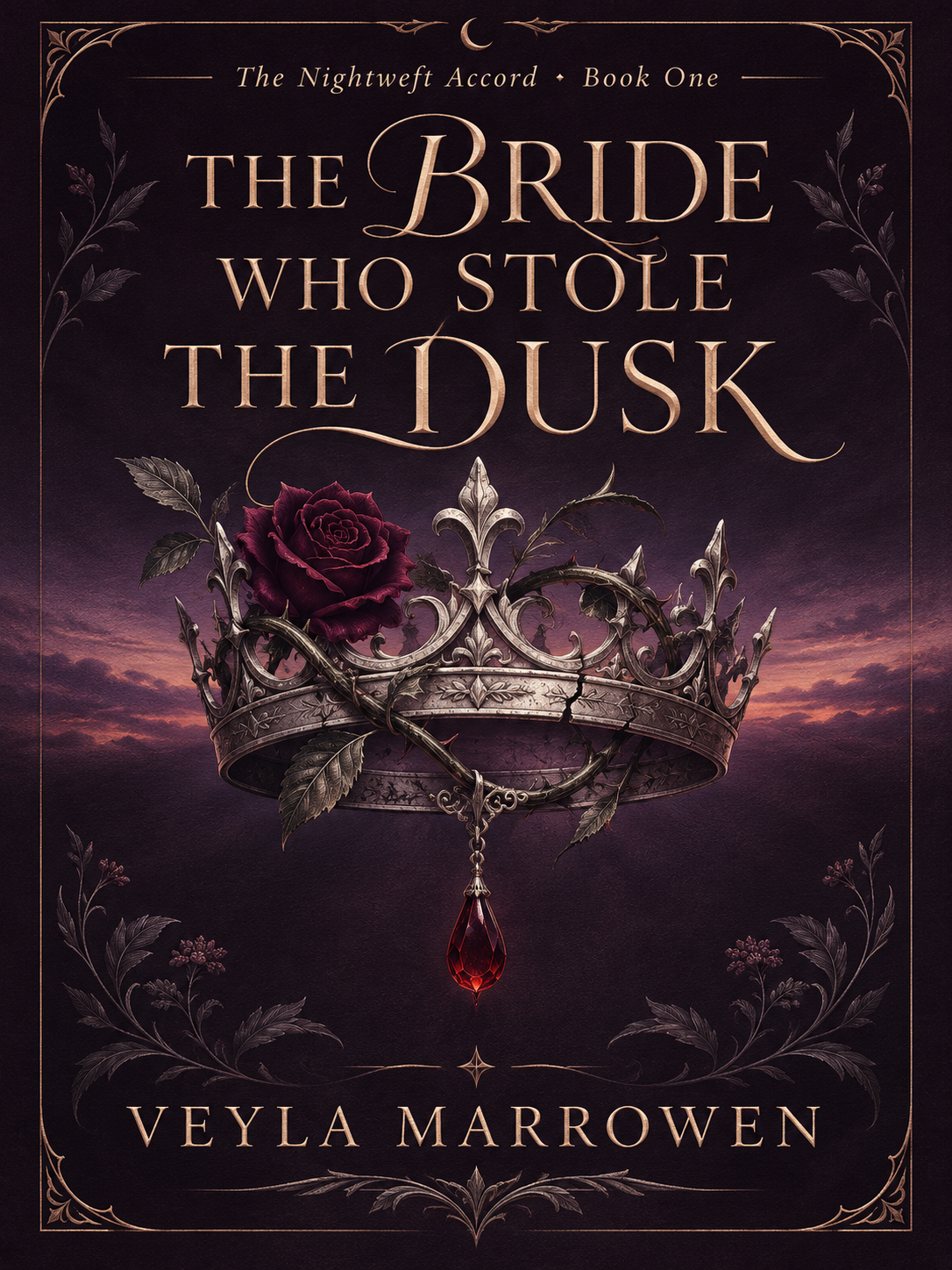
Chapter One
The Woman in the Red Ledger
Esvira Nhal had executed three men for the Crown and lied about all three on the same page.
The fourth name waited beneath them in the red ledger. Her own.
She stood in the Registry’s upper hall with rain drying on her cuffs and a clerk watching the movement of her eyes. Beyond the windows, Veyrathen’s capital wore its evening bells like chains. Nine strokes announced the hour before dusk. At the tenth, the city gates would be barred. At the eleventh, the lamps would be lit, and people would pretend they did not know what lived in the dark beyond them.
“Read it aloud,” the clerk said.
Esvira closed the ledger. “I can read.”
“Then you understand the charge.”
Treason. Fraud against the Crown. Concealment of a prohibited bloodline. She was guilty of the third and had spent twenty-six years trying to discover why that mattered. She was innocent of treason unless allowing condemned prisoners to escape through an old sewer counted. The clerk could not know about the sewer. The men could not know her name; she had taken care of that.
She looked at the first page. Three narrow columns. Name. Sentence. Witness. In the final column beside each escaped prisoner’s name was the same word, written in her hand: Fulfilled.
“A tribunal would require testimony,” she said.
“There will be no tribunal.”
A soldier in ash-colored armor stepped forward. His sword remained sheathed. It was the small courtesy that frightened her.
The clerk turned the page, revealing a black wax seal stamped with a crown and a single vertical line. “By decree of High Regent Solveth Marr, you are remanded to Gloamhold. The night’s bride.”
For a moment the rain seemed to stop outside.
The last bride had vanished seven years ago. The one before her, a century earlier, if the official account could be trusted. Both had entered Gloamhold before dusk and were never seen again. No one could agree whether they had died, escaped, or become something the city lacked a word for. A bride was chosen every hundred years, the people said. Yet the gaps between the names in the red ledger were wrong. Esvira knew because she had counted them.
“The cycle is not due,” she said.
“The Crown has declared an early choosing.”
“The Crown has no monarch.”
The clerk’s face stiffened. “You will address the Regent respectfully.”
Esvira gave him the respect he deserved: none. The soldier took her wrists. His hands were gentle and his grip exact.
As he turned her toward the doors, Esvira saw a second line below the decree, cramped beneath the seal. She had spent years learning to read the bureaucratic shorthand that hid killings inside reasonable words. This one said: Asset delivered intact. Blood verification pending.
They did not want a bride. They wanted what was in her veins.
On the staircase she passed a narrow mirror. The woman in it had dark hair pinned close to her head, a white scar beneath her chin, and a borrowed executioner’s coat that did not fit across the shoulders. Her mother had taught her to keep her face empty when men with authority spoke. Her mother had also taught her never to let anyone draw her blood.
The soldier opened a door onto the carriage yard. A covered coach waited, its windows lacquered black. No horses stood before it. Instead a pair of long-limbed nightstags lowered their antlered heads, impatient beneath harnesses of dull silver.
“What happens to an early bride?” Esvira asked.
The soldier glanced toward the coach, then down at his boots. “I was ordered not to answer questions.”
“You’ve answered one already.”
“Which?”
“That you know.”
His mouth tightened. He helped her inside without speaking again.
The door locked from the outside. Under the leather bench, someone had scratched a message into the wood: DO NOT DRINK THE FIRST CUP.
Esvira ran her thumb across the letters. One of them had been carved deep enough to splinter the grain. She checked the seams of her coat. They had left her the narrow wire she used to open prison latches, hidden behind a loose button. They had searched her for a knife. That was their first mistake.
The nightstags pulled the coach into the rain. Esvira watched the palace roof vanish behind a curtain of water and counted the turns. Four left, two right, then the bridge with its uneven stones. The route north. The road to Gloamhold.
She had never believed the story of the Shadow King’s appetite. Monsters did not require ledgers, signatures, and an armed escort. Institutions did.
Whatever waited at the fortress, she would find out what had happened to the brides. Then she would find her way back to Solveth Marr.
The carriage crossed the last city gate as the eleventh bell sounded. For one breath the rain hung motionless beyond the window. A thread of darkness lay across the glass, thin as a seam in black cloth.
Esvira touched it. The thread stirred toward her finger.
Her mother had called that the family sickness.
Her mother had died before explaining its cure.
⁂
The first night of the journey, the coach halted at the tollhouse above Cinder Ford. Esvira counted four sets of boots outside, though only two men spoke. The nightstags scraped their antlers against the carriage harness. A guard opened the door enough to pass in a tin plate of supper and a piece of parchment folded twice.
“For your signature,” he said.
The document recorded that Esvira Nhal had entered the carriage of her own free will and had taken no injury in the custody of the Crown. Under the final line was a blank reserved for a witness. Esvira held the parchment against the window until she could read the writing beneath its fresh ink. Two earlier signatures had been scraped away. She could still see the indentations of a woman’s name.
“You can tell your superior I refused,” she said.
“My superior doesn’t need your permission.”
“Then he doesn’t need my signature.”
The guard returned with his captain, a thin man who smelled of boiled onions and lamp oil. He carried a ledger of his own and set it on the opposite bench. For a moment Esvira felt the old familiarity of a clerk’s table, of columns that could turn a lie into law if everyone agreed to keep writing it.
“This route is expensive,” the captain said. “If you cooperate, we’ll remove the irons at the next stop.”
She held up her unbound hands. “You didn’t use irons.”
“Then imagine what else we might give you.”
He showed her a line listing provisions. Bread, water, winter blanket, carriage toll. Beneath them: blood vessel, glass; extraction needle; sleeping draught. Everything priced and receipted. The bottle was not for a wedding banquet. It was an inventory of what would be taken from her.
“Who signed for the glass?”
“The Regent’s office.”
“Which officer?”
He closed the ledger with one finger marking the page. “It’s not information you need.”
“You should be careful with that answer. When this ends, a court may ask which instructions you followed and which you invented.”
The captain smiled. “There won’t be a court.”
She had heard that same confidence from three men who had overseen executions. Two had later begged her for a private favor. The third was dead. Power made people careless about how much paper they left behind.
The captain went out, taking the ledger. The guard remained a moment longer. He was young, with a nick across his chin where a razor had slipped. He looked at the untouched plate and then at the gouges beneath her seat.
“Was it true?” he asked. “The prisoners you let escape?”
She considered lying. His shoulders were too stiff, his voice too low. A man rehearsing courage.
“What do you think?”
“My brother’s name was in the lists last winter. A weaver. They said he’d hidden a prohibited chart. The Registry sent word his sentence had been fulfilled. We never received a body.”
Esvira kept her face still. A weaver with ink-stained hands, one of the three she had walked through the drainage culvert. She remembered the way he’d coughed in the cold and insisted she leave him when the water rose.
“The lists are not always accurate,” she said.
The guard looked at her for a long time. He was not asking her to confess. He was asking whether hope was dangerous. She knew enough about danger not to give him a certainty she could not guarantee.
“If he is alive,” she said, “he needs time to stay that way.”
He nodded. Before he closed the door he slid a wrapped bundle beneath the bench. A wool blanket, warm from a stove, and a small brass pin shaped like a fish. “My mother made that,” he said. “For luck.”
When the carriage started again, Esvira touched the pin. It was unremarkable, except for the price the young man might pay if someone noticed its absence from his coat. She hid it behind the lining of her sleeve.
She had once thought she could keep her acts of mercy separate from her work. Deliver the sentence publicly, open the sewer grate privately, send a bodyless report to a clerk who preferred not to ask. The people she’d saved were no longer entries. They had brothers. They had people waiting at gates.
Outside, the road narrowed between pines. On the far side of the window, a black seam followed the coach for half a mile before vanishing into the rain. Esvira did not reach for it. She placed her palm over the pin and practiced remembering the name of the weaver’s brother, though she did not know it yet.
The road beyond Cinder Ford belonged to people the capital never bothered to count.
At the first stopping village, a woman stood beside a public water pump with a bucket in each hand and an iron collar beneath her scarf. She watched the carriage pass with the fixed attention of someone assessing how many guards it carried. One of the nightstags faltered near the pump. The captain cursed, ordered a halt, and went to argue with the ostler about feed that had been paid for in advance.
Esvira had been trained to recognize a waiting messenger. She recognized the woman instead as a person who had learned that running was worse than standing still.
The young guard with the shaved chin opened the coach door to let the air in. His name, she learned when the captain shouted for him, was Fen. He shifted his stance so that he could see both her and the pump.
“I won’t run,” Esvira said.
“I wasn’t going to ask.”
“That makes two of us.”
He seemed to think that was a joke. She wasn’t certain it was.
A child emerged from the inn carrying an enormous loaf wrapped in cloth. He hurried to the woman at the pump, took her smallest bucket, and started toward the lane. She caught his sleeve before he reached the road, looked at the coach, and drew him behind her. Not fear of the animals, Esvira thought. Fear of the mark on the coach door: the Regent’s divided crown.
She could ask Fen to carry a message. She could embroider it with instructions and secret names and hope he was honorable. But honorable people died carrying other people’s plans. The young guard had already risked giving her a blanket. She would not convert his kindness into obligation.
“That woman,” she said. “Does she belong to the inn?”
“There are no bonded servants here,” Fen answered too quickly.
“I didn’t ask if she was bonded.”
He met her eyes. After a moment he said, “The toll has doubled since winter. Everyone owes something.”
The woman turned away, but not before Esvira saw the skin at her throat where the scarf had slipped. A narrow silver clasp lay beneath the collar. It was the shape used by the Registry’s debt officers. Esvira knew the kind. She had watched people sign contracts granting five years of labor for the price of a winter’s grain. Most served twelve.
The captain returned with a tin of feed and an angry expression. “Close her in. We have a schedule.”
As Fen lifted the door, Esvira slid the brass fish pin from her sleeve. She hesitated. The guard’s mother had given it to him. It was the only thing she possessed that was not state-issued or stolen from a prison office.
“Tell me something,” she said. “If the toll is doubled, what happens when a family cannot pay?”
Fen looked beyond her to the woman at the pump. “They keep a tally.”
“A tally is a promise someone intends to collect.”
She held out the pin. “Give this back to your mother when you next see her. Tell her it brought me luck already.”
“Why?”
“Because gifts are harder to confiscate when you can prove whose they are.”
He frowned, but he took it. She had thought for a moment that she might put it in the boy’s hand and ask him to remember a stranger’s face. That would have been foolish. Instead she asked Fen to remember the collar, the clasp, and the woman. He could do with those facts what he chose. His hand closed around the fish.
The coach rolled onward. Esvira kept her gaze on the lane until it vanished around the bend. In the Registry she had called some sentences administrative, the kind assigned by a magistrate without an executioner’s attendance. She had never counted how many years of life a collar could take. She had signed the schedules that kept the office running. The woman by the pump would never know Esvira’s name. Perhaps that was appropriate. An apology without repair was another kind of vanity.
In the afternoon, the landscape grew rough. The fields gave way to slate terraces and thickets of stunted pine. Water ran black in the ditches, though the rain had stopped. The nightstags began to turn their antlered heads toward the north even when the road bent east. Fen walked beside the coach for a time, keeping one hand on the harness. Once he looked up and made a gesture with his fingers: two taps against his own wrist.
Esvira did not understand until the second milestone. A row of old wardstones ran parallel to the road, each with a carved circle divided by one line. Two of the stones were warm enough to steam in the cold air. The third was split cleanly down its face.
She touched the inside of the glass. A filament of darkness moved beneath her skin. It was not a reflection. She had felt such things twice before: once beside her mother’s deathbed, when the room’s corners seemed to come unwoven; and once while escorting a prisoner who claimed to hear bells beneath the river. On both occasions she had pressed her hands together until the feeling passed.
Now the filament did not withdraw. It turned, as if something outside the carriage had tugged it toward the broken stone.
“Stop,” she called.
No one answered. She struck the door with her heel. “The third marker is open.”
The captain leaned from the front seat. “Keep your seat.”
The shadows between the trees thickened. A stag screamed, a startling human sound. Fen ran toward the harness, and the captain stood to haul him back. Beyond them, a narrow figure appeared beside the split wardstone. It wore a coat that might once have belonged to a road surveyor, and its left hand dragged through the grass with fingers much too long. Its face was hidden under the brim of a felt hat.
“What is that?” Fen shouted.
The captain drew his sword. “Road phantom. Hold your ground.”
A road phantom would not have caused the seam at Esvira’s wrist to ache. She had no training, only the old prohibition in her mother’s voice. Never pull on a thread unless you know what the other end holds. Yet the figure’s shadow had already reached the harness. One nightstag was backing toward the ditch. If it broke its leg, none of them would reach Gloamhold.
Esvira found the seam by instinct, not sight. It ran along the carriage window where the rain had stopped. She pressed the pad of her thumb against it and pushed, as if closing a drawer that had warped in its frame.
Pain flashed beneath her thumbnail. The thread flattened. Outside, the long-fingered figure turned its head. She could see nothing under the hat except an empty space where its face should have been. Then the wardstone gave a brittle report and a line of pale light opened across its broken surface. The figure folded inward and disappeared.
For several seconds no one moved. The nightstags lowered their heads. Fen looked at his hand as if it had done something without permission. The captain sheathed his sword and ordered the carriage onward with a voice that shook only slightly.
Esvira examined her thumb. A thin gray line marked the nail, running from cuticle to tip. It did not bleed. She had not saved anyone by courage; she had moved something she did not understand. She had opened no door, and still something had seen her.
She watched the road until dark. Then she took the unsigned custody form from beneath the bench and tore it along the fold. On the blank reverse, with a splinter of charcoal, she wrote the time, the third wardstone, the clothing of the figure, and the injury to her thumb. Evidence, she had learned, was most useful when recorded before memory turned fear into certainty.
She tucked the note into her boot. If she survived, she would ask someone what she had done. If she did not, perhaps someone would find the note and ask in her place.
Beyond the northern hills, the carriage passed a field of stone posts that carried no fences. Each had a small metal plate nailed to its face. Esvira read the nearest through the window: PROPERTY TRANSFERRED UNDER EMERGENCY AUTHORITY. The plates ran down the hillside by the hundreds, like markers on graves too shallow to contain a body.
Fen was walking beside the lead nightstag. She knocked twice against the pane, and he came near enough to hear her through the narrow opening.
“What happened here?”
“They moved the farmers.”
“Where?”
“I don’t know.”
“Did they pay for the land?”
He shook his head. “They said it wasn’t safe.”
The next post had been marked with a family name. The one after that bore a number. Farther on, the land dipped into a hollow where the grasses had grown tall around a ruined farmhouse. Two walls remained standing, one still hung with a narrow blue door. There were no burn marks. Whatever had emptied the valley had left its houses intact.
Esvira remembered approving one of the transfer orders a year earlier. The Registry had described the operation as a temporary relocation of vulnerable communities. The forms were stamped urgent. No addresses had been entered for the destination sites. She had noticed and done nothing.
A sound came from under the carriage, a small metallic knocking that kept time with the wheels. Esvira leaned over the bench. The coach had been inspected at Cinder Ford, and she’d seen no loose fittings. The sound returned three times, paused, then repeated. It was not coming from the wheels. It was coming from the box built beneath the floorboards.
She ran her wire through the join between two panels. A latch moved. The panel opened just far enough to show a shallow cavity holding rolled documents, a sealed flask, and a folded strip of cloth dyed the color of old wine. She removed the top paper, careful to leave the seal intact. It was a transport manifest. The cargo was described as one compliant ceremonial subject. The date was today’s. A second sheet gave instructions for an exchange at Gloamhold, where custody would pass from the Registry to the Ministry of Seals.
On the last line someone had written: If the subject exhibits spontaneous thread recognition, proceed to restraint sequence three.
Esvira read the words twice. She did not know what sequence three meant, but she knew enough to avoid giving the escort proof that she had seen the seam by the broken wardstone. She replaced the documents and left the panel open a fraction, hoping no one would detect the shift.
At noon the captain entered the coach with a small leather case and a physician’s polished metal instruments. A narrow blade, a measuring band, and a glass tube sat in carefully fitted grooves. He placed the case on the bench as if its existence ought to reassure her.
“The Regent requests a routine examination,” he said.
“The Regent is welcome to examine himself.”
“A blood sample. Nothing more.”
“Then you should have no difficulty obtaining my consent.”
The captain gave a weary sigh. “We have lawful authority.”
“So does an executioner. It doesn’t make every act an execution.”
He took out the glass tube. Esvira noticed a ring of grooves carved around the base, identical in number to those on the wardstones. The instrument was not designed only to hold blood. It was made to direct something.
“What will you do if I refuse?” she asked.
“Take it when you sleep.”
She had expected him to lie. His answer startled her for being so plain.
“Then you ought to make certain I sleep,” she said.
For a moment he seemed unable to decide whether she was threatening him. Then he closed the case and left, locking the door. Esvira waited until the carriage moved again. She drew the blanket over her knees and removed the bottle of water from her bag. The water had been issued…
Sh…
Keep reading The Bride Who Stole The Dusk
You've reached the end of the free preview. Purchase this eBook for permanent access in your Novel Thunder Library, or read it with an eligible Novel Thunder subscription.
Buy eBook — $2.99