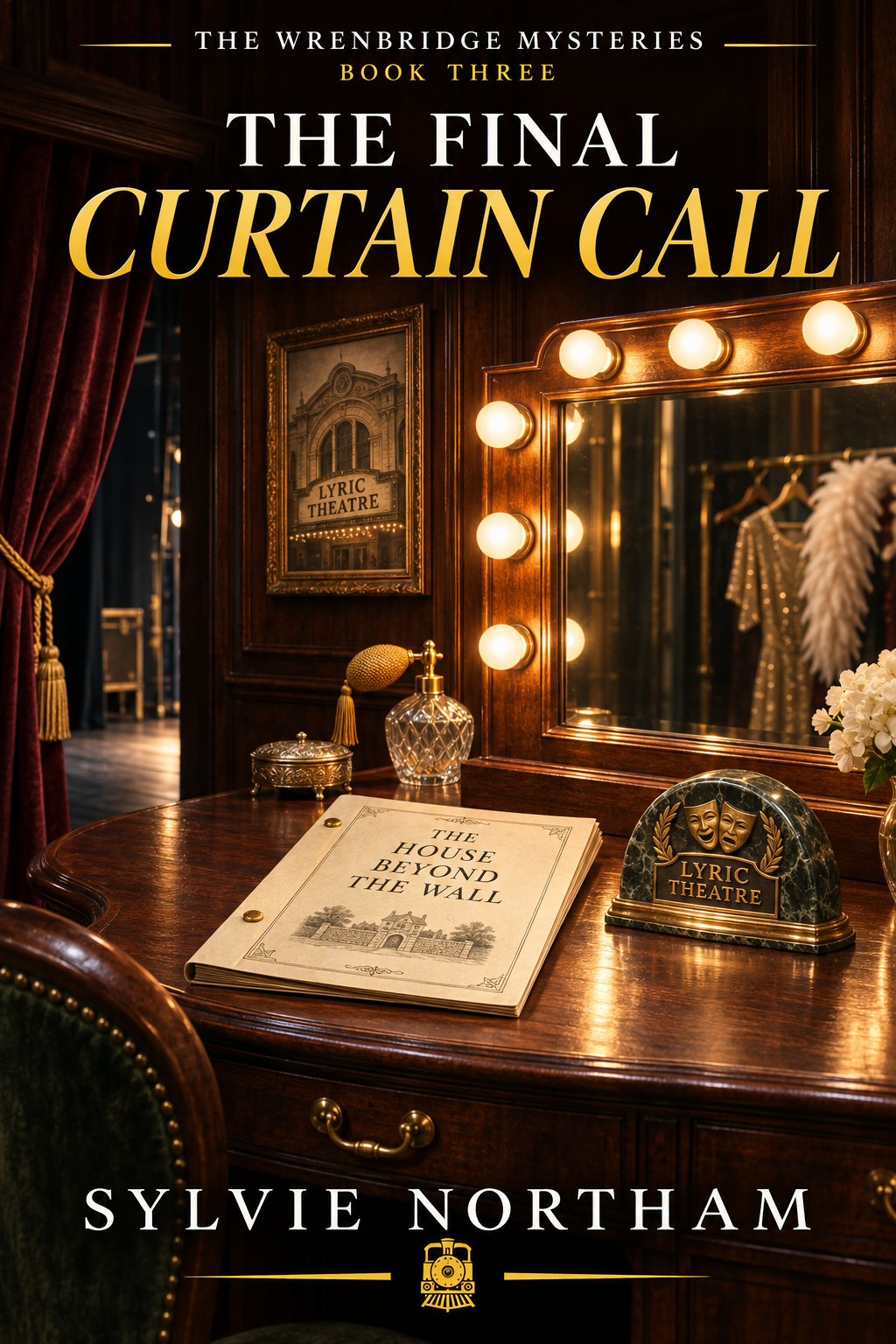
THE WRENBRIDGE MYSTERIES
BOOK THREE
The Final Curtain Call
Sylvie Northam
CHAPTER I
A Voice Beyond the Wall
The theater was full of people pretending not to look at the ceiling.
For seventy-eight years the plaster angels above Wrenbridge's municipal stage had shed fine white dust whenever a train passed along the old freight spur. Now the angels had been cleaned, the ceiling had been reinforced, and the people underneath them had paid thirty dollars each to hear an actor speak words last performed in their town before most of them were born.
The restoration committee had placed a row of photographs in the foyer so that ticket holders could admire the transformation before the performance. Nell had seen the building when its seats were torn, its carpet carried the ghost of a long leak, and the balcony smelled of wet plaster. In one photograph men in work gloves stood beneath a ceiling opened like the inside of a clock. In another, a young woman held up a fragment of the original gilt cornice with the expression of someone who had found a letter in an old coat. Now the cornice had been mended, and the chandelier's new glass caught the light with a brilliance that made people speak more quietly beneath it.
A program seller recognized her and asked whether the Chronicle would print the names of all the volunteers. Nell said the paper would publish the list on its website. The seller looked relieved, then anxious, and explained that two families had each supplied the same carved chair for an exhibition in the lobby. Nobody wanted the publicity to imply that one family owned the other's chair. It was a small Wrenbridge dispute, the sort that used to occupy a whole Wednesday afternoon at the newspaper. Nell missed that kind of problem more than she wanted to admit.
At the coat rail she encountered Martin Hale, chair of the theater board, checking a neat stack of receipts against a penciled attendance estimate. He had the slightly injured manner of a man who had promised a gala and discovered that a gala involved arithmetic. He told her the municipal allocation had paid for fire exits, accessible entrances, and the wiring behind the walls. The restored velvet and gilt came from private gifts. “People like to finance things they can see,” he said, lifting his eyes to the ceiling. “Nothing makes a good photograph of a circuit breaker.”
“Unless the circuit breaker fails,” Nell said.
Hale conceded that point and asked how her mother was. He had once been on the school board when June Mercer taught English at the middle school, and his conversations with the family invariably made a detour through the education budget. Nell asked if the Lyric would hire students for future productions. He said the new Youth Stage workshops were being discussed, that nothing had been approved, and that he did not intend to announce a promise the board could not finance. His caution struck her as refreshing, though she wondered why a theater so loudly celebrating a local playwright could not say where its first youth-program money would come from.
Owen rejoined her from the balcony stair carrying a photograph of a ventilation grate that resembled a grimace. He had found an old decorative grille on the auditorium wall and wanted to know if its twin existed backstage. Nell suggested they see whether the performance had the decency to make the machinery irrelevant. He gave her the camera's patient, skeptical look. He could appreciate a play and still be interested in how the doors opened. That was the oldest difference between them, and usually the most useful.
Nell Mercer watched a woman in the front row touch the new upholstery as if checking its reality. Beside her, Owen tried to photograph the carved balcony without including the emergency-exit sign. His third attempt included a steward's elbow instead.
“Leave it,” Nell said. “The exit is part of the building.”
“It has more of a career than the cherubs.”
On the program's cover, a faded photograph of the Lyric Theatre in 1948 sat beneath a new title: The House Beyond the Wall. The play was by Wrenbridge-born playwright Helena Sayer. The cast list placed the name Jasper Bell above the title, an actor who had left town thirty years earlier and returned with a national reputation and an astonishingly small tolerance for questions about his first job.
Nell had interviewed him at rehearsal. He had answered her questions as though each one was a door he could close by smiling. When she asked why he had come back, he said, “A town ought to be allowed to hear itself again.” When she asked who owned the rights to Sayer's work, he said, “That is not a question for opening night.”
The theater's producer, Daphne Cross, had intervened smoothly. She wore a black silk jacket and a small pearl brooch shaped like a leaf. “The trust arrangements are in order,” she said. “The municipal archive approved the revival. Please tell your readers the theater now has heat.”
Nell did. The heat was new and excessive. She loosened her scarf as the house lights dimmed.
The house manager, Edmund Vale, had dressed for the evening in an immaculate charcoal suit whose narrow lapels made him look like a man who belonged to the building rather than to its year. He moved along the aisle asking guests to tuck their coats beneath their seats and explaining that the side doors were not shortcuts to the lobby once the performance began. When an elderly patron worried that she could not manage the stairs, he showed her the level route with a courtesy that made the instruction sound like a favor. Nell watched him stop beside the orchestra rail, where a young usher was trying not to cry over an incorrect ticket. Edmund quietly exchanged two seat numbers and sent the child toward the right row.
“That's the kind of work nobody will thank him for tomorrow,” Owen murmured.
“Somebody thanked him tonight.”
The usher's relieved expression mattered to Nell. After the railway and the antiques exhibition, she had become wary of turning every competent employee in a historic building into a future witness to catastrophe. Most were simply trying to make an evening go properly. An usher balanced a tray of water glasses. A stagehand secured a cable behind a low barrier. Someone at the far end of the aisle adjusted the angle of a wheelchair space. The town had worked too hard to reopen the Lyric for its people to be regarded only as suspects waiting to happen.
The lights dipped once in warning, brightened, and settled. In the row ahead, a child asked his father whether the actors knew the audience was there when the stage was dark. His father said he thought they could hear them breathing. It seemed to Nell an insufficient explanation, but she liked the question. Theater depended on two rooms existing at once: one bright and visible, one hidden just beyond the audience's understanding. A practiced actor could make the second room seem like a whole country. A technician could make a footstep sound as though it came from thirty feet away. Nobody called these things deceptions when they were listed on a program.
A small woman named Marion Pike, who had taught music at Wrenbridge High for decades, leaned across the aisle to tell Nell she had once seen Helena Sayer at a library reading. She remembered Sayer's silver shoes and the way she had laughed when a student asked why her plays contained so many doors. “Because people always believe a closed one is the end of the story,” Sayer had said, or something near enough that Marion had preserved it as exact. Nell wrote the remark under the heading of recollection, not quotation. Thirty years altered the words even when a memory kept the feeling intact.
Owen took a final photograph before the lights dimmed for good. In it the audience looked toward a stage that had yet to show them anything. Years earlier their father had taken a similar picture at a school concert. He had called it the moment before expectation became an opinion. Nell could almost hear him saying it. She closed her notebook and let the dark arrive.
Detective Mara Keene had arrived with her partner for the pleasure of seeing a play rather than for duty. She waved from the aisle. Since the two murders in Wrenbridge that autumn, people had begun treating her presence anywhere as a prediction. Nell was glad to see her sit beside a man carrying a paper bag of sweets.
Onstage, Jasper Bell appeared beneath a single suspended lamp. He looked older than the photographs, his face more interesting because of it. He began speaking to an empty doorway in the set, and the audience fell quiet enough for Nell to hear the heating pipes settle inside the wall.
The play told of a man returning to a house he had inherited and discovering the voices of the people he had failed. In the final scene he was meant to speak from beyond a closed wall, unseen by those left in the room. Nell had admired the device when she read the synopsis. A voice could persist after its speaker departed. It was a theatrical idea, not a supernatural one.
Halfway through the first act, Owen leaned toward her. “See the narrow grille beside the proscenium?”
“A speaker?”
“Probably. They've restored the original acoustics, but they still need help at the edges.”
“Watch the play.”
“I am watching the building.”
The audience laughed gently at a line that was not intended as a joke. Jasper did not break character. Nell found herself wishing she could write about the evening without mentioning either the railway or the cabinet. It was not a reporter's duty to force one town's tragedies into a serial story.
The first act gave her reason to believe the town had not merely paid for an attractive building. Jasper made the spare language of the play feel inhabited. He spoke to an empty room, then allowed an interval of silence to last long enough for the audience to discover its own impatience. Isla Reed, who played the daughter returning to a house she did not wish to inherit, resisted him with a voice that sounded bright from every part of the auditorium. Their scenes did not ask viewers to choose which character was good. Each had a reason to be afraid of the same doorway.
At one point a wall on casters moved half a foot as a stagehand corrected the set. A dark seam appeared between two panels, then vanished. Owen noticed; Nell saw him notice. There was a tiny scraping sound under a line of dialogue, the kind of practical flaw that people remembered only when they knew what mattered. The audience never turned its head. Jasper kept speaking, and the movement passed into the evening as though it had been written there.
During a scene change a low bell sounded from beyond the stage. Nell assumed it came from an instrument, perhaps a real bell hidden in the flies. Owen leaned toward her to suggest that the sound had the same precise attack each time, and she gestured for him to be quiet. She was not irritated with him so much as with her own attention. She had spent the autumn learning how to isolate anomalies; now a little part of her mind wanted every repeated noise to become a clue. A person could exhaust herself looking for the seams in ordinary experience.
The play's central argument, whether guilt belonged more to the person who shut a door or the person who walked away from it, made her think unexpectedly of her father. Graham Mercer had never cared for the theater's ceremonies, yet he had taken both his children to performances when they were young. He had always bought tickets at the back, where he could slip out if a press call came. Nell once thought that habit disrespectful. Only later did she understand that he had been trying to divide one evening among two loves and a failing newspaper.
At the end of the act Jasper stood beside a painted door, one hand resting on the frame. “You cannot hear a house if you have already decided what it will say,” he told the daughter. The line was simple; the audience received it as a warning. Nell wondered whether Jasper, after thirty years away, heard anything of his own youth in the silence that followed. At six fifty-two he bowed his head for the blackout, and the house lights rose slowly to reveal people blinking as if they had come out of a real night.
A woman behind Nell said she had heard the actor was going to announce a gift to the town. Another insisted it was a scholarship. A third thought he planned to leave the theater in his will, a remarkable achievement for a man who did not own it. By the time the aisle cleared, three versions of an event that had not occurred were moving toward the lobby. Nell resisted the temptation to correct them. Her work would begin with what somebody actually said, not with the audience's appetite for an ending.
During the interval before Act II she opened her notebook to a clean page. Across the top she wrote: A BUILDING LEARNS TO LISTEN.
CHAPTER II
The Promised Line
Backstage, the doors had been painted identical dark red. Owen noticed because the arrows added for the reopening were too small to read unless a person stood directly beneath them.
Daphne Cross had agreed to let the Chronicle photograph the final preparations during the interval between Acts I and II. She met Nell and Owen at a rope barrier and warned them not to enter any marked dressing room. The passage smelled of dust, face powder, electrical insulation, and oranges someone had peeled into a wastebasket.
The interval tour had been promised as a look at the restored machinery, not at the actors' private lives. Nell took that distinction seriously. In the first corridor a wardrobe rack held costumes beneath clear covers. Each hanger carried a label in block letters and a second label with a number. The production assistant in charge of the rack, Mae Barlow, explained that clothes traveled a precise route from fitting to dressing room to stage, then back to laundry. “If a waistcoat goes missing, the actors believe the building has swallowed it,” she said. “The building rarely gets the blame it deserves. People put things down.”
Mae was twenty-nine, with pins in a magnetic holder strapped to her wrist. She had worked at touring houses where a single missed costume change could send a performer onstage wearing the wrong century. At the Lyric she also managed the quick-change screen near the stage-left passage. Nell asked whether the first act had gone smoothly. Mae said that Jasper had wanted his dark coat adjusted a week earlier and had been too polite to say the first alteration was wrong. After a moment she admitted she had seen him arguing with Daphne that afternoon, though she had heard only the words “not after tonight.”
“Arguing in what sense?” Nell asked.
“The kind where both people smile because there's an audience.” Mae thought about it. “They were in the rehearsal room. I was collecting shoes. I didn't hear enough to give you an account.”
Nell made a note of the limitation. It would have been easy to ask Mae to repeat the most alarming words and print them as a feud. Instead she asked how the new workshop arrangements affected the staff. Mae described the narrowness of the old passage and the way an opened fire door could cut the route in half. She mentioned that several producers had been issued temporary credentials for the reopening, allowing them through interior service doors without a stagehand escort. The practice was efficient and, to Mae, mildly irritating; some visitors mistook access for permission to interrupt a change.
At the end of the corridor a painted portrait of Helena Sayer hung where a mirror once had. The playwright looked down upon a trolley of spare lamps, a stepladder, and two buckets. Owen photographed the practical scene, keeping Mae out of the frame at her request. In the picture the distinguished woman's eyes seemed directed toward a broken caster. “That's more honest than any gala portrait,” he told Nell. She thought of the volunteer list in the foyer and made a note to include Mae's description of the route in her theater feature. Small working details would give the reader a building rather than a monument.
The stage manager, Grace Malik, intercepted them near a fire door with a question about the photographer's pass. She examined Owen's badge, checked the name against the press list, and waved him toward the public side without making him feel accused. Nell asked whether the same check applied to a visiting producer. Grace said staff credentials were assigned by responsibility, not fame. A producer could move through some corridors to handle an emergency, but a change to the sound package still required a proper approval. She had spent years telling touring actors that knowing a building did not give them the right to improvise its safety rules.
As she spoke, a young technician passed carrying a coil of cable and almost caught it on a door handle. Grace stepped aside and let him through before finishing her sentence. Owen saw how often the corridor's practical demands interrupted conversation. A witness there might remember a face and a direction without remembering the precise minute. Nell asked whether Grace had been able to watch the whole stage-left passage during the performance. She laughed without amusement. “If I could do that, I'd have twice as many eyes as everyone else.” Her job was to coordinate cues, not monitor a hallway like a guard. The answer would matter to the newspaper later, though at the interval it sounded merely competent.
A young sound operator named Theo Marsh stood at a worktable with a pencil behind one ear. The table held a printed cue sheet, a pair of headphones, and a laptop connected to the theater's digital playback console. He said the renovated auditorium had one excellent quality: the audience could hear a whispered line in the last row. Its less excellent quality was that the backstage walls transmitted footsteps like drums.
“Are you recording Jasper tonight?” Owen asked.
“Archiving the performance, yes. With permission. But the show isn't prerecorded.” Theo tapped the cue sheet. “We have effects, doors, a distant bell, and the final wall voice. That's an offstage microphone. The point is to make him sound as though the house is remembering him.”
“Who wrote the cues?”
“The director and I worked from the script. Daphne approved the final printout.”
Nell glanced at it. A penciled note beside number forty-two said WALL VOICE — HOUSE POSITION. The paper had been printed that afternoon. Theo covered the next line with his thumb, smiling. “No spoilers.”
Theo showed them how the numbered entries on a cue sheet matched places in the script. The board was a collection of ordinary controls: faders, mute keys, a screen displaying a sequence of files, and an illuminated button that did nothing until it was told where to send its sound. The machinery was more modest than Owen had imagined. He had spent a decade around surveying instruments whose errors were measured in fractions of a degree; he was surprised to find that a room full of emotional effect depended on instructions typed into a computer by people who still lost pencils behind their ears.
“The operator can fire the right number and still get the wrong source,” Theo said, speaking generally. “If somebody maps a file to the wrong bus, we hear what the system tells us to hear. That doesn't mean every mistake is sabotage. Most of the time it's a naming problem.”
Nell asked how a corrected cue reached the stage manager. Theo showed her the revision boxes on a printed sample. The sheet named the creator, an approval date, and a version number. He said the final run had been approved before the audience entered; the laptop's credentials belonged to a small group responsible for production, not to the entire cast. Owen asked whether a change made after printing would necessarily appear on paper. Theo said a sound package could change without the actors carrying new scripts, which was why the show file, not the printout alone, mattered when reconstructing the actual performance.
Daphne, hearing the tail of that explanation, told Theo the journalists needed a human story, not a technical manual. Her tone was pleasant. Nell answered that a human story was often made clearer by knowing who had turned a switch. Daphne said the theater had an excellent operator and every confidence in him. Theo looked uncomfortable at being praised while being instructed to end his explanation. Owen thought of taking a photograph of the console display but asked permission first. Theo refused because the page contained internal file names and personal rehearsal notes. Owen lowered his camera at once.
A narrow shelf over the workstation held a bronze plaque commemorating the old Lyric orchestra. Beside it stood an original Lyric desk paperweight: a solid marble base beneath a cast-bronze roof. Owen asked about it. Theo said the theater had sold the heavy pieces at a fundraiser years earlier. Cheaper resin miniatures had been given away in raffles. This one was not a raffle model. “You could hold a door open with it,” Theo said. He lifted it with both hands and set it down with a dull knock. Another original stood on Jasper's dressing-room table. Nell registered the difference in weight and thought no more of it.
A bell rang backstage. Theo glanced toward the cue sheet and reminded them he…
The…
“…
Keep reading The Final Curtain Call
You've reached the end of the free preview. Purchase this eBook for permanent access in your Novel Thunder Library, or read it with an eligible Novel Thunder subscription.
Buy eBook — $2.99