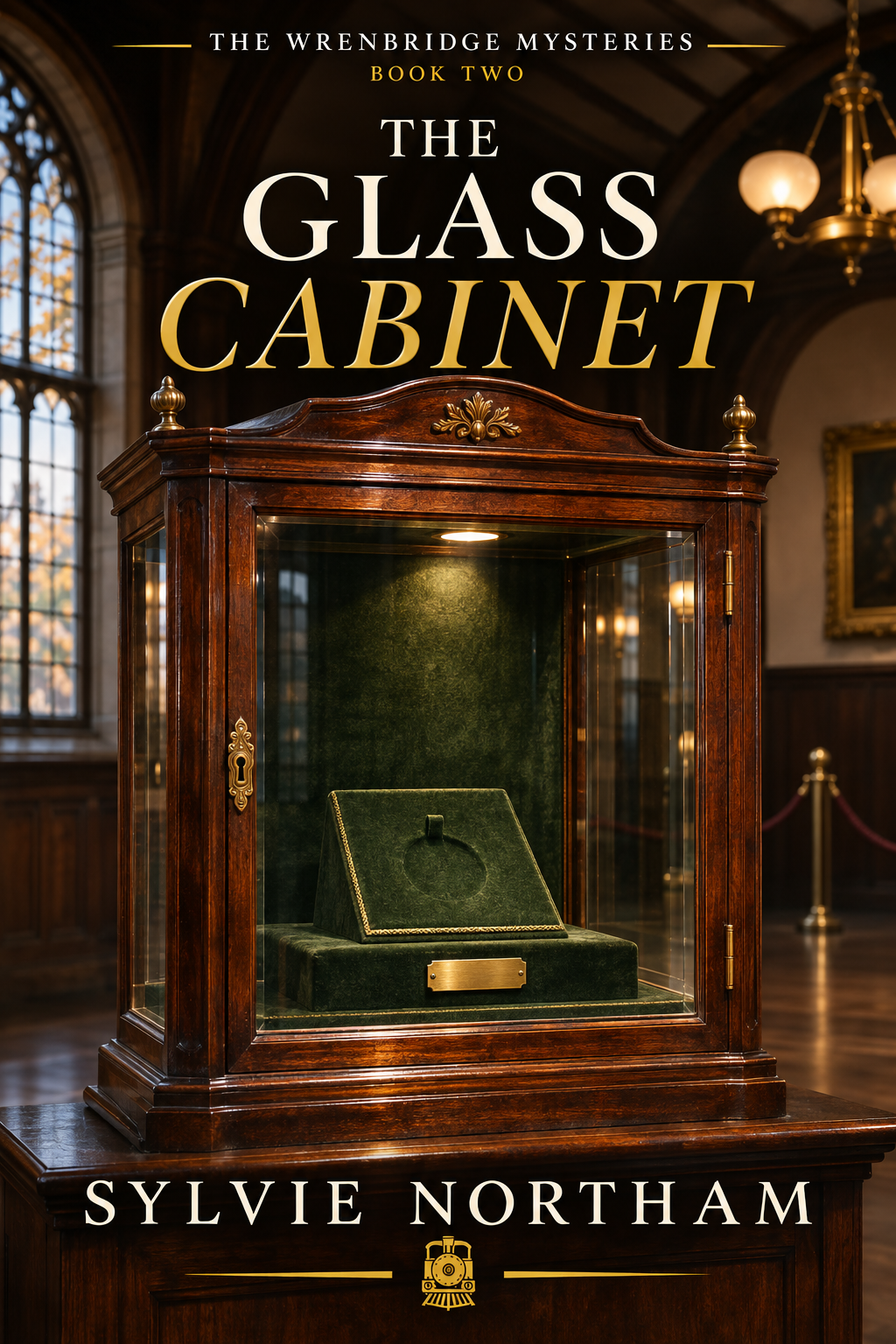
CHAPTER I
The Watch That Stood Still
The first thing Nell Mercer noticed about the watch was that it had stopped.
It was not a fact she could use in a newspaper story. A watch from 1893 could hardly be expected to keep better time than the town hall clock, which had lost seven minutes during the previous week's rain. Still, the small white face beneath the jeweler's glass seemed less an instrument than an accusation. Its slender black hands pointed to a few minutes after eight. Outside, in the November afternoon, Wrenbridge was already preparing to become dark.
“Don't lean,” said the man behind her.
Nell withdrew her hand from the edge of the table. “I haven't touched anything.”
“I know. That's why I said it before you did.”
Martin Quill had a face whose resting expression suggested that he was about to ask someone to stand behind a yellow line. His gray work jacket bore the discreet crest of the Linden Hall Autumn Exhibition. He had spent three years supervising security at county events and enough years before that maintaining public buildings to distrust furniture with a history of being moved.
He softened when he saw the notebook in Nell's hand. “Sorry. They've told me there'll be four hundred people wanting photographs of that thing. I can't stop them all by glaring, but I intend to try.”
“Is it an expensive thing?”
“Ask the people who set the price. I just protect it.”
Nell looked again at the watch. Its gold case was plain from the front, almost stubbornly so. A circular chain loop rose above the crown; below the white enamel dial a tiny seconds hand occupied its own little circle. It resembled an object a conscientious man might have carried to work every day, not something that required a security team. On a card beside it, in black lettering no larger than the newspaper's classified notices, appeared: HALDEN NO. 17, 1893. LOANED BY ADELE HALDEN. ESTIMATED INSURANCE VALUE: $310,000.
She read the amount twice, not because the zeroes surprised her but because they seemed to change the object in front of her. An instrument made to tell the hour had become a way of measuring other people's willingness to protect it.
“Three hundred and ten thousand,” said Owen, arriving at her shoulder. “That's an awful lot to spend being late.”
He carried his camera and a folded set of exhibition floor plans. He had been elsewhere in Linden Hall measuring an alcove for a photograph he wanted to take when the visitors arrived. A former land surveyor, Owen found a building interesting only after he knew how the rooms fitted together. A grand staircase was scenery until he knew where it led.
“Did you find your angle?” Nell asked.
“I found six. Five have a fire extinguisher in the background.”
“It's a public building.”
“Exactly. Public buildings refuse to be picturesque for more than a few minutes at a time.”
They stood in the east gallery of Linden Hall, a former savings bank whose stone facade retained a pair of carved eagles. The main hall lay behind them; a narrow service corridor ran along the gallery's western wall, ending at a preparation room that smelled of lumber and old display cloth. The county had converted the bank into civic rooms twenty years earlier. Most of the brass was original, and much of the wiring was not.
In the center stood an exhibition cabinet made of thick glass and dark walnut. Its base was taller than Owen expected, with a shallow decorative panel at the back and a trim of small brass screws around the lower molding. Green velvet filled the space above the pedestal. For the moment, before the watch went inside, the mount looked like a small stage waiting for an actor.
Owen raised his camera, then lowered it. “Interesting case.”
“What is?”
“The cabinet. It's deeper than the watch needs.”
Martin followed his glance. “The hall borrowed it from a touring collection. I'm told the extra depth helps with humidity.”
“That's possible,” Owen said, without sounding convinced. He moved away to photograph the large window beside the main entrance, where an aging oak was drawing shadows over the marble floor.
Nell had heard that note in his voice before. He had made a career of identifying an unexpected dimension and then refusing to become dramatic about it. She let the question go.
The Chronicle had nearly declined the invitation to cover the show. Nell had spent the previous two weeks correcting a long piece about the railway restoration, and there were afternoons when the thought of another civic celebration made her want to close the office door and read nothing but the school lunch menu. The arrest in the train case was recent. The suspect had been charged, not tried, and there would be months of hearings before anyone could responsibly write an ending to that story. She was determined not to drag it into every new article merely because readers remembered the name.
The newspaper had gained enough subscribers to make the printing bill less frightening. It had not gained enough to hire another reporter. Nell was still taking photographs when Owen was occupied and answering the advertising telephone while writing an editorial. On Thursdays her mother sometimes came upstairs with sandwiches and the kind of practical advice that was easiest to accept from someone who knew exactly how many days were left before rent.
Owen had suggested that they cover the exhibition as a piece of local culture rather than a story about money. He wanted to photograph the craft of restoration: the joints of old furniture, the repair marks on a silver teapot, the surviving lettering on a railroad instrument. Nell had argued that people were the reason those things mattered. A teapot survived because somebody kept it on a shelf when the kitchen was remodeled. A watch remained in a family because somebody remembered who had once carried it. Their disagreement had ended, as most of their useful disagreements did, with both going to work.
Before they entered the gallery, they had stopped in the former bank's lobby to look at the old safekeeping counter. The brass grille had been left in place for atmosphere, though the locked drawers behind it held brochures rather than cash. Owen touched the polished rail and remarked that the building had changed its purpose without changing all its habits.
“People do that,” Nell said.
“You'd know. You still fold your notes the way Dad did.”
She looked at the crease running down the center of her notebook page. Graham Mercer had folded interview notes so he could keep questions on one side and facts on the other. She had adopted the habit as a teenager, then continued it long after the paper acquired better filing software. The gesture had become a way of keeping him close without admitting she needed to.
“Do you want to write the exhibition feature?” she asked.
“No. I want to photograph something beautiful and be told the caption is wrong.”
“Then you've chosen the right occupation.”
They had laughed, and Nell had felt for a moment that their days might settle back into the modest rhythm their father had expected them to inherit. A public opening. A useful feature. A paper delivered on time. Nothing more.
Across the room, Vera Holt was directing two volunteers who had placed a carved wooden chair beneath a panel about regional furniture makers. Vera was the exhibition director, a tall woman of forty-nine whose style of speaking could turn a small clerical problem into an administrative policy. She had fought for three years to bring a proper antiques show to Wrenbridge and was determined that its first evening should resemble an established cultural institution rather than a crowded church sale.
“Move it left,” Vera called. “No, my left. The label needs air.”
A younger woman with a clipboard stepped around the chair. Louise Fenwick, the registrar, was making pencil checks beside every item received on loan. Her hair escaped its clip in small determined strands. She looked up as Nell approached and shook her head before the question had been spoken.
“Nothing's missing.”
“I only wanted the number of exhibitors.”
“Seventy-two in the entire building. Twenty-one in this room, if Mr. March doesn't arrive with another set of brass candlesticks.”
“That sounds personal.”
“He keeps telling me the two are an inseparable set, and they were delivered six hours apart.”
Nell wrote down the numbers. The Chronicle had covered the early planning meetings, the rental arrangement, and the objections of several council members who believed the town had more urgent uses for restoration funds. After the railway murder, questions about how civic projects were financed had become more pointed. The Heritage Trust remained under interim financial oversight, and the restored railway was still closed to passengers. This exhibition belonged to a different committee, with a different bank account, though Nell did not yet trust anyone in Wrenbridge to see that distinction as clearly as the committee hoped.
Vera approached with a smile she had evidently practiced for the press. “A good crowd would be a tonic, don't you think?”
“For whom?”
“For Wrenbridge.”
Nell saw that Vera was serious. “Then tell me what people will get for their ticket.”
“Rooms full of things that have lasted,” Vera said. “In a year when everyone has been so consumed with what broke, that ought to count for something.”
A woman in a tan coat entered from the main hall with a young relative at her elbow. Adele Halden, the watch's owner, was sixty-seven, upright and careful in the way of someone who had never wanted another person to decide when she might sit down. Her niece Kit followed carrying an umbrella and looking mildly displeased by its existence.
“You're early,” Vera told Adele.
“I'm on time,” Adele said. “The watch is early. You asked me to bring it before five.”
She carried a small leather transit case with a carrying handle of braided cord. Felix Arden, the watchmaker responsible for the object's most recent conservation report, came in from the service corridor. He had pale eyebrows, long careful fingers, and the look of a man who had spent so much time near delicate mechanisms that he had begun speaking softly even to adults.
“May we have the room?” he asked Vera. “Five minutes.”
Martin placed a discreet rope across the gallery entrance. Nell and Owen moved toward the window but stayed within sight of the table, with the owners' permission. This was the Chronicle's promised behind-the-scenes photograph. Louise set her clipboard on an empty chair and donned clean gloves. Felix opened the transit case. Adele watched him with an anxiety so private that Nell looked away.
The watch emerged in a velvet-lined tray. Its back was open. Inside the gold lid a small blue enamel swallow swept above a line of lettering Nell could not read. Felix tilted the case to catch the light, and the mark flashed like a minute piece of sky.
“My husband called it the bird that was always going home,” Adele said. “He wore it on Sundays. He wouldn't let it near the lawnmower.”
“It's never been a lawnmower sort of watch,” Felix answered.
Kit sighed. “Aunt Adele, everyone knows the story.”
“Then they can hear it once more.”
Nell glanced at the niece. She looked embarrassed, though it was the embarrassment of family intimacy rather than hostility. There were people who found a familiar anecdote comforting. There were also people who feared it might go on forever.
Felix closed the back with a soft click. Louise read the serial from the paperwork, and Felix confirmed the engraved number beneath the rear cover. He laid the watch into a fitted support. Martin observed the movement and made a small note in his duty log.
A man's voice called from the main hall. “Are we already having the important ceremony without me?”
Julian March stood beyond the rope, carrying a narrow parcel wrapped in brown paper. At forty-three he had the easy elegance of a man who knew what his clothes ought to cost and how to make people believe they had cost a little more. His antique shop near the lake had supplied more than one object in the exhibition. Nell had interviewed him about a collection of lighthouse lamps that turned out to be ordinary harbor lights, a distinction he had accepted with less grace than he wore now.
“Felix has the honor,” Vera told him. “You have three minutes before I turn you into a volunteer.”
Julian looked at the transit case. “Beautiful piece, Adele.”
“You've made your opinion of it clear,” she said.
He gave a rueful smile. “I asked whether you might consider selling. That's not a crime.”
“No,” Adele said. “Neither is refusing.”
Martin cleared his throat. “If everyone who doesn't need to be here would step back, I'd appreciate it.”
Julian raised both palms and went toward the candlesticks. Nell watched him cross to the far table, where he unwrapped his parcel and discovered that Louise had already placed a pair of brass objects beneath a card that said PAIR.
There were two things she wanted in her story now. One was the blue swallow, small and human among all this expensive care. The other was Martin Quill's mild but unmistakable insistence that people give him room to do his job. She had reported long enough to know that a certain kind of confidence had very little to do with authority. Martin possessed authority because he knew when a door ought to stay closed.
At five past five, Louise entered the serial number on her form and photographed the watch on its mount. Felix stepped away. Martin watched Vera close the glass door and press a numbered strip of tamper-evident tape across the latch. Nothing about the act was theatrical. When it was over, the watch occupied the center of a little green field, and the room became quite ordinary again.
Owen took his picture. Behind the glass the stopped hands retained their impossible confidence. They seemed to say that the evening might begin whenever everyone else was ready.
No one in the room yet understood how many of them would spend the next week arguing about a cabinet that appeared never to have opened.
CHAPTER II
An Ordinary Kind of Glass
The invitation said six o'clock, but people began arriving at Linden Hall at twenty minutes to the hour, bringing the brisk air with them and filling the marble entrance with the rustle of coats. Someone had hired a pianist who kept losing his place in a piece Nell almost recognized. The scent of furniture polish mingled with wet wool and coffee. Outside, the streetlights came on while a group of schoolchildren pressed their faces against the bank's old plate-glass windows to look at the chandeliers.
Owen liked the crowd because it supplied scale. In an empty room, a cabinet could be photographed as a cabinet, and that was the end of it. With people gathered around it, the cabinet became something else: an object they approached, pointed toward, admired, and moved away from. He stood behind a low velvet rope that kept visitors from touching the display and watched the reflections collecting on the glass.
“There's a problem with your picture,” Nell said when she found him.
“There's a problem with the room.”
He showed her the back of the camera. The watch occupied a small gold oval amid reflections of the chandelier. Depending on the angle, a visitor near the window appeared to be standing inside the cabinet; someone by the doorway became a pale ghost floating over the velvet.
“You could solve that with a filter,” Nell suggested.
“I could. I could also move three feet to the left.”
“Why haven't you?”
“Because then the plinth looks crooked. It isn't. It's a perspective thing.”
He indicated the polished base beneath the glass. From the side, the green mount looked unusually wide, with a faint dark line that might have been a seam. A narrow brass point showed near its lower edge, scarcely visible beneath the cloth. Owen photographed it without knowing why. He had learned to trust the impulse to record a measurement before interpreting it.
At the entrance, Martin Quill was checking names against an admission sheet, his voice controlled and pleasant. A volunteer with a yellow ribbon asked if the watch was really worth the amount on the label. Martin directed her to Vera, who was better equipped to discuss valuations than he was. He then asked a man with a large shoulder bag to leave it in the supervised coat area.
“Are you telling me you think I'll steal something?” the man demanded.
“No,” Martin answered. “I'm telling you the rules are the same for everyone.”
Nell heard Owen laugh quietly. “He's not going to be popular.”
“People like him better after they've had a bad evening,” she said.
The east gallery filled with a succession of small conversations. Felix Arden stood beside a case of old surveying instruments, explaining to an engineer why the best tools were sometimes the ones that had been repaired most often. Kit Halden spoke to a former city councilwoman about the possibility of a permanent local-history display. Adele watched them from a bench with a paper cup in both hands.
Nell sat down beside her. “I'm trying to write about a person rather than a price tag,” she said.
“Then you're already improving on most of the questions I've been asked.”
“Would your husband have lent the watch?”
Adele thought for a moment. “Daniel believed things were made to be used. He would have carried it here in his pocket and asked whether the exhibition had a clock that kept time.”
“Does the watch still run?”
“Felix says it could, with careful winding. We leave it stopped so no one is tempted to show that it works. It's less dangerous for everyone to admire it as an object.”
“Does Kit agree?”
“My niece thinks I should sell it before its value becomes an argument after my death.” Adele gave Nell a sideways look. “That isn't an unreasonable opinion. It simply isn't mine.”
In the center of the gallery a young carpenter was tightening the brass screw on a reading stand. His name tag said CALVIN MOSS. Owen recognized him from a job at the former railway office, where Calvin had built a cabinet for a scale model. Owen asked about the glass case's base.
“Borrowed fixture,” Calvin said. “I checked the floor load and the locks. Why?”
“It looks like a double mount.”
Calvin frowned, studying the walnut panel. “Old exhibition furniture gets altered. You build a case for dolls, use it for jewelry ten years later, and someone expects the wood to forget what it was.”
“Dolls?”
“I think so. They sent a load of photographs from the collection. I hardly looked at the furniture history. My job was making sure it wouldn't fall over.”
Owen turned the remark over in his mind. He had seen bad design cause enough injuries to know that safety checks often concentrated on the dangers people could picture. A case that stood upright and a lock that latched might satisfy a great many forms. He made a note in his phone to ask Calvin for the supplier's name, more out of curiosity than suspicion.
A volunteer passed with a tray of tiny quiches. Owen took one and regretted it immediately. Nell saw his expression and knew, without asking, that he had encountered something pretending to be pastry.
“Do you want the rest of mine?” she said.
“I'd rather take another photograph.”
Julian March had made himself a little island of conversation near the west wall. A jeweler from Grayhaven and two well-dressed visitors were listening to him explain why a damaged object could be more desirable than a perfect one. He had a talent for appearing candid about the parts of his business most people would prefer to conceal. When Nell approached, he welcomed her with more warmth than their previous interview had earned.
“Here comes the woman who exposed my lamps,” he said.
“They were nice lamps.”
“They weren't the…
“Exac…
Keep reading The Glass Cabinet
You've reached the end of the free preview. Purchase this eBook for permanent access in your Novel Thunder Library, or read it with an eligible Novel Thunder subscription.
Buy eBook — $2.99