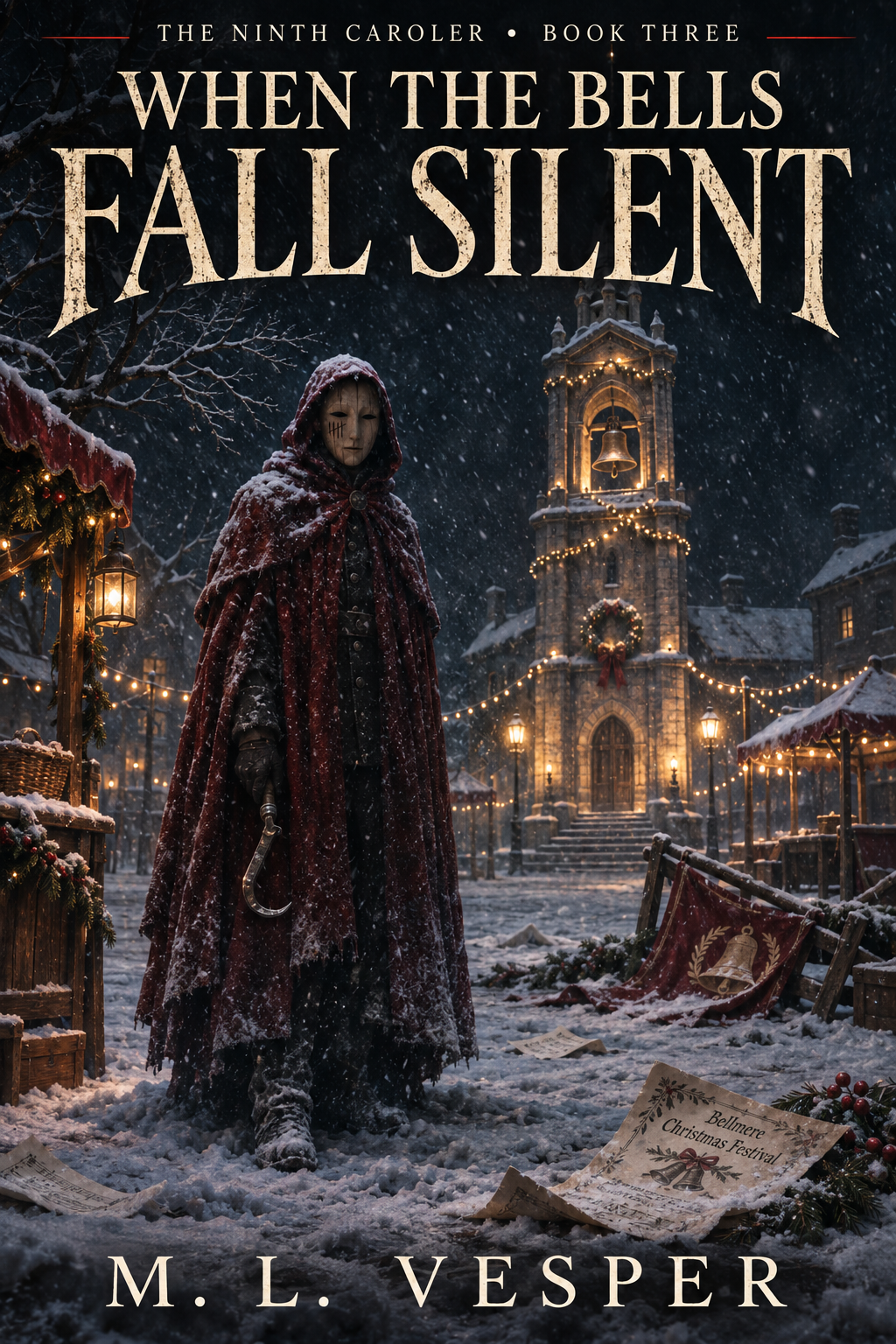
CHAPTER 1
The Bell That Wouldn't Ring
The first thing Ava Mercer noticed about Bellmere was the new paint on the doors.
The municipal hall had been a soot-colored building when she last saw it. Now the double entrance shone a respectable green, the brass handles polished until they reflected the festival lights strung between the courthouse and the old bell tower. Someone had hung a wreath over the lintel. Someone else had positioned a wooden sign beside the steps: THE BELLS OF BELLMERE — FORTY YEARS OF CHRISTMAS TRADITION.
Forty years. Ava stopped beneath the sign long enough to make certain she was reading it correctly.
A teenager had disappeared forty Christmases ago because the people responsible for him had kept a door shut. The next two Christmases had ended with nine more people dead. Ava knew the exact number, not because she enjoyed keeping it but because families had been obliged to correct newspaper accounts that turned casualties into a single, imprecise catastrophe.
She crossed to the hall without taking a photograph.
Inside, the heating had been set too high. Wet coats gave the corridor the smell of wool and radiator dust. A volunteer held a cardboard box of paper programs against her hip while trying to open a door with her elbow. Ava took the box from her, waited for the girl to work the latch, and returned it on the other side.
“Are you here for the safety meeting?” the girl asked.
“I am.”
“Downstairs. Mayor March is already there.”
Ava thanked her. The volunteer wore a badge identifying her as a high-school student. She could not have been much older than Samuel Pike had been when he stood outside Caldwell House with his borrowed cloak and thin gloves.
Ava descended the municipal hall's narrow staircase, counting the places where an evacuation would bunch: the turn at the landing, the water cooler protruding into the corridor, the heavy door that opened inward across the bottom step. She had not meant to resume this kind of work after Caldwell House. For months, the thought of evaluating exits made her hands sweat. But the county had asked her to review the festival's temporary operations because she understood crowd movement and because she would not be persuaded to ignore a failed latch for the sake of an attractive photograph.
The second reason, she suspected, mattered more.
In the committee room, a man in a fleece jacket was drawing arrows across a printed square map. A woman in a slate-colored suit stood beside him, listening with the expression of someone who was trying not to show how many other meetings she had that morning.
“Ava Mercer,” the woman said, turning. “Elise March. Thank you for coming.”
The mayor was younger than the stone building suggested. Her handshake was brisk, neither warm nor defensive. Ava appreciated that. People who knew the Caldwell House case tended to touch her arm or speak as though volume might injure her.
“This is our fire chief, Leena Ortiz,” March continued. “And Caleb Dwyer, who knows every cable we've run through the square.”
Caleb raised one hand without putting down his pencil. He was in his forties, broad through the shoulders and dressed for work rather than ceremony. A scratch ran along his cheekbone. His drawing showed the town square as a series of rectangles, with arrows leading away from the bell tower toward three streets.
“Tell me which of these exits you trust,” Ava said.
“None until I've walked them this afternoon.” Caleb smiled. “I was hoping you'd say the same.”
Leena Ortiz slid the map across the table. “We can clear the square in under eight minutes if the west lane stays open. The market vendors are trying to use it for storage. That's the argument we're having today.”
“Then they can't use it for storage.”
“Thank you,” Leena said. “Could you say that at the next four meetings too?”
March folded her arms. “The vendors paid for those positions. We're working out an alternative.”
“An alternative is fine,” Ava said. “A blocked exit isn't.”
The mayor looked at her for a moment, then wrote something on her legal pad. Ava did not know whether it was an instruction or a reminder that the new consultant would be difficult.
A diagram of the old bell tower hung on the wall. The tower was attached to a brick maintenance annex behind the municipal hall. A steel service door opened from the north alley into the annex. Inside, a narrow masonry stair climbed past a small clock room to the bell chamber. The bell itself hung from a timber frame reinforced with steel plates. For ceremonial ringing, a rope descended through a protected shaft into the lower clock room, where a keeper could work it without entering the chamber.
“People will gather under the tower at nine on Christmas Eve,” March said. “One hundred years since the bell was installed. Forty since the town began the winter-song ceremony.”
Ava glanced back at the banner visible through the committee-room window. “The two anniversaries don't seem to agree.”
March followed her gaze. “The bell has older roots. The current program is forty years old.”
“Did it start the year Samuel Pike disappeared?”
Silence changed the room. Caleb's pencil stopped. Leena held Ava's gaze rather than looking at the mayor.
“The first organized Christmas Eve bell ceremony was that year,” March said. “The council's official history lists a choir of eight. We're aware that record has been challenged.”
“It hasn't merely been challenged.”
“I know about the testimony. I know about Caldwell House and the train.” March's voice remained level. “We have a committee reviewing what needs to be corrected. But thousands of people come to this festival. We can't cancel every part of town life while the records are examined.”
Ava kept her hands open on the table. “I'm not asking you to cancel the festival. I'm asking you not to build a public program around a factual claim you know may be false.”
“Then the anniversary wording can come down,” Leena said.
Caleb nodded toward the map. “I'll get someone to take the banner off the hall. I hung it. I'll take it down.”
March looked from one of them to the other. “After we finish the safety discussion.”
Ava could have argued about the order. She had spent the past two years learning that an argument sometimes served only to make its participants feel as though they had acted. Instead she turned the diagram over and started marking a second evacuation route, one that did not depend on people climbing steps toward the tower to see what had made a noise.
They talked for nearly an hour. Caleb described a temporary steel crowd barrier separating the market stalls from the annex alley. Leena confirmed the fire service could remove it from either side. Ava insisted on testing that claim while volunteers were present, not with an empty street and a photographer. The bell keeper's access door had a push bar on its public side and a key-operated cylinder on the service side. The mayor asked whether it could be locked during the ceremony. Ava replied that any door included in an evacuation plan had to open from the escape side without a key, regardless of which officials found that inconvenient.
By noon, they had a workable list. Leena would inspect the tower stair and certify the closure of its upper gallery, where the public had no business standing. Caleb would demonstrate the hand-chain release on the maintenance annex's sectional fire shutter, installed years earlier to separate an old electrical workshop from the stair. Ava would walk every route with two volunteers moving at ordinary walking speed. March would instruct festival staff not to use the north alley for deliveries after dusk.
“That's a lot of precautions for a bell concert,” the mayor said when the others had gone.
“Most of them are precautions for a crowd.”
“And the others?”
Ava looked through the lower window toward the square. Above the bright stalls rose the bell tower, a narrow dark structure outlined against snow clouds. There was nothing visibly wrong with it. That was the trouble with danger. Sometimes the only sign was a detail someone had decided not to examine.
“Those are precautions for someone who has been attacked twice in two years,” she said. “Once personally. Once in the place where the people I care about were trying to survive.”
March's face softened, but she did not reach across the table. “Do you think he'll come here?”
“I don't know. I know he moves through real doors. I know winter gives him a reason to be where people are gathered. And I know telling yourself he's only a story doesn't improve a lock.”
Outside, the volunteer from the staircase carried another box of programs across the square. She had both arms full and was trying to keep a scarf from falling off her shoulder. A man in a wool hat stopped to hold the door for her. She smiled with obvious relief.
Ava watched until the girl was safely inside.
“I don't need the town to believe every part of what happened at Caldwell House,” she told the mayor. “I need it to believe people when they say a door is unsafe.”
By the time she stepped back outside, an electrician was testing the bell's controls. The rope descended through the clock room, beyond public view. A tiny movement traveled through the old machinery, and the bell gave one flat, imperfect note.
Caleb stood in the open annex doorway and listened, frowning. He waved to a colleague inside to stop. A second note did not follow.
He saw Ava watching and called, “It's a tired bearing, not a curse. We'll have it working by the ceremony.”
“I'd like to see the inspection report,” Ava said.
“You'll have it.” He pointed to the north alley. “And I'll show you the route out of the workshop. Nobody gets left behind on my shift.”
It was an ordinary promise made by an ordinary man, which was what gave it weight. Ava followed him around the corner, where melted snow ran black along the curb. The alley opened behind the tower into the municipal service yard. Beside the annex door she noticed nine small dents in a strip of weathered painted metal.
They might have been made years ago by a delivery cart. Caleb passed them without looking.
Ava put her fingers against the first dent, then withdrew them. She would not build a theory from damage she could not date.
Across the square, a woman in a dark coat stood beside the war memorial with a notebook in one hand. She looked up when Ava emerged from the alley.
Nora Keene crossed the street without hurrying. Her hair had been caught by the wind and she had stopped trying to repair it.
“Are you safe?” Ava asked before anything else.
Nora gave a tired half-smile. “I was going to ask you the same thing.”
They had spoken by phone for almost a year, sometimes for hours, but had never stood together without an investigator or an editor nearby. Nora held out her hand. Ava took it. Both women hesitated, then embraced briefly, two people who knew that the ordinary rules of an introduction did not quite apply.
“I found something,” Nora said as they drew apart.
“You always do.”
“This time I can show you where the paper goes next.” She looked toward the tower, then at the banner on the municipal hall. “And the town isn't going to like it.”
Ava glanced at the green doors. The volunteer had disappeared inside. The brass handles caught the pale afternoon light.
“Then we'd better make sure it hears us,” she said.
CHAPTER 2
The Receipt and the Register
Nora Keene had spent eleven months discovering how many different kinds of paper could record a thing that never happened.
A freight waybill could say a wagon arrived at a warehouse. A municipal account book could say the same wagon contained donated coal. A public report could say the coal had been distributed to families who signed for it. Each record could look legitimate on its own. The difficulty was persuading them to describe the same winter.
The county records room occupied a former courtroom on the second floor of the administration building. It smelled of old binding glue and recent paint. Deputy investigator Rosa Delaney had reserved a table away from the public counter and arranged three archival boxes there. She stood when Nora entered, moving a chair out with her foot.
“Before you ask,” Rosa said, “these aren't my copies to give away. You can inspect the authorized set and cite what the county has released. The originals stay in custody.”
“I'd rather have a good chain of custody than a dramatic photograph.”
“After last Christmas, I hoped you would.”
Nora set her bag down. Last Christmas had left her with an old fracture in one of her fingers that ached when weather changed. It also left four people dead aboard the Northlight holiday train. She could still see Owen Reed leaning over his service diagram, Celia Frost guarding her leather case, Rowan Finch pushing a piece of display metal into a doorway to help someone else, Bennett Shaw turning away from a hand that could have saved him. She had written the published account with care. It had not prevented the names from becoming search terms beside photographs of a masked man.
Rosa opened the first box. “Let's start with what you already know.”
The railway document was a carbon duplicate freight waybill from the winter Samuel Pike disappeared. Its destination field had been changed in red ink. The original entry named the municipal distribution depot; the correction directed the wagon to the Caldwell service siding. Two initials appeared beside the correction: E.V. Rowan Finch had warned Nora that initials alone were not proof of a particular signatory. She had not forgotten.
“The waybill records a changed destination,” Nora said. “It doesn't by itself prove who authorized it.”
“Correct.” Rosa placed a transparent sleeve beside it. “This is the corresponding entry from the rail dispatch register, recently recovered in an uncatalogued volume at the regional depot.”
The register was larger, written in two columns by a hand careful enough to be read forty years later. Wagon number, date, originating yard, destination, and special instruction had separate headings. A line on the date of Samuel's final rehearsal referred to the same wagon number. The destination field had been corrected. In the margin was a clerk's note: AUTHORITY PRODUCED, WINTER RELIEF COMMITTEE, E. VALE. The paper bore an impressed railway receiving stamp that matched the next dated entry.
Nora read it twice.
“Who found the register?”
“A retired depot clerk who recognized the number after your article. We checked the accession trail, photographed every page before removal, and had two independent examiners evaluate the ink and printing. The stamp is consistent with other entries in that volume. That's as far as the technical report goes.”
“Did he know anything about Samuel?”
“Not personally. He was a child at the time.” Rosa moved a second box between them. “This is the municipal side.”
The Bellmere Winter Relief Fund's public annual report had listed the wagon as delivered to the town warehouse. Attached was a schedule of household distributions: bags of coal, winter coats, and food parcels. The printed totals had once been read aloud at an end-of-year council meeting. They were the figures Bellmere used in anniversary brochures, tourist displays, and school lessons about its charitable traditions.
Beside them lay a receiving ledger recovered from a storage room beneath the old municipal boiler plant. The entries were unglamorous: dates, families, quantities, signatures. For that wagon number, there were no household signatures. The page that should have carried them contained a single line in a different hand: HELD FOR DIRECTOR'S DISTRIBUTION.
“No names of families,” Nora said.
“No.”
“But the annual report shows twenty-four deliveries.”
“Twenty-four claimed. The warehouse record doesn't support them.”
Nora looked at the neat, even figures. Her father had once received a relief parcel when he lost his job. He had turned the printed label inward before putting the food away, as though gratitude ought to be private. She wondered how many parents in Bellmere had been told that their delivery was recorded even when nothing arrived.
“There's a third record,” Rosa said. “I want you to understand why we don't call the entire fraud proven yet.”
She opened a folder of payment vouchers. The Winter Relief Fund had issued reimbursements to Caldwell House for storage, fuel transport, and emergency accommodation. Some services had a plausible charitable purpose; the estate had once housed relief committee meetings. But several vouchers coincided with invoices for repairs to the Caldwell conservatory, boiler pipes, and guest wing. One was marked in pencil with an estimate payable to the estate's maintenance contractor, not the town warehouse.
“Those are expenditures,” Nora said. “Still not necessarily diversion unless we establish the receiving party and the goods.”
“Right. We're matching bank records and the contractor's surviving invoice books. Some were held by a family business that closed twenty years ago. I won't pretend there aren't gaps.”
Rosa pulled up a chair. Her hair was pinned back with the practical indifference of someone who spent more time in evidence rooms than in public hearings. “A court can test provenance. A festival audience cannot. So if you speak about this tonight, tell them what is verified and what's still being examined.”
“I'm not speaking tonight.”
“Someone has invited you to.”
Nora looked at her.
“The town's committee called this morning,” Rosa said. “They want a documentary exhibit to accompany the carol program. A corrected history panel. They asked if you'd read the summary. I said you'd probably insist on checking it.”
“Who wrote the summary?”
“That's part of the problem.”
Rosa slid a photocopy across the table. Beneath the heading THE FIRST BELLS OF BELLMERE, the proposed text said that eight student singers had been sheltered at Caldwell House after an unexpected storm and that a ninth student, Samuel Pike, had departed before the weather worsened. It described later…
Nora felt…
“…
Keep reading When the Bells Fall Silent
You've reached the end of the free preview. Purchase this eBook for permanent access in your Novel Thunder Library, or read it with an eligible Novel Thunder subscription.
Buy eBook — $2.99