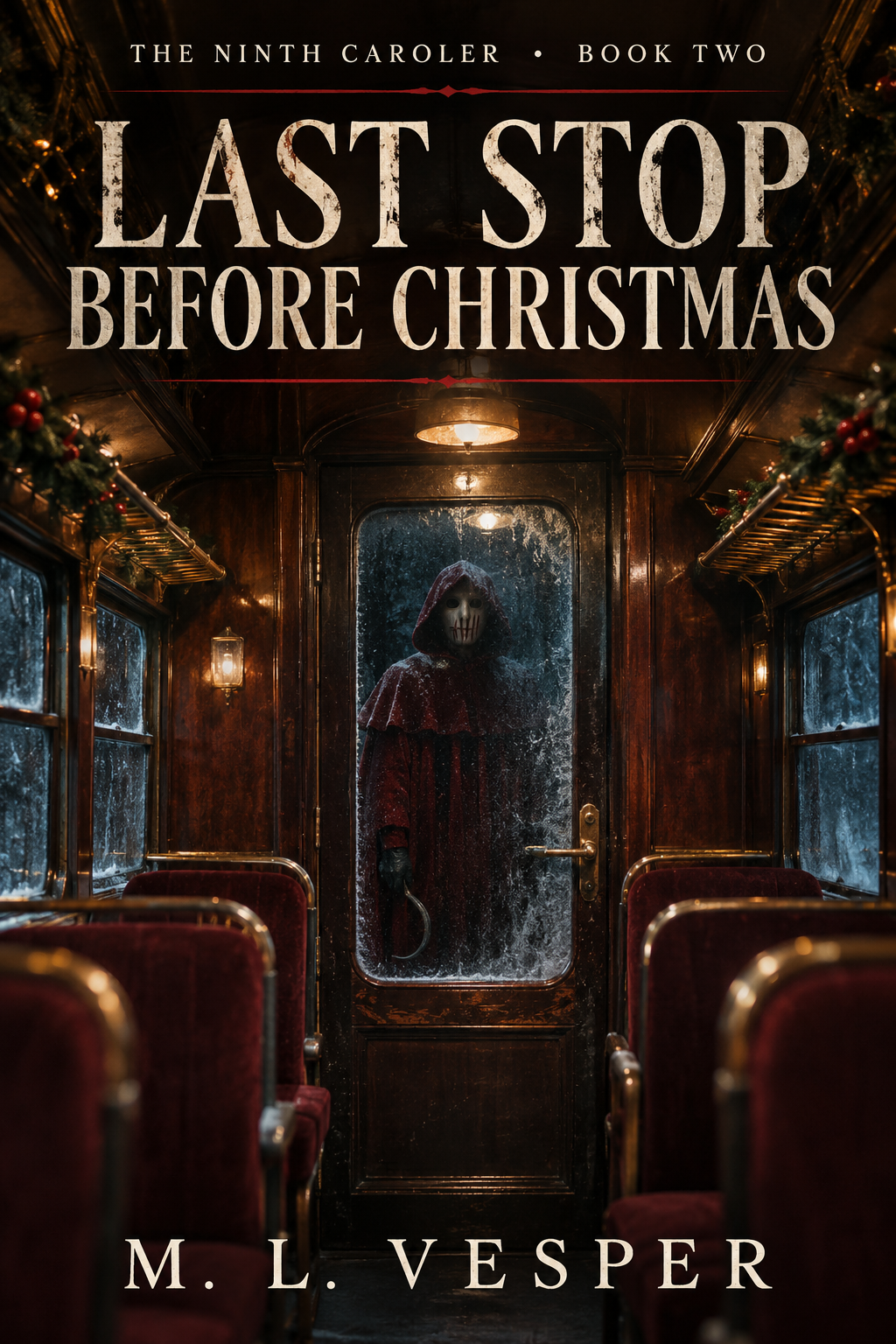
THE NINTH CAROLER · BOOK TWO
LAST STOP BEFORE CHRISTMAS
M. L. VESPER
CHAPTER ONE
The Press Ticket
The first photograph Nora Keene saw in Bellmere looked like an advertisement for a place where five people had died.
It hung behind the counter of the station café, framed beneath a string of red lights: Caldwell House under a clean white roof, every window bright, the stone steps empty. Across the bottom, in gold letters added by the photographer, someone had printed A CHRISTMAS TO REMEMBER.
The photograph was older than the murders. That did not make it easier to look at.
Nora set her overnight bag between her boots and turned her coffee so the cardboard seam faced away from her palm. The train was not due to board for another forty minutes on Christmas Eve. Outside, wet snow crossed the station windows in short horizontal lines. The street beyond the platform had the drained, afternoon color of a road after the sun had stopped trying.
On the table lay a folded article with her byline at the top. It had been published eleven months earlier, after the hearing in which Ava Mercer described how five people died at Caldwell House. The original headline had been the editor’s choice: CHRISTMAS MASSACRE AT HISTORIC ESTATE. Nora had objected, then let it pass. She could still remember the line she ought to have fought harder to change.
A masked assailant, reportedly associated with a decades-old local legend.
Reportedly associated. The phrase made it sound as though a dead sixteen-year-old boy had caused a problem for the tourism office.
Nora folded the page again.
She had spent nearly a year interviewing anyone willing to speak about Samuel Pike, the ninth singer deleted from a choir program thirty-eight Christmases before the murders. Most people were happy to tell her what they remembered about the weather. Far fewer would discuss who had shut the door.
In her bag were copies of the surviving pages from that program, the photograph of the nine teenagers, and an excerpt from Ruth Danner’s recorded statement, released after a judge allowed its use in the inquiry. Ruth herself had died inside the house. In her voice, the word outside sounded like an accusation against the person saying it.
Nora had not come back for another article about a haunted mansion. She wanted to learn why a town kept repairing its official memory whenever something ugly showed through.
A message arrived on her phone from the editor who had commissioned the piece. His instructions were two sentences long: Look for a strong holiday angle. Avoid sensationalizing the Caldwell story unless something new is on the record. Nora read them twice. The first instruction belonged to a website that needed Christmas copy; the second belonged to a man who had once stayed with her in the office until two in the morning, helping her correct an error he had not made. Both were sincere. That was what made the work hard.
She replied that the railway restoration would be the main story and she would separately verify any historical claims. She did not promise an exclusive. Last Christmas had already taught her how often the word exclusive meant no one else had been allowed enough time to ask a second question.
The barista came to clear a nearby table. He looked at the folded newspaper beside her notebook, then at the photograph of Caldwell House above the counter.
“People still come here to see that place,” he said. “They drive up the road and take pictures from the gate. The county put a fence across the approach after the inquiry. Doesn’t stop them from trying.”
“Did you know anyone who worked there?”
He hesitated. “Leah Moss used to come for coffee when she was preparing for that reopening. She’d ask whether we had any of the orange biscuits left. Always bought two, even when there was only one person with her.” He gathered a cup and set it into a tray. “You going to put her in something?”
“Not without talking to her family first.”
“Good.” He looked past Nora at the train platform. “They keep using the house as a picture in the paper. I don’t think it belongs to the house anymore.”
The sentence stayed with her after he went. Nora had spent a year trying to reconstruct a truth from records that had been copied, corrected, denied, and occasionally destroyed. But she had spent less time learning the small habits of the people whose deaths forced those records into public view. An excellent investigation could still make its subjects disappear if it allowed the institution to occupy all the space.
She opened a page in her notebook, wrote Leah Moss’s name, and beneath it added the coffee shop and the orange biscuits. The detail would not necessarily appear in print. She wanted it in the record because somebody remembered her alive.
A train horn sounded far down the line, low enough to turn the water in her cup into a trembling circle. A child on the station side of the windows lifted a hand and waved toward the unseen locomotive. Nora watched the gesture and wondered how many children in Bellmere had learned to associate the tracks with Christmas. The public account of the town’s past spoke constantly of gifts, charity, generous donors. It rarely mentioned the people expected to thank them.
Her own father had worked night shifts through most of the holidays she remembered. The Christmas he lost his job, a relief organization delivered a box of canned vegetables to the apartment. She could still recall the label on the lid, written in cheerful red letters, and how he had folded it under before putting the food away. It was not shame he had wanted to hide, she understood now; it was the idea that somebody else might claim ownership of his gratitude.
She put the notebook aside when she heard approaching footsteps. No useful inquiry began by assuming it already knew whose version of the past would matter most.
A woman in a navy wool coat stopped beside the table. She carried a clipboard and had a pale line across the bridge of her nose where a pair of glasses usually rested.
“Nora Keene?”
“Yes.”
“Clara Wren. We spoke Tuesday.” She offered a hand, then noticed the article. Her expression changed only slightly. “I didn’t know you were bringing that into the café.”
“I wasn’t planning to display it.”
“People who work here knew some of the victims.”
Nora slipped the folded page into her notebook. “So did the people who answered my questions.”
Clara took the seat opposite without removing her coat. She was thirty-two, younger than Nora had expected from the confident voice on the telephone. The Bellmere Rail Heritage Trust had restored three passenger cars and a museum baggage car over six years and needed this year’s Christmas run to pay for a roof replacement. The trip was private: donors, two invited guests, and a small crew. Clara had granted Nora a seat because she had promised a story about the preservation project rather than another piece about Caldwell House.
“I’m here to write about the train,” Nora said.
“You have other questions.”
“I can have both.”
“I suppose you can.” Clara put the clipboard on the table. “I’ll introduce you to the engineer and conductor. There’ll be a hot supper in the Northlight car. When we stop at Alder Cut, the crew will make the usual inspection before the return trip. The mountain section can be rough in this weather.”
Nora looked outside. “That sounded more reassuring on the phone.”
“The weather service upgraded the warning an hour ago. Malik wants us back before midnight, and so do I. If he says we turn around early, we turn around.”
It was the first thing Clara had said that Nora found unequivocally reassuring. A person who was willing to disappoint guests could often be trusted with safety.
Behind Clara, a bell on the café door sounded. An older woman entered with a red scarf tucked carefully beneath her collar. She stopped when she saw Nora’s notebook. Something in her face went completely still.
“Mum,” Clara said, rising. “This is Nora Keene.”
The woman looked at Nora’s hand but did not take it. “I know her name.”
“Iris Wren,” Nora said. She had seen it once before: handwritten on an old rehearsal sheet, among the eight names that survived the official program. “Thank you for coming.”
“I’m here for my daughter’s train.”
Clara’s jaw tightened. “Mum, please.”
Iris surveyed the café and the photograph above the counter. She had a practical face, fine-boned and unadorned, the face of someone who had spent many years deciding which thoughts could safely be spoken. “I saw your article.”
“Some of it was incomplete.”
“Most things are.”
Nora could have asked the obvious question. She had bought a ticket partly for the chance to stand close enough to ask it. But the woman was staring toward the café window, and Nora noticed a thin tremor in her fingers where they gripped the strap of her handbag.
“You’re not obliged to talk to me,” Nora said.
Iris gave a small, almost suspicious nod. Clara looked briefly grateful.
From the platform came a low mechanical rumble. It traveled through the glass, settled in the café cups, and became a sound Nora could feel in the soles of her feet.
“That’s the locomotive,” Clara said. “We should board before the wind picks up.”
They crossed the concourse together. The station had once served freight trains supplying mills farther up the valley. Now the old loading doors opened onto a short sheltered platform where volunteers had hung paper stars beneath the iron canopy. At the end of the train a luggage hatch stood open. A young man in an orange maintenance jacket was stacking sealed crates inside under a work lamp. He climbed down, disappeared behind a cart, and returned carrying a coil of heavy cable.
Clara lifted a hand. “Owen, after you finish the power check, latch the Parcel door. I don’t want somebody wandering through the displays.”
“It’s on my list,” he called back.
Iris stopped beneath the canopy. Beyond it, black rails passed between snow-heavy pines. The little red lights along the platform canopy blinked against the encroaching dark.
“You used to ride this train?” Nora asked.
“Not this one. The old freight line.” Iris looked toward the rear car. “They carried coal up there when I was a girl. Whole wagons of it, in winter.”
“For the mills?”
“For whoever paid.” She turned to Clara. “Which car is mine?”
“Lantern. The seats by the left window. I’ll put your coat away.”
They moved down the platform. Nora took one final look at the baggage hatch. It was still open. A strand of dark red fabric showed briefly behind the freight cart, then was hidden when Owen pushed the cart across the doorway.
It might have been a decoration. Every window in the station was dressed for Christmas. Nora wrote nothing about it.
At the coach steps, the conductor checked the ticket on her phone against a printed list.
“Nora Keene,” he said. “Welcome aboard. You picked a cold night for an exclusive.”
“Do you say that to everyone?”
“Only the people who’ve paid for it.”
He offered a weathered, steady hand. Nora took it, stepped into the warm carriage, and heard the door shut behind her with a weighty metallic click.
For a moment she remembered Ava Mercer’s testimony: the sound of a bolt thrown into place, then someone striking the other side.
She told herself that a closed door could mean safety as easily as danger. The distinction ought to depend on who was permitted to open it.
CHAPTER TWO
All Aboard
The train smelled of steam heat, varnished wood, and orange peel. The last scent came from a dish of pomanders on the first table in the Evergreen car, though the heating system itself was an old electric installation fed from the locomotive. Nora had asked the conductor before she hung her coat. The man seemed pleased that somebody cared how the train worked.
“The diesel provides our head-end power,” Leon Price explained, pointing up toward the ceiling lights. “If Malik has to isolate it, you’ll get emergency lamps for a while. There’s no need to think of us as a house with an extension cord stretched through the forest.”
“And the doors?”
“Manual. Heavy. Two at each vestibule, one at the end of each car. Nobody is walking through a wall, and nobody is walking through a locked one without making a considerable nuisance of himself.”
He smiled when he said it. The smile belonged to an older man who had made a career of putting strangers at ease in places that moved.
They passed into the Northlight dining car, where twelve lamps glowed over polished tables. A narrow service counter occupied the north end. A woman in a green apron was checking the lids of insulated containers while keeping one eye on a pot of coffee secured inside a metal frame.
“Jo Alvarez,” Leon said. “Jo keeps us fed and stops Bennett Shaw from taking all the shortbread.”
“I heard that,” a man’s voice said from farther down the car.
Jo raised her eyebrows. “He was meant to.”
Nora introduced herself. Jo shook her hand with a grip warmed by hot dishes. She pointed out the emergency medical bag, the portable water containers, and the little fire extinguishers tucked into brackets. None of it had been arranged for show.
“Can I help?” Nora asked.
“You can stay out of the galley until the train is moving.” Jo shifted a tray away from the edge of the counter. “And if you need anything, say it before you’re freezing. People get shy when they’re frightened.”
Nora carried that observation with her into Lantern, the last passenger coach. Its windows were larger than those of the other cars, framed by carved wooden arches. At the far end, a steel vestibule door led to the Parcel car. A brass plate beside it read AUTHORIZED STAFF ONLY. Leon had also shown Nora a heavy sliding fire partition in Evergreen, usually left open but able to separate the front parlor from the dining-car passage if a corridor fire ever broke out.
A man in a tweed coat was examining a photograph mounted near the door. He looked up at Nora with the expression of a lecturer interrupted at the end of a thought.
“Dr. Rowan Finch,” he said. “Clara tells me you work for a magazine.”
“When they can afford me.”
“Ah. Then we share a profession.” He tapped the display. “The rail trust keeps the old freight invoices because the railway moved half this valley’s winter supplies. Most of the museum pieces are unromantic. That’s why I like them.”
In the frame, men in flat caps stood in front of a small goods depot holding sacks of something too dark to identify. A timetable had been placed beside it. Behind glass on the opposite wall lay a series of freight receipts, each with handwritten initials and destination marks.
“A cabinet full of stories nobody bothered to finish,” Rowan said.
Celia Frost joined them, smelling faintly of a floral perfume. She wore a silver pendant shaped like a railway wheel and carried a narrow leather case she kept close against her body.
“Some of those pieces have value,” she said. “Actual value, not just the sentimental variety.”
“Celia manages private collections,” Rowan told Nora. “She thinks every document wants to be sold.”
“I think every document wants to be kept somewhere dry. Selling can pay for dry.”
The remark might have been friendly if Celia had smiled. Instead she stepped toward the glass cabinet and looked at the printed dates on the dockets.
At the windows sat Iris Wren, her handbag on her lap, and a younger woman with bright red mittens laid neatly beside her. The younger woman stood as Nora approached.
“Sadie Ross. I’m the one responsible for all the singing. If there’s a complaint, tell Clara; she hired me.”
“Any requests?” Nora asked.
“Anything with fewer verses than 'The Twelve Days of Christmas.'”
Sadie had a quiet stage presence: a pianist’s disciplined hands, an upright posture, and a way of letting a joke end without chasing approval. She glanced toward Iris, waiting for a response. Iris watched the rails outside.
Rowan led Nora to the glass cabinet on the east wall, where the display labels were printed on small cards with an old-fashioned railway crest. The freight records had been arranged for visual effect, not for documentary order. A map of the line showed the early coal yards; below it were receipts for parcels, sacks of meal, lamp oil, and winter clothing. The labels invited passengers to imagine bustling depots and generous neighbors. Very little was said about the difference between a shipment paid for and a shipment received.
“The restoration committee thinks people prefer objects they can recognize,” Rowan said. “Hats, lanterns, polished suitcases. Sometimes I think a mundane receipt has more to say than all the brass in the car.”
Nora crouched to read the bottom row. One paper had a destination crossed out and rewritten in red ink. Its label identified it simply as a freight duplicate from an unspecified winter. A small metal clip fixed the sleeve to the backing board.
“Why would somebody keep a duplicate?” she asked.
“Because mistakes become expensive when wagons have already moved. The depot needed a record independent of the customer. In the old days the goods clerk signed the arrival book and a second copy traveled with the consignment. If a charity disputed delivery, a railway could show where the goods had gone.”
“Did this line ever carry the Bellmere Winter Relief Fund shipments?”
He looked at her over his spectacles. It took him a moment to decide whether her question belonged to the railway article or to Caldwell House.
“It carried anything that fit inside a freight wagon. The coal yard used this spur. The relief committee sometimes arranged pooled shipments through the same depot. But our collection is incomplete. When the museum received it, some boxes had been open for decades. I wouldn’t draw a financial conclusion from a caption card.”
Nora stood. “Neither would I.”
Celia, listening from a pace away, pressed a fingertip to the cabinet’s glass. “The point of a proper provenance is that it survives the person who makes a claim. A collector pays for the chain of ownership, not the story an owner tells at dinner.”
“And what do you do when the chain is broken?” Nora asked.
“You find the missing link. Sometimes somebody has been saving it in a drawer without knowing its value.” Her eyes moved toward the locked vestibule beyond the display. “People throw away things they don’t understand every day.”
Clara joined them…
“You…
“I…
Keep reading Last Stop Before Christmas
You've reached the end of the free preview. Purchase this eBook for permanent access in your Novel Thunder Library, or read it with an eligible Novel Thunder subscription.
Buy eBook — $2.99