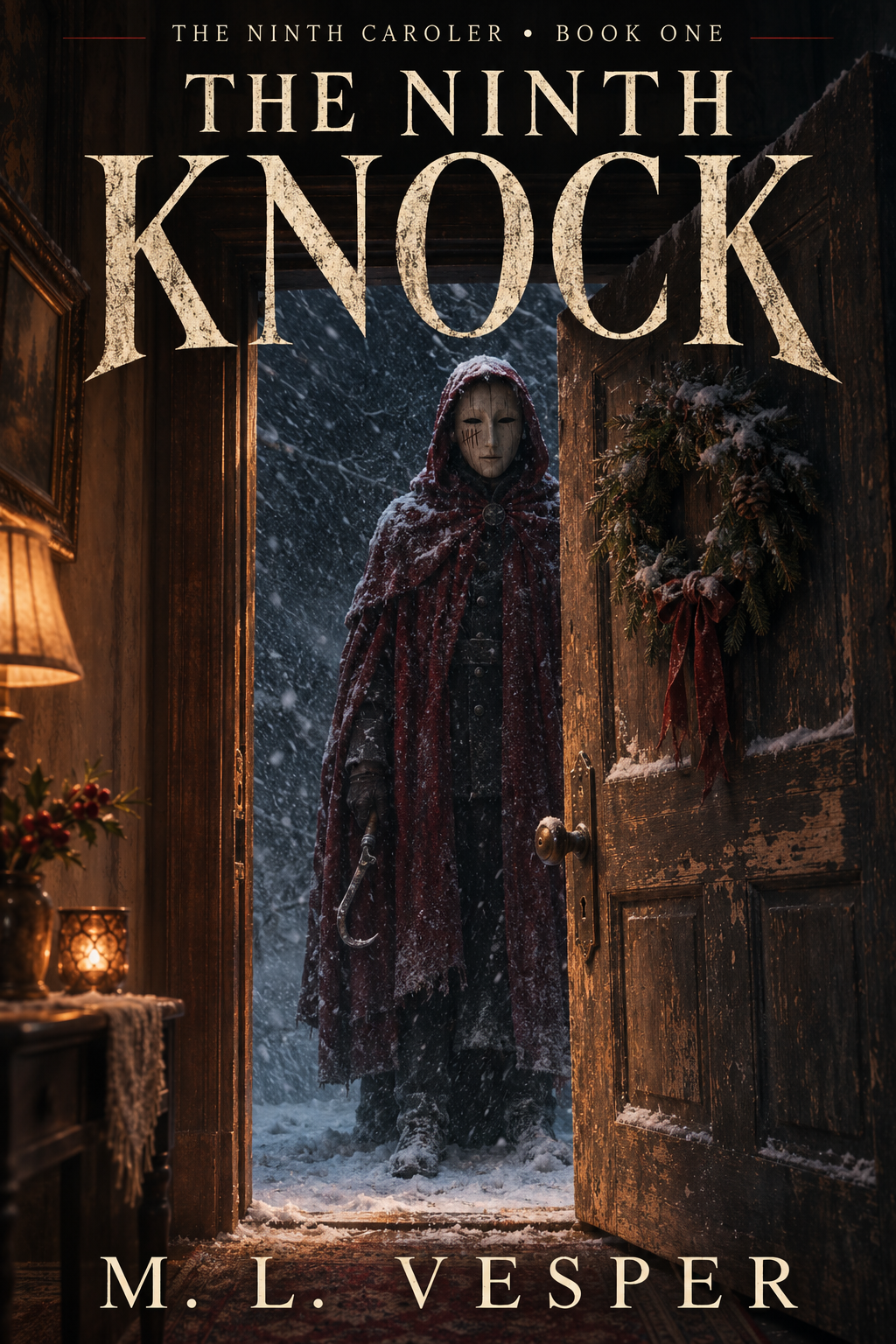
CHAPTER ONE
Nine in the Photograph
The first thing Ava Mercer noticed about Caldwell House was that somebody had decorated the dead tree.
It stood beyond the gates, a spruce with one side stripped to gray branches by weather or disease. White lights had been wrapped around it with the same painstaking care given to the healthy firs lining the drive. In the wind, the unlit needles of its living neighbors shivered while the dead one held perfectly still.
She slowed the rental car to look. A green extension cable crossed the snow, tucked beneath rubber matting where the drive curved toward the house. An efficient arrangement, if a little morbid. Someone had been determined to make the place welcoming.
Her phone gave one reluctant bar of service, then none.
“Of course,” she said.
Caldwell House stood at the top of a broad ridge like a building waiting for the apology it had never received. Its front was pale stone, its windows tall and narrow, its roofline crowded with chimneys. A wing of dark glass projected east toward a stand of pines. Above the south-facing porch, a banner announced THE CALDWELL CHRISTMAS PREVIEW in gold letters that kept catching the wind.
Ava had spent eleven years making difficult buildings look easy. Hotels with faulty elevators, restaurants with staff shortages, resorts whose owners thought a new logo could correct a failing boiler. This was different in degree, not kind. The Caldwell Trust was testing whether its ancestral estate could become an exclusive holiday destination. A dozen carefully selected investors would visit after New Year’s, assuming the private preview worked. For now, there would be only eight people on the property, counting Ava.
Eight was manageable. Eight meant she could know exactly where everyone was when the heating faltered or the kitchen ran short of something important.
It was the sort of number she trusted. On a hotel floor, ten rooms could be checked by name; a hundred required a system; a thousand required the kind of system people stopped questioning because nobody remembered who had made it. Ava had spent too much of her career watching a useful procedure become an excuse.
At her last property, a laundry attendant had sprained her wrist trying to force open a service door whose defective latch had been reported for weeks. Management had asked Ava to write the incident summary. The approved language had been about unsafe manual handling and retraining. Ava had written it that way, then added a separate maintenance note to a folder nobody outside her department was likely to read. She had not lied. It had taken her nearly a year to admit that she had helped hide the important part behind the less important one.
Caldwell House offered an opportunity to begin again with fewer stakeholders and clearer lines of responsibility. The money was less generous than it might have been at a large hotel group, but the contract gave her authority over safety, staffing and operating procedures. She had insisted on that sentence. Simon had laughed and signed it, apparently believing nothing dangerous ever happened in a house with good furniture.
She knew the trust wanted photographs of a glittering Christmas estate. She wanted a building in which any person could ask for help and expect an answer. She had not imagined those goals would come into conflict quite so directly.
She parked beside a low stone wall. Snow whispered under her shoes. Before she reached the porch, a woman in a canvas coat stepped out carrying a bucket of salt.
“You’re Mercer.”
“Ava. And you must be Mara.”
“Mara Voss. The roads are worse than they look.” Mara spoke with the economical bluntness of someone who had long ago decided politeness did not clear snow. She wore work gloves with a hole through one thumb. “Bridge is slick already. They’re calling for another foot overnight.”
“I read the forecast.”
“Forecast doesn’t know our bridge.”
Mara scattered salt on the top step and looked toward Ava’s car. “You brought chains?”
“No.”
“Good. People with chains get brave.”
Mara let her through the front door, and the smell of orange peel, beeswax and fresh greenery met Ava at once. Inside, the foyer glowed with shaded lamps. A carpet runner covered worn stone. Someone had arranged brass candlesticks beneath a framed photograph of the estate in summer, its lawns full of people who had probably never worried about snowplows.
The floor near the door had a pale rectangular patch where a mat should have been.
“Mat?” Ava asked.
“Washroom. Simon didn’t like the color.”
“Put it back. Wet stone, expensive shoes, one slip-and-fall.”
Mara’s mouth moved in something that might have been a smile. “I thought you’d say that.”
Ava set her bag under the registration table and walked the ground floor. She had a printed checklist clipped to a board: emergency lights, water pressure, exits, heating zones, staff radios, food safety, guest-room assignments. Her employer had sent mood boards and champagne specifications. She had asked for a copy of the emergency plan instead.
The kitchen occupied the west side of the house, beyond a narrow service hall and pantry. A compact woman with close-cropped dark hair was pulling a tray of ginger biscuits from the oven.
“Leah Moss,” she said before Ava could introduce herself. “If you need dinner early, tell me now. If you need it late, tell me now too.”
“Eight places, seven-thirty. I’ll help carry if you get stuck.”
“Don’t say that unless you mean it.”
“I mean it.”
Leah assessed her for a beat, then handed her a biscuit wrapped in a paper towel. “Good. Eat something before the speeches.”
In the service hall, a small amber light blinked on a wall panel labeled GENERATOR—KITCHEN AUXILIARY. Mara tapped it with a knuckle.
“Temperamental circuit. The diesel generator is sound; it runs the essential circuits whenever the incoming power fails. Leah knows how to reset the separate kitchen alarm. I’ll check the shed after the wind settles.”
“Don’t go alone in the dark,” Ava said.
“It’s forty yards across a yard, not the Arctic.”
“Still.”
Mara looked at her a moment longer and nodded.
The main salon opened off the foyer with a tall fireplace and a dozen pine garlands. Eli Park, the architectural photographer, was lying on the rug to capture a low angle of the mantel.
“Careful,” Ava told him. “People who look comfortable in these places are usually lying to the camera.”
Eli rose on one elbow. He had a quiet face and a habit of looking first at the light rather than at the person speaking. “That’s the assignment. Make it seem like someone could live here.”
“Can someone?”
“The ceilings are lovely. The draft isn’t.”
He showed her a photograph of the conservatory: black branches beyond glass, tiny points of light reflected between panes. “I’m waiting for dusk. It’ll look like a lantern.”
“Make sure you aren’t blocking any exits with the tripod.”
“Already moved it twice for Mara.”
“Then we’ll get along.”
Across the salon, a younger man with headphones around his neck was testing a microphone. Nico Bell, the sound contractor, had been hired to capture a short caroling demonstration and enough atmospheric sound to make a promotional film feel alive. He had set up a recorder on a side table instead of running cables across the floor.
“It records to its own memory card,” he said when Ava asked. “I brought a battery laptop and a separate field drive for copies. No cloud upload, no Wi-Fi needed.”
“Thank you for knowing.”
“I also brought spare batteries. That tends to surprise people.”
He played a few seconds of room tone: a low hiss of heat, a subdued crackle from the fireplace, the barely perceptible creak of old boards.
“Sounds haunted,” he said.
“Sounds expensive to maintain.”
Nico grinned. “Same thing, sometimes.”
By six, the group had converged in the foyer. Graham Holt, a substantial man in a beautiful camel coat, had arrived with the confidence of someone certain the road would improve for him personally. He described three previous investment properties while Ava checked the emergency lantern batteries. Ruth Danner, invited as a local preservation advocate, carried a slim leather portfolio and spoke gently enough that people leaned toward her to hear. Simon Vale, who represented the Caldwell Trust, wore a winter-white shirt with cuff links shaped like holly leaves.
Simon surveyed the foyer as if the building were being judged in his absence. “We could move the old photographs out of sight,” he said. “Guests want magic, not a museum.”
“Guests want to know they’re staying somewhere with a history,” Ruth answered.
“A curated history.”
Ava looked up from the lantern. “The house has both. We can decide what goes where after the preview.”
Simon gave her a pleased nod. He was fond of any sentence that sounded like agreement, even when it wasn’t.
Mara brought in the entrance mat. Graham moved aside for her with a small theatrical gesture, as though permitting a stagehand to cross his set. Leah appeared to confirm dinner, then vanished back to the kitchen. Nico adjusted the recorder’s gain. Eli took a group photograph in front of the staircase: Simon and Graham composed, Ruth unsmiling, Mara with her arms folded, Leah still wearing an apron, Nico making a face, Ava trying not to blink. Eight adults. All accounted for.
It was an absurd relief to have the number in her head.
When the others drifted toward the salon, Ruth remained by a photograph hanging beside the registration table. Unlike the bright promotional images, this one was small and silvered at the corners. Nine adolescents stood on the Caldwell House steps beneath a snowfall of white scratches on the old print. Each wore a dark cape with a pale collar and held a carved mask at chest height.
Ava stopped beside her.
“School choir?”
Ruth’s hands tightened around her portfolio. “A Christmas pageant.”
“How old?”
“Thirty-eight years ago.”
Ava leaned closer. There were five young people on the back step and four below, arranged in two uneven rows. One boy on the far edge stood slightly apart. He was narrow-shouldered and looked as if he had been told to stand where the others would not have to touch him.
“Were you in it?” Ava asked.
Ruth’s gaze stayed on the picture. “A long time ago.”
Ava followed her line of sight to a girl in the second row, solemn under a knitted hat. She was about sixteen. Ruth at fifty-four had the same deep-set eyes.
“That’s you.”
“Yes.”
Ava counted again. Nine.
The printed program on the table below was a replica of the one used at the estate’s last public pageant. Its cover showed a wreath and a stylized bell. Inside, under THE CALDWELL CHRISTMAS SINGERS, were eight names. Ruth Danner appeared third.
Ava held the sheet next to the photograph. “There are nine people here.”
Ruth said nothing.
“Did somebody get cut from the program?”
“A lot was different then.” Ruth closed her portfolio. “You’ll want to bring in the plants before it freezes. The conservatory is colder than it looks.”
She walked away before Ava could answer.
Simon appeared at her shoulder. “Ruth can be sensitive about the old days.”
“Who’s the ninth singer?”
He examined the picture without touching it. “Friends of the choir, I suppose. The photographer didn’t necessarily follow the program.”
“Seems odd to be wearing the same cape.”
“Probably a late substitute. The trust inherited boxes of material, and not everything is annotated.”
“That makes more sense than the printing error?”
“It hardly matters for the preview, does it?”
Ava looked from him to the boy on the edge of the photograph. His face was pale in the old exposure; there was no way to tell whether he was smiling.
“It matters if we’re telling guests this is an exact reproduction.”
Simon sighed softly. “Then call it a representative program. You’re the one who knows how to handle language.”
He lifted the sheet from her hand and squared it on the table.
At dinner, the storm worsened. Snow came crosswise against the west windows, and the chandeliers made the glass look full of sparks. Graham proposed a toast to profitable old houses. Leah served roast chicken with winter roots and asked whether anyone needed more bread. Ava reminded the group that the road would be off-limits if the bridge iced over. Simon described the estate’s potential for intimate retreats and seasonal wedding packages. Ruth picked at her food.
At the head of the table Ava could see every place setting. There was a comfortable rhythm to eight: two groups of four, one table that required no added leaf, enough people for conversation without a room becoming a crowd.
The weather report came from Mara’s battery-powered radio. Wind, heavy accumulation, a warning to avoid nonessential travel through the night.
“Maybe we ought to leave,” Graham said.
Mara turned down the volume. “I wouldn’t take that bridge now unless somebody needed a hospital.”
“An SUV is built for snow.”
“A bridge isn’t.”
Ava waited for the argument to subside. “We have food, heat and a backup generator. The safest plan is to stay put until the road crew clears the approach. No one goes into the grounds alone after dark.”
Graham raised both hands in mock surrender. “Yes, captain.”
She had been called worse by richer men.
After dinner, Ava walked the foyer one last time. Mara had put the mat back. The exterior door was locked; its heavy brass latch rested fully in the catch. Behind her, voices from the salon mingled with a rehearsal chord Nico had begun playing on his small speaker. Above the registration table the nine children stood forever inside their frame.
Ava straightened the program beneath it. She disliked errors left where people could see them.
Then a bell rang outside—one small, flawed note.
It was a small sound, thin and imperfect, as if the brass had split somewhere near its lip. Ava stood very still. There was no music playing in the foyer, and no one at the desk. Beyond the front windows, the grounds were a moving darkness of snow.
She waited for the sound to repeat.
It did not.
Ava looked at the locked door, at the wet mat below it, and finally at the old photograph. For an instant she had the unreasonable impression that the boy on the far edge of the second row was looking directly out at her.
She switched off the desk lamp and went to find the others.
CHAPTER TWO
The Last Rehearsal
Nico wanted everyone to stand in a half circle. Graham wanted to sit. Simon wanted the fireplace in the shot, although Eli pointed out that a fire looked lovely on film and sounded terrible on a recording. Mara wanted to know whether they would be finished before she had to check the outer shutters.
Ava settled the matter by moving three chairs out of the way and asking Nico exactly what he needed.
“Forty seconds of a familiar carol,” he said. “Nobody has to be good. It’s supposed to sound like a private gathering, not a cathedral.”
“That’s fortunate,” Graham said.
Leah appeared in the doorway, wiping her hands on a tea towel. “If there’s a video of my singing, I’ll deny it’s me.”
“Audio only,” Nico promised. “Eli’s doing the pretty part tomorrow.”
“Then I can be terrible in peace.”
“You sound good when you don’t think anybody’s listening,” Nico said.
“That’s because I’m listening to the oven,” Leah replied. “The oven has expectations, but it doesn’t review me.”
She stayed to straighten the evergreen sprig on the mantel. Ava watched her pinch out a dry needle and drop it into her apron pocket rather than onto the rug. Leah had the quiet competence Ava looked for in people who were expected to keep everyone else comfortable. She had spent the afternoon making enough pastry for two breakfasts, even though the schedule called for only one, because she’d seen the storm warning and guessed a delivery could fail.
“I leave recipes with the staff,” Leah had said while arranging dinner. “If I’m out, nobody has to guess which pan to use.”
“You aren’t planning to be out tomorrow?” Ava had asked.
“I was planning to be sleeping late in January. That’s different.” Leah had laughed and mentioned visiting her sister in Albany once the preview was finished. She had already bought the train ticket. Her sister collected ugly Christmas ornaments; Leah had bought a little ceramic snowman and wrapped it in tissue for the journey.
Ava remembered the conversation now as Leah came to stand at the edge of the half circle. The cook had flour on the cuff of her dark sweater and an expression of resigned amusement. Her work was finished for the evening. She had every reason to expect it would be finished tomorrow too.
“Ready to be immortalized?” Nico asked.
“For forty seconds,” Leah said. “Not a second more.”
They chose “The First Noel,” mostly because everyone knew the opening. Nico placed his recorder on a small stand in the center of the salon and stepped back. He explained that his machine would capture each voice in one room microphone. There was nothing complicated enough to fail: a battery, a card, and the red light that showed it was recording.
Ava stood between Ruth and Mara. Ruth kept glancing toward the foyer. When Nico raised a hand to cue them, the old woman flinched.
They sang. Nico’s voice was clear and a little too enthusiastic. Graham dragged behind the others, and Mara kept nearly perfect pitch despite having claimed not to know the song. Leah’s voice carried in an unexpectedly warm contralto. Ava concentrated on getting through the verse without thinking about the wind.
As they reached the final line, the salon lamps dipped. The automatic transfer relay clicked in the service hall. The generator, already humming in the shed, took the essential circuits, and those lamps brightened while the decorative chandelier stayed dim. Nobody stopped singing.
“That’s enough to make us look civilized,” Nico said.
Graham clapped once. “Release it to the world.”
Nico played back the recording.
Their singing sounded small in the enormous room. Ava could hear her own voice, the kind of voice she ordinarily heard only from someone else’s phone. At first she thought the playback was slightly out of time. Then the last phrase arrived and she understood what bothered her.
One voice held a note after everyone else had finished.
It was a young male voice, thin but true, floating beneath the room’s natural echo. It did not harmonize with them so much as insist on its place among them.
“Who did that?” Nico asked.
No one answered.
He replayed the last ten seconds. They heard the eight voices make their untidy ending. Then the ninth voice continued, alone, into the silence.
“Somebody outside?” Eli suggested.
“The windows are double glazed,” Mara said.
“Sound can travel.”
“Not that cleanly. And not through this storm.”
Nico studied the machine. “There’s no second track in the file. It’s on the room mic.”
Simon laughed without much humor. “A child in the recording? Are we truly frightened of a technical mistake?”
“What child?” Leah asked.
“Feedback. A harmonic. Whatever you sound people call it.”
“Harmonics don’t pronounce words,” Nico said.
Ava had heard them too. The last word had been clear, shaped…
Keep reading The Ninth Knock
You've reached the end of the free preview. Purchase this eBook for permanent access in your Novel Thunder Library, or read it with an eligible Novel Thunder subscription.
Buy eBook — $2.99