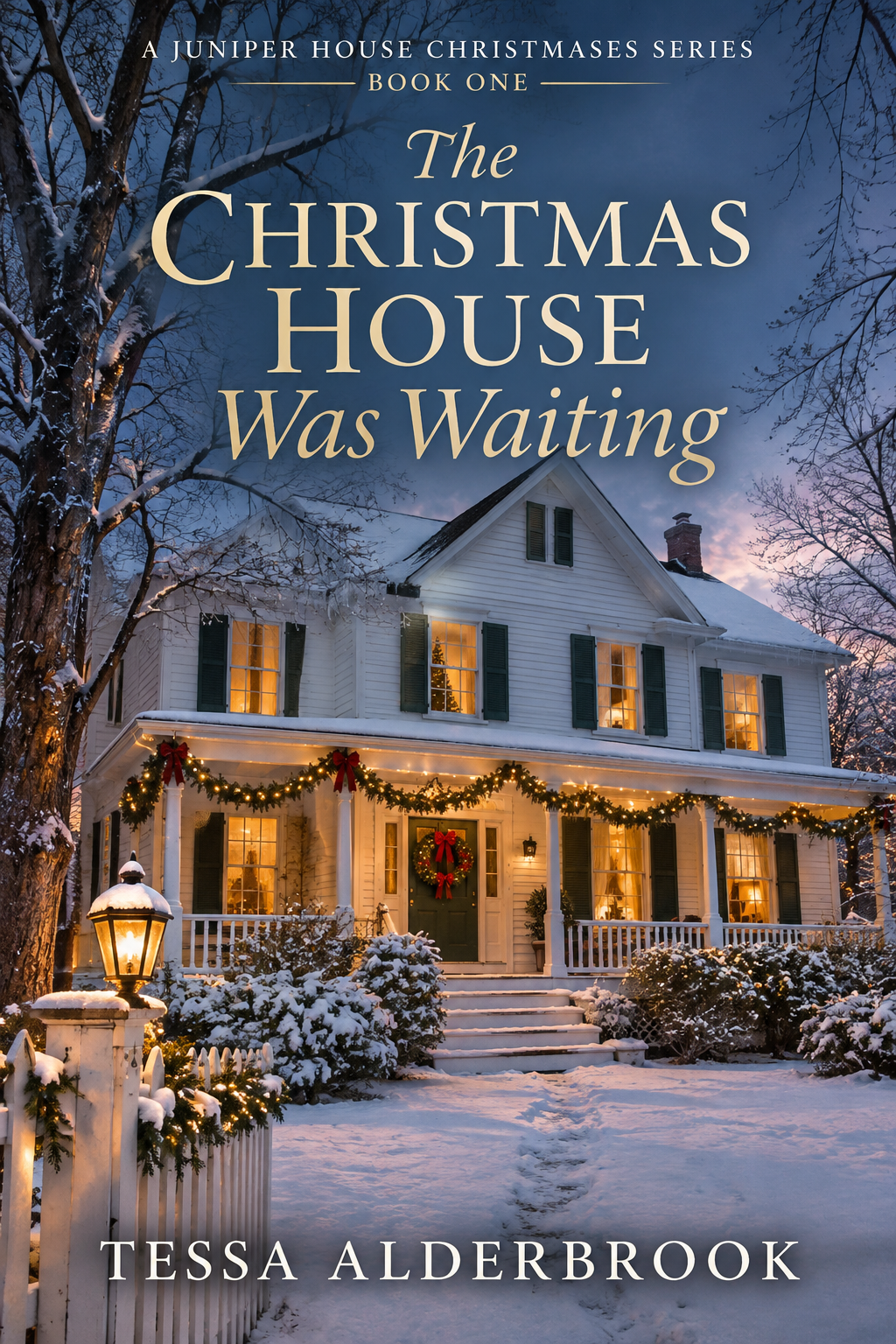
CHAPTER ONE
On the road into Bellwether Bay, the Christmas lights began two miles before the town itself.
They appeared first on a farmhouse fence, a deliberate line of white bulbs shining through a stand of bare maples. Then came a gas station with a crooked plastic reindeer on its roof, a church steeple wrapped in lights, and a row of storefronts whose windows threw cheerful rectangles onto wet pavement. Clara Hart watched the decorations pass through her windshield and tried not to make a story out of them.
She had spent the drive from Chicago dictating notes about pricing structures for a hotel group that had no idea she intended to resign in January. She had revised a proposal, rejected an expensive vendor, and listened to a voicemail from a potential client who wanted her to guarantee a turnaround before anyone had shown her the numbers. By the time the lake came into view, flat and pewter-colored beneath a low winter sky, the work had settled her nerves.
Work had always been good at that.
Juniper Lane was narrower than she remembered. Its houses sat behind old stone walls and trees thick with winter shadows. Children had built a snowman beneath the neighborhood sign. His head had slipped sideways, giving him the expression of someone who had just heard disappointing news.
Clara turned left, slowed, and saw the house.
For a moment she forgot to breathe.
Juniper House stood at the end of the lane with its white clapboard walls and dark green shutters, three stories of windows facing the street. The wide front porch ran between two shallow bays. A copper star, tarnished green at its tips, hung above the door. Every December of her childhood, the house had been lit from the foundation to the attic dormer. Tonight only one lamp burned behind the front window.
She parked in the gravel drive, cut the engine, and remained where she was. The car clicked and cooled around her.
Her grandmother had been dead for nine weeks.
That sentence still arrived in her mind as an incorrect piece of information someone ought to fix.
Clara had been back for the memorial in October. There had been casseroles in the kitchen, flowers on every surface, and so many people telling stories about Evelyn Hart that she had barely managed to step inside the rooms. This visit was different. The last of the sympathy cards had been put away. The house was hers to deal with, and the only person expected to decide what happened next was her.
Before she picked up her bag, Clara made herself walk around the outside of the house once. She had not done it at the memorial, when every inch of the property seemed occupied by people who wanted to make sure she was all right. Alone, she could at least look at what was hers to manage.
The south wall had a line of ivy clinging to the brick foundation. The old garden gate hung slightly crooked from its hinges. Beyond it, the narrow side lawn sloped toward a patch of winter-bare apple trees and the toolshed Daniel Hart had painted red when Clara was nine. The paint had weathered to a dull brown. She could still remember her father's delight in announcing that he'd chosen a color guaranteed to annoy the neighbors. Evelyn had responded by putting up a sign reading APPLES AND OTHER TROUBLE.
Clara stopped beside the gate. Her father had died in the middle of an ordinary spring, long before anyone in the family was prepared for his absence. She'd attended the funeral, helped her mother with the paperwork, and returned to work because she didn't know what else to do. For months afterward people praised her for being so strong. She had accepted the compliments as if they were assessments of professional performance. Only later had she recognized that strength was a strange word for being too frightened to stop moving.
She crouched to inspect the gate hinge, which sagged when she touched it. She had been the one who wrote operational plans for hotels with hundreds of rooms. She understood capital expenditures, maintenance budgets, and the difference between a temporary fix and a sustainable one. Yet this little hinge brought her close to tears. Daniel had promised to replace it one summer, then been distracted by a broken pipe. Evelyn had written about it in half a dozen notes. Nobody had ever done it.
In Chicago, Clara's apartment was bright and expensive and almost entirely free of history. She could replace a sofa without any relative saying it had belonged to somebody. She could throw away a cracked mug and never wonder which pair of hands had once carried it. There was a relief in that kind of freedom. There was also a thinness she had begun to feel in the evenings when she came home too tired to cook and no one noticed whether the lights were on.
She stood and brushed snow from her trousers. The gate did not require an emotional decision. It required a hinge, a qualified assessment of the old post, and somebody willing to do the work. She made a note on her phone, absurdly grateful to have identified something that could be solved.
The property extended farther back than she remembered. Near the toolshed stood the remains of a small vegetable garden, marked by cedar stakes that had survived another winter. She remembered the bitter tomatoes Evelyn grew one year and insisted were delicious. Clara and Daniel had eaten them solemnly at the kitchen table while Judith tried not to laugh. Her mother had never liked the old house as much as Clara and Daniel did. She found it noisy, drafty, and too full of obligations. That wasn't a moral failing. It was a difference of temperament. Clara had begun to understand how many family arguments could have been avoided if people had allowed one another that.
The wind rose off the lake, lifting snow from the edge of the path. Clara pulled up her scarf. She had already been outside longer than she'd intended. The inspection would have to wait until daylight, and she hadn't even turned on the lights inside. She went back toward the porch, stepping carefully where ice had formed beside the drain.
At the front door, she looked up at the dark windows. The house was neither welcoming nor accusing. It was a building that had sheltered people, and now it needed decisions. She could make those decisions without pretending she knew what they would cost her emotionally. It was not a comforting conclusion. It was, at least, honest.
She took her overnight bag from the back seat. A thin wind moved across the driveway. The ground glittered with old snow where it hadn't melted. Beneath the porch railing, the boxwoods had grown untidily into one another. Grandmother would have disliked that.
No, Clara corrected herself. Grandmother would have found a way to say the shrubs were giving the house a hug.
The front lock resisted, then turned under the heavy brass key. She had forgotten the way the door required a little upward pressure on the handle. The small physical memory startled her more than the smell inside: cedar from the hall chest, beeswax polish, the faint sweetness of the peppermint candies Evelyn kept in a glass jar by the telephone.
Clara put her bag down. The foyer was cold but not freezing. An amber lamp had been left on beside the staircase, making a pool of light over the patterned runner. The coat hooks were empty. On the little table below the mirror stood a ceramic dish, a folded envelope, and the bright red scarf Evelyn wore when she handed out cocoa at the town tree lighting.
Clara lifted the envelope. Her name was written on the front in a handwriting she'd known since she could read.
She hadn't expected that. She hadn't been told to expect it.
For a ridiculous second she was angry with the whole world for failing to warn her.
She broke the seal with her thumbnail.
My darling Clara,
If you're reading this, I'm sorry I've left you with a great many things to sort. I know you prefer to have a plan before you enter a room, but sometimes the room has a plan for you. Before you make any decisions about this house, open the curtains. It has been shut up too long.
There is tea in the blue tin. The good biscuits are in the pantry, unless I ate them.
Love always,
Gran
Clara read the note twice. It was infuriatingly like Evelyn to have anticipated the exact moment her granddaughter would need a cup of tea and then turn a practical instruction into a gentle argument.
She set the envelope down, crossed the hall, and entered the front parlor.
The furniture was dressed in white sheets. The piano stood against the far wall, its lid closed. No tree. No woven stockings hung from the mantel. No box of tinsel waiting for Evelyn's annual argument about whether anyone should still use it.
Clara gripped the curtain fabric and pulled.
The window looked out over the porch, the quiet street, and the first new flakes of snow. The view was hardly spectacular. Two parked cars, a hedge, the house across the lane with a bicycle leaning against its garage. Yet the change in light made the room seem suddenly inhabited.
She opened the second curtain and turned on a lamp.
Then she opened the rest, one after another, until the parlor was filled with the blue light of an early December evening.
Her phone vibrated. A message from her mother.
You there safely?
Clara typed back, Yes. House looks okay. I'll call tomorrow.
She stared at the words. House looks okay was neither accurate nor dishonest. It was simply the kind of response that prevented someone from asking a question she didn't want to answer.
A knock sounded at the front door.
Clara looked at the time. Five twenty-seven. She had told nobody she would arrive before six. She crossed the hall, glanced through the narrow side window, and saw a man standing on the porch with a canvas tool bag and a knitted cap darkened by snow.
He shifted, allowing the porch light to catch his face.
Clara's hand stayed on the lock.
Ben Navarro had grown into the kind of man people would find their eyes returning to without quite knowing why. He was tall, broad in the shoulders, with an open, weathered face and a dark beard trimmed close to his jaw. His hair was threaded with early silver at the temples. She recognized his eyes before anything else: a deep, steady brown, patient and impossibly observant.
He raised one gloved hand.
Clara opened the door.
"You still take your time answering," he said.
"You still arrive without an appointment."
"I have an appointment with the porch light. It has been flickering since last week."
"That's a very serious commitment."
"Long-term relationship."
She almost smiled. It seemed like a small betrayal of the mood she had intended for the evening.
"Hello, Clara," he said more quietly.
"Hello, Ben."
For a beat, the years between them were present and invisible at once. He had attended the memorial. She remembered seeing him at the back of the church, talking to the people who couldn't stop crying, helping her mother carry folding chairs without making a production of it. They had exchanged a few words, none of them private.
Now the house was empty, and Ben looked not at the windows but directly at her.
"Nadine said you were coming today," he explained. "I was going to check the fixture before the weather gets worse. I can come back."
"No. Please. As long as you don't take the whole porch down."
"I'd need a bigger bag for that."
She stepped aside, and he entered just far enough to put his boots on the mat. Cold air followed him in. He carried a faint scent of sawdust and clean wool. Clara remembered how, as a teenager, he had always had a pencil tucked behind one ear. Today there was a carpenter's pencil in his coat pocket.
"I didn't know you were still doing work on the house," she said.
"Some maintenance. Not much after October. Your grandmother made me promise not to let the porch light go dark."
Clara glanced over his shoulder. "Was she expecting somebody?"
"Evelyn was always expecting somebody."
It was a simple answer. It landed harder than she wanted it to.
Ben's gaze moved past her to the open curtains. "You did that."
"Opened a few windows to the world. Apparently I was under orders."
"Sounds like her."
She folded her arms. "I'm not staying long. A week, perhaps ten days. There's an estate inventory and a valuation. I'll coordinate whatever needs to happen after that."
He listened without interrupting. A younger Ben might have given her an argument right then, some grand defense of every creaking floorboard. This Ben merely nodded.
"Okay."
She wasn't sure why that disappointed her.
"You don't have an opinion?"
"I have several. None of them are useful before you've slept."
"You always used to have an opinion."
"I still do. I'm learning when to deploy them."
He looked toward the hall table and the little red scarf. The warmth went out of his expression for a moment.
"She'd have liked knowing you got here before dark," he said.
Clara's throat tightened. "She would have reminded me I needed a heavier coat."
"And fed you before asking whether you'd eaten."
"Then asked whether I'd eaten again."
He smiled, and the shared memory did what sympathy at the memorial hadn't managed to do. It allowed Evelyn to exist, briefly, as a living and exasperating person.
Ben lifted the bag. "Ten minutes. Maybe fifteen."
"I'll make tea. The blue tin is apparently mandatory."
"The good biscuits?"
"Depends whether she ate them."
He gave a low laugh and went back onto the porch. Clara watched him set a small ladder beneath the flickering fixture, steady the base with one foot, and reach up to remove its glass cover. He moved as someone who understood exactly where his weight was. There was no flourish to it.
She went into the kitchen, which was too large and too quiet, and filled the kettle. The blue tin stood in the same place beside the stove. Behind it was a paper calendar with November still showing. A square around the twenty-second of December was marked with a little holly leaf.
Clara touched the pencil mark.
She hadn't looked at Evelyn's December plans. She had told herself there would be time once the legal matters were sorted. The estate attorney had sent her account summaries and trust documents, all neatly organized, and she'd read those. But the ordinary life of the house, the lists and appointments, was still waiting.
From the porch came the brief scrape of a tool, then a soft click. A second later, bright light spilled across the window.
Clara looked out. Ben stood beneath the fixture with snow dusting his shoulders, testing the switch. The house shone around him in the falling dark.
She found herself wondering what it might feel like to arrive here and not immediately calculate how soon she could leave.
CHAPTER TWO
Ben had been under the porch roof for less than twelve minutes when he realized he had made a mistake.
It wasn't the fixture. The loose connection was easy enough to repair once he isolated the circuit, and the new weather seal would keep moisture out for another winter. His mistake was telling himself he'd come only because of a promise to Evelyn.
That was part of it. It wasn't all of it.
He'd seen Clara's car turn onto Juniper Lane from the intersection near his office. He had almost continued toward home. Instead he'd checked his watch, found the tool bag he'd left in his truck, and driven the long way around the block so he wouldn't appear to have followed her.
Thirty-eight years old, and behaving like a boy who hoped to pass a girl at the school lockers.
He replaced the glass cover and climbed down. From the front window he could see Clara moving around the kitchen, opening cupboards with the practiced assurance of someone returning to a place she'd known by heart. She wore dark trousers and a blue sweater, her hair caught in a loose knot that had begun surrendering to the drive. The sight of her here again did something inconvenient to his chest.
Ben put away the ladder. When he came inside, she was pouring tea into two mismatched cups and surveying a plate of biscuits with obvious suspicion.
"Found them," she said. "They were behind a tin labeled OATMEAL. Which seems deliberately misleading."
"Evelyn used to hide the expensive chocolate from the choir committee in an oatmeal tin."
"That tracks."
Ben took the cup she offered him. They stood at opposite sides of the kitchen island, warming their hands around the china. The overhead light had always been a little too bright. He made a mental note to ask whether she wanted the dimmers checked, then stopped himself. A person could spend an entire lifetime making small repairs to avoid a difficult conversation.
"How's your mother?" he asked.
"Fine. She moved into a smaller place in Arizona. She's happy with the weather and resentful of the homeowners' association. Apparently both can be true."
"Sounds like your family."
"I am nothing like her."
Ben raised an eyebrow.
"Don't," Clara said.
He bit into a biscuit to conceal his smile.
She leaned against the counter. "And your parents?"
"Dad's determined to keep climbing ladders even though his knee has decided otherwise. Mom runs Navarro Hardware as if it's a military installation. They're good."
"I saw the new sign on the way in."
"Mom designed it. Dad says the old sign was better, but he also says that about the roof, the cash register, and most of modern civilization."
Clara laughed. It was a sharper sound than her polite memorial voice, and it brought back the summer afternoons when she'd sat on the Navarro family's back steps, drinking lemonade and arguing with Ben about whether the town needed a movie theater or a wider library. She'd always been convinced the world was insufficiently organized. He'd admired that about her then. He still did, though he understood better how such determination could wear a person thin.
"Nadine said you're an architect now," she said.
"Preservation work. I manage projects for Lake and Pine. A lot of old buildings, a lot of people surprised that old buildings require money."
"You enjoy being the one to tell them?"
"It's the glamorous part of my job."
She glanced toward the ceiling. "So you're going to tell me this place is falling apart."
"I'm going to tell you what I know and what needs a specialist. That's not the same thing."
Clara set down her cup. "The attorney said the structure was sound at Evelyn's last insurance inspection."
"That was a basic condition report, not a full survey. And I haven't been in the back guest wing since spring."
He could have softened the answer. Given her a comfortable approximation and hoped for the best. But she'd arrived with a suitcase and a plan built around certainty. He had seen too many property owners punished by false reassurance to offer her any.
"I can walk through with you tomorrow," he said. "Make a list. You'll still need licensed contractors for the heating and electrical systems."
"I'd appreciate that. I'll pay you for the assessment."
He felt a ridiculous flash of offense, quickly replaced by respect. Clara wasn't asking him to volunteer because he had known her grandmother. She understood the value of professional work.
"We'll put something in writing," he agreed. "A defined scope. No surprises."
"My favorite kind of arrangement."
"I remember."
He saw her glance toward the back window. Snow was gathering on the bare branches of the crabapple tree. Her grandmother had planted it the year Clara was born, apparently in the mistaken belief that a beautiful tree would make her granddaughter less eager to leave town someday.
"Are you okay?" he asked.
Clara's attention came back to him. "I'm busy."
"I didn't ask whether you were busy."
"I know what you asked."
He waited.
"The house feels strange," she said at last. "Everything's exactly where it should be. Everything's wrong anyway."
That, he understood. When his grandfather had died, the old man's workbench had been so orderly that Ben hadn't been able to touch a single chisel for weeks. It had seemed indecent to rearrange the evidence of a life.
"You don't have to sort it all this week," he said.
"Actually, I have a property walkthrough tomorrow morning and a valuation appointment tomorrow afternoon."
"Those don't require you to decide what to do with the red scarf."
Her eyes flickered toward the hall. He wondered whether he'd gone too far.
"No," she said. "They don't."
They finished their tea in a more comfortable silence. After a while she walked him to the porch. He had pulled on his coat when she said, "Thank you for keeping the light on."
He looked at the fixture, now throwing a steady halo over the steps. "I promised Evelyn."
"Yes. You said."
The short answer held a question neither of them was prepared to ask.
Ben put on his hat. The night smelled of snow and woodsmoke. Across the street, a family was arranging plastic candy canes along a path, the youngest child issuing instructions with the authority of a foreman.
"Clara?"
"Mm?"
"I'm sorry we didn't talk properly in October."
Her face changed. Not much. Enough.
"I couldn't talk properly to anyone," she said. "People kept saying they were sorry, and I kept thanking them as if they'd complimented my shoes."
"That sounds exhausting."
"It was."
He had a memory of her at eighteen, furious because an application she'd submitted had been returned with one box left unchecked. She had declared that she'd never entrust her future to bureaucracy again. He'd liked her anger. It had been alive and unreasonable. He didn't want her to feel she had to be reasonable now.
"Tomorrow at nine?" he asked.
"Nine is good. I'll have the documents ready."
"And the biscuits?"
"No promises."
He left her on the porch, standing beneath the repaired light. At the end of the drive he glanced back. She had stepped outside to look at the house, her arms folded against the cold. It looked almost like an inspection. It looked, too, like a woman trying to recognize a place she'd once believed would never change.
When Ben first met Clara, she had been twelve and sitting on the porch steps with a dismantled alarm clock in her lap. She'd borrowed a screwdriver from his father's store and was trying to discover why the clock gained four minutes every day. He had been fourteen and sure he knew enough about mechanical things to advise her. In fact he'd made the problem worse, removing a spring that shot across the porch and disappeared into a crack between the boards.
Evelyn had come out with lemonade and found them both crawling on their knees. She had watched for a moment before saying that young people who wanted to understand a clock ought to learn the value of time first. Then…
B…
Keep reading The Christmas House Was Waiting
You've reached the end of the free preview. Purchase this eBook for permanent access in your Novel Thunder Library, or read it with an eligible Novel Thunder subscription.
Buy eBook — $2.99