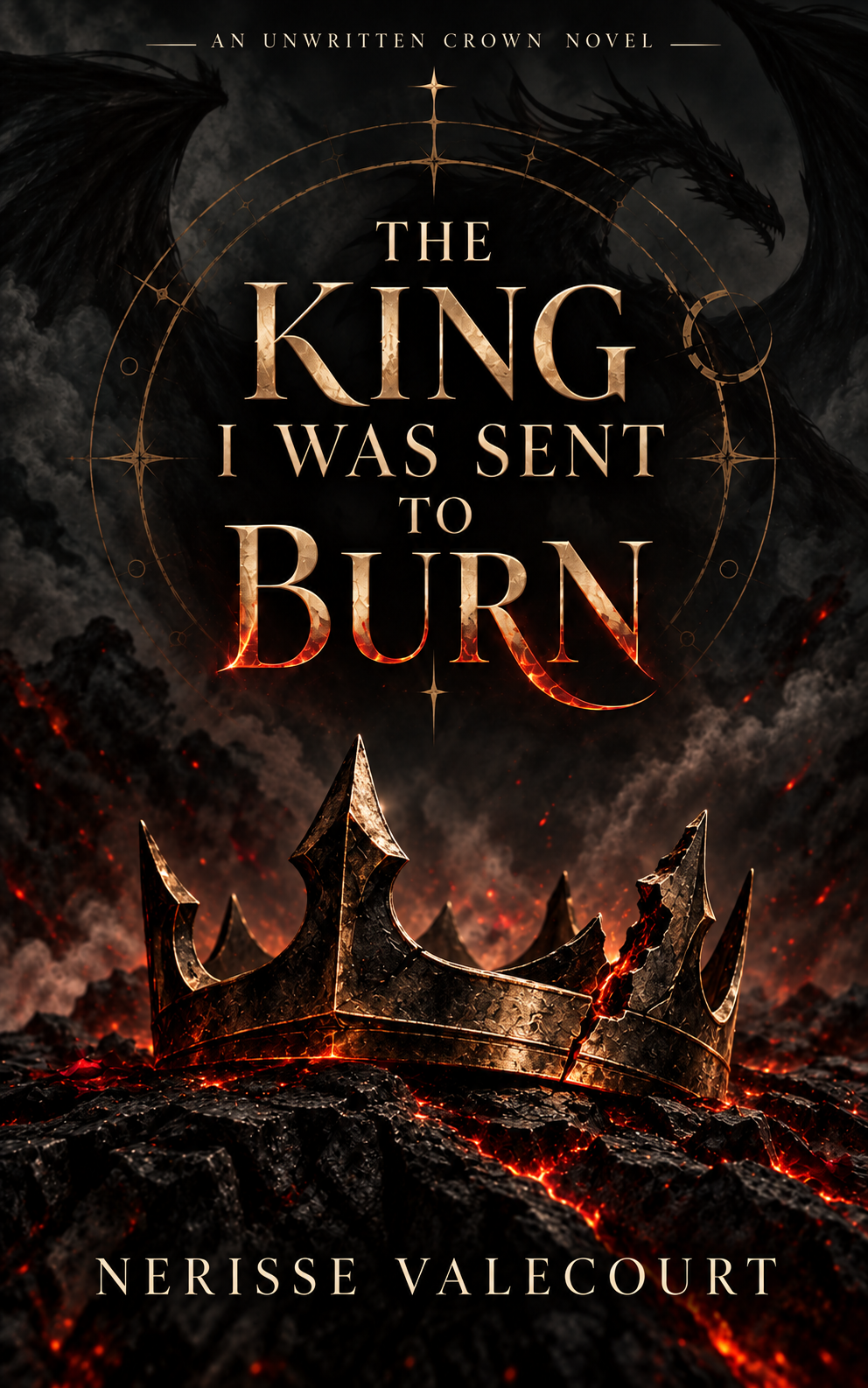
Prologue
The King Who Burned
By the time Zevren Orlath became king, he had stopped sleeping.
That was what he remembered most clearly afterward.
Not the bells.
Not the black banners lowered over the western towers.
Not the priests changing the wording of prayers three times in six days because first one brother died, then the other, then his father before sunrise.
He remembered lying awake in his old rooms while servants moved through the corridor outside, carrying clothing that belonged to dead men.
His eldest brother's red hunting coat disappeared first.
Then the ceremonial sword his second brother had hated because the hilt pinched his palm.
By dawn, someone had removed their boots.
By noon, their rooms no longer looked occupied.
The palace had a way of making absence efficient.
Now Zevren stood beneath it with dried blood still under one thumbnail from helping close his father's eyes.
Three priests waited around a slab of black volcanic stone.
The oldest of them gestured toward it.
“Your left hand, Your Majesty.”
Zevren looked at the stone.
Every king of Ravessyr had touched it before descending to Thyrravor.
His father had done it.
His grandfather.
His grandfather's father.
The line stretched backward until history became myth and myth became whatever kings found useful.
“Left hand,” the priest repeated.
Zevren put down his left hand.
The stone was warm.
Nothing happened.
One of the priests glanced at another.
Zevren noticed.
He noticed everything now.
People thought grief made a man inattentive.
For him it had done the opposite.
It had stripped the world down to small movements.
A servant swallowing too hard before speaking.
A minister folding and unfolding the same corner of a document.
A priest pretending not to be disappointed by a piece of stone.
“What were you expecting?” Zevren asked.
The priest blinked.
“Your Majesty?”
“When I touched it.”
“No manifestation is required.”
“Then why did you look surprised?”
The youngest priest went pale.
The oldest inhaled slowly through his nose.
“It is symbolic.”
Zevren lifted his hand.
“Then perhaps we should stop expecting symbols to perform.”
Silence.
That, too, had changed since his father's death.
People had always paused when Zevren spoke.
Now they waited.
There was a difference.
Behind the priests, a narrow stairway descended into darkness.
No torches burned below.
He had known that since childhood.
Thyrravor permitted no open flame in the old passages, though whether that came from reverence, superstition, or simple fear depended on who explained it.
Zevren stepped toward the stairs.
Boot leather scraped behind him.
Dorran Kel.
At thirty-six, the captain of the royal guard still had more black than gray in his beard and enough old scars to make courtiers uncomfortable.
“You can wait until morning,” Dorran said.
The priests stiffened.
Zevren looked over his shoulder.
“Can I?”
Dorran's face answered before his mouth did.
No.
By morning, envoys would already be riding toward the borders.
The southern houses would be counting troops.
The copper merchants would be delaying shipments until someone proved Ravessyr still had a ruler.
And the six other kingdoms would be asking the same question in six different languages:
Had Thyrravor accepted the third son?
If not, Ravessyr did not merely have a succession problem.
It had a dragon without a king.
Zevren turned back to the stair.
“Wait here.”
Dorran stepped forward.
“Zevren.”
Not Your Majesty.
Zevren needed at least one person left who remembered he had possessed a name before a crown.
“If he kills me,” Zevren said, “I don't think your sword changes the outcome.”
“That is not reassuring.”
“It wasn't intended to be.”
For half a second, Dorran looked like he might argue.
Then he bowed his head.
Zevren descended alone.
The air changed first.
The palace above always smelled faintly of smoke, hot iron, wax, food, horses, bodies.
Below, those scents disappeared.
There was only stone.
Hot stone.
Mineral water somewhere far beneath him.
And something metallic that gathered at the back of his tongue the deeper he went.
The stairs ended at a passage wide enough for six men to walk abreast.
The walls were carved.
He had seen copies of the reliefs all his life.
Kings standing beneath dragons.
Dragons bowing.
Crowns raised high.
Flame curling upward like blessing.
His tutors called the sequence the Founding.
His father called it proof that the Orlaths had been chosen to rule.
His eldest brother once called it ugly during a history lesson and received a week without riding privileges.
Zevren stopped in front of one panel.
A man in a crown held out one hand.
A dragon lowered its head toward him.
The king was twice as large as every other human figure.
The dragon was smaller than the palace tower carved behind it.
Zevren almost laughed.
Even here, beneath the world, humans had made themselves larger.
He kept walking.
The corridor widened.
Then the wall on his left ended.
The darkness beyond it did not.
Zevren stopped.
For several heartbeats, he thought the chamber was empty.
Then something breathed.
The sound was low enough to vibrate through the soles of his boots.
A pale eye opened in the dark.
Zevren's body reacted before his mind did.
His shoulders locked.
His breath shortened.
Every lesson about kingship, dragon law, military command and royal blood vanished.
There was only scale.
Stone.
Darkness.
And an eye larger than his chest.
Thyrravor moved.
The sound came slowly: one layer of scale dragging against another, claws grinding over black stone.
Gold appeared beneath the darkness.
Not flame.
Thin fractures of light under black scales, as if molten metal ran under cooled volcanic glass.
One horn swept backward intact.
The other ended in an old, jagged break.
Scars crossed the dragon's face and throat.
Not fresh wounds.
Old enough that entire human lives might have passed while they faded.
His body extended so far into the chamber that Zevren could not see its end.
Nothing in the palace carvings had prepared him for the size of him.
Nothing had prepared him for the smell either: heat, stone, cold iron, and rain on ash.
The pale eye narrowed.
Then Zevren heard a voice.
Not through his ears.
Inside him.
Another Orlath.
His hand closed around the hilt of the ceremonial blade at his hip.
The absurdity of that response reached him at the same time it reached the dragon.
Something brushed Zevren's thoughts.
Not laughter.
Closer to the recognition of stupidity.
He released the sword.
“I'm glad one of us is entertained.”
Thyrravor's head moved nearer.
Two were prepared before you.
Zevren's stomach tightened.
“My brothers.”
Yes.
The word came with an image.
His eldest brother in the western orchard, reaching into a tree for an apple he had no intention of eating.
Gone.
Another image.
His second brother kneeling in the practice yard, frowning at a broken bowstring.
Gone.
Zevren stumbled back.
The images vanished.
“Don't.”
The dragon watched him.
They are not your memories alone.
Zevren stared.
“What does that mean?”
No answer.
His anger rose too quickly.
That had been happening since the first death.
Grief waited beneath his skin now, close enough to become rage at the slightest invitation.
“Do not put them in my head.”
Thyrravor's gaze did not change.
You entered a chamber built for joining minds.
“I haven't agreed to anything yet.”
That caused stillness.
Not surprise exactly.
Attention.
Zevren took one step farther into the chamber.
“You know who I am.”
Zevren Orlath. Third son of King Maelor.
The title landed harder than his father's name.
“He's dead.”
Yes.
No comfort.
No false reverence.
Zevren found that easier to bear.
“My brothers too.”
Yes.
“You met them?”
Briefly.
He hated how much he wanted to ask what they had said.
Whether they had been afraid.
Whether Thyrravor remembered them.
He swallowed the questions.
“What happens now?”
You decide.
Zevren laughed once.
It sounded wrong in the chamber.
“No.”
The dragon's eye narrowed.
“I didn't decide that my brothers would die. I didn't decide that my father would follow them before we buried either one. I didn't decide to become the only living son in the line.”
He stopped.
The next words came out quieter.
“I didn't decide any of this.”
Thyrravor remained silent.
Zevren looked away.
At the carved walls.
At the darkness.
Anywhere but the dragon's eye.
“Everyone upstairs already knows what I am supposed to do.”
That is not the same thing.
“It's close enough.”
No.
The word struck harder than he expected.
Zevren looked back.
Thyrravor lowered his head until his eye was nearly level with Zevren.
That mistake has cost your kind much.
“Which mistake?”
The dragon did not answer.
Zevren's patience broke.
“My father said your bond passes through our blood.”
Nothing.
“He said the kings of Ravessyr command you.”
The chamber changed.
Not in heat.
Pressure.
The gold under Thyrravor's scales brightened.
Zevren felt the instinct to retreat all the way into his teeth.
He did not move.
The dragon's voice filled his skull.
I belong to no crown.
Zevren believed him.
The conviction came without argument.
Without history.
Without priests.
He believed him because nothing that old and enormous could fit inside the word belong.
“My father believed otherwise.”
Your father believed many things that benefited your father.
The answer was so dry Zevren almost smiled.
The smile died before it reached his mouth.
His father had laughed at breakfast two days ago.
He had complained that the tea was weak.
He had asked Zevren whether he planned to attend the council session.
Before dawn, Zevren had stood at his bedside while a physician stopped pretending.
Grief struck without warning.
Sharp.
Physical.
Zevren turned his face away.
For several breaths, neither of them spoke.
Then Thyrravor shifted.
One claw touched the stone.
Light moved beneath it.
Golden lines spread through grooves in the floor.
A pattern emerged.
Zevren frowned.
He had expected the seven-point royal sigil.
This had eight.
One point had been damaged.
Not worn away.
Chiseled.
Deliberately.
He stepped closer.
“What is that?”
Thyrravor said nothing.
“There are eight.”
Silence.
“Every history says seven.”
Still nothing.
Zevren looked at the dragon.
“What was removed?”
The pale eye held him.
Much.
That was not an answer.
Before Zevren could say so, pain exploded behind his eyes.
His knees hit stone.
Memory came through him like a blade.
Not his.
A field beneath a black sky.
A tower collapsing inward.
Men running.
Stone weakening before any flame touched it.
Then something older.
A chamber.
Not this one.
Human hands extended toward living light.
Dragons surrounding them.
Not kneeling.
Watching.
Seven currents of power.
Then eight.
A woman stood among the humans.
Dark hair braided down her back.
Blood on her hands.
She said something Zevren could not hear.
The light tightened.
Agreement became structure.
Structure became inheritance.
Something that had once been chosen became impossible to refuse.
Zevren gasped.
The vision snapped.
He was on both hands.
Blood struck the stone beneath his nose.
One drop.
Then another.
He wiped it away with the back of his wrist.
“What did I just see?”
Memory.
“Yours?”
Some of it.
“What did they do?”
Thyrravor withdrew slightly.
The answer took time.
They made permanence from fear.
Zevren looked again at the eight-point pattern.
“And my family?”
Inherited the result.
His mouth went dry.
“What happens if I refuse the bond?”
Thyrravor's gaze did not move.
Tonight?
“Yes.”
You leave.
“And you?”
Remain.
“Ravessyr?”
Continues until it does not.
Zevren let out a breath.
“That's useful.”
You asked what happens. Not whether you would like it.
That time, he did smile.
Barely.
Then he hated himself for it.
His brothers were dead.
His father was dead.
And he was smiling in a dragon's chamber.
Thyrravor seemed to feel the turn in him.
Grief is not loyalty.
Zevren's expression hardened.
“Do not tell me what it is.”
Then do not confuse suffering with devotion.
The words landed too close.
He looked away.
For the first time in six days, someone had said something to him that did not sound designed to keep him standing.
He did not know whether to be grateful or furious.
“So this is a choice.”
Yes.
“Even though refusing it could destroy my kingdom.”
Yes.
“That is not much of one.”
Thyrravor's gaze sharpened.
Consequences do not erase choice.
Zevren went still.
The words unsettled him because he understood them.
He wished he did not.
“What happens if I accept?”
You will hear me.
“That seems survivable.”
Sometimes.
Zevren looked up.
You will feel what should belong only to me. I will feel what should belong only to you. The boundary will weaken with use.
“The Burning.”
Thyrravor did not answer.
He didn't need to.
Zevren had grown up with those stories.
Kings consumed by dragons.
Cities destroyed.
Royal tutors pointing to burned ruins on old maps and explaining that strong kings controlled their beasts.
But the memory he had just seen did not look like control.
It looked like something older being made compulsory.
“What did my father ask you when he came here?”
A long pause.
Then:
Whether I would obey him.
Zevren closed his eyes.
Of course.
“And my eldest brother?”
Whether it hurt.
His eyes opened.
That sounded like him.
“What did you tell him?”
Yes.
Zevren swallowed.
“My second brother?”
Another pause.
He asked whether he could come back later.
A sound escaped Zevren before he could stop it.
Half laugh.
Half break.
His second brother had always delayed anything he feared until fear became embarrassing.
Zevren pressed the heel of his hand against his mouth.
For several seconds he could not speak.
When he finally did, his voice had changed.
“They would have been better at this than me.”
Thyrravor's eye narrowed.
At what?
“Being king.”
You have been king for less than a day.
“That has never stopped anyone from judging.”
Humans often confuse speed with certainty.
Zevren looked at the light in the floor.
Eight points.
One damaged.
“What do you want from me?”
Thyrravor's reply came without hesitation.
Nothing.
“That cannot be true.”
It is.
“You expect me to believe a creature tied to my bloodline for centuries wants nothing?”
I expect nothing from belief.
Zevren stared at him.
The dragon extended one foreclaw.
Slowly.
Until the curved tip rested inside the golden pattern.
If you take this bond, do not call me servant.
“I wasn't planning to.”
Do not call me weapon.
“I wasn't planning to do that either.”
A faint pressure touched his thoughts.
Skepticism.
Zevren almost resented how quickly he recognized it.
“And do not call me yours,” he said.
That stopped the dragon.
For the first time since Zevren entered the chamber, Thyrravor's expression changed enough to be visible.
Not softness.
Dragons did not look soft.
But something old shifted behind the pale eye.
You are not mine either.
“Good.”
The word came out rough.
Zevren stepped into the pattern.
Light climbed around his boots.
His pulse accelerated.
He looked once toward the corridor.
He could still leave.
Dorran waited above.
His father's body waited above.
Ministers.
Priests.
A crown.
An entire kingdom arranged around the assumption that Zevren would descend into darkness and come back altered.
He thought of his brothers' empty rooms.
He thought of servants carrying away their boots.
He thought of how quickly the palace erased evidence that anyone had expected another future.
Then he looked at Thyrravor.
“If I do this, I do it because Ravessyr needs a king.”
The dragon waited.
“Not because my blood commands yours.”
Stillness.
“Not because you belong to my family.”
The gold in the floor brightened.
“And not because anyone dead gets to choose for me.”
Something passed through Thyrravor's mind.
Not approval.
Recognition.
Then choose.
Zevren held out his hand.
The dragon touched one claw to his palm.
Pain arrived before light.
Every weakness in Zevren's body announced itself at once.
The wrist he had fractured at eleven.
The rib damaged in training three winters later.
The scar under his chin.
The sleeplessness of the last week.
The strain in his heart.
The places grief had made fragile that no physician could name.
Then the chamber.
Hairline fractures in stone.
Water working through a seam in the eastern wall.
Metal hinges weakening three levels above.
Mortar beneath the palace.
Fault lines in the mountain.
Ruin.
Not destruction.
Possibility.
The certainty that everything solid already contained the shape of its ending.
Zevren screamed.
Thyrravor entered his mind.
Immense.
Ancient.
Memory layered over memory until Zevren could no longer understand time.
Cities.
Wars.
Mountains under different names.
Kings who thought themselves permanent.
Children who had once scratched drawings into stones now buried beneath roads.
Pain.
Fury.
Patience.
And beneath all of it—
fear.
Thyrravor was afraid.
The realization stunned Zevren more than the pain.
Then something else tightened around them.
Old magic.
Not Thyrravor.
Not Zevren.
The bond itself.
Words without voices pressed through him.
KING.
DRAGON.
MASTER.
WEAPON.
OBEY.
Zevren felt Thyrravor recoil.
The dragon's rage hit him hard enough to blur his vision.
The command tightened.
Zevren understood suddenly that this was the thing he had seen in the memory.
The part that had not been chosen.
The inheritance.
The cage.
Something inside him reacted before thought could catch up.
“No.”
The word vanished into the chamber.
The pressure tightened.
Zevren tasted blood.
“No.”
The gold lines flashed white.
The force in the bond pushed again.
MASTER.
WEAPON.
Zevren dug his fingers into the stone.
“He is not my weapon.”
The chamber shook.
A roar tore through him.
Not from outside.
Inside.
The bond snapped closed.
Darkness took him.
When Zevren woke, his cheek rested against warm stone.
He tasted iron.
His whole body hurt.
For several seconds he did not know where he was.
Then he felt it.
A presence.
Distant.
Enormous.
Not inside him.
Beside him.
Like a door had been built into the wall of his mind and something waited on the other side.
Thyrravor.
Zevren pushed himself upright.
The dragon lay in the darkness.
His eye was closed.
“Did it work?”
A pause.
Unfortunately.
Zevren laughed before he could stop himself.
It hurt his ribs.
“That was almost funny.”
No.
Zevren sat there another moment.
He had become king above.
Now he had become something else below.
He was not certain which frightened him more.
Eventually he stood.
His legs trembled.
He hated that.
“I should go.”
Yes.
“They'll put the crown on me at dawn.”
Humans enjoy putting metal on problems.
Zevren looked at him.
“That was definitely a joke.”
No response.
He turned toward the corridor.
The first step felt strange.
As though part of him remained behind.
He took another.
Then the dragon spoke his name.
Zevren.
He stopped.
Thyrravor had named him before.
Not like that.
Zevren turned.
The pale eye opened.
When Choice returns, do not repeat what your ancestors did.
The word caught him.
“Choice?”
No answer.
He walked back two steps.
“What does that mean?”
Silence.
“What did they do?”
The dragon's eye shifted toward the glowing pattern in the floor.
Eight points.
One gouged away.
Then back to Zevren.
They became afraid of losing what had never belonged to them.
Zevren waited.
Thyrravor closed his eye.
“That's all you're giving me?”
Nothing.
Zevren stared at the dragon.
At the broken horn.
At the old scars.
At the faint gold under black scale.
Then at the damaged eighth point beneath his feet.
Above him waited a dead father's throne.
Two empty rooms.
A kingdom already changing his name into a title.
Zevren started toward the stairs.
Behind him, the chamber went dark again.
He did not understand what Choice was.
Not then.
He only understood that somewhere in his family's history, someone had been terrified enough to destroy even the memory of it.
Twelve years later, Choice would arrive at his gates wearing a wedding veil.
Chapter One
The Assignment
The poison was in the wrong cup.
That was how Tavira knew the test had begun before Mother Elesryn said a word.
Three silver goblets stood on the table between them, each filled with dark red wine. From across the room they appeared identical.
Almost.
Tavira did not touch them.
The left goblet had dulled near the rim. Not enough to draw attention unless someone expected the metal to tell on what it had touched.
Sulfur, perhaps.
Or deliberate misdirection.
The center cup was cleaner.
Too clean.
The right showed nothing at all.
Elesryn sat across from her with both hands folded loosely in her lap.
Behind her, two senior Sisters watched in silence.
“Choose,” Elesryn said.
Tavira looked at the goblets.
“No.”
One of the women at the wall shifted.
Elesryn did not.
“Why?”
“Because you want me to.”
A small pause.
“That is not an answer.”
“It is the beginning of one.”
Tavira leaned closer to the table.
The room smelled faintly of lamp oil, stone, and something bitter underneath the wine.
Maybe from the fire.
Maybe not.
She examined the left goblet again.
“The silver is reacting to something.”
“Which means?”
“It may contain sulfur compounds.”
“Poison?”
“Possibly.”
“Then drink from the right.”
Tavira looked at her.
“No.”
This time Elesryn's mouth moved almost imperceptibly.
“Again. Why?”
“Because if the left cup is designed to look dangerous, the right is the obvious refuge.”
“And the center?”
“The choice meant to flatter me for distrusting the obvious refuge.”
Silence.
Tavira reached for the folded white cloth near the edge of the table.
Underneath it sat a narrow glass vial.
She lifted it.
“Ferrous solution?”
Elesryn said nothing.
Tavira uncorked the vial and added a single drop to each goblet.
The wine in the left goblet clouded.
The center turned black.
The right remained unchanged.
One of the watching Sisters inhaled.
Tavira set the vial down.
“Sulfur in the left. Nightroot in the center.”
“And the right?”
“Unknown.”
Elesryn's gaze sharpened.
“Would you drink it?”
“No.”
“Even now?”
“Especially now.”
That earned the smallest hint of approval.
Elesryn turned toward the women at the wall.
“That will do.”
They left without comment.
When the door closed, Tavira looked at the right-hand goblet.
“Was it poisoned?”
Elesryn picked it up and drank.
Slowly.
Then set it down.
“No.”
Tavira stared at her.
“You weren't testing poison recognition.”
“No.”
“You were testing obedience.”
“I was testing whether you could separate instruction from judgment.”
“That sounds more flattering.”
“It isn't meant to.”
Elesryn rose.
She wore plain gray, as she usually did. No ceremonial robes. No insignia beyond the narrow black cord at her wrist that marked senior rank.
Silver had begun to overtake the dark in her hair.
Tavira had known her long enough to remember when there had been none.
“Walk with me.”
Tavira followed.
They left the testing chamber and moved through the western corridor.
The house had no public name.
Officially, it was a remote scholastic refuge for widows, herbalists, translators, and women whose families preferred them somewhere distant and respectable.
The lie had lasted almost four centuries.
Tavira had grown up inside it.
She knew where the roof leaked in spring, which doors swelled shut after heavy rain, and which stair complained under a careful foot.
She also knew which corridors carried sound.
Children always learned a building differently from adults.
Elesryn led her toward the lower archive.
That was unexpected.
Tavira said nothing.
At the bottom of the stair, Elesryn unlocked the restricted door herself.
Inside, rows of shelving disappeared into amber darkness. The air smelled of old parchment, lavender, dust, and oil.
A single volume waited on the central table.
Beside it lay a knife.
Tavira stopped.
The blade was black.
Not blackened steel.
Black all the way through, as though light had difficulty remaining on its surface.
She had seen illustrations of one before.
Never the thing itself.
“A severing blade,” she said.
Elesryn watched her.
“Yes.”
“There aren't supposed to be any left.”
“Many useful things survive their own histories.”
Tavira stepped closer.
The handle was wrapped in faded white cord.
She did not touch it.
Not yet.
“What is this?”
Elesryn opened the leather-bound volume.
Inside was a map of Ravessyr.
Tavira knew the borders immediately.
The volcanic interior.
The western cliffs.
The iron routes in the south.
The ancient caldera where the Black Crown stood.
A mark had been drawn beneath the palace.
Below it: Thyrravor.
The Dragon of Ruin.
Tavira looked up.
Elesryn's face had lost whatever warmth remained from the testing room.
“Twelve days ago,” she said, “a watchtower failed along Ravessyr's eastern fortifications.”
“Failed how?”
“Completely.”
She turned a page.
Tavira read the copied field report.
Iron supports had degraded in hours.
Stone split along old stress lines.
Mortar crumbled.
Three soldiers died.
“No sabotage?”
“None they could identify.”
Tavira turned the page.
A bridge.
Then a grain store.
Then a man.
Her eyes slowed.
He had been thirty-two.
By the time he died, his organs had deteriorated as though he were decades older.
She read that section again.
“Ruin.”
Elesryn nodded.
“Likely.”
Tavira looked at her.
“Likely?”
“We cannot prove Thyrravor caused it.”
“But you think he did.”
“We think his bond may be deteriorating.”
That changed the room.
Tavira closed the report.
“Bleeding?”
“Yes.”
“How far?”
“We don't know.”
“Convergence?”
“We don't know.”
“The Burning?”
“No evidence yet.”
Yet.
Tavira looked back at the map.
Every child educated in court history knew the progression.
Whispering.
Bleeding.
Convergence.
Burning.
A king began by hearing too much of his dragon.
Then came the memories.
The instincts.
The loss of boundaries.
Eventually, the dragon remained and the monarch did not.
Or so the histories said.
“How many incidents?”
“Seven confirmed.”
“And Ravessyr has announced none of them.”
“No.”
“Of course not.”
If the other kingdoms believed Thyrravor was approaching the Burning, armies would start moving before anyone used the word invasion.
A dying king could be replaced.
A dragon losing control could erase a province.
Tavira's eyes went back to the knife.
Now she touched it.
The metal was so cold it hurt.
No.
Not cold.
Empty.
As though the blade refused the warmth of her hand.
“What do you want me to do?”
Elesryn did not answer immediately.
That was answer enough.
Tavira set the blade down.
“No.”
“You don't know what I'm asking yet.”
“I know enough.”
“Tavira.”
“You bring me underground, show me a severing blade, and put Thyrravor's chamber on the table.”
She held Elesryn's gaze.
“I know enough.”
For a moment neither spoke.
Then Elesryn closed the book.
“King Zevren Orlath requires a wife.”
Tavira blinked.
The shift was so abrupt that it took a second to land.
Then it landed completely.
“No.”
Elesryn said nothing.
Tavira almost laughed.
“He has refused every serious marriage proposal for years.”
“Yes.”
“From women with armies behind them.”
“Yes.”
“Trade alliances.”
“Yes.”
“Royal blood.”
“Yes.”
Tavira stared at her.
“And somehow this concerns me.”
Elesryn crossed to the far shelf and withdrew a sealed letter.
The wax had already been broken.
A crowned flame marked the page.
Ravessyr.
Tavira did not move.
“What is that?”
“A response.”
“To what?”
Elesryn placed the letter on the table.
“To your marriage proposal.”
For several seconds, Tavira heard only the low hiss of the lamps.
“My what?”
“The order proposed the match three weeks ago.”
Tavira looked at the letter.
Then at Elesryn.
“You proposed me to the king.”
“Yes.”
“Without telling me.”
“Yes.”
The ease of the answer sharpened something inside her.
“On whose authority?”
“The order's.”
“My marriage belongs to the order?”
“No.”
“That answer would be more convincing if you had asked me first.”
Elesryn's expression tightened by a fraction.
“We needed to know whether access was possible.”
“Access.”
“Tavira—”
“No. Use the word you mean.”
Elesryn held her gaze.
“Access to the Black Crown.”
There it was.
Tavira looked again at the severing blade.
Then at the royal letter.
“How much did you tell him?”
“Enough to make the match plausible.”
“That means almost nothing.”
“It means your education, minor lineage, language training, and scholarly upbringing were presented accurately.”
“And the rest?”
“Was not.”
“Did you tell him I was raised by the Sisters?”
“No.”
“Did you tell him why I was being offered?”
“No.”
“Did you tell him anything that would explain why he should choose me over half the continent?”
Elesryn's eyes stayed on hers.
“No.”
That was worse.
Tavira looked at the letter again.
“Then he refused.”
“No.”
Something in Elesryn's voice made her turn.
“He accepted.”
Tavira stared.
“Accepted what?”
“The marriage.”
“No negotiation?”
“None.”
“Conditions?”
“None.”
“Dowry?”
“None.”
“Political concessions?”
“None.”
The archive suddenly felt too quiet.
Zevren Orlath had spent years refusing advantageous matches.
Then a proposal arrived through an intermediary court offering him a minor, obscure woman he had never met, and he accepted immediately.
No bargaining.
No delay.
No investigation visible to them.
Tavira felt the first real edge of fear.
Not of Thyrravor.
Of Zevren.
“Why?”
“We don't know.”
Tavira looked sharply at Elesryn.
“You keep saying that.”
“Because pretending certainty would not improve the truth.”
Tavira stepped toward the table.
“He accepted without negotiation.”
“Yes.”
“That is not merely strange.”
“No.”
“It means either he is desperate—”
“Possibly.”
“—or he knows something.”
Elesryn said nothing.
Tavira saw it.
“You've considered that.”
“Of course.”
“And you're still sending me.”
“We believe the risk is justified.”
Of course they did.
Tavira looked down at the severing blade.
“What exactly is the assignment?”
Elesryn's face changed.
Not much.
Enough.
Tavira had seen that expression before women left the house on missions no one discussed afterward.
“You will go to Ravessyr.”
Tavira said nothing.
“You will marry King Zevren.”
Her fingers curled once against her palm.
“You will determine the state of the Crown Bond.”
“And if Thyrravor is entering the Burning?”
“You will sever him.”
Silence.
“And if severing isn't enough?”
Elesryn did not look at the knife.
She did not need to.
Tavira did.
“You want me to kill a First Dragon.”
“We want you to prevent catastrophe.”
“Those are different statements.”
“Yes.”
At least she did not soften that.
Tavira moved away from the table.
The archive shelves seemed closer now.
“And Zevren?”
“What about him?”
“You cannot sever a Crown Bond as though cutting rope from a post.”
“No.”
“What happens to the monarch?”
“We do not know.”
Tavira turned.
“You've had four hundred years to study this.”
“We have had four hundred years of incomplete records.”
“He could die.”
“Yes.”
The word landed cleanly.
No euphemism.
No explanation.
A man Tavira had never met became suddenly specific.
Not king.
Not title.
Not obstacle.
A body tied to another living thing strongly enough that cutting one might kill both.
“You're asking me to marry him while preparing for the possibility that I will kill him.”
“We are asking you to stop something worse.”
“There you go again.”
Elesryn's gaze hardened.
“What?”
“Changing the sentence.”
“No.”
Elesryn's voice remained quiet.
“You are changing the scale.”
Tavira went still.
“If Thyrravor burns,” Elesryn continued, “how many live in the caldera region?”
Tavira knew the figures.
She did not answer.
Elesryn waited.
“Approximately two million.”
“And Ravessyr?”
“Twelve million.”
“If Ruin destabilizes the old volcanic fault system?”
“We do not know.”
“Exactly.”
Tavira hated the argument because it worked.
Or looked as if it did.
That was not the same thing.
“How long until the wedding?”
“Twenty-one days.”
Tavira stared.
“You leave in three.”
For the first time since entering the archive, she laughed.
One short sound.
“You arranged my marriage, obtained the king's acceptance, chose the date, and then decided to mention it three days before I leave.”
“When you phrase it that way—”
“How would you prefer I phrase it?”
Elesryn closed her mouth.
Tavira pressed her thumbnail into the thin scar on her left palm.
The pain helped.
Three days.
Travel south.
Wedding.
A king who had accepted too quickly.
A dragon possibly entering the Burning.
A blade made to sever something no one living fully understood.
She looked at the map.
“What happens if I refuse?”
For the first time, Elesryn's expression became difficult to read.
“At this moment?”
“At all.”
“You refuse.”
Tavira waited.
“That simple?”
“No.”
There.
“The match collapses,” Elesryn said. “Ravessyr asks questions. The intermediary court asks questions. We lose access. If Thyrravor is deteriorating, we may lose the only opportunity to intervene before the other kingdoms act.”
“So people could die.”
“Yes.”
“Because I chose not to go.”
“Consequences remain consequences whether we approve of them or not.”
Tavira looked at her for a long moment.
A true sentence could still be used dishonestly.
That was one of the first things Elesryn had ever taught her.
Perhaps not intentionally.
“Do I have until morning?”
“Yes.”
Tavira moved toward the door.
“Tavira.”
She stopped.
“When you came here, you were afraid of closed rooms.”
Her hand remained on the latch.
“You hated thunder. Wouldn't sleep unless the door was open. You refused to speak to anyone for nearly a month.”
Tavira remembered almost none of that.
Only pieces.
A blanket.
A window.
Someone sitting beside her until she slept.
“You became extraordinary,” Elesryn said.
Tavira closed her eyes.
There were times when Elesryn knew exactly where to place a word.
“You are not being chosen because your life matters less.”
Tavira turned.
Elesryn's face was softer now.
Almost the face Tavira had known as a child.
“You are being chosen because you can do what others cannot.”
There it was.
Not comfort.
Function.
Tavira nodded once.
“I'll answer in the morning.”
She left.
The corridor outside felt colder.
She walked past the herb room, past the western stair, past two novices carrying folded linen.
Her mind began sorting the problem before she consciously allowed it.
Travel routes.
Ravessyri protocol.
Wedding rites.
Security inside the Black Crown.
Dragon anatomy.
Potential access below the palace.
She stopped herself.
Not yet.
At the eastern courtyard, someone caught her sleeve.
Tavira turned sharply.
Ilyne Sarrec stood behind her with half a loaf of bread in one hand.
“Easy.”
“You grabbed me.”
“I touched your sleeve.”
“You enjoy technical distinctions when they benefit you.”
Ilyne smiled.
Then saw Tavira's face.
The smile vanished.
“What happened?”
Tavira looked around the courtyard.
Empty.
Bare winter vines clung to the stone wall.
The fountain had been drained months ago.
“I've been given an assignment.”
Ilyne's grip tightened around the bread.
“How far?”
“Ravessyr.”
That was all Tavira needed.
The reaction was too quick.
Recognition.
“You knew.”
Ilyne froze.
Tavira watched her.
“How much?”
“Tavira—”
“How much?”
“I knew there was discussion.”
“About Ravessyr?”
“Yes.”
“About the marriage?”
Ilyne looked down.
That hurt more than Tavira expected.
Not because Ilyne had kept a secret.
They had both kept dozens.
Because Ilyne had known the shape of Tavira's life was changing while Tavira had still been walking through ordinary days.
“How long?”
“A few days.”
“And you said nothing.”
“I was ordered not to.”
Tavira almost smiled.
“Of course.”
“I wanted to tell you.”
“That's worse.”
Ilyne looked up.
“How?”
“Because then you decided not to.”
The words landed harder than Tavira intended.
Ilyne flinched.
Tavira immediately regretted it.
Not enough to take it back.
“What did Elesryn ask you to do?” Ilyne said.
Tavira looked toward the hills.
“Marry Zevren Orlath.”
Ilyne exhaled.
“And?”
That one word changed everything.
Tavira turned back.
“You knew there was an and.”
Ilyne's face went pale.
Tavira felt something inside her settle.
Not anger.
Confirmation.
“Kill his dragon.”
Ilyne said nothing.
For a moment the courtyard seemed very large.
Then she crossed the distance between them and put both arms around Tavira.
Tavira stiffened.
Comfort always made her aware of her own body in the wrong way.
Where to put her hands.
How long to stay still.
What to say.
Eventually she put one arm around Ilyne.
“I don't know whether I'm going,” Tavira said.
Ilyne held on.
“Yes, you do.”
Tavira pulled back.
Ilyne looked instantly sorry.
But the words remained.
“You think I'll say yes.”
“I think you won't let people die if you believe you can stop it.”
Tavira stared at her.
There it was.
Not command.
Not pressure.
Something more intimate.
Expectation.
Everyone knew what Tavira would do.
Everyone except Tavira, apparently.
She stepped away.
“You know what I've always done.”
Ilyne frowned.
“That isn't the same thing.”
“No.”
A bell rang from inside.
Evening meal.
Footsteps began moving beyond the courtyard doors.
Ilyne broke the bread in half and held one piece out.
Tavira took it.
Neither of them ate.
At dawn, Tavira returned to the archive.
Mother Elesryn was already there.
The map remained open.
The severing blade lay beside it.
Tavira had slept perhaps an hour.
Enough to dream of a pale dragon eye she had never actually seen.
She crossed the room.
Elesryn said nothing.
Tavira picked up the blade.
Its cold sank into her palm.
“Tell the king,” she said, “his bride is coming.”
Relief moved through Elesryn's face before discipline erased it.
Tavira turned the blade once in her hand.
“Before I leave, I want every surviving account of Crown-Bond severance.”
“You'll have them.”
“And everything you know about why Zevren accepted so quickly.”
A pause.
“We have very little.”
“Then find more.”
Elesryn studied her.
Tavira met the look.
She had agreed to go.
That was not the same as agreeing to remain ignorant.
“Of course,” Elesryn said.
Tavira started toward the door.
Then stopped.
“One more thing.”
“Yes?”
“If there is anything about Thyrravor, Zevren, or the severing blade that you believe I am better off not knowing—”
Elesryn's face became very still.
Tavira saw the answer before she heard it.
“Tell me anyway.”
Silence.
Only a second.
Perhaps less.
But it was there.
Elesryn smiled.
“Of course.”
Tavira left with the severing blade wrapped beneath her cloak.
She had accepted the mission.
What unsettled her was how quickly everyone else seemed to have known she would.
And what frightened her was the growing suspicion that King Zevren Orlath had known something too.
Chapter Two
The Daughter They Needed
By noon, Tavira had discovered three different accounts of what happened when a Crown Bond was severed.
The first said the monarch died.
The second said the dragon died.
The third claimed both survived, though the king went mad within a year and ordered every witness executed.
None cited a source.
Tavira sat alone at a narrow table in the restricted archive with all three books open before her and resisted the urge to throw one across the room.
Instead, she made another note.
No primary record. No named witness. Dates inconsistent.
The ink dried quickly in the warmth of the lamp.
She turned back to the oldest volume.
Its leather cover had cracked nearly through at the spine. The pages smelled faintly of dust and something medicinal used centuries ago to preserve parchment. A previous archivist had filled the margins with corrections in three different hands.
Tavira preferred books like this.
New histories were too certain.
Old ones still showed where people had argued.
She traced one line with the blunt end of her pen.
Upon the breaking of the royal tether, His Majesty—
A strip of parchment had been cut out.
Not torn.
Cut.
Carefully.
Tavira leaned closer.
The missing section began halfway through a sentence and ended nearly a page later.
She checked the binding.
Original.
The removal had happened after the book was assembled.
Another note.
Deliberate excision.
She had found five of those already.
Every one occurred near an account of severance.
A knock sounded against the archive door.
Tavira did not look up.
“If that's another stack from Elesryn, put it wherever the floor seems least likely to collapse.”
The door opened.
“I brought food.”
Tavira looked up.
Ilyne entered carrying a tray.
“That's less useful.”
“You've been in here since dawn.”
“I ate.”
Ilyne put the tray down.
“No, you didn't.”
Tavira considered denying it.
Then saw the empty breakfast plate Ilyne had apparently brought with her as evidence.
“That feels unnecessarily prosecutorial.”
“Eat.”
There were cold slices of roast chicken, hard cheese, bread, two pears, and a small cup of honey.
Tavira looked at the pears.
Ilyne followed her gaze.
“I know.”
“Do you?”
“You'll eat them with honey.”
“I resent how much information you possess.”
“You've had nineteen years to become mysterious. You wasted them.”
Tavira took a piece of bread.
Ilyne sat opposite her.
For a while, neither mentioned yesterday.
That was unusual between them.
Silence had never been Ilyne's preferred weapon.
Eventually she picked up one of the books.
“What have you found?”
“Contradiction.”
“That narrows the entire archive considerably.”
“Three severance accounts. Three outcomes.”
Ilyne read the nearest page.
“Which do you believe?”
“None.”
“Comforting.”
“There are no named witnesses. No preserved medical record. No explanation of method. One account dates the same king's death eleven years before another says the bond was severed.”
“Copying errors?”
“Possibly.”
Tavira took a bite of bread.
“Except every useful section has been cut out.”
Ilyne's expression shifted.
“Cut?”
Tavira turned the oldest book toward her.
Ilyne examined the missing strip.
“That could have happened at any point.”
“Yes.”
“You think the Sisters removed it?”
“I think someone did.”
“That's not what I asked.”
Tavira looked at her.
Ilyne put the book down.
There it was again.
That small change in the room whenever Tavira came too near something Ilyne did not want to discuss.
Yesterday, she might have let it pass.
Today, she had fewer reasons to be polite.
“You knew about the marriage.”
Ilyne's shoulders lowered slightly.
“We did this already.”
“No. Yesterday I was angry.”
“And today?”
“Today I'm asking questions.”
“That is somehow worse.”
“It usually is.”
Ilyne reached for a pear, then apparently remembered the food was meant for Tavira and set it back down.
“What do you want to know?”
“Who told you?”
“Mother Elesryn.”
“When?”
“Five days ago.”
“You said a few days.”
“Five qualifies.”
“Not when I ask for a number.”
Ilyne exhaled through her nose.
“Five.”
“What exactly did she say?”
“That Ravessyr had accepted a marriage proposal involving you. That I was not to discuss it until you had been briefed.”
“Did she tell you why?”
“Not fully.”
“Which part did she tell you?”
“That Thyrravor might be destabilizing.”
“And the blade?”
“No.”
“The severing?”
“No.”
“The possibility that Zevren dies with him?”
Ilyne looked down at the table.
“No.”
Tavira watched her.
That answer felt true.
Which did not mean the others were.
“How did you know there was an and?”
Ilyne's eyes lifted.
Yesterday in the courtyard, Tavira had said she was to marry Zevren.
Ilyne had asked, And?
Not why.
Not what for.
And.
Ilyne had hoped she wouldn't remember.
Tavira saw that now.
“I know how assignments work,” Ilyne said.
“Not enough.”
“Tavira.”
“You knew marriage wasn't the mission.”
“No one sends one of us into a royal court for matrimony.”
“One of us.”
Ilyne's mouth tightened.
“You know what I mean.”
“I know what you said.”
Tavira leaned back.
The chair creaked beneath her.
“Why me?”
“We talked about this too.”
“No. Elesryn listed qualifications. That isn't the same question.”
Ilyne went quiet.
Tavira continued.
“There are women here who speak Ravessyri. Women with more court experience. Women better at poisons, medicine, or infiltration. I am good at several things. That does not make me unique.”
“You passed every assessment.”
“So have others.”
“Not at your level.”
Flattery.
Too quick.
Tavira felt irritation rise.
“Ilyne.”
“I don't know.”
“You are a terrible liar.”
“I am actually an excellent liar.”
“Not with me.”
“That is an offensive lack of appreciation for years of effort.”
Tavira waited.
Ilyne's humor faded.
“I don't know why you specifically.”
“But you've wondered.”
“Yes.”
“Since when?”
Ilyne looked away.
That answer took too long.
Tavira set down the bread.
“Since before the marriage.”
Ilyne's silence confirmed it.
The room seemed to cool.
“What aren't you telling me?”
“Nothing I can prove.”
“Try me.”
“Tavira—”
“Try.”
Ilyne pushed her chair back and stood.
She paced to the nearest shelf.
That was how Tavira knew the subject frightened her.
Ilyne moved when emotion became difficult.
Tavira became still.
They had always divided fear between them that way.
“When we were sixteen,” Ilyne said, “I was assigned inventory in the north records room.”
Tavira frowned.
“That room was closed after the roof failure.”
“Later.”
Ilyne ran one finger along the spine of an old ledger.
“I found intake books.”
“For novices?”
“For everyone brought into the house.”
Tavira's attention sharpened.
The Sisters kept records obsessively.
Births when known.
Parentage.
Place of origin.
Who sponsored a woman's admission.
Training recommendations.
Deaths.
Departures.
Tavira had searched for her own record twice as a teenager.
Both times she had been told the older intake books had been damaged by damp.
“What did you find?”
“Your name.”
Tavira did not move.
Ilyne turned.
“Not much. Tavira Orsenne. Approximate age seven. No father listed.”
“My mother?”
“A first name.”
Tavira's heart gave one hard beat.
“What?”
“I don't remember.”
“You don't remember my mother's name?”
“I wasn't looking for it then. I didn't know you'd never seen the record.”
Tavira stared at her.
“You've known for ten years that there was an intake record.”
“I thought you knew.”
“When did you realize I didn't?”
Another pause.
“I don't know.”
“That answer is insulting.”
“Two years later. Maybe three.”
“And you never said anything.”
“I forgot about it until—”
“No.”
Ilyne stopped.
Tavira's voice had gone very quiet.
“Do not give me something convenient because the truth is uncomfortable.”
Ilyne looked genuinely ashamed now.
“I didn't tell you because the record was strange.”
“How?”
“There was no sponsor.”
Tavira frowned.
“Elesryn said a traveling Sister brought me here.”
“I know.”
“And?”
“The intake form had a place for the sponsoring Sister.”
“Blank?”
“Removed.”
That word.
Removed.
Tavira looked at the cut page in front of her.
“How?”
“The name wasn't scratched out. Someone had cut a clean rectangle from the parchment.”
For several seconds, Tavira said nothing.
Her thumb found the scar in her palm.
Pressed.
The small pain focused the rest.
“What else?”
Ilyne shook her head.
“That's all I remember.”
“You're sure?”
“Yes.”
“Where is the ledger?”
“I went back for it after you first asked me about your parents.”
Tavira remembered that period.
Fifteen.
Then sixteen.
Then seventeen.
Questions gradually becoming embarrassing because everyone treated them as childish longing.
“What happened?”
“The room had been cleared.”
“All of it?”
“The old intake records were moved.”
“Where?”
“No one would tell me.”
Tavira looked at her.
“And you decided this was unimportant?”
“No.”
“Then why didn't you tell me?”
“Because you were already tearing yourself apart trying to find answers.”
Ilyne's voice had hardened.
“You would go three nights without sleeping. You stole keys from the archivist. You followed Mother Sereth into the old burial records because you convinced yourself your mother might have been a Sister. And every time you found nothing, you treated it as proof that you hadn't searched hard enough.”
Tavira remembered.
Not fondly.
“So you made the decision for me.”
“Yes.”
At least she admitted it.
“I thought I was protecting you.”
Tavira gave a small, humorless laugh.
“Apparently everyone does.”
Ilyne flinched.
Tavira regretted that one too.
Again, not enough to retract it.
She turned back to the book.
The missing parchment seemed larger now.
A hole cut precisely around information someone had decided did not belong to the next reader.
“How many people here know more about my childhood than I do?”
“I don't know.”
“Stop saying that.”
“What would you prefer? A better lie?”
Tavira looked up.
Ilyne met her gaze.
There she was.
The person Tavira trusted.
Or had.
Trust did not disappear all at once.
That would have been easier.
It developed fractures.
And once Tavira saw a fracture, she could not stop looking for where it led.
“Help me find the ledger,” she said.
Ilyne's expression changed.
“You leave tomorrow.”
“Then we have today.”
“Elesryn will know.”
“Eventually.”
“That doesn't bother you?”
“It does.”
Tavira closed the oldest severance account.
“It no longer stops me.”
The north records room had been sealed for seven years.
The Sisters claimed the ceiling was unstable.
Tavira discovered within thirty seconds that the ceiling was fine.
The lock was newer than the door.
Ilyne crouched beside it while Tavira held the lamp.
“You learned to pick locks without telling me,” Tavira said.
“You learned to identify seventeen poisons by smell.”
“Sixteen.”
“You said seventeen during the examination last spring.”
“One was spoiled vinegar.”
“You're avoiding the accusation.”
“So are you.”
The lock clicked.
Ilyne smiled.
Tavira pushed the door open.
Dust moved through the lamplight.
The room beyond was narrow and windowless.
Shelves covered three walls.
Most were empty.
A few contained rolled maps and tax records so unimportant even secrecy had failed to make them interesting.
Tavira stepped inside.
No sign anyone had been here recently.
She ran her fingers along one shelf.
Dust.
Then another.
Less dust.
“Here.”
Ilyne came closer.
A rectangular section on the third shelf was cleaner than the surrounding wood.
Something had rested there until recently.
Tavira looked at the size.
Large ledger.
Possibly several.
“Moved again.”
Ilyne swore softly.
“You've become vulgar.”
“I've always been vulgar. You're only noticing because you're becoming judgmental.”
Tavira crouched.
The floor beneath the shelf had scratches.
Not old.
She placed the lamp lower.
Four parallel marks led beneath the bottom shelving.
“Help me.”
Together they shifted the lowest shelf forward.
It resisted.
Then moved half an inch with a scrape.
Behind it, wedged between wood and wall, lay a folded piece of parchment.
Ilyne reached for it.
Tavira caught her wrist.
“Gloves.”
Ilyne glanced at her.
“Do you genuinely believe someone poisoned a scrap of archive rubbish?”
“I spent yesterday being taught not to drink from cups because they appeared safe.”
“Fair.”
They wrapped their hands in handkerchiefs.
Tavira retrieved the parchment.
It was not an intake record.
Much older.
The writing used an archaic form of the old ecclesiastical script, one Tavira had studied for historical translation.
She unfolded it carefully.
A numbered list.
Ilyne leaned over her shoulder.
“What is it?”
Tavira read.
The first line was damaged.
The second less so.
Names.
No.
Titles.
First — That Which Ends
Second — That Which Remembers
The next line had partially faded.
Third — That Which Hungers
Tavira's breathing slowed.
Dragon doctrine.
Old enough that the modern force names had not yet standardized.
Ruin.
Memory.
Hunger.
She moved down the list.
Fourth.
Fifth.
Sixth.
Seventh.
Then—
Ninth.
Tavira stopped.
Ilyne noticed.
“What?”
“There is no eighth.”
“The line is missing?”
“No.”
Tavira brought the parchment closer to the lamp.
There was room.
A clear separation between seven and nine.
No tear.
No cut.
No obvious erased ink.
The numbering simply skipped.
“Could be a scribal error.”
“Possibly.”
“You don't think so.”
Tavira looked at the rest of the document.
The ninth entry was not another force.
It appeared to be an instruction or appendix reference.
Which meant the list contained seven forces and then jumped to a ninth section.
Perhaps coincidence.
Perhaps not.
At the bottom, almost hidden by a fold, was a sentence in a different hand.
Tavira translated silently once.
Then again.
“What?” Ilyne asked.
Tavira read aloud.
“What was freely given must not be made inheritance.”
Ilyne's face changed.
Neither spoke.
Tavira thought of the severing accounts.
The removed sections.
The Crown Bonds passed through blood.
The story everyone knew:
The dragons had chosen royal houses.
The dragons remained bound to them.
Their heirs inherited both crown and power.
“What does that mean?” Ilyne asked.
“I don't know.”
This time the phrase felt different in Tavira's own mouth.
Not empty.
A challenge.
She turned the parchment over.
Nothing.
No seal.
No author.
Only a faint mark near the bottom corner.
A circle interrupted by a vertical line.
Tavira had never seen it before.
Ilyne reached toward the page.
“Should we take it?”
“Yes.”
“That's theft.”
“We are members of the organization that owns it.”
“That is an impressively flexible definition of ownership.”
Tavira folded the parchment.
“Then don't come with me.”
Ilyne stared at her.
“You knew I would.”
Tavira almost answered.
Stopped.
The words lodged unpleasantly.
You knew I would.
Yesterday, everyone had known Tavira would accept Ravessyr.
Today, she had known Ilyne would follow her into a locked archive.
Expectation moved invisibly between people.
Was that all trust was?
Predicting which choices someone would make?
The thought irritated her.
She put the parchment inside her sleeve.
“We should go.”
They had almost reached the door when footsteps sounded in the corridor.
Ilyne froze.
Tavira extinguished the lamp.
Darkness swallowed the room.
Someone stopped outside.
A key entered the lock.
Ilyne's hand found Tavira's.
Not affection.
Navigation.
Tavira pulled her behind the shelving.
The door opened.
Light spilled across the floor.
A woman entered.
Tavira recognized the gait before the face.
Mother Elesryn.
Of course.
She carried no lamp.
Another Sister stood in the corridor behind her with one.
Elesryn crossed directly to the shelf they had moved.
She stopped.
Looked down.
The shelf sat half an inch farther from the wall than before.
Tavira's pulse slowed rather than quickened.
Fear did that sometimes.
Everything became precise.
Elesryn crouched.
Touched the dust.
Then stood.
“Has anyone been inside this room?”
The Sister at the door answered.
“Not that I know.”
“When was it last checked?”
“Three days ago.”
Elesryn remained very still.
Tavira could not see her face from behind the shelf.
“Move the remaining records tonight.”
“Where?”
A pause.
“The lower sanctuary.”
Tavira felt Ilyne's fingers tighten around hers.
Lower sanctuary.
There was no lower sanctuary.
Not on any floor plan Tavira knew.
“Everything?” the Sister asked.
“Everything concerning the Orsenne line.”
The words struck so hard Tavira almost moved.
Ilyne's grip became painful.
Pain kept Tavira silent.
The Sister lowered her voice.
“Does she know?”
“No.”
“She leaves tomorrow.”
“I know.”
“Then perhaps it no longer matters.”
Elesryn answered softly.
“It matters more now.”
Tavira stopped breathing.
The women left.
The door closed.
The lock turned.
Darkness returned.
Neither Tavira nor Ilyne moved.
For ten heartbeats.
Twenty.
Then Ilyne whispered:
“Orsenne line.”
Tavira pulled her hand free.
“I heard.”
“There are records.”
“Yes.”
“They lied.”
“Someone did.”
“Tavira.”
“Not here.”
She waited another minute before relighting the lamp.
Her hand did not shake.
That bothered her more than if it had.
Mother Elesryn found her two hours later in the eastern preparation room.
Tavira was folding dresses.
Not because she needed to.
Three women had already packed enough clothing for a royal marriage.
But folding gave her hands something to do.
Elesryn entered alone.
Tavira did not look up.
“Your carriage leaves after first light.”
“I know.”
“Dorran Pass may be closed by snow, so your escort will take the southern road.”
“That adds a day.”
“Possibly two.”
Tavira folded another dress.
Dark green.
Ravessyri colors leaned toward black, red, iron gray.
Someone had apparently decided green would make her look diplomatic rather than funerary.
“You'll travel under the protection of Lord Merrow's household until the border.”
“Mm.”
Elesryn watched her.
“You seem calm.”
“Would you prefer panic?”
“No.”
“Then we're both fortunate.”
A pause.
“Did you find what you needed in the severance records?”
There.
Not: What did you find?
What you needed.
Tavira placed the dress into the trunk.
“No.”
That was true.
Elesryn's gaze moved around the room.
“Few reliable accounts survived.”
“So I've noticed.”
“I wish I had better answers for you.”
Tavira finally looked at her.
For a moment she considered asking directly.
What is the lower sanctuary?
Why are there records concerning the Orsenne line?
Who was my mother?
But direct questions only worked when the other person felt obligated to answer.
Elesryn had already demonstrated otherwise.
So Tavira smiled.
Small.
Controlled.
“I'll find them.”
Something passed through Elesryn's eyes.
Pride, perhaps.
Or concern.
Tavira could no longer tell where one ended and the other began.
Elesryn approached.
She held out a small wooden box.
“What is it?”
“For the journey.”
Tavira opened it.
Inside lay a narrow silver ring.
Plain except for a tiny dark stone.
She recognized it.
Her mother's.
Or what she had always been told was her mother's.
Tavira had not seen it in years.
Her throat tightened.
“Why do you have this?”
“It was kept with the few belongings brought with you.”
“You told me there weren't any.”
Elesryn's face remained composed.
“I told you there was very little.”
Tavira looked at the ring.
That was true.
Technically.
She hated technical truths.
“Why give it to me now?”
“You are marrying.”
“As opposed to all the other times I might have wanted something that belonged to her?”
Elesryn's expression softened.
“I made mistakes.”
It was so unexpected that Tavira looked up.
“Is that one of them?”
“Yes.”
The answer unsettled her.
Elesryn reached into the box and lifted the ring.
“It was too large when you came here.”
She placed it in Tavira's palm.
Now it fit her middle finger.
Barely.
Tavira studied the dark stone.
“Do you remember her name?”
The room went still.
Elesryn looked at Tavira's hand.
Not her face.
“Yes.”
Every muscle in Tavira's body seemed to sharpen.
“What was it?”
Elesryn took too long.
Not long enough for anyone else to notice.
Tavira noticed.
“Elara.”
The name did nothing.
No memory.
No recognition.
Only a sound she had wanted for nineteen years.
“Elara Orsenne?”
“Yes.”
“Where was she from?”
“A village north of Callen Ford.”
“Which one?”
“It no longer exists.”
Convenient.
“How did she die?”
“Fever.”
“What kind?”
“Tavira.”
“What kind?”
“I don't know.”
A lie.
Not necessarily because Elesryn knew the answer.
Because she had changed.
Voice.
Eyes.
Breath.
Tiny things.
Tavira slid the ring onto her finger.
“Thank you.”
Elesryn looked almost relieved.
That made Tavira certain.
They spoke another few minutes about the journey.
Weather.
Escort.
Protocol.
Nothing that mattered.
When Elesryn left, Tavira waited until the door closed.
Then removed the ring.
She held it to the window.
The stone was not black.
Deep brown.
Almost translucent where winter light passed through it.
A mark had been engraved inside the band.
Tiny.
Easy to miss.
Tavira squinted.
A circle interrupted by a vertical line.
The same mark from the hidden parchment.
Her heartbeat changed.
She closed her fist around the ring.
Three knocks sounded at the door.
Ilyne entered before Tavira answered.
“You look terrible.”
“Thank you.”
“I meant spiritually.”
“Much kinder.”
Ilyne shut the door.
“Did you ask her?”
“No.”
“Why?”
“Because she would lie.”
Ilyne stopped.
Tavira opened her hand and showed her the ring.
“She gave me this.”
Ilyne leaned closer.
“What am I looking at?”
“Inside.”
Ilyne tilted it toward the light.
Her face changed.
“The same symbol.”
“Yes.”
“So the parchment—”
“Has something to do with my family.”
“Or the Sisters.”
“Or both.”
Ilyne sat on the edge of the trunk.
“What are you going to do?”
Tavira put the ring back on.
“Go to Ravessyr.”
“That was already the plan.”
“No.”
Tavira closed the lid of the trunk.
“Yesterday I was going because Thyrravor might burn a kingdom.”
“And now?”
“Now I'm going because everyone here seems terrified of what I might learn if I stay.”
Ilyne considered that.
“That is almost spiteful.”
“It's entirely spiteful.”
“I'm proud of you.”
“Don't be.”
Ilyne smiled.
For the first time all day, Tavira almost did too.
Then footsteps approached.
A novice appeared at the open door.
“Mother Elesryn asked me to bring this.”
She held out a narrow packet sealed in black wax.
Tavira took it.
“From whom?”
“The Ravessyri delegation.”
Tavira and Ilyne exchanged a look.
“The delegation is already here?”
“No. A rider arrived.”
The novice bowed and left.
Tavira broke the seal.
The letter inside was short.
Far too short for royal correspondence.
She read it once.
Then again.
“What?” Ilyne asked.
Tavira handed it over.
Ilyne read aloud.
“Lady Tavira Orsenne. Your rooms have been prepared. The road through the southern valley remains clear. My guard will meet you at the Ravessyri border.”
She stopped.
“There isn't a signature.”
“Turn it over.”
Ilyne did.
One line had been written on the reverse.
The handwriting was clean and severe.
Do not bring anything into my kingdom that you are unwilling to explain.
Ilyne went silent.
Tavira took the letter back.
A king who had never met her.
A king who had accepted too quickly.
A king who now sent warnings without accusations.
She thought of the severing blade packed beneath three layers of clothing.
Then of the parchment hidden inside the false bottom of her travel case.
Then of the ring on her finger.
For the first time since Elesryn had said Zevren's name, Tavira considered a possibility none of the Sisters seemed willing to voice.
Perhaps she was not the only person preparing for this marriage.
Perhaps King Zevren Orlath had been waiting for her long before anyone proposed she become his wife.
Chapter Three
The Bride He Expected
By the time Zevren received confirmation that Tavira Orsenne had accepted the marriage, three members of his council had already decided she was a spy.
A fourth thought she was an assassin.
Marshal Dorran Kel believed she could be both.
Zevren considered that the most reasonable assessment offered all morning.
“She has no meaningful lineage,” Lord Carven said.
“Most people don't,” Zevren replied.
Carven ignored that.
The council chamber occupied the eastern side of the Black Crown, where morning light came through narrow windows cut directly into volcanic stone. The room had been designed for twelve councillors.
Seven chairs were occupied.
One belonged to Senna, who had arrived late and was now reading a medical journal beneath the table.
Zevren pretended not to notice.
Another belonged to Dorran, who looked as though he regretted allowing furniture into military discussions at all.
At the center of the table lay the dossier on Tavira Orsenne.
It was insultingly thin.
That interested Zevren more than anything written inside it.
Twenty-six years old.
Minor northern family.
Mother deceased.
Father unrecorded.
Educated privately.
Fluent in Ravessyri court dialect, old trade script, and two neighboring regional languages.
No known prior betrothals.
No siblings.
No estates of significance.
No political value that explained why anyone would send her to a king.
Carven tapped the page.
“Her bloodline offers nothing.”
Zevren looked at him.
“An appealing foundation for marriage.”
Silence.
Senna lowered her journal just enough to hide a smile.
Carven flushed.
“What I mean is that the proposal makes no political sense.”
“Yes.”
“And you accepted it.”
“Yes.”
“Immediately.”
“Yes.”
Dorran leaned back.
His chair complained beneath him.
“Which means you know something.”
Zevren looked at the marshal.
Dorran had served him too long to waste time asking questions he did not expect answered.
Still, he asked them.
It was one of the reasons Zevren kept him.
“I know several things.”
“About her?”
“Some.”
“Enough to marry her?”
“No.”
Carven stared.
Senna finally closed her journal.
“That is not the reassurance you think it is.”
“I wasn't attempting reassurance.”
“I know. That's why you're so poor at it.”
Carven looked between them with the strained expression of a man who had never understood how royal siblings were permitted to speak privately, much less publicly.
Zevren turned one page of the dossier.
A sketch had been included.
Charcoal.
Probably produced from description rather than from a sitting.
Dark hair.
Long face.
Serious eyes.
Useless.
He slid the paper aside.
“Who sent the proposal?” Dorran asked.
“Officially?”
“Yes.”
“House Merrow.”
Dorran grunted.
“Minor court.”
“Respectable enough to carry it without attracting attention.”
“Which means they were chosen for exactly that reason.”
“Probably.”
Carven frowned.
“Chosen by whom?”
Zevren said nothing.
Senna looked at him.
Unlike the others, she knew that silence was often an answer.
Her expression sharpened.
“You know that too.”
“Possibly.”
“There is that word.”
“You prefer certainty?”
“I prefer not discovering my brother has agreed to marry an unknown woman because a dragon whispered something cryptic in a cave.”
The room went completely still.
Carven blinked.
Dorran closed his eyes.
Senna looked pleased with herself for approximately half a second.
Then realized she had said it aloud.
Zevren leaned back.
“Thank you, Senna.”
“You're welcome.”
“That wasn't gratitude.”
“I know.”
Carven stared at Zevren.
“The dragon requested this woman?”
“No.”
“Then what did Princess Senna mean?”
Senna reopened her journal.
“That I should occasionally remain silent.”
“An ambition worth pursuing,” Zevren said.
Dorran covered his mouth with one hand.
Possibly a cough.
Possibly not.
Carven looked offended on behalf of governance.
“This is serious.”
“Yes.”
“Then why is everyone behaving as though it isn't?”
“Because panic rarely improves intelligence.”
Carven stood.
“This woman could be entering the royal household under false pretenses.”
“She is.”
The room fell quiet again.
Zevren watched the realization move across each face.
Senna lowered her journal a second time.
Dorran did not react at all.
That meant he was listening hardest.
Carven sat back down.
“You know this.”
“I know her history is fabricated in places.”
“How many?”
“Enough.”
“Then why in the names of the Seven did you accept?”
Zevren looked at the dossier.
Because twelve years ago Thyrravor had told him Choice would return.
Because six months ago the dragon had begun repeating a phrase in his sleep.
Because three weeks ago an unremarkable marriage proposal had arrived from a woman whose history vanished almost completely before the age of seven.
Because when Zevren had ordered discreet inquiries into the name Orsenne, two informants stopped answering.
One was later found alive and frightened enough to refuse payment.
The other had disappeared.
Because Thyrravor, who could go months without speaking a complete sentence, had opened one pale eye when Zevren read Tavira's name aloud and said:
Her.
Instead, Zevren said, “Because I wanted to.”
Senna stared at him.
“That may be the least convincing thing you've ever said.”
“It is also true.”
“Those are not mutually exclusive.”
Dorran tapped one thick finger against the table.
“What are we preparing for?”
At last, a useful question.
Zevren turned toward him.
“Everything.”
Dorran nodded.
No complaint.
No demand for clarification.
He understood.
“Double the internal guard?”
“No.”
Carven looked confused.
Dorran did not.
“Why?”
“If she is what I suspect, doubling the guard tells her we suspect it.”
“And if she's here to kill you?”
“Then she will find the existing guard inconvenient enough.”
Senna closed her journal completely.
“You're being irritatingly calm about assassination.”
“I've had practice.”
“That wasn't a joke.”
“Neither was my answer.”
She looked away first.
Zevren regretted that.
Not the words.
The reminder.
Their father.
Their brothers.
The years since.
The palace had become very good at continuing after death.
Senna had become very good at pretending that did not frighten her.
So had Zevren.
Dorran pulled the dossier closer.
“What do you want done before she arrives?”
“No searches obvious enough for her to detect.”
“If she's trained, she'll detect them anyway.”
“Then make them worth detecting.”
A small crease appeared between Dorran's brows.
Zevren continued.
“Three surveillance points in her rooms.”
Carven looked satisfied.
Dorran understood immediately.
“Three she can find.”
“Yes.”
“And the ones she cannot?”
“None.”
That surprised him.
“None?”
“If she discovers three devices and then finds nothing else, she'll assume the fourth is beyond her ability.”
Senna stared at Zevren.
“You are exhausting.”
“Frequently.”
“Why no actual surveillance?”
“Because I would prefer to know what she does when she believes she has privacy.”
Carven looked baffled.
“That sounds like surveillance with fewer results.”
“It produces better ones.”
Dorran's mouth twitched.
“Anything else?”
“Restrict nothing she would reasonably expect access to as queen.”
“Archives?”
“Most.”
“Lower levels?”
“No.”
“Thyrravor?”
Zevren paused.
Everyone noticed.
“Not initially.”
Senna leaned forward.
“Initially?”
Zevren looked at her.
“He has opinions.”
“Of course he does.”
“He has always had opinions.”
“Most of his opinions don't involve your wedding.”
Carven appeared increasingly unhappy that the dragon apparently possessed opinions at all.
Zevren ignored him.
“Dorran, I want the border escort under Captain Merec.”
The marshal raised an eyebrow.
“Not your usual preference.”
“Exactly.”
“Merec is competent.”
“And visibly competent.”
“You want her to notice him.”
“Yes.”
“Why?”
“To see what she watches.”
Dorran considered that.
Then nodded.
“I'll handle it.”
Carven opened his mouth.
Zevren raised one hand.
“We're done.”
“But—”
“We are done.”
There were ways of ending meetings politely.
There were also efficient ways.
The council dispersed.
Carven left first, carrying his irritation with enough dignity to make it almost respectable.
Dorran gathered the dossier and stopped beside Zevren.
“You're certain about this?”
“No.”
“Good.”
Zevren looked at him.
Dorran shrugged.
“If you'd said yes, I'd be more worried.”
Then he left.
Senna remained.
Of course she did.
She waited until the door closed.
Then dropped the journal onto the table.
“You're getting worse.”
“At what?”
“Lying to me.”
“I wasn't aware this was being scored.”
“It is.”
“By whom?”
“Me.”
“Unbiased.”
“Entirely.”
Zevren stood.
The movement sent a sharp ache behind his right eye.
Small.
Manageable.
He ignored it.
Senna did not.
Her expression changed.
“Again?”
“No.”
“Zevren.”
“Headache.”
“You said that yesterday.”
“I had one yesterday.”
“And the day before.”
“I am thirty-one. Apparently decline has begun.”
She did not smile.
That told him how worried she was.
Senna came around the table.
“Look at me.”
“No.”
“I'm your physician.”
“You are not.”
“I am the only person in this palace who has spent six years studying Crown-Bond pathology.”
“That makes you obsessive, not appointed.”
“Look at me.”
He did.
She took his chin between two fingers and turned his face toward the window.
Zevren endured it.
Barely.
Her eyes moved over his.
“Any memory intrusion?”
“No.”
“Loss of time?”
“No.”
“Voices?”
“Yes.”
Senna's hand stopped.
He regretted the answer immediately.
“Thyrravor?”
“Presumably.”
“Presumably?”
“He sounds like himself.”
“That is not reassuring.”
“Nothing seems to reassure you today.”
“Perhaps because you keep giving me material.”
She released him.
“How often?”
“A few times a day.”
“A few?”
“Senna.”
“How many?”
He looked toward the window.
She made an impatient sound.
“Three?”
“More.”
“Five?”
“Possibly.”
“Ten?”
“No.”
She folded her arms.
“You are Bleeding.”
“I know.”
Saying it aloud changed nothing.
He had known for weeks.
The signs were subtle at first.
A smell that was not in the room.
Stone beneath scales he did not possess.
A fragment of hunger that vanished before he understood it.
Then dreams.
Memories.
A mountain collapsing under a sky Zevren had never seen.
A city built where modern maps showed ocean.
Lately, Thyrravor's voice arrived without invitation.
Not conversation.
Fragments.
Questions.
Names.
And once, in the middle of a trade meeting:
She is coming.
Zevren had nearly answered aloud.
Senna lowered her voice.
“How far?”
“Not far.”
“That isn't medical terminology.”
“It should be.”
“Zevren.”
He looked at her.
She was frightened.
He knew because she was angry.
Senna had never been good at distinguishing the two.
“I am not Converging.”
“Yet.”
“No.”
“You cannot know that.”
“I can feel where he ends.”
“For now.”
There it was.
The thing neither liked naming.
The Burning.
Not death.
Zevren could accept death.
Every king did eventually, though most spent considerable resources pretending otherwise.
But the loss of boundary—
That was different.
To wake one morning and discover that every instinct in his body belonged partly to something else.
To lose a memory and not know whether it had been taken or simply drowned under older ones.
To look through his own eyes and wonder who was doing the looking.
That frightened him.
He kept the fear where he kept most things.
Useful and unseen.
Senna touched his arm.
“Why her?”
Zevren knew what she meant.
This time he considered answering honestly.
Almost.
“Because Thyrravor recognized the name.”
Senna's face changed.
“How?”
“I don't know.”
“From where?”
“I don't know.”
“That's two things you don't know.”
“Yes.”
“And you're marrying her.”
“Yes.”
She stared at him.
“Do you hear yourself?”
“Frequently.”
“What did he say?”
Zevren looked at the closed doors.
No one stood outside.
Dorran had long ago learned not to station guards close enough to overhear family arguments.
“He's been speaking about someone.”
“For how long?”
“Months.”
Senna's brows drew together.
“Who?”
Zevren answered carefully.
“Not exactly who.”
“What, then?”
He looked at her.
“The daughter of Choice.”
Senna's expression went blank.
Then skeptical.
“That means nothing.”
“I know.”
“Choice as in the concept?”
“I assume.”
“Why would a dragon ask for a concept's daughter?”
“He has never been committed to clarity.”
“This isn't funny.”
“It is slightly funny.”
“No.”
Zevren almost smiled.
She hated when he did that. It kept her from looking too closely at how tired he was.
Senna walked to the table and picked up Tavira's dossier.
“This woman is connected to whatever that means?”
“Thyrravor believes so.”
“And you trust him?”
The answer should have been simple.
It wasn't.
“Yes.”
Senna looked surprised.
“So completely?”
“No.”
“Then what does yes mean?”
“That I trust him not to lie to me.”
“That isn't the same as trusting what he tells you.”
“No.”
“Because he leaves things out.”
“Constantly.”
“Wonderful.”
She dropped the dossier.
“I'm beginning to understand your marriage strategy.”
Zevren leaned against the table.
“I don't have one.”
“That may be the problem.”
Thyrravor was awake when Zevren entered the lower chamber that night.
That alone was unusual.
The dragon spent long stretches in a state humans called sleep because they lacked a better word for it.
Zevren had once asked whether dragons dreamed.
Thyrravor had replied:
Not in ways you would enjoy.
Zevren had never asked again.
The chamber breathed heat around him.
Water moved somewhere in the darkness.
The old carvings along the walls caught only fragments of torchlight from the upper passage before darkness swallowed the rest.
Zevren did not carry flame inside.
Never had.
Thyrravor's eyes provided enough light when he wanted them to.
Tonight one pale eye was already open.
She accepted.
Zevren stopped.
“You've developed an impressive interest in correspondence.”
You smell pleased.
“I am not.”
Humans often mistake denial for privacy.
Zevren continued toward him.
“Senna would like you.”
No.
“Probably not.”
Thyrravor's head shifted.
The movement displaced enough air to stir Zevren's coat.
For a moment neither spoke.
Then Zevren felt it.
Not pain.
Pressure behind his ribs.
A memory trying to surface.
He resisted.
The pressure increased.
“Not tonight.”
Thyrravor went still.
The sensation vanished.
That was new.
Months ago, Zevren had not been able to stop the intrusions.
Or Thyrravor had not been able to stop them.
Neither possibility reassured him.
“You said she was the one.”
I said her.
“That is not meaningfully different.”
It is entirely different.
“Explain.”
No answer.
Zevren walked closer.
The ancient eight-point pattern lay faint beneath his boots, one point still scarred away. He had spent twelve years looking for information about it, and very little survived.
Seven kingdoms.
Seven First Dragons.
Seven royal bloodlines.
Seven forces.
Everything aligned too neatly, which meant someone had worked very hard to make it so.
“Why Tavira Orsenne?”
Thyrravor's gaze settled on him.
Because she should not exist.
Zevren's hand tightened at his side.
“That would be more useful if she weren't currently traveling toward my kingdom.”
Existence is rarely improved by usefulness.
“I am attempting to prevent marrying a catastrophe.”
You have already agreed to marry her.
“You encouraged that.”
No.
Zevren stared.
“You said her name.”
Yes.
“You told me not to let the proposal disappear.”
Yes.
“You called her the one we were waiting for.”
No.
Zevren paused.
“What did you say?”
The dragon's eye narrowed.
You heard what fear required.
Irritation flared.
“Then correct it.”
Thyrravor was silent long enough for Zevren to consider leaving.
At last:
I said the waiting was over.
That was worse.
Zevren rubbed the bridge of his nose.
The headache had returned.
“You enjoy this.”
What?
“Watching humans try to extract information from you.”
No.
“Liar.”
The dragon's eye sharpened.
Zevren felt the warning through the bond.
Not anger.
Boundary.
Thyrravor had never lied to him.
Omitted.
Redirected.
Refused.
But never lied.
Zevren lowered his hand.
“Why should she not exist?”
The dragon's gaze shifted toward the damaged eighth point.
There.
Always there.
Zevren looked down.
“Choice.”
No response.
He stepped onto the missing section of the pattern.
Nothing happened.
It never did.
“You said it would return.”
Yes.
“Twelve years ago.”
Yes.
“And now Tavira appears.”
Yes.
“And you expect me not to connect those facts.”
I expect nothing of the kind.
“Then help me connect them correctly.”
Thyrravor lowered his head.
One pale eye came level with Zevren.
For an instant the bond opened wider.
Not enough for memory.
Enough for emotion.
Old grief.
So old Zevren could barely understand it.
Loss layered beneath centuries.
Then it closed.
Your kind once understood that some powers cannot remain powers if possessed.
Zevren waited.
Thyrravor continued.
Then fear taught you otherwise.
“The Crown Bonds.”
Silence.
“You mean there was an eighth dragon. Choice.”
The chamber became still.
Not confirmation.
Not denial.
Zevren knew better than to push too quickly.
“What does Tavira have to do with it?”
Ask her.
“She doesn't know.”
This time Thyrravor's response was immediate.
No.
Zevren frowned.
“You're certain?”
Yes.
That mattered.
If Tavira herself did not know, then whoever sent her might.
Or they might know only enough to be dangerous.
“Who raised her?”
Thyrravor's attention shifted.
A subtle thing.
But Zevren felt it through the bond.
Recognition again.
“The Sisters?”
The dragon did not answer.
Zevren's pulse slowed.
He had expected that.
Still, expectation and confirmation were different things.
“The Unbound Ember.”
At last:
They changed the name.
Zevren stared.
“What were they called before?”
Nothing.
“Thyrravor.”
The dragon closed his eye.
Zevren laughed once under his breath.
“You are intolerable.”
You are alive.
“Barely related.”
Frequently.
Zevren turned away.
Then something struck him.
He stopped.
“You knew them.”
The pale eye opened again.
Not the modern order.
Something older.
The thing beneath it.
Zevren looked toward the carvings.
“How old are they?”
Older than their stories.
“Do they know what Tavira is?”
A long pause.
Some know enough to be afraid.
The answer chilled him.
“Afraid of her?”
No.
“Then what?”
Thyrravor's gaze moved again toward the damaged eighth point.
What she may choose.
Zevren exhaled slowly.
There it was again: Choice, always framed as action rather than power.
He looked at the dragon.
“Is she dangerous?”
Thyrravor seemed to consider the question.
Yes.
Zevren waited.
The dragon did not elaborate.
“Dangerous to me?”
Possibly.
“To you?”
A pause.
Yes.
That answer mattered more.
Zevren stepped closer.
“And you still wanted her brought here.”
Thyrravor's gaze did not shift.
Yes.
“Why?”
The dragon's voice entered him more quietly than before.
Because a cage does not become righteous because its prisoner fears the door.
Zevren stopped.
For one moment the chamber seemed to narrow.
He looked again at the scars in the floor.
The Crown Bond.
The inheritance.
The thing passed through his blood without consent.
He understood what Thyrravor was telling him.
Not completely.
Enough.
“Tavira can open it.”
No answer.
Zevren felt his heartbeat in his throat.
“And if she does?”
Thyrravor closed his eye.
That frightened him.
“Thyrravor.”
Silence.
“What happens if she opens it?”
The dragon's answer came from inside the darkness.
That depends on whether she was sent here to free me or kill me.
Zevren returned to his chambers after midnight.
A packet waited on his desk.
Dorran's handwriting marked the outside.
Further inquiry: Tavira Orsenne.
Zevren broke the seal.
Three pages.
The first confirmed information he already knew.
The second contained rumor.
The third was almost blank.
Almost.
One paragraph had been copied from a northern village register.
A girl named Tavira Orsenne had appeared in tax rolls once.
Age approximately seven.
No father.
Mother listed only by first name.
Then the family vanished from local records.
The village itself had been abandoned after a fever season.
Nothing remarkable.
Except for the date.
Zevren read it again.
Then stood.
He crossed to the locked cabinet beside his desk.
From its lowest drawer he removed a bundle of copied documents.
Twelve years of private research.
Old dragon records.
Partial genealogies.
References to erased bloodlines.
Mostly fragments.
He found the page he wanted.
A royal archive inventory written a hundred and eighty years ago.
A list of texts later destroyed in a fire.
One title had bothered him for years.
On the Orsenne Heresy and the Refusal of Inheritance.
Zevren laid Tavira's dossier beside it.
Not originally a minor northern surname. Someone had buried it—not completely, but enough.
His headache sharpened.
For a fraction of a second, Zevren smelled rain on hot stone.
Not his memory.
Thyrravor.
Then a voice inside him.
She is closer.
Zevren closed his eyes.
“How close?”
No answer.
He opened them again.
The dossier remained on the desk.
A woman with a fabricated childhood.
A buried bloodline.
A secret order behind her.
A dragon who believed she might be capable of opening a prison built around him centuries ago.
And somewhere beneath all of that, a king expected to greet her at an altar and pretend this was a marriage.
Zevren picked up Tavira's charcoal likeness.
The artist had given her an expression of calm obedience.
He doubted that part immediately.
“Three days,” he said.
From somewhere deep beneath the palace, the bond stirred.
Not words.
Anticipation.
Zevren put the portrait down.
Then rang for Dorran.
When the marshal arrived, half dressed and visibly annoyed, Zevren handed him Tavira's dossier.
“I want one change to the border escort.”
Dorran rubbed sleep from one eye.
“What change?”
“Tell Captain Merec not to search her belongings.”
The marshal woke completely.
“You expect her to be carrying something.”
“Yes.”
“What?”
Zevren looked toward the floor.
Toward the dragon beneath them.
“A question.”
Dorran stared at him.
“That may be the most useless order you've ever given me.”
“Probably.”
“What do you actually want me to do?”
Zevren met his eyes.
“Let her bring it in.”
Dorran's expression hardened.
“If the question is a knife?”
“Then I want to know where she intends to put it.”
Silence.
Dorran studied him for several seconds.
Then took the dossier.
“You have become much less enjoyable since nineteen.”
“I wasn't enjoyable at nineteen.”
“You were easier to hit.”
“Go back to bed.”
Dorran left muttering something disrespectful.
Zevren remained at the desk.
Outside, Ravessyr slept beneath a thin red haze from the distant volcanic vents.
Three days.
He had waited twelve years to understand what Thyrravor had meant by Choice.
Now the answer was crossing his border disguised as a bride—and if Zevren was correct, she had no idea what she was bringing with her.
Chapter Four
Ravessyr
Ravessyr did not look like a kingdom waiting to burn.
That was the first thing Tavira thought when the southern road crested the final ridge.
She had expected blackened fields.
Smoke.
Perhaps villages built from stone because wood had become too dangerous.
The histories written outside Ravessyr liked to describe the kingdom as if the earth itself resented being lived on.
Instead, green terraces descended across the valleys.
Dark soil cut between them in wide bands, rich enough that winter wheat had already taken root.
Steam lifted from narrow mineral rivers.
Farther south, black cliffs rose in layers against a pale sky.
And beyond them—
the Black Crown.
Even at that distance, the palace dominated the horizon.
It did not sit on the mountain.
It seemed carved out of it.
Jagged black towers rose from the broken rim of an extinct caldera, connected by bridges too narrow to appear sensible from so far away.
No banners were large enough to soften it.
No white stone.
No bright roofs.
No concession to beauty Tavira could immediately recognize.
Ilyne would have called it threatening.
Tavira found it precise.
“Disappointed?”
Captain Merec rode beside her.
Tavira looked at him.
“By what?”
“You've been staring at the palace for ten minutes.”
“I've been looking at the surrounding terrain.”
“Of course.”
His tone suggested otherwise.
Captain Merec had met her at the Ravessyri border two days earlier with forty mounted guards and instructions from the king.
He was younger than Tavira had expected.
Perhaps thirty-five.
Dark beard cut close.
Broad shoulders.
A thin scar beginning near one ear and disappearing beneath his collar.
Everything about him looked intentional.
Even the way he relaxed in the saddle.
Especially that.
Tavira had decided within an hour that Zevren wanted her to notice him.
She had not yet decided why.
“You expected lava?” Merec asked.
“No.”
“Fire?”
“No.”
“People screaming in the roads?”
Tavira turned her head.
“Do foreign brides usually arrive with such flattering expectations?”
One corner of his mouth moved.
“Most foreigners think we eat from iron bowls and sacrifice goats to the volcano.”
“Do you?”
“Only during weddings.”
Tavira looked at him.
Merec held the expression for three heartbeats, then laughed.
Not completely disciplined. That was useful.
The carriage carrying most of her luggage followed behind, along with attendants from Lord Merrow's household and six Ravessyri wagons that had joined them at the border.
Her severing blade rode beneath a false panel in the largest trunk.
No one had searched it.
That bothered her.
She had expected a search.
Prepared for one.
Had chosen which harmless objects to make difficult to find, which letters could withstand inspection, which compartment should be discovered first.
Nothing.
Captain Merec had greeted her, examined the travel seal, and ordered the caravan onward.
No hands in trunks. No questions about personal belongings.
A king who warned her not to bring anything she could not explain had then declined to look for it.
That contradiction had occupied her for two days.
Either Zevren was less suspicious than his letter suggested—
unlikely—
or the lack of inspection was itself deliberate.
Much more likely.
The road curved downward.
A cluster of children stood beside a low stone wall ahead.
They had been waiting.
Tavira saw it immediately.
One held a strip of red fabric.
Another bounced on the balls of his feet.
The moment the royal escort approached, they began waving.
Not at the guards.
At her.
“News travels quickly,” Tavira said.
Merec followed her gaze.
“You're marrying the king.”
“So I've been told.”
“You sound uncertain.”
“I enjoy keeping options open.”
He looked at her.
There.
Tiny reaction.
She stored it away.
The children shouted something she couldn't hear over the horses.
One girl ran along the wall until an older woman grabbed her by the back of her coat.
Tavira looked past them.
No soldiers forced anyone into place, and no officials stood nearby managing enthusiasm. That did not prove the scene was genuine; it only meant that, if staged, it had been staged well.
She disliked both possibilities equally.
“Do they usually greet royal processions?” she asked.
“No.”
“Then why are they here?”
“Curiosity.”
“That simple?”
Merec shrugged.
“You're new.”
Tavira glanced toward the road behind them.
“Do they like him?”
“Who?”
“The king.”
Merec's expression went neutral.
Too neutral.
“You'll meet him soon.”
“That was not my question.”
“No.”
Tavira waited.
Merec did not answer.
Interesting.
Not fear.
Loyalty, perhaps.
Or training.
The road narrowed as they passed between two black-stone ridges.
Iron markers had been driven into the rock at regular intervals, each stamped with the crowned flame of Ravessyr.
Beyond them, the land changed.
Less farmland.
More settlements built directly into slopes.
Stone houses with copper roofs.
Workshops cut into black cliffs.
Long channels carrying hot water downhill.
Nothing looked improvised.
Ravessyr had not survived its landscape despite the terrain.
It had engineered itself around it.
Tavira found that more impressive than she wanted to.
She looked again toward the Black Crown.
Closer now.
The palace occupied nearly the entire northern rim of the old caldera.
Below it, the city descended in concentric terraces.
Bridges crossed deep cuts in the rock.
Smoke rose from foundries.
Greenhouses gleamed in sheltered pockets between walls.
Tavira frowned.
“What are those?”
Merec followed her gaze.
“Glasshouses.”
“For food?”
“Some.”
“You grow through winter.”
“We try not to starve seasonally.”
Dry.
Very Ravessyri, apparently.
She had read that volcanic soil produced excellent harvests.
The texts had spent more time describing the kingdom's weapons.
Foreign historians liked danger better than irrigation.
The convoy entered the first city gate by late afternoon.
No formal reception waited there.
That surprised her too.
A few officials.
Soldiers.
Civilians gathering wherever streets offered a view.
No musicians.
No ceremonial flower throwing.
No speech about unity between noble houses.
Tavira approved before she could stop herself.
A woman near the gate bowed deeply.
Others followed.
Some merely watched.
A man in a leather apron shouted, “Welcome to Ravessyr.”
Another voice behind him yelled, “Tell him to fix the north aqueduct.”
Laughter moved through the crowd.
Tavira turned toward Merec.
He did not look embarrassed.
“He allows that?”
“Complaints?”
“Publicly.”
“Would you prefer executions?”
“No.”
“Then yes.”
The crowd closed around the road as they moved deeper into the city.
Guards maintained space but did not strike anyone back.
People stared openly.
A few waved.
Some did not.
Tavira saw more curiosity than reverence.
And very little fear.
That troubled her.
Not because she wanted them afraid.
Because it did not match what she had been taught.
The Ember Crown.
The rumored fratricide.
The king who ruled through calculated terror.
The man foreign courts described as cold enough to use prisoners as bargaining chips and ruthless enough to kill his own blood for the throne.
Yet his citizens shouted about aqueducts.
Something in the record was wrong.
Again.
She touched the ring on her finger.
Her mother's ring.
The symbol inside the band pressed invisibly against her skin.
A circle interrupted by a vertical line.
She had spent the journey trying to identify it.
Nothing.
No match in the books Elesryn had given her.
No reference in her own notes.
No memory.
Only the hidden parchment.
The missing eighth.
And the Orsenne records someone had moved before she could reach them.
She dropped her hand.
Not here.
The city road began climbing.
By dusk they had reached the lower approach to the Black Crown.
The palace was worse up close—not uglier, but larger
The main walls rose directly from the caldera's rock.
No visible seam separated foundation from mountain.
Black iron gates stood open beneath an arch carved with hundreds of names.
Tavira looked up as they passed under it.
“What are those?”
“Kings?”
Merec glanced up.
“No.”
“Generals?”
“No.”
“Then?”
“Workers.”
Tavira looked at him.
“The people who built the gate?”
“And repaired it. Rebuilt it after the western collapse. Reinforced it after the quake eighty years ago.”
Tavira read what names she could while the horse carried her beneath them.
Masons.
Smiths.
Engineers.
Laborers.
A royal monument that recorded workers instead of monarchs.
Another discrepancy.
“You seem disappointed again,” Merec said.
“Your king is inconvenient.”
That amused him.
“You haven't met him yet.”
“Exactly.”
They crossed the gate.
The inner courtyard opened before them.
Hundreds of windows climbed the palace walls.
Servants moved across covered walkways.
Stable hands emerged before the convoy stopped.
Someone opened the carriage behind her.
Everything operated with the speed of long practice.
Then the courtyard changed.
Not visibly at first.
People began looking toward the western steps.
Tavira followed them.
A man descended alone.
No herald announced him.
No crown.
No procession.
She knew anyway.
King Zevren Orlath.
He was taller than the sketch had suggested.
That irritated her immediately, though she had no reasonable explanation for why.
Dark clothing.
Black coat falling nearly to his knees.
No gemstones.
No ceremonial armor.
His hair was black and pushed away from his face as though he had put a hand through it recently.
He looked less like the portraits of Ravessyri kings than Tavira expected.
Too alive.
The sketches had made him severe.
His face was severe, certainly.
Strong nose.
Straight mouth.
Dark eyes that appeared almost gray from a distance.
But there was exhaustion around them the artist had omitted.
That interested her more than the rest.
He stopped at the bottom of the steps.
Tavira's horse continued forward.
She became abruptly conscious of every instruction ever written about dismounting before royalty.
Wait for assistance.
Do not rush.
Do not appear reluctant.
Allow the king's appointed gentleman to—
She dismounted before anyone reached her.
Captain Merec made a small sound behind her.
Too late.
Tavira handed the reins to the nearest groom.
Then faced the king.
Zevren watched her approach.
No smile.
No theatrical intimidation.
He simply looked.
Tavira had spent most of her life being observed by people trained to conceal observation.
Zevren did not conceal it.
That was somehow more invasive.
She stopped the required distance away.
Bowed.
“Your Majesty.”
“Lady Orsenne.”
His voice was lower than she expected.
Not soft.
Controlled.
Tavira straightened.
He did not offer his hand.
Good.
Neither did she.
For one moment they simply looked at each other.
The courtyard continued around them.
Hooves.
Servants.
The scrape of trunks.
Nothing about the moment should have felt private.
It did.
Zevren's gaze moved briefly toward the ring on her hand.
So briefly another person might not have noticed.
Tavira did.
His eyes returned to hers.
“Your journey?”
“Uneventful.”
“Captain Merec disappointed you.”
Behind her, Merec coughed.
Tavira kept her face still.
“He made one attempt to convince me Ravessyri weddings involve goat sacrifice.”
Zevren looked past her.
“Merec.”
“Your Majesty.”
“We discussed frightening foreign dignitaries.”
“We discussed frightening diplomats.”
Tavira waited.
Zevren turned back to her.
“The distinction is important to him.”
“I gathered.”
Something shifted near Zevren's mouth.
Not a smile.
Close.
Tavira disliked noticing.
“You came sooner than expected,” he said.
“My escort made good time.”
“I meant the proposal.”
Tavira's attention sharpened.
“Did you?”
“Yes.”
Nothing in his face suggested he had misspoken.
Tavira chose her words carefully.
“You accepted sooner than expected.”
“There are advantages to decisiveness.”
“And disadvantages.”
“Usually more interesting ones.”
It sounded like something a dangerous man might say if he knew exactly how others saw him.
Zevren did not seem to be performing, which was worse.
Tavira looked toward the palace doors.
“You warned me not to bring anything I could not explain.”
“I did.”
“Yet your guards never searched my belongings.”
Captain Merec became suddenly interested in a saddle strap.
Zevren's gaze remained on Tavira.
“No.”
“Why?”
“If I searched them, you would only know what I found.”
Tavira said nothing.
“If I don't,” he continued, “I learn what you were willing to bring.”
There.
The answer was so close to what she had suspected that it still unsettled her.
“You assume I brought something.”
“I assume everyone does.”
“Most brides bring dresses.”
“I've been warned.”
She nearly smiled.
Nearly.
“And if I brought something else?”
“Then I imagine we'll eventually discuss it.”
There was no threat in the words.
That made them threatening.
Tavira looked at him carefully.
He knew something.
Not enough.
Probably.
“Should I assume you have things you're unwilling to explain as well?”
“Yes.”
The immediate answer caught her.
She had expected deflection.
Zevren looked toward the palace.
“You'll meet my sister before dinner. She dislikes ceremonial greetings and may insult you accidentally.”
“Accidentally?”
“Usually.”
“And intentionally?”
“You'll know.”
He stepped aside.
That was all.
No grand welcome.
No dramatic declaration.
He simply made space for Tavira to enter the Black Crown.
The gesture felt more significant than basic courtesy had any right to. Tavira almost laughed at herself for noticing.
She walked toward the steps.
Zevren fell into pace beside her.
He did not touch her.
Another detail she noticed despite herself.
At the top, Tavira looked back across the courtyard.
The city spread below the palace.
Terraces.
Bridges.
Steam.
Black rock turning red beneath the last light of day.
Beautiful.
Not gently.
But undeniably.
“I expected something different,” she said.
Zevren followed her gaze.
“Most people do.”
“What do they expect?”
“A kingdom continuously on fire.”
“That appears inefficient.”
“Extremely.”
She looked at him.
This time he did smile.
Only slightly.
It changed his face enough to annoy her further.
Then the smile disappeared.
His attention shifted somewhere behind Tavira.
No.
Below.
She followed his gaze.
Nothing.
Only black paving stones.
Yet Zevren had gone completely still.
A muscle moved once in his jaw.
“Your Majesty?”
He looked back at her.
The moment vanished.
“Nothing.”
A small, competent lie. Tavira filed it away.
The palace doors opened.
Inside, the entrance hall was warmer than the courtyard but less ornate than she expected.
Black stone.
High ceilings.
Long tapestries in muted reds.
No excessive gold.
The floor beneath her boots carried a faint vibration.
Probably machinery.
Or underground water.
The servants leading her luggage turned toward the eastern corridor.
A woman approached from the opposite direction.
Shorter than Tavira.
Dark hair cut at the shoulders.
Ink on three fingers.
She wore no court dress.
Her coat had a stain near one cuff.
Princess Senna Orlath, Tavira assumed.
Senna looked at Zevren, then Tavira, then back at Zevren.
“This is her?”
Zevren stopped.
“Tavira, my sister.”
Senna looked offended.
“I know who she is.”
“Then why ask?”
“I was expressing surprise.”
“You did.”
Senna turned toward Tavira.
Her eyes moved over her with open medical efficiency.
Not jewelry.
Not clothing.
Posture.
Face.
Hands.
Tavira recognized an examination.
At least someone here was being obvious.
“Lady Orsenne,” Senna said.
“Your Highness.”
Senna winced.
“Don't.”
Tavira waited.
“I dislike it.”
“What would you prefer?”
“Senna.”
Zevren said, “She says that until someone she dislikes actually calls her Senna.”
“I don't dislike her yet.”
“Promising.”
Senna looked at Tavira again.
“You're thinner than the sketch.”
Tavira blinked.
“Senna.”
“What?”
“Try diplomacy.”
“I study medicine.”
“That isn't an exemption.”
“It should be.”
Tavira decided she liked her.
That was probably premature.
“You're taller than the report suggested,” Senna added.
“I wasn't aware there was a report.”
Senna went silent.
Zevren closed his eyes briefly.
Tavira looked between them.
“Interesting.”
Senna cleared her throat.
“Dinner is at eight.”
Then she walked away.
Tavira watched her disappear down the corridor.
Zevren said, “That went well.”
“How poorly does it usually go?”
“She's never met a prospective sister-in-law.”
“Then your sample is limited.”
“It remains my best available data.”
Tavira looked at him.
Again that almost-smile.
Again gone before she could decide whether it mattered.
A servant approached.
“Your Majesty, Lady Orsenne's rooms are prepared.”
“Good.”
Zevren looked at Tavira.
“You've traveled for days. Dinner can be postponed if you prefer.”
“No.”
The answer came automatically.
His eyes narrowed slightly.
Not displeased.
Observing.
Tavira heard the refusal after she had already spoken it.
A choice made simply because rest sounded too much like weakness.
She almost changed her answer.
Didn't.
“Eight, then,” Zevren said.
The servant bowed.
Tavira started toward the eastern corridor.
“Lady Orsenne.”
She turned.
Zevren remained where she had left him.
There was something different in his expression now.
Not suspicion.
Something she could not identify.
“Welcome to Ravessyr.”
Simple words.
He sounded as though they cost him more than they should have.
Tavira inclined her head.
“Thank you.”
She followed the servant.
The corridor curved gradually downward before rising again.
Odd architecture.
The palace had been built into existing stone rather than imposed on top of it.
Tavira counted turns.
Not deliberately at first.
Then deliberately.
Two staircases.
One narrow gallery.
A bronze door.
Another corridor overlooking the western caldera.
Her rooms occupied the far end.
Large enough to be diplomatic.
Not so large they became absurd.
Bedroom.
Sitting room.
Bath chamber.
A smaller dressing room.
Tall windows looking south.
Her trunks had already arrived.
Tavira waited until the servants left.
Then locked the door.
She stood still.
Listened.
Nothing.
She checked the obvious places first.
Behind the mirror.
Under the writing desk.
Inside the decorative vent near the fireplace.
First listening device.
Poorly concealed.
She almost smiled.
Second beneath a carved table near the sitting room.
Better.
Third inside the bed canopy.
Best of the three.
Tavira sat on the edge of the mattress.
Three devices. Exactly enough to be found by someone trained to look.
Nothing in the wall seams.
Nothing behind the hearth stones.
Nothing in the wardrobe panels.
Zevren had done this deliberately.
He wanted her to discover them.
Which meant either there was a fourth she could not find, or there was none at all.
She remembered his answer in the courtyard.
If I don't search them, I learn what you were willing to bring.
He wasn't trying merely to catch her.
He wanted to know how she thought.
Tavira opened her largest trunk.
Removed dresses.
A traveling cloak.
Two pairs of shoes.
A layer of folded linen.
Then the false panel.
The severing blade remained exactly where she had placed it.
Wrapped in white cloth.
She touched it.
Cold.
She closed the trunk.
Not yet.
The hidden parchment came next.
Then her mother's…
Keep reading The King I Was Sent to Burn
You've reached the end of the free preview. Purchase this eBook for permanent access in your Novel Thunder Library, or read it with an eligible Novel Thunder subscription.
Buy eBook — $7.99