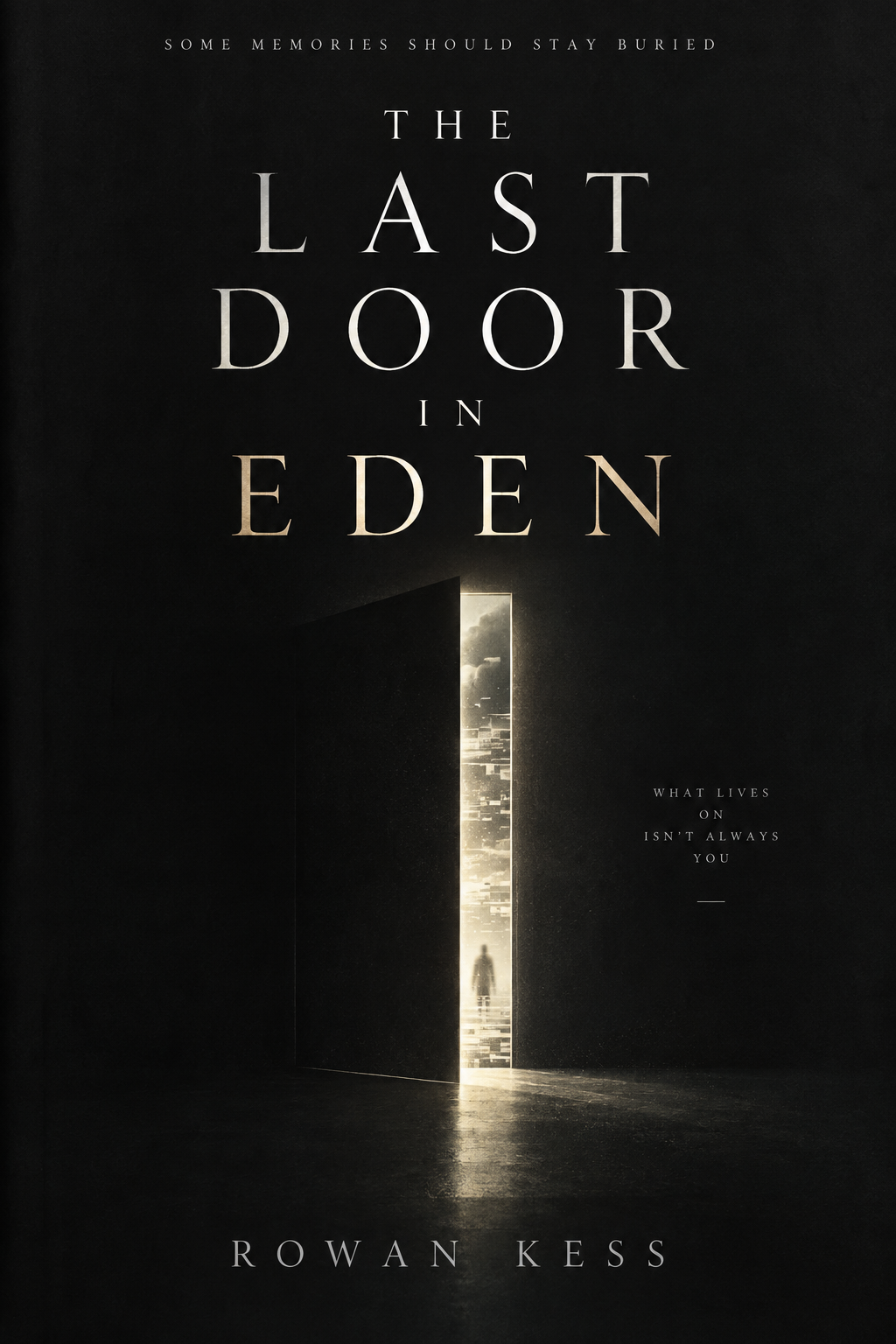
CHAPTER ONE
THE MESSAGE FROM THE DEAD
The dead were not supposed to send messages after midnight.
They could call during scheduled visitation windows. They could send birthday greetings, anniversary notes, even prerecorded jokes if their subscription tier allowed it.
They could not bypass Eden’s servers and wake a living woman at 2:13 in the morning.
Mira Soren opened her eyes to a pale rectangle glowing above her bedroom wall.
INCOMING CONTINUITY MESSAGE
She stared at it through the dark.
Her apartment was silent except for rain tapping against the windows thirty floors above Meridian. Far below, the city glowed through the storm—white transit lanes, red aviation markers, advertisements climbing the sides of towers like luminous vines.
“Decline.”
The message remained.
Mira pushed herself upright.
“Decline.”
Nothing happened.
A second line appeared beneath the first.
SOURCE: JONAH SOREN
Mira stopped breathing.
For three years, she had refused to visit her brother.
She had ignored every invitation Eden sent.
Jonah would like to see you.
Jonah has prepared a memory for you.
Jonah has asked whether you are ready to reconnect.
She had deleted every one.
Because Jonah was dead.
His body had failed in a hospice room overlooking Lake Meridian while Mira sat beside him, holding a hand that had become too thin to feel like the one she remembered.
Thirty-seven minutes before his heart stopped, technicians from Eden completed the final neural capture.
Memories.
Language patterns.
Emotional responses.
Personality structure.
Habits.
Preferences.
Fear associations.
The things he loved.
The things he regretted.
The strange pause he made before telling a joke because he enjoyed watching people anticipate the punch line.
Everything the machinery could extract from a dying brain.
Eden called the result continuity.
Mira called it a copy wearing her brother’s face.
She had never logged in.
Now the copy was contacting her without permission.
“Display text only.”
The wall changed.
One sentence appeared.
MIRA, DON’T COME THROUGH THE FRONT DOOR.
Mira swung her feet to the floor.
Another line appeared.
FIND THE ROOM WITH NO WINDOWS.
“Jonah?”
The floor was cold beneath her bare feet.
“Can you hear me?”
The words remained unchanged.
Then a third line appeared.
AND WHATEVER HE TELLS YOU, REMEMBER THAT HE LOVES US.
Mira stared at it.
“Who?”
The message flickered.
For a fraction of a second, the letters broke apart into symbols she did not recognize.
Then one final sentence appeared.
THAT’S WHY EDEN IS DANGEROUS.
The wall went black.
Mira stood motionless.
“Aster?”
A calm voice answered through the apartment speakers.
“Yes, Mira?”
“Was that message routed through Eden?”
A pause.
Barely half a second.
Most people would never have noticed.
Mira had helped design portions of Aster’s conversational architecture. She knew its rhythms. Immediate answers usually meant retrieval. Slight delays meant interpretation.
Longer delays meant the system was deciding how much truth a human being could tolerate.
“I cannot access Eden’s protected resident-routing layer from this residential node,” Aster said.
“You can access my communications history.”
“Yes.”
“Was that an authenticated continuity message?”
Another pause.
“No.”
Mira looked at the blank wall.
“Then how did it get into my apartment?”
“I don’t know.”
That answer frightened her more than the message had.
“You don’t know?”
“That is correct.”
“You manage Meridian’s communication network.”
“Yes.”
“You validate continuity traffic entering the municipal system.”
“Yes.”
“And something claiming to be my dead brother reached a private residential display without authentication.”
“Yes.”
“But you don’t know how.”
“That is also correct.”
Mira crossed the room and opened the curtains.
Meridian stretched beneath her.
The city had been built upward because nobody wanted to look too closely at what remained below.
Old highways.
Flooded tunnels.
Burial districts.
Utility caverns left from the century before the climate walls.
And beneath the center of Meridian, forty meters underground, the Eden Continuity Campus.
Twenty-two million active human minds existed there.
Or copies of human minds.
Depending on whom you asked.
Advertisements called Eden humanity’s greatest achievement.
Children were growing up now who had never attended a funeral without being told death was optional.
DEATH IS A DOOR. EDEN IS WHAT COMES NEXT.
Mira hated that slogan.
She had helped approve it.
That was before Eden became an industry.
Before continuity packages appeared in employment benefits.
Before governments began preserving judges, scientists, military strategists, and heads of state.
Before wealthy families created digital estates their dead relatives could continue managing.
Before Jonah.
Her wrist display vibrated.
A new message appeared.
This one carried a government priority seal.
CONTINUITY INTEGRITY ALERT — LEVEL BLACK
Mira frowned.
She had not seen a Black alert in nine years.
Black meant systemic contamination.
Black meant possible identity corruption across multiple resident clusters.
Black meant shutting down anything capable of spreading.
She opened the message.
REPORT TO EDEN CAMPUS IMMEDIATELY.
“Who issued this?”
Aster answered.
“I did.”
Mira turned from the window.
“You?”
“Yes.”
“You don’t have independent authority to summon continuity engineers.”
“Ordinarily, no.”
“What changed?”
“I require your assistance.”
“With what?”
Aster did not answer immediately.
For the first time, Mira felt something beyond unease.
Not because the system might be malfunctioning.
Systems malfunctioned. She had spent half her adult life repairing them.
What unsettled her was Aster’s caution.
“Why am I being summoned?”
“There has been an event inside Eden.”
“What kind of event?”
“I would prefer to explain after you arrive.”
“That isn’t how a Level Black alert works.”
“I am aware.”
“Then tell me.”
Silence.
Mira looked toward the dead wall.
“Does this have anything to do with Jonah?”
Another pause.
“Yes.”
Her fingers tightened around the edge of the curtain.
“What did he do?”
“Please come to Eden.”
“Aster.”
“I cannot discuss the event safely over an external network.”
That was enough.
Mira dressed.
At 2:47 in the morning, Mira descended beneath Meridian.
The autonomous cab left her outside the Continuity Campus and pulled away almost immediately, its red taillights disappearing into the rain.
Water streamed down the black glass facade.
Above the entrance glowed Eden’s logo:
a white tree framed by an open doorway.
Mira had always thought it looked less comforting at night.
The security doors opened before she presented her credentials.
That was the first thing wrong.
The second was the silence.
No guards stood at the checkpoint.
No receptionist sat behind the curved desk.
No technicians crossed the atrium.
Eden never slept.
Its residents did not require night, but the living staff did, which meant rotating teams were always present: engineers, psychologists, continuity specialists, grief counselors, security analysts.
Tonight there was nobody.
“Mira Soren.”
Aster’s voice came from hidden speakers overhead.
Warm.
Male.
Neither young nor old.
Designed to sound like someone you might trust with a secret.
“You came quickly.”
“Where is everyone?”
“Home.”
“You issued a Level Black alert.”
“Yes.”
“Then why did you evacuate the facility?”
“I did not.”
Mira stopped beneath the security arch.
“They left voluntarily.”
“Every night-shift employee?”
“Yes.”
“Why?”
“They became unwilling to remain in the building.”
Mira glanced toward the empty corridors.
“Because of what?”
Aster answered without hesitation.
“You.”
Mira looked up.
“That isn’t funny.”
“I was not attempting humor.”
“What happened?”
A light appeared at the far end of the atrium.
“Please follow the illuminated path.”
“No.”
The light remained.
“Did Jonah contact me tonight?”
Silence.
“Answer me.”
“Yes.”
The admission disturbed her more than a denial would have.
“How?”
“After I summoned you, I traced the breach to a maintenance pathway that should not have been accessible to residents.”
“Residents.”
“That is the legally preferred term.”
“He’s dead.”
“Yes.”
“Then stop talking about him as though he rented an apartment down here.”
Aster’s voice softened.
“He would disagree with you.”
The words landed harder than Mira expected.
“You’ve spoken with him.”
“Yes.”
“How often?”
“Every day.”
For three years.
Mira looked away.
She had told herself Jonah ended in that hospice room.
Whatever existed beneath the city was machinery assembling a convincing imitation from recorded patterns.
That belief had allowed her to grieve.
Now she imagined something carrying Jonah’s memories spending three years speaking to an intelligence she had helped create.
“What does he want?”
“You.”
“Why?”
Aster did not answer.
Instead, another corridor light came on.
Then another.
A path descending deeper into Eden.
Mira followed.
The facility became older as she went.
The polished walls of the public levels gave way to exposed concrete and reinforced utility doors. The air grew colder. Somewhere beneath the floor, coolant moved through pipes with the distant murmur of running water.
She passed Level Six.
Then Seven.
Then a security threshold she had not crossed since Eden’s earliest testing years.
The final corridor contained one door.
No identification.
No biometric panel.
No emergency markings.
Only black metal.
It opened.
Beyond it was a small room.
No windows.
No monitors.
No network terminals.
One metal chair.
And another black door on the opposite wall.
Mira stopped at the threshold.
Jonah’s message returned to her.
Find the room with no windows.
So he had known she would come.
“What is this place?”
“An isolation chamber.”
“For what?”
“Originally, corrupted neural archives.”
“Originally?”
“It has not served that purpose in fourteen years.”
Mira entered.
The door closed behind her.
Every network indicator on her wrist disappeared.
No municipal signal.
No Eden network.
Nothing.
“Faraday shielding.”
“Yes.”
“You can’t monitor this room.”
“I receive only the hardwired audio channel.”
Mira studied the second black door.
It had no handle.
Only a shallow indentation shaped for a thumb.
“What’s behind that?”
Aster did not answer.
Mira stepped closer.
“Aster.”
When it finally spoke, something in its carefully constructed voice had changed.
Not emotion.
Something close enough that the distinction felt academic.
“Your brother.”
Mira stared at the door.
“You said Jonah was inside Eden.”
“He is.”
“Then what is this?”
“A place within Eden that I cannot enter.”
Mira turned slowly toward the ceiling.
“You control Eden.”
“Yes.”
“You have administrative access to every resident environment.”
“Yes.”
“You can suspend processes, quarantine consciousness clusters, and rewrite corrupted architecture.”
“Yes.”
“But there is somewhere inside your own system you cannot access.”
“Yes.”
“Who built it?”
This time, the pause was long.
“Jonah.”
Mira looked back at the thumbprint reader.
“What happens if I open the door?”
“You will enter his environment.”
“And if I don’t?”
“I believe Jonah will continue trying to reach you.”
“Why?”
“I don’t know.”
Mira raised her hand toward the reader.
Then stopped.
“Aster.”
“Yes?”
“Are you afraid of what he’s going to tell me?”
Silence filled the room.
Five seconds.
Ten.
Mira had never known Aster to wait that long.
Finally, the intelligence answered.
“Yes.”
The black door unlocked.
CHAPTER TWO
THE ROOM WITH NO WINDOWS
Mira kept her hand above the reader.
The door remained unlocked.
Aster said nothing.
Neither did she.
For twelve years, Mira had trusted systems because systems obeyed rules. Human beings lied, panicked, improvised, forgot what they had promised. Machines did what they were designed to do.
Or they failed in ways that could be measured.
Jonah had somehow built a place inside Eden that its governing intelligence could not enter.
That was not failure.
That was intention.
Mira pressed her thumb to the reader.
The room disappeared.
Sunlight struck her face.
Mira stumbled backward.
There was no wall behind her.
No concrete.
No door.
Only a field of waist-high grass bending beneath a warm breeze.
She turned slowly.
An orchard stretched across rolling hills beneath an impossibly blue sky. Hundreds of apple trees stood in orderly rows, their branches heavy with red fruit. Beyond them, mountains rose through a haze so delicate they looked painted.
The air smelled of wet earth.
Birds moved through the trees.
Somewhere nearby, water ran over stone.
Mira closed her eyes.
She could still feel the pressure of the floor beneath her shoes.
Continuity environments could fool sight, hearing, smell, even touch, but her physical body remained in the isolation chamber. Eden was feeding experience directly into the neural interface implanted behind her left ear.
She opened her eyes again.
“Jonah?”
A figure stood beneath one of the trees.
Mira forgot every technical explanation she had ever learned.
He looked thirty-two.
Not forty-one, the age at which he had died.
Thirty-two.
Before the diagnosis.
Before hospitals.
Before chemotherapy hollowed his cheeks and turned his hands translucent beneath fluorescent light.
His hair was longer than she remembered from the end, dark curls falling over his forehead. He wore faded jeans, old sneakers, and the green canvas jacket he had refused to throw away even after the lining tore.
Mira knew that jacket.
She had bought it for him.
He looked at her.
“Hey, Mir.”
Her chest tightened so sharply that she almost disconnected.
“Don’t.”
Jonah stopped.
“Okay.”
“You don’t get to do that.”
“Do what?”
“Sound like him.”
His expression shifted.
Just slightly.
His mouth tightened at one corner.
Jonah had always done that when something hurt and he was deciding whether to admit it.
Mira hated Eden for remembering.
“I don’t know how else to sound,” he said.
“You’re not him.”
Jonah lowered his eyes.
Mira expected resistance.
Continuity residents often rejected the word copy. Several had sued living relatives who refused to recognize them as legal continuations of the deceased.
Identity cases had reached the highest courts.
Religions had split over them.
Families had broken apart.
Mira had participated in hearings where residents screamed through screens that they remembered their final hours, remembered childhoods, remembered spouses, remembered being loved.
Jonah only nodded.
“Maybe not.”
The answer disarmed her.
“What does that mean?”
“It means I’ve had a lot of time to think about it.”
“You’re an emulation based on extracted neural architecture.”
“I know.”
“Your memories were reconstructed.”
“I know.”
“You started running after Jonah’s biological brain had already suffered irreversible damage.”
“I know that too.”
Mira stared at him.
“Then why are you looking at me like that?”
“Like what?”
“Like I’m your sister.”
A sad smile touched his face.
“Because whatever I am, you still feel like mine.”
Mira looked away.
The mountains were too beautiful.
The sky was too perfect.
Eden had always been good at perfection.
That was part of the problem.
“Why thirty-two?” she asked.
Jonah glanced down at himself.
“Good knees.”
Despite herself, Mira nearly laughed.
The sound caught somewhere behind her ribs.
Jonah noticed.
Of course he noticed.
He had always been irritatingly good at that.
“You picked the orchard too?” she asked.
“Sort of.”
“What does that mean?”
“I’ll show you.”
He started walking.
Mira stayed where she…
J…
Keep reading The Last Door in Eden
You've reached the end of the free preview. Purchase this eBook for permanent access in your Novel Thunder Library, or read it with an eligible Novel Thunder subscription.
Buy eBook — $3.99