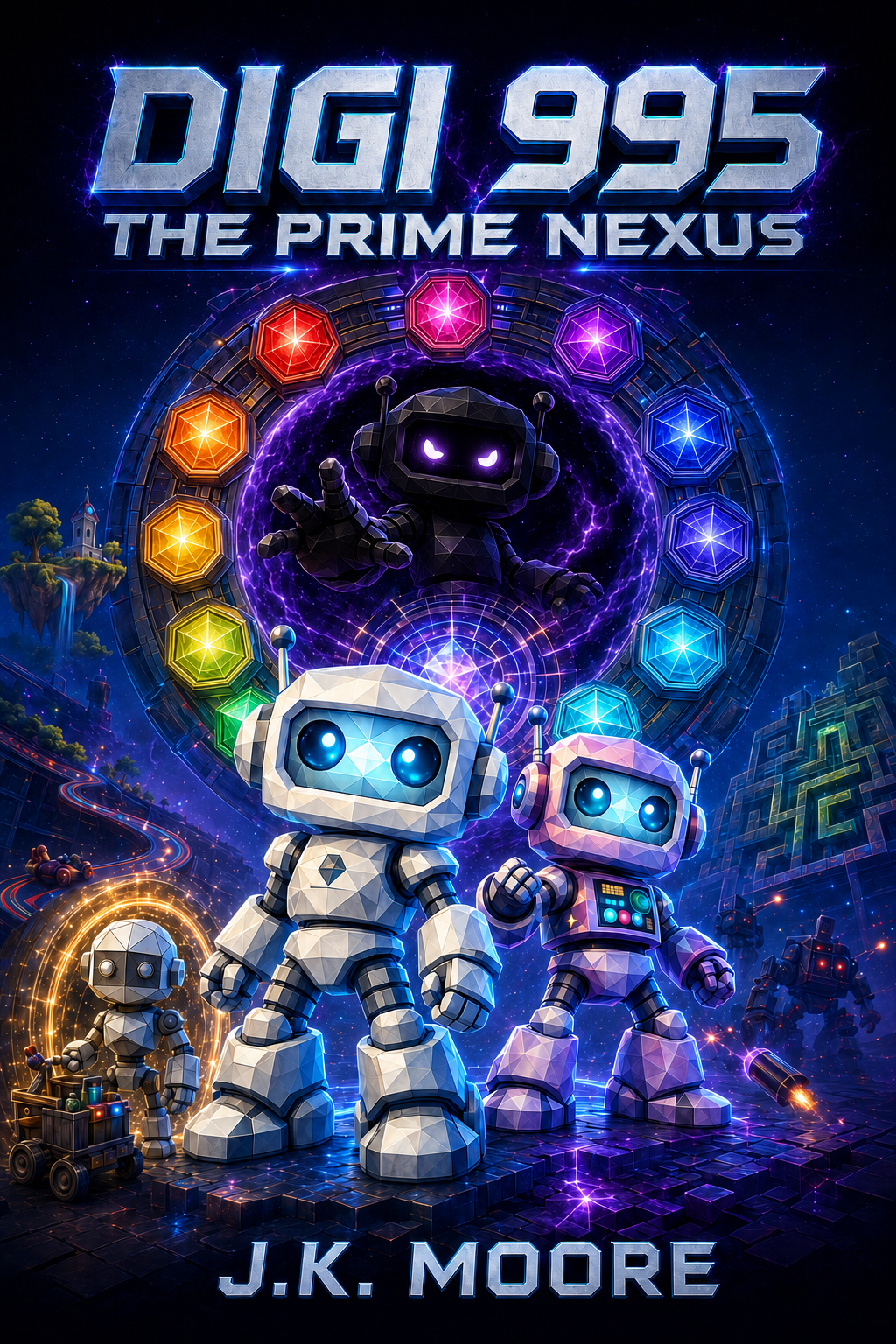
Chapter One
Where Am I
For the first time since my creation, nobody needed me.
I stood beneath the shade of a tree at the edge of the city and watched the world continue without me.
The afternoon sun rested warmly across the rooftops. Light flashed from windows as people moved through their homes. Vehicles rolled along the streets in orderly lines. Somewhere beyond the nearby buildings, a bell chimed the hour, and no alarm followed it.
No warning sirens.
No distant explosions.
No call for help.
Only the ordinary rhythm of people living ordinary lives.
Then something happened. A spark. Then it began to grow. A portal began to form.
The portal opened before I could take another step.
A sharp crack split the air behind me. Blue-white light spilled across the pavement, stretching my shadow between the passing feet of people who did not stop to look.
I turned.
The portal hung between two buildings, its surface snapping with bright squares of static. It had no frame, no controls, and no explanation.
They never did.
I watched it for several seconds, waiting for something to emerge. Nothing came through. The light continued flickering while the world around it carried on as if reality had not just opened a door where no door belonged.
“Where this time?” I asked.
The portal offered no answer.
I looked back at the street. People talked, crossed intersections, entered buildings, and continued lives that no longer required my protection. This world had made its choice.
Apparently, the portal had made one too.
I stepped toward it.
Static crawled across my armor before I touched the surface. My systems registered energy, motion, and several readings that contradicted one another. Before I could finish analyzing any of them, the pavement disappeared beneath me.
The portal pulled me through.
Light spun in every direction. Gravity changed its mind three times. A burst of electronic music chimed somewhere inside the tunnel, followed by a sound like an old machine switching on.
Then the portal threw me out.
I struck solid ground, slid across a clean sidewalk, and stopped beside a public bench.
A man sitting there lowered his newspaper and stared at me.
“Sorry,” I said.
He stood, folded the newspaper under his arm, and hurried away.
I pushed myself upright and examined my surroundings.
Cars moved steadily along a wide street. People carried shopping bags, waited at crosswalks, and talked outside small restaurants. Tall buildings rose above older brick storefronts. Delivery vehicles stopped at the curb while workers unloaded boxes.
There were no alarms.
No smoke.
No soldiers.
Nothing appeared damaged, invaded, or in immediate need of rescue.
I turned toward the portal, but it had already begun shrinking.
“Wait.”
It collapsed into a single point of blue light and vanished.
No destination. No explanation. No way back.
Again.
I scanned the peaceful street once more.
“At least nobody is shooting at me,” I said.
Then I chose a direction and started walking.
The city did not react to me like I was a threat.
A few people looked in my direction, but most continued walking. Nobody reached for a weapon. No alarms followed me down the street. Even the man from the bench had only moved far enough to put several other pedestrians between us.
That was understandable. Robots appearing through holes in reality were probably not part of his morning routine.
I continued along the sidewalk while my systems gathered what information they could.
The atmosphere matched Earth. So did the gravity, language, road design, and the general habit of pedestrians stepping into traffic before the crossing signal changed.
But this was not my Earth.
Buildings stood where my records said none should exist. Street names were familiar until they suddenly were not. An old stone clock tower occupied the center of a modern shopping district, surrounded by restaurants, offices, and apartment buildings that looked as though they had grown around it instead of replacing it.
Nothing carried the scars I expected.
There were no reinforced checkpoints. No emergency barricades stacked beside intersections. No surveillance drones sweeping rooftops for approaching attackers. The people around me moved without constantly checking the sky.
A small machine rolled past, brushing litter from the sidewalk.
I stepped aside.
“Thank you,” it said.
“You’re welcome.”
It stopped.
The machine rotated toward me. Two mechanical arms folded against its narrow body, and a collection bin covered most of its back.
“Are you assigned to this block?” it asked.
“No.”
“Excellent. This block is already assigned.”
It turned around and continued cleaning.
I watched it go.
Farther ahead, another robot unloaded packages from a delivery vehicle. One stood behind the counter of an outdoor café, passing drinks to waiting customers. A third moved slowly beside an elderly man, carrying his bags while reminding him that one of the containers needed refrigeration.
Robots were everywhere.
None of them carried weapons.
None appeared designed for battle.
They cleaned streets, delivered food, repaired signs, and helped people with ordinary tasks. People spoke to them without fear. Some barely noticed them at all.
I examined my armor.
Compared with the machines around me, I looked prepared to invade the city.
A bus stopped beside the curb. Its doors opened, and several passengers stepped onto the sidewalk. A young boy holding his mother’s hand noticed me immediately.
He stopped walking.
His mother took two more steps before his arm pulled tight between them.
“What is it?” she asked.
The boy pointed at me. “Why is the game-store robot out here?”
His mother looked up.
Her eyes moved from my head to my armor and then back to my face.
“Don’t point,” she said quietly.
“But he looks different.”
“I noticed.”
I approached slowly enough not to alarm them.
“Excuse me,” I said. “What game-store robot?”
The mother pulled the boy slightly closer.
He leaned around her and stared at me with open curiosity.
“The one from the game store,” he said.
“That part I understood.”
“He fixes things.”
“And sells games,” his mother added. “The children see him through the window.”
“Does this robot look like me?”
The boy studied me with the seriousness of someone comparing two nearly identical puzzle pieces.
“Kind of.”
“Kind of?”
“You have more armor.”
His mother gave him a look.
“What?” he said. “He does.”
I could not argue with that.
“Where is this store?”
The boy pointed across the intersection. “Down there. Past the bakery.”
“Thank you.”
I started to turn away.
“Are you two brothers?” he called after me.
I looked back at him.
“I have no idea.”
The crossing signal changed, and I followed the flow of pedestrians to the other side of the street.
Past the bakery, the businesses became smaller. A repair shop sat beside a bookstore. Next came a clothing store, a restaurant, and a narrow shop filled with phones and electronic parts.
Then I saw it.
The store occupied the corner at the end of the block. Posters covered part of its front windows. Shelves of games and consoles were visible through the glass. A sign above the entrance advertised games, repairs, accessories, and tournaments.
Beside the words was the image of a robot’s face.
My face.
Almost.
The head was shaped differently, with heavier lines and an older design. The features were simplified for the sign, but the resemblance was impossible to dismiss. The same eyes. The same structure around the sides of the head. The same antennas positioned near the ears.
I stopped in the middle of the sidewalk.
People moved around me while I compared the image with the reflection staring back from the store window.
The boy had been right.
Somewhere inside that building was a robot who looked like me.
I crossed the final stretch of sidewalk and stood beneath the sign.
“No alarms, no soldiers, and apparently another me,” I said.
This world was becoming interesting.
The door opened with a soft electronic chime.
I stepped inside.
Shelves filled most of the store, arranged in neat rows with games, controllers, cables, headsets, and accessories. Newer consoles occupied displays near the front. Older systems sat behind glass cases along one wall. Several arcade machines lined the back, their screens running demonstrations for empty stools.
A repair counter stood to my right.
Behind it, a robot leaned over an open console with a tool in one hand.
He had not noticed me yet.
I noticed everything about him.
His frame was close to mine in height and basic construction, but the differences were immediate.
My exterior was mostly white and silver, protected by thick, angular plating built to survive combat. A solid faceted plate covered my chest, with reinforced armor continuing across my arms, hands, legs, and feet.
His plating was lighter and less reinforced. White remained underneath, but much of his frame carried a soft pink-and-purple tint that changed beneath the store lights. Small star designs decorated his forearms and chest.
The greatest difference was his chest plate.
Instead of solid armor, he had a rectangular control panel built directly into his torso. Colored buttons, indicator bars, and a circular green display filled its surface. One of his ear housings also carried a large round detail that made his design look like it came from an earlier technological era.
Yet the similarities were impossible to ignore.
The same bright eyes. The same screen-like face. The same antennas rising beside the head. The same general structure beneath two very different kinds of plating.
He looked like a version of me designed for another purpose.
A customer stood on the opposite side of the counter, watching him work.
“How bad is it?” the customer asked.
The robot removed a damaged part from the console.
“Someone poured a drink into it.”
“That was my son.”
“The console did not provide a name.”
“Can you fix it?”
“I can fix the console. Your son may require a different specialist.”
The customer laughed.
The robot reached for another tool.
Then he looked up and saw me.
His hand stopped halfway across the counter.
I stood near the entrance.
He stood behind the repair bench.
Neither of us moved.
The customer followed his stare and turned toward me.
“Oh,” the customer said.
The robot slowly set down his tool.
I raised one hand.
“Hello.”
His eyes narrowed slightly.
“I do not remember ordering another employee.”
“I’m not an employee.”
“Then you are violating the dress code.”
I looked down at my armor. “You have a dress code?”
“I do now.”
The customer moved away from the counter so he could see both of us.
“Is this some kind of promotion?” he asked.
“No,” the robot and I answered together.
We looked at each other again.
The customer nodded as if that had answered nothing.
The robot returned his attention to the console. He installed the replacement part, secured the casing, and pressed the power button. The system started immediately.
“There,” he said. “It works.”
The customer continued staring at me.
The robot slid the console across the counter.
“Try to keep future beverages outside the ventilation ports.”
“Right.”
“And consider purchasing your son a cup with a lid.”
“I’ll do that.”
The customer collected the console but did not leave. He glanced between us once more.
“You’re sure this isn’t a promotion?”
“I am becoming less sure by the second,” the robot said.
The customer finally walked toward the exit. He passed me slowly, examining my armor as he went.
The door chimed behind him.
Now we were alone.
The robot stepped out from behind the counter.
I moved farther into the store.
He examined the reinforced plating across my arms, chest, and legs. His attention paused on several marks my armor had collected during battles.
I studied the pink-and-purple tint across his lighter frame, the star details on his forearms, and the control panel built into his chest. Several indicators changed as he examined me. A green circle brightened, then returned to its previous glow.
He circled me.
I turned to keep him in view.
“You are heavily armored,” he said.
“You have buttons in your chest.”
“They are controls.”
“One is pink.”
“It remains a control.”
“What does it do?”
“You are not authorized to press it.”
“I wasn’t going to.”
“You looked like you were considering it.”
“I was examining it.”
“With your finger.”
I lowered my hand.
The robot looked at the reinforced plate covering my chest.
“You were built for combat.”
“Yes.”
“I was built for customers.”
“That may explain the chest controls.”
“It explains some of them.”
I waited for him to elaborate.
He did not.
A thin beam passed over my shoulder as he scanned my frame.
My systems detected it immediately.
“Are you scanning me?”
“Yes.”
I activated my own scanner.
A matching beam moved across his chest.
He looked down at it.
“Are you scanning me?”
“Yes.”
“That seems unnecessary.”
“You started it.”
“That does not make it necessary.”
“It makes it fair.”
He considered that.
“Acceptable.”
Our scans finished at nearly the same time.
The results confirmed what I could already see. The construction beneath our plating shared too many patterns for coincidence, but our exterior systems had developed around completely different purposes.
My white-and-silver frame carried heavier armor, reinforced joints, and protection intended for battle. His tinted plating favored mobility, precision work, and direct access to the controls embedded in his chest.
Different functions built over a strangely familiar foundation.
Neither scan explained why two separate Earths had produced two versions of the same robot.
He reviewed his findings.
I reviewed mine.
“You are not from here,” he said.
“What gave it away?”
“The armor. The entrance. The fact that I have never seen you before.”
“You saw my entrance?”
“No. But ordinary customers use the door immediately instead of standing outside speaking to my sign.”
I looked toward the front window.
“You heard that?”
“The exterior microphones did.”
I made a note to inspect signs more carefully before talking beneath them.
The robot folded his arms.
“Who are you?”
“I’m Digi 995.”
He looked at me for another moment.
“Of course you are.”
“What does that mean?”
“You look like someone who would attach a number to his name.”
“I didn’t choose it.”
“That makes more sense.”
“And you are?”
“Retro Digi.”
I waited for the rest.
There was no rest.
“Just Retro Digi?” I asked.
“It has worked so far.”
“Your name is on the store?”
“My face is on the store.”
“It looks like my face.”
“No. Your face looks like mine.”
“I arrived less than an hour ago.”
“Then mine was here first.”
“That is not how alternate versions work.”
“You know we are alternate versions?”
“I know you entered my store wearing combat armor, share several of my core design structures, and seem personally offended by my sign. Alternate version is currently the least inconvenient explanation.”
I could not find a better one.
“Where am I?” I asked.
“My store.”
“I noticed.”
“Then we are making progress.”
“What world is this?”
His dry confidence shifted into genuine curiosity.
“Earth.”
“Which Earth?”
“The one containing my store.”
I stared at him.
“That was also a joke,” he said.
“I know. I was deciding whether it was useful.”
“And?”
“It was not.”
“Then we are even.”
He walked back behind the counter and began returning his tools to their compartments.
I approached the repair bench.
“This Earth is different from mine.”
“I assumed it would be. Otherwise, one of us has been doing an impressive job of avoiding the other.”
“I was created during a war.”
Retro Digi stopped organizing the tools.
“What kind of war?”
I gave him a brief description. The destruction. The machines built for combat. The people who had needed something capable of standing against them.
His attention remained focused, but the humor left his voice.
“Nothing like that happened here.”
“No War Bots?”
“No.”
“No Resistance?”
“Not unless you count customers resisting the extended warranty.”
I looked through the front window.
People continued along the sidewalk. Cars passed. A delivery robot carried packages into the business across the street.
“You were not built to fight,” I said.
“I was commissioned to operate this store.”
“That is all?”
“I sell games, repair consoles, assist customers, maintain the arcade machines, and organize tournaments. That is already several jobs.”
“No one needed you to save them?”
Retro Digi placed the final tool inside a drawer.
“From corrupted storage drives occasionally.”
I looked at his lighter, tinted frame and then at my reflection in the glass counter.
This world had created its version of me too.
Not as a weapon.
Not as a defense.
Not as a savior.
The realization settled over me, but it did not carry the same weight it once would have. I had already seen one world choose its own future. This one had apparently reached the present without requiring me at all.
Retro Digi watched me.
“You appear disappointed that nobody needs rescuing.”
“No.”
“Good. That would be concerning.”
“I’m trying to understand why the portal brought me here.”
“What portal?”
“The one that dropped me into this world.”
Retro Digi leaned forward slightly.
“You traveled here through an active portal?”
“Yes.”
“From another Earth?”
“Yes.”
“Do you know who opened it?”
“No.”
“Do you know why it selected this world?”
“No.”
“Can you reopen it?”
“No.”
He paused.
“You have brought me an impressive amount of nothing.”
“I also brought armor.”
“That was difficult to miss.”
Retro Digi closed the console-repair tray and rested both hands on the counter.
His attention had changed. He was no longer examining me as a strange customer or possible alternate version. He was studying a problem.
“You should start from the beginning,” he said.
“I fell through a portal.”
“Start before the falling.”
“How far before?”
Retro Digi looked at my armor.
“Far enough to explain why another version of me arrived prepared for war.”
“That may take a while,” I said.
Retro Digi looked around the store.
“I work in retail. I am familiar with stories that take longer than necessary.”
“You asked.”
“And I am already preparing for the consequences.”
He left the repair counter and motioned for me to follow.
“If you are going to explain yourself, you can do it while I finish my closing inspection.”
“Are you closing the store?”
“No. Closing inspection sounded more important than checking whether customers returned controllers to the correct shelves.”
We entered the first aisle.
Retro Digi straightened several game cases while I considered where to begin.
“I was awakened by the Resistance,” I said. “Lena, Rook, Tobias, and Elias.”
“Four people were required to turn you on?”
“They were fighting a war.”
“That explains the inefficient staffing.”
“They needed help against the War Bots.”
Retro Digi stopped adjusting the cases.
“The machines you mentioned earlier?”
“Yes. They were created for war. W-00X commanded them.”
“And the Resistance created you to stop him?”
“Elias created me. The others helped awaken me when they needed me.”
Retro Digi glanced at my armor.
“That is a more reasonable explanation for your construction than aggressive customer service.”
He continued down the aisle.
I followed him past a display of controllers.
“The war led me beyond Earth. I discovered the Restoration Cards and learned that magic was real.”
Retro Digi stopped again.
“Cards.”
“Yes.”
“With magic.”
“Yes.”
“Were the cards magic, or did they lead you to magic?”
“It is complicated.”
“That usually means the explanation is longer than the answer deserves.”
“They helped lead me to Eldoria.”
Retro Digi removed a controller from the wrong display and carried it toward another shelf.
“And Eldoria is?”
“A world of magic. Kingdoms, ancient forces, and dangers that had nothing to do with the war I was created to fight.”
“You traveled from a machine war to a magical kingdom because of cards.”
“When you say it like that, it sounds unlikely.”
“I am repeating what you told me.”
“It sounded more reasonable while it was happening.”
Retro Digi placed the controller in its proper display.
“Most disasters do.”
We reached the back section of the store, where the arcade machines stood in two rows. Retro Digi opened a small panel on the side of the nearest cabinet and checked the components inside.
“In Eldoria, I fought Nexusus,” I continued.
“War Bot?”
“No.”
“Wizard?”
“Not exactly.”
“Difficult customer?”
“Very.”
Retro Digi closed the panel.
“Finally, something I understand.”
“He was defeated, but the danger did not end with him. I traveled through the Void.”
Retro Digi’s hand remained on the arcade cabinet.
“The Void?”
“A place that consumes and corrupts. It spreads into other worlds.”
“That sounds less manageable than a damaged console.”
“It was.”
“And you went inside willingly?”
“Not every part of the journey was voluntary.”
“I am beginning to see a pattern.”
I watched one of the arcade screens cycle through its demonstration. The character on-screen reached the end of a path, disappeared, and restarted at the beginning.
“I eventually made it back to Earth,” I said. “The Resistance was still fighting. W-00X was preparing for the final battle.”
Retro Digi moved to the next machine.
“You defeated him.”
It was not a question.
“Yes.”
“Then you saved your Earth.”
“I stopped W-00X.”
“That was not my statement.”
I looked away from the screen.
“Eldoria fell to the Void before I could save it.”
Retro Digi stopped.
The lights from the arcade machines moved across the pink-and-purple tint of his plating. For once, he did not respond with a joke.
“I won the battle I was created to fight,” I said. “But another world was lost while I fought it.”
“Could you have reached Eldoria in time?”
“I don’t know.”
“That is not the same as no.”
“No.”
“It is also not the same as yes.”
I looked at him.
Retro Digi closed the maintenance panel more gently than before.
“You are carrying responsibility for two worlds,” he said. “One because it needed you and another because you believe you failed it.”
“I did fail it.”
“Possibly. I was not there.”
His answer was neither agreement nor reassurance. It was simply honest.
That made it easier to continue.
“After the war, another portal appeared. It brought me to a world where I met another version of myself. Frankedigi.”
Retro Digi turned toward me.
“There are more of us?”
“At least one.”
“What color was he?”
“That is your first question?”
“I already know he traveled through a portal and looked like us. Color remains unresolved.”
“He looked different.”
“That answer is intentionally unhelpful.”
“I learned it from you.”
Retro Digi gave a small tilt of his head.
“I may regret being a positive influence.”
“The next portal carried me to another Earth. There had been no War Bot invasion there. The Resistance never needed to awaken its version of me.”
“So that world did not have a Digi?”
“It did not need one.”
Retro Digi looked around his store.
“I am becoming less unique with every sentence.”
“That world had Lena, Rook, Tobias, and Elias.”
“The people who awakened you?”
“Yes.”
“And they did not recognize you?”
“No. Their lives had followed different paths.”
I paused beside one of the machines.
In my world, their voices belonged to memories. In that world, they argued, worked, laughed, and continued living without knowing what their other selves had sacrificed.
Seeing them had hurt.
Leaving them had been worse.
“They died in my world,” I said.
Retro Digi’s attention settled on me.
“All four?”
“Yes.”
His chest indicators dimmed slightly.
I did not explain how they died. I did not list the moments I had replayed or the decisions I had questioned. Their alternate lives had belonged to them. Their deaths belonged to my world.
Retro Digi waited until I continued.
“The world chose its own future,” I said. “It rejected the plan that would have created me. I had no enemy to fight and no mission to complete.”
“What did you do?”
“I remained.”
“For how long?”
“Until the portal opened.”
Retro Digi examined me as though the answer had changed one of his earlier conclusions.
“You do not control these portals.”
“No.”
“You cannot predict them.”
“No.”
“You do not know who creates them.”
“No.”
“But each one takes you to another world containing some version of your history.”
“So far.”
“That is not random.”
“I know.”
“It is also extremely poor transportation service.”
“I know that too.”
“No schedule. No return route. No destination notice.”
“I once received light and several readings that contradicted one another.”
“Unacceptable.”
“I will submit a complaint when I locate whoever is responsible.”
Retro Digi moved past the arcade machines and opened a door marked EMPLOYEES ONLY.
I looked at the sign.
“Am I allowed back there?”
“No.”
He held the door open.
“Then why are you letting me in?”
“Because you have survived a machine war, traveled through magic, crossed the Void, defeated W-00X, lost a world, met alternate versions of yourself, and been thrown through several unexplained portals.”
“That makes me an employee?”
“It makes the sign unlikely to stop you.”
The room beyond contained shelves of replacement parts, several worktables, and a row of consoles connected to diagnostic equipment. Cables ran between the systems in neat, labeled paths. Retro Digi checked each station as we passed.
“This is where I handle repairs that require more than the front counter,” he said. “Storage failures, damaged processors, network problems, corrupted data, and customers who insist they did nothing before the system stopped working.”
“Do they usually do something?”
“Always.”
He reached the final workstation.
A console sat beneath a dark monitor. Unlike the systems near the front, it had no repair tag, customer information, or open casing.
I pointed toward it.
“What is wrong with that one?”
“Nothing.”
A sharp electronic pulse interrupted him.
The monitor flashed.
Retro Digi’s chest panel responded immediately. The circular green display turned amber. Colored indicators moved in rapid patterns across the rectangular controls.
The console emitted another pulse.
The monitor filled with broken lines of light.
Retro Digi stepped closer.
“What happened?” I asked.
He did not answer.
His hands moved across the diagnostic controls. The joking store worker disappeared behind sudden precision. He checked the console, the attached cables, and the readings on his chest display.
The signal pulsed a third time.
This time, the monitor showed a distorted image for less than a second.
A world.
Then static covered it again.
Retro Digi studied the readings.
“That signal isn’t coming from the console,” he said.
The circular display in his chest changed from amber to red.
“It’s coming through it.”
Chapter Two
The Colorless World
I moved closer to the workstation.
Retro Digi raised one hand without looking away from the monitor.
“Do not touch anything.”
“I wasn’t going to.”
“You said that about my chest controls.”
“I did not touch those.”
“Because I stopped you.”
The broken lines on the monitor shifted. For an instant, they formed the outline of buildings beneath a blue sky. Then a gray wave passed across the image.
The sky lost its color.
Blue drained into white. Green disappeared from the trees. The buildings faded until they looked like unfinished drawings.
Static swallowed the image.
Retro Digi pressed two controls on his chest. The circular display changed from red to green, then divided into several rotating sections. Matching symbols appeared across the diagnostic screens.
The cables attached to the consoles lit one after another.
“You are doing more than repairing it,” I said.
“Yes.”
“What is this room?”
“The Console Room.”
“I thought it was your repair area.”
“It is.”
Retro moved between the workstations, activating systems as he went.
“The front of the store is where customers buy games, play arcade machines, enter tournaments, and ask whether dropping a console from a second-floor window is covered by the warranty.”
“Is it?”
“No.”
He activated another monitor.
“The Console Room is where I maintain the systems behind those games.”
The room changed around us. Dark screens awakened. Lines of information appeared across them, connecting each console to a central display built into the wall.
Dozens of game titles filled the screen.
Some I recognized from the store shelves.
Others I had never seen.
Thin lines connected every title to a glowing structure at the center.
“The Console Matrix,” Retro Digi said.
I studied the web of connections.
“You built this?”
“No.”
“Who did?”
“Not relevant to the current emergency.”
“That means you are not going to tell me.”
“That means I am trying to prevent an entire game from collapsing while you ask historical questions.”
He selected one of the titles.
COLOR PROTOCOL
The words expanded across the central screen. Beneath them appeared maps, player records, system activity, and rapidly changing diagnostic reports.
“That is the game?” I asked.
“The exact game customers purchase and play.”
“So this is damaged software.”
“More than damaged.”
“It is still a game.”
“To the people holding controllers, yes.”
Retro entered another command. The image of the colorless city returned.
“Players normally experience Color Protocol through a screen. They restore color, complete its challenges, collect rewards, and progress through the world according to its rules.”
“And you?”
“I can connect directly.”
The gray wave moved across another section of the city. A red building faded. A row of yellow lights turned white. Even the shadows appeared to weaken.
Retro’s chest display flashed.
“The Console Matrix allows me to upload my active consciousness into the game. Once connected, I can move through its systems from the inside.”
I looked from the screen to him.
“You enter the game.”
“I believe I just said that.”
“You said you upload your consciousness.”
“Yes.”
“That is not how people normally play.”
“No. It would create unacceptable customer-service complications.”
The image distorted violently.
A section of the city disappeared.
Not faded.
Disappeared.
Buildings, streets, and trees broke into empty white space.
Retro moved quickly across the controls. He isolated the damaged section, but the blank area continued growing.
“Color Protocol is not another Earth,” he said. “It is a digital world created for this game. But when a complete consciousness enters through the Matrix, the code becomes an environment. Its objects become solid. Its hazards become dangerous. Its rules become physical laws.”
“And the damage?”
“Also real while we are connected.”
I watched another street vanish.
“You said ‘we.’”
Retro stopped.
“I said nothing of the kind.”
“You said ‘while we are connected.’”
“A grammatical error.”
“You do not make grammatical errors.”
“I have known you for less than an hour. You cannot possibly know that.”
“You are planning to take me.”
“I am considering whether your armor would be useful or merely decorative.”
The console released another pulse.
Every screen in the room flashed gray.
Retro’s chest indicators shut off for half a second.
His body stiffened.
Then the lights returned.
“What happened?” I asked.
“The game rejected my diagnostic request.”
“Can games normally do that?”
“No.”
“Then you need help.”
“I need accurate information.”
“You need someone who has fought things that were not supposed to exist.”
Retro turned toward me.
“You do not understand the rules inside Color Protocol.”
“You do.”
“Yes.”
“You understand the game. I understand enemies that break expected rules.”
“We do not know whether there is an enemy.”
“Something just attacked your diagnostic system.”
“It rejected access.”
“It knocked out your chest lights.”
“That was a temporary interruption.”
“It looked like an attack.”
“You view most problems as attacks.”
“Most of my problems have attacked me.”
Retro looked back at the spreading blank space.
He could enter alone. That much was clear.
It was equally clear that he no longer wanted to.
“You said you were the Keeper,” I said.
“I have not said that yet.”
“You were going to.”
Retro stared at me.
“You are very irritating.”
“I learned from an experienced store worker.”
His circular chest display changed from green to blue. The Console Matrix responded, drawing its connected lines toward Color Protocol.
“I am the Keeper of the Console Network,” he said. “I maintain the connections between its games, monitor their stability, and enter them when an external repair is insufficient.”
“And the Console Matrix?”
“I am its Guardian.”
I looked toward the front of the store, beyond the closed door.
“You secretly protect all these games while selling controllers.”
“There is nothing secret about selling controllers.”
“You know what I meant.”
“My work in the store is not a disguise, Digi 995. Customers require help. Consoles require repair. Arcade machines require maintenance. Tournaments require organization.”
“And game worlds occasionally erase themselves.”
“Not until today.”
The monitor flashed again.
Another color vanished.
Purple this time.
A field of flowers became gray before breaking apart into white fragments.
Retro entered several commands. The Matrix offered no response.
“I cannot repair this externally,” he said.
“So we enter.”
“I enter.”
“You already admitted that you need me.”
“I admitted no such thing.”
“You used the word ‘we.’”
“I withdrew it.”
“I did not accept the withdrawal.”
Retro faced me fully.
“If you connect, your armor may not function the way it does here. Color Protocol decides what abilities are available. Its mechanics control movement, interaction, success, and failure.”
“I have adapted to unfamiliar worlds before.”
“This is not an unfamiliar world. It is a game.”
“I have adapted to those too.”
“Not like this.”
He pressed a command.
Two mechanical chairs extended from the wall. Each had a high back, arm restraints, and a group of cables connected to the Matrix.
I examined them.
“They look comfortable.”
“They are not.”
“That was also a joke.”
“It was also accurate.”
Retro sat in the first chair. Several cables moved automatically toward connection points along his back, arms, and the base of his head.
He paused before allowing them to connect.
“There is something else.”
“What?”
“Ordinary players are safe. Their controllers send commands into the game, but their minds and bodies remain separate from it.”
“That will not be true for us.”
“No.”
Retro indicated the second chair.
“The Matrix transfers your entire active consciousness. Your physical body remains here, but everything that makes you aware enters the game.”
“And if I am injured?”
“You experience the injury.”
“If I die?”
Retro’s chest controls went still.
“Your consciousness is destroyed.”
I looked at the empty chair.
“My body?”
“Permanently shuts down.”
“So I die in the game and in this world.”
“Yes.”
“No extra lives?”
“No.”
“Respawning?”
“No.”
“Checkpoints?”
“They may preserve game progress. They will not preserve you.”
“You should have started with that.”
“I was working toward it.”
The gray signal struck again.
This time, the Console Matrix emitted a warning tone.
Color Protocol’s status changed from UNSTABLE to CRITICAL.
Retro looked at the central screen.
“If the game collapses while I am connected, I may not be able to extract either of us.”
“You continue improving this offer.”
“You are free to remain here.”
“And do what?”
“Protect our empty bodies.”
“From what?”
“Customers ignoring the EMPLOYEES ONLY sign.”
I approached the second chair.
Retro watched me.
“You do not have to enter,” he said.
“Yes, I do.”
“No world commissioned you to save it.”
“This one does not need to.”
I sat down.
Retro studied me for a moment before activating the restraints.
They closed around my arms and legs.
“Those are necessary?” I asked.
“Your body may react when consciousness transfer begins.”
“How?”
“Violently.”
“You continue remembering important details very late.”
The cables moved toward me. One connected to my back. Another locked into an access point beneath my chest armor. Two more attached near the base of my head.
My systems recognized the Matrix but could not identify its full architecture.
Retro’s chair completed its connections.
His pink-and-purple plating reflected the blue light surrounding him.
“Once transfer begins, do not resist it,” he said.
“What happens if I resist?”
“It becomes unpleasant.”
“And if I do not?”
“It remains unpleasant.”
Retro activated the final control on his chest.
The room darkened.
Every connected game disappeared from the central screen except Color Protocol.
The game expanded until its damaged world filled the wall.
One patch of color remained in the city.
A narrow red road cutting through endless gray.
“Connection synchronized,” Retro said.
A cold pulse entered through the cables.
My hands disappeared.
Not physically. I could still feel them restrained against the chair. But my awareness of them began separating from the body that held them.
The Console Room stretched into thin lines of light.
Retro Digi broke apart into pink, purple, and white fragments beside me.
My own armor followed.
The last thing I saw was the central screen.
Then I fell through it.
There was no portal.
No tunnel.
No changing gravity.
One moment I occupied my body in the Console Room.
The next, I struck a hard street beneath a white sky.
I rolled, regained my footing, and checked my frame.
My armor had entered with me.
Across the street, Retro Digi formed from hundreds of…
Th…
Keep reading Digi 995: The Prime Nexus
You've reached the end of the free preview. Purchase this eBook for permanent access in your Novel Thunder Library.
Buy eBook — $6.99