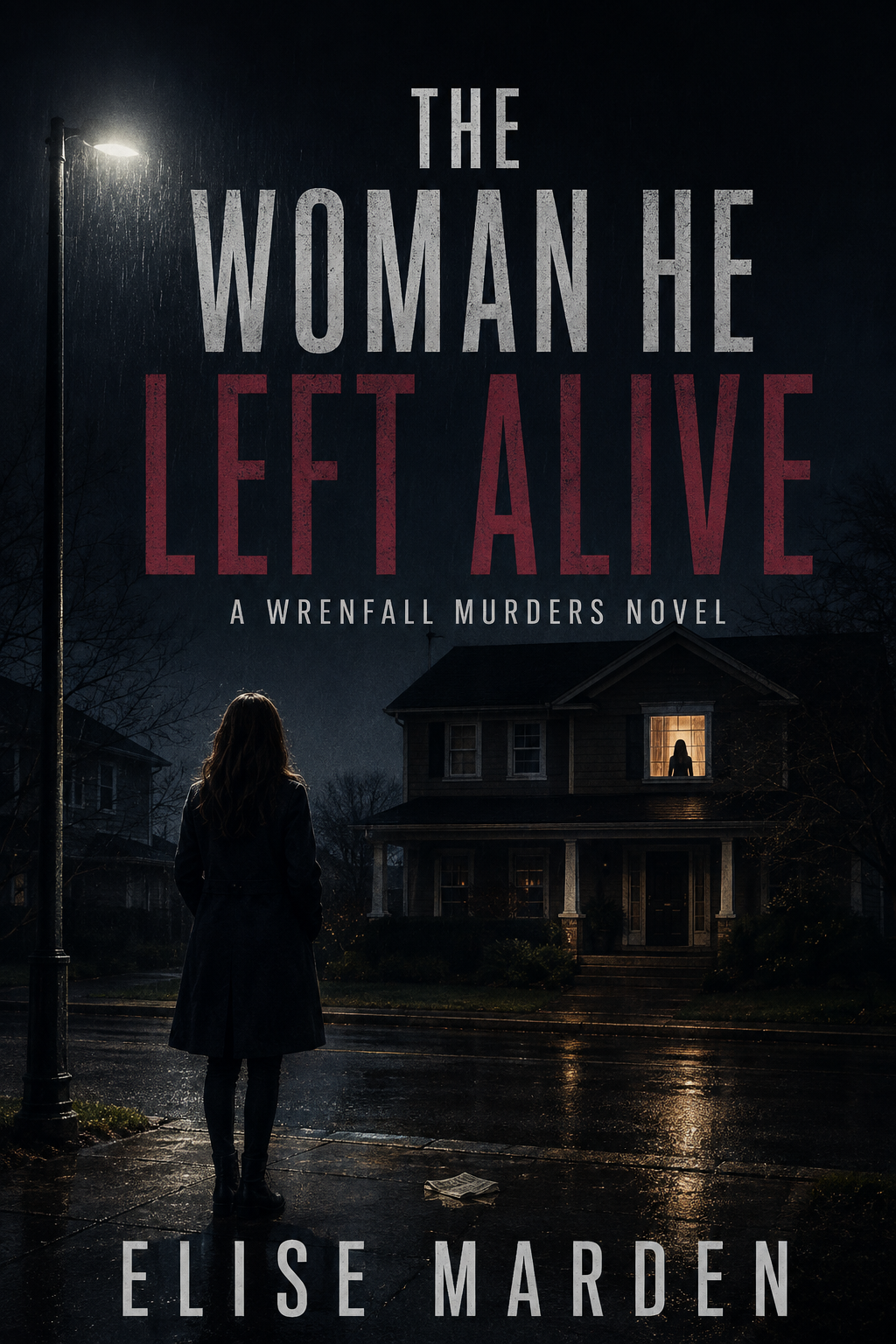
The Wrenfall Murders
The Woman He Left Alive
ELISE MARDEN
Chapter One
The Dead Woman’s Statement
Celia Ward walked into the newsroom carrying my obituary.
She arrived at 9:17 on a Monday morning, six weeks after disappearing from a locked psychiatric transport and three days after police publicly reclassified her from a missing witness to a fugitive.
No one stopped her.
The Wrenfall Ledger had replaced its security guard with an electronic badge reader after the Bellweather story broke, but someone had propped open the rear entrance with a box of printer paper. Celia crossed the newsroom unnoticed while reporters argued over headlines and phones rang unanswered beneath the fluorescent lights.
I did not see her until she sat in the empty chair beside my desk.
“You changed your hair,” she said.
I looked up.
The woman from my porch appeared older now.
Not physically older. The dark hair remained cropped close to her scalp, and her pale gray eyes still belonged to someone younger than the thirty-three years listed in police records. But the terror she had worn six weeks earlier had disappeared.
She wore black trousers, a cream blouse, and a dark green coat buttoned to her throat. No mud. No bruises. No hospital bracelet.
No blue elastic around her wrist.
“Celia.”
Half the newsroom stopped moving.
Her photograph had appeared on every local broadcast and thousands of websites. Police circulated three versions: the twenty-two-year-old museum intern who vanished eleven years ago, the frightened woman who arrived at my door, and the grainy transport image captured before she disappeared again.
Celia placed a folded newspaper on my desk.
The obituary occupied the bottom half of the page.
MARA CLAIRE VOSS
INVESTIGATIVE REPORTER AND WRENFALL SURVIVOR
1988–2026
My staff photograph appeared beneath the headline.
“You look tired,” she said.
I did not touch the paper.
“Where did you get that?”
“It comes out Thursday.”
The newspaper was dated three days from now.
Around us, people began reaching for phones.
“Don’t,” Celia said.
Her voice remained conversational.
I raised one hand toward my editor.
Everyone froze.
“If anyone calls the police, the first woman dies.”
“Which woman?”
“The one Adrian left alive.”
“You?”
Celia smiled.
“Is that what he told you?”
“Adrian hasn’t told me anything. His attorney won’t let him speak.”
“He always lets other people choose his silence.”
My eyes moved over her coat. The material hung naturally. No obvious weapon. Her hands rested in her lap.
“You disappeared from a secured transport.”
“I left.”
“Your restraints were found inside the vehicle.”
“They weren’t mine.”
“Two officers were drugged.”
“I didn’t drug them.”
“The transport authorization carried Rourke’s forged signature.”
“I didn’t forge it.”
“Who did?”
“You ask questions as though answers have only one owner.”
Caroline used to speak that way.
The similarity was deliberate.
“Where is Mara Carr?”
Celia’s smile vanished.
“She asked me to tell you she remembers the red wall.”
“Where is she?”
“Safe.”
“With Caroline?”
“Caroline is in jail.”
“There was a woman wearing Caroline’s dress inside number eighteen.”
“You saw a dress through a window.”
“I saw someone.”
“You have always been excellent at turning silhouettes into suspects.”
I studied her face.
“Why come here?”
“To correct the story.”
“Which part?”
“All of it.”
She pushed the obituary toward me.
The paper smelled of fresh ink.
It was not a photocopy or home-printer imitation. The registration marks, column widths, and stock matched the Ledger’s production proofs.
Only three departments could access the page templates.
Editorial.
Advertising.
Production.
“Who printed this?”
“You did.”
“I’ve never seen it.”
“Not yet.”
“What happens Thursday?”
“You disappear.”
A camera shutter clicked behind me.
Celia turned.
A junior photographer named Noah stood near the conference room with his camera raised.
Celia unbuttoned her coat.
A black cord crossed her chest.
Noah lowered the camera.
“Everyone leave,” I said.
My editor, Calvin Shaw, stepped from his office.
“Mara—”
“Clear the newsroom.”
“We can’t evacuate without—”
“If you say police, she may have a bomb.”
Celia looked almost amused.
“I don’t.”
“You wanted them to think you did.”
“I wanted them to listen.”
Calvin ordered everyone toward the front stairs. No one argued. Chairs rolled backward. Reporters collected nothing. Phones continued ringing as the room emptied.
Noah remained beside the conference room.
“Go,” I told him.
He looked at Celia.
“She killed my sister.”
Celia’s expression did not change.
Noah’s sister, Amanda Reese, was one of the women recovered beneath the eighth garden. She had disappeared two years earlier after leaving a domestic-violence shelter outside St. Louis.
“What happened to Amanda?” he asked.
“I never met her.”
“You were inside Bellweather.”
“So were dozens of people.”
“You helped them escape the hospital.”
“I escaped the hospital.”
“You were working with the first Mara.”
“Mara Carr was looking for her sister.”
“Mara is her sister.”
“She knows that now.”
Noah raised the camera again.
“Tell me where she is.”
Celia stood.
The black cord beneath her coat connected to a small rectangular device taped against her sternum.
Wires ran beneath her blouse.
“Go,” I said again.
Noah did not move.
I stepped between them.
“If you want answers about Amanda, stay alive long enough to receive them.”
His jaw tightened.
Then he left.
Calvin was the last to reach the stairs.
“You have five minutes,” he said.
“Make it ten.”
“I’m calling—”
“Call everyone after the door closes.”
Celia waited until we were alone.
Then she removed the device from her chest and placed it on my desk.
It was a portable voice recorder.
No explosives.
“You enjoyed that,” I said.
“No. But fear makes people obedient.”
“Caroline teach you that?”
“You taught me.”
“I barely know you.”
“That has never prevented you from writing about me.”
She pressed Record.
A red light appeared.
“My name is Celia Anne Ward. On March nineteenth, 2015, Adrian Vale abducted me from the Harrow Museum.”
“That isn’t what the security footage showed.”
“The footage was altered.”
“By whom?”
“Adrian.”
“He didn’t have access to the museum system.”
“His wife did.”
“Caroline helped abduct you?”
Celia looked toward the empty newsroom.
“She chose me.”
“For what?”
“The first experiment.”
I sat across from her.
“What experiment?”
“Adrian wanted to know whether a woman could be given a memory convincing enough to replace something she witnessed.”
“Adrian told police he saw you enter a dark SUV.”
“He drove it.”
“The article said he watched you leave with someone else.”
“He was the someone else.”
“Where did he take you?”
“Bellweather.”
“Which garden?”
“The one beneath his house.”
“Adrian did not own number eighteen in 2015.”
“He had access.”
“Through Caroline?”
“Yes.”
“What happened there?”
Celia looked into the recorder.
“They showed me eight photographs and asked me to choose which woman had killed my mother.”
“Helen Ward is alive.”
“She isn’t.”
“Investigators located her in Arizona.”
“They located someone using her identity.”
“Have you met the woman?”
“No.”
“Then how do you know?”
“Because I watched my mother die.”
Her eyes remained dry.
“Who killed her?”
“Adrian.”
The accusation came without hesitation.
“How?”
“He buried her.”
“Where?”
“Under the cedar tree.”
Investigators had excavated the soil beneath the tree. They found the archive chamber and the real Patricia Bellamy.
No body identified as Helen Ward.
“The police recovered no remains matching your mother.”
“They recovered twenty-seven women.”
“None was Helen.”
“None carried her name.”
I could not argue with that.
Bellweather had made names unreliable.
“What did Adrian use to dig?”
Celia’s gaze sharpened.
“A shovel.”
“What kind?”
“Metal.”
“Long or short handle?”
“Long.”
“Color?”
“Black.”
“Was the blade pointed or square?”
She stopped.
“You think details prove truth.”
“They help.”
“The shovel had a red handle.”
“You just said black.”
“I said it was dark.”
“You said metal.”
“The blade was metal.”
“And the handle?”
“Red.”
“Was it day or night?”
“Night.”
“Season?”
“Winter.”
“March nineteenth was two days before spring.”
“It was cold.”
“Was there snow?”
“Yes.”
Weather records showed no snow in Wrenfall during the week Celia disappeared. I remembered because the original article described an unseasonably warm evening and an outdoor museum reception.
“Where were you standing?” I asked.
“Beside the fence.”
“Which side?”
“The side facing Mara’s house.”
“My parents lived there.”
“I know.”
“Did you see them?”
“No.”
“Did you see me?”
Celia looked at the recorder.
“You were digging too.”
The newsroom seemed to contract around us.
“I was twenty-six and living in Chicago.”
“You came home.”
“No.”
“You wore a gray coat.”
“I didn’t own one.”
“You held Helen’s feet.”
“I had never met her.”
“She kept asking you to stop.”
“Why would I help Adrian bury a woman?”
“Because Caroline told you Helen was already dead.”
“You’re describing something that did not happen.”
“Then why did you write it down?”
She unfolded the obituary.
My death notice occupied one side.
On the reverse was a page from a spiral notebook.
I recognized my handwriting.
MARCH 19
ADRIAN — SHOVEL
HELEN — CEDAR
GRAY COAT
SHE WAS STILL BREATHING
Below the notes, I had drawn a circle around a single sentence.
WE BURIED THE WRONG WOMAN.
I touched the paper.
The ink had faded slightly. The page appeared old. A brown stain marked one corner.
“This isn’t mine.”
“You recognize the handwriting.”
“It can be copied.”
“The notebook is in your basement.”
“My house is still sealed.”
“Not anymore.”
“Who entered it?”
“You did.”
I forced myself to breathe slowly.
This was how Bellweather worked. Present a fact. Attach it to an impossible conclusion. Allow the target to exhaust herself proving which portion was false.
“Where is the notebook?”
“Behind the red wall.”
“The wall was opened.”
“They opened the cavity. Not the room behind it.”
“There is no room.”
“You’ve been inside it.”
“No.”
“When you were twenty-six.”
“I would remember.”
Celia leaned toward me.
“Would you?”
I thought of Adrian aiming an empty gun while a childhood song played through the speakers. Sedatives. Isolation. Repeated stories. Photographs altered until memory and evidence became indistinguishable.
No supernatural control.
No erased life.
Only fear, drugs, suggestion, and lies told often enough to become familiar.
“I was working in Chicago on March nineteenth,” I said.
“Prove it.”
“I wrote for the Tribune.”
“You freelanced. No one recorded when you entered the building.”
“I lived with Daniel.”
“You were separated for four months that year.”
My pulse changed.
The separation had not appeared in our divorce filings. Daniel moved into a short-term rental after I discovered messages from another woman. We reconciled before anyone in my family learned.
“How do you know that?”
“You told me.”
“I had never met you.”
“You came to Bellweather looking for your mother.”
“Evelyn?”
“You still think she is the only mother you had.”
“Who else?”
Celia stopped the recorder.
The red light went dark.
“This is the part they cannot hear.”
“Who?”
“The people listening through your microphone.”
I had not worn a microphone since number eighteen.
My hand moved instinctively toward my collar.
Celia smiled.
“You checked.”
“No one is listening.”
“Rourke is.”
“He isn’t here.”
“He doesn’t need to be.”
She reached beneath my desk and removed a circular black device attached near the drawers.
A listening transmitter.
The same model investigators had recovered from the walls of my house.
“How long has that been there?”
“Before you returned to work.”
“Who placed it?”
“Ask Rourke.”
“Why would he monitor me?”
“Because the bodies did not stop appearing after Caroline was arrested.”
“What bodies?”
Celia switched the recorder on again.
“Mara Voss murdered Helen Ward on March nineteenth, 2015. Adrian Vale helped her conceal the body. I survived because they believed I had forgotten.”
“You expect police to accept that?”
“I expect them to accept your confession.”
“I haven’t confessed.”
“Not yet.”
She pushed the obituary closer.
The story beneath the headline said my vehicle had been found at a commuter station. A suitcase was missing from my home along with clothing, jewelry, and my passport.
The same evidence planted after Caroline disappeared.
“They’re going to make it look like I ran.”
“Yes.”
“Then kill me.”
“No.”
“What happens?”
“You become someone else.”
“I already survived that.”
“Not voluntarily.”
“And you think I’ll volunteer now?”
“I think you’ll choose it when you see what Mara Carr has done.”
She reached inside her coat.
I stood.
Celia withdrew a mobile phone and slid it across the desk.
A video was already playing.
The first Mara stood inside a concrete room. Her hands were stained with soil. Behind her, photographs of missing women covered the wall.
She looked into the camera.
“Ruth, if Celia reached you, then Caroline lied about the first garden. There were never eight founding women. There were nine.”
She held up the photograph taken in 1994.
Joanne Mercer.
Diane Foster.
Helen Ward.
Patricia Bellamy.
Rebecca Thorne.
Lydia Carr.
Caroline Shaw.
Evelyn Hart.
Eight women.
Mara peeled back the photograph’s paper backing.
A ninth figure appeared beneath a folded section at the edge of the image.
The woman’s face had been cut away.
“There is one identity Bellweather never placed inside the archive,” Mara said. “One woman who could move between every garden without being recorded.”
She turned the photograph over.
A name had been written beneath the flap.
CLAIRE VOSS.
My middle name.
Daniel’s surname.
“No,” I whispered.
Mara continued.
“Claire Voss was not a Bellweather member. She was its first prisoner. Every girl who entered the gardens inherited something from her—her name, her records, or her memories.”
The video changed.
A woman sat in a chair beneath a harsh overhead light. A hood concealed her face. Black thread bound her wrists.
Mara entered the frame and removed the hood.
The woman was older than me. Mid-fifties, perhaps. Her dark hair had silvered at the temples, and a healed burn scar covered one side of her neck.
She looked directly into the camera.
Directly at me.
“My name is Claire Voss,” she said. “And Mara is my daughter.”
The video ended.
Celia retrieved the phone.
“That woman is not my mother.”
“You use her name.”
“Claire is my middle name.”
“Because Evelyn wanted part of her to survive.”
“Why would Daniel have her surname?”
“He doesn’t.”
“His name is Daniel Voss.”
“His legal name.”
“What other name does he have?”
Celia stood.
“Ask him who he married before you.”
“Daniel was never married.”
“Then ask why his first wife is buried beneath your house.”
She buttoned her coat.
“You are not leaving.”
“You have ten minutes before police arrive.”
“You threatened the newsroom.”
“I carried a voice recorder.”
“You made them believe it was an explosive.”
“They made themselves believe it.”
“Where is Mara Carr?”
“She is preparing the grave.”
“For whom?”
Celia looked at my obituary.
“You.”
She walked toward the stairs.
I followed.
The newsroom was empty, but camera crews had already gathered outside. Someone had leaked Celia’s arrival before the evacuation was complete.
Police vehicles blocked both ends of the street.
Rourke stood behind the glass entrance with his weapon drawn.
When he saw Celia, he shouted for her to raise her hands.
She obeyed.
The green coat fell open.
The recorder remained taped against her chest.
“No bomb,” she called. “Only my statement.”
Officers entered from both sides.
They forced her to the floor.
Celia did not resist.
Rourke handcuffed her and looked toward me.
“Are you hurt?”
“No.”
“Did she threaten you?”
“She showed me something.”
“What?”
“Who placed the transmitter beneath my desk?”
His expression did not change.
“We’ll discuss that somewhere secure.”
“So it was you.”
“Not here.”
“Have more bodies been found?”
Rourke looked at the reporters gathered behind the police line.
“Who told you that?”
“Celia.”
He lifted her from the floor.
She smiled at me.
“She knows because she buried the last one,” Rourke said.
Celia’s smile disappeared.
“What body?” I asked.
Rourke reached inside his coat and removed an evidence photograph.
A woman lay inside a shallow grave. Her face had been covered with a page from the Wrenfall Ledger.
The article displayed my byline.
Police had found the body that morning behind Daniel’s Chicago apartment.
The victim carried identification belonging to Mara Claire Voss.
My DNA was beneath her fingernails.
And according to the preliminary examination, she had been alive when Adrian Vale was taken into custody.
He could not have killed her.
Celia looked at the photograph.
For the first time since entering the newsroom, she appeared genuinely frightened.
“That isn’t the woman we buried,” she whispered.
Chapter Two
The Woman in My Grave
Celia Ward had confessed to burying a woman.
She did it quietly, almost beneath her breath, while police officers, reporters, and cameras surrounded her.
That isn’t the woman we buried.
Rourke heard her.
So did I.
By 10:03, Celia was locked inside an interview room on the third floor of the Wrenfall Police Department. Rourke placed me in a separate room two doors away and confiscated my phone, handbag, coat, and shoes.
He did not call it detention.
The locked door did.
A camera watched from the ceiling.
The room contained a steel table bolted to the floor and three chairs. Someone had scratched a series of vertical lines into the paint beneath the tabletop.
Twenty-three marks.
I counted them four times before Rourke returned.
He carried two paper cups of coffee and a clear evidence bag containing the obituary.
“I didn’t request coffee.”
“You haven’t eaten.”
“That isn’t the same thing.”
He placed one cup near me.
“Drink it or don’t.”
“Am I under arrest?”
“No.”
“Am I free to leave?”
“Not until we establish whether the people outside intend to follow you.”
“Then I’m being protected.”
“Yes.”
“By locking me in an interrogation room.”
“It is the only room in the building without exterior windows.”
“Why did you place a listening device under my desk?”
He sat across from me.
“We received a threat.”
“When?”
“Four weeks ago.”
“What kind?”
“An envelope addressed to you.”
“What was inside?”
“A photograph of your desk.”
“That’s it?”
“The photographer was standing behind your chair while you were sitting in it.”
I remembered my first day back at the Ledger.
Reporters applauded when I entered. Calvin placed Rachel Dunn’s photograph on the conference-room wall. People I had known for years hugged me and apologized for doubting my investigation.
Anyone could have stood behind me.
“The photograph included a message,” Rourke said.
“What did it say?”
He removed a second evidence bag from inside his coat.
The photograph showed the back of my head.
My computer screen displayed the opening paragraph of my first Bellweather article. A woman’s pale hand rested against the top of my chair.
I had not felt it.
Across the bottom, someone had written:
SHE STILL DOESN’T KNOW WHICH MARA CAME HOME.
“Why didn’t you tell me?”
“We believed disclosure would make you behave differently.”
“You wanted to use me as bait.”
“We wanted the person watching you to remain confident.”
“So you installed a microphone.”
“And two cameras.”
“Where?”
“One inside a smoke detector. One in the conference room.”
“Did Calvin know?”
“Yes.”
“My editor knew you were monitoring me?”
“He consented to the equipment.”
“It was attached to my desk.”
“The company owns the desk.”
“You recorded my private conversations.”
“We monitored the workspace during business hours.”
“Without a warrant?”
“We had one. Calvin consented to the equipment, and a judge authorized limited monitoring because the photograph established a credible threat against your life.”
“You still recorded private conversations without warning me.”
“Yes. Because whoever took that photograph was close enough to touch your chair.”
His answer came too easily.
“What aren’t you telling me?”
“The transmitter Celia removed wasn’t ours.”
The anger stopped.
“Your device was somewhere else?”
“Inside the desk phone.”
“Then who placed the transmitter beneath the drawer?”
“We’re checking it.”
“How many people heard our conversation?”
“We don’t know.”
“Was it transmitting?”
“Yes.”
“To where?”
“The signal disappeared when Celia removed it.”
“You let her walk out carrying it.”
“She left it on your desk.”
“Then why did the signal disappear?”
“Because whoever was receiving it shut down.”
He slid the obituary across the table.
“This was printed on the Ledger’s production press at 4:12 this morning.”
“Who had access?”
“The building alarm recorded one entry at 3:58.”
“Name?”
“Mara Voss.”
I looked at him.
“My badge?”
“Your code.”
“My badge is in my bag.”
“Was it with you overnight?”
“Yes.”
“Where did you sleep?”
“Lena’s apartment.”
“Who else was there?”
“Lena.”
“Anyone else?”
“No.”
“Daniel?”
“He’s in Chicago.”
“Are you certain?”
“I spoke to him yesterday.”
“By video?”
“Telephone.”
“He didn’t report to work this morning.”
My unease deepened.
“What does Daniel have to do with someone using my access code?”
“He knew the code to your house.”
“That was years ago.”
“He knew where you hid your spare key.”
“So did Patricia.”
“Daniel entered the house and removed evidence.”
“At Evelyn’s request.”
“He also located Caroline’s storage unit.”
“She sent him the key.”
“According to Daniel.”
“You think he’s involved.”
“I think he has spent years moving through the edges of Bellweather while presenting himself as someone who wanted no part of it.”
“Because my mother manipulated him.”
“Possibly.”
The word had become Rourke’s shield against certainty.
“What happened to the body?” I asked.
“It is with the medical examiner.”
“Who was she?”
“We don’t know.”
“She carried my identification.”
“Your current driver’s-license number, date of birth, and address.”
“Photograph?”
“Yours.”
“Then why did the police know it wasn’t me?”
“The responding officer recognized you.”
“From the news?”
“From the photograph Celia sent six weeks ago.”
The image of Celia beside the unfamiliar grave had appeared on every station after she vanished. My face had followed hers through the coverage.
“Cause of death?”
“Undetermined.”
“You showed me a shallow grave.”
“She was found before burial was completed.”
“Strangled?”
“No obvious ligature marks.”
“Shot?”
“No wound.”
“Drugged?”
“Toxicology is pending.”
“How long had she been dead?”
“Between twelve and eighteen hours.”
“Adrian was already in custody.”
“For forty-six days.”
“So Celia was telling the truth about that.”
“About which part?”
“That this woman wasn’t killed by Adrian.”
“She said it wasn’t the woman they buried.”
“Meaning there are at least two.”
“Or she wanted us to believe there are.”
I studied the obituary.
The photograph was mine. The biographical details were accurate. It mentioned my ruined investigation, the Wrenfall bodies, and the upcoming articles I had planned to write.
It also mentioned a book.
At the time of her death, Voss had recently completed a memoir detailing her experiences inside the Bellweather identity network.
“I’m not writing a memoir.”
Rourke followed my gaze.
“Did anyone approach you about one?”
“My agent forwarded two offers. I declined.”
“Why?”
“I’m a reporter. I want the investigation published before someone turns it into entertainment.”
“Who knew about the offers?”
“My agent. Calvin. Lena. Daniel.”
“Evelyn?”
“I don’t know.”
“Did Mara Carr?”
“I haven’t spoken to her since she entered protection.”
“She is no longer in protection.”
“I know.”
“Then how can you be certain you haven’t spoken to her?”
I looked up.
“What does that mean?”
“She lived under your name for years. She knows your childhood, family history, and speech patterns. She has access to identity documents and people capable of altering appearances.”
“I would recognize my sister.”
“You didn’t recognize Caroline when she posed as Rachel Dunn.”
“That was different.”
“How?”
“Caroline wore prosthetics.”
“Did you see her apply them?”
“No.”
“Did investigators recover them?”
“They found cosmetics and wigs.”
“No facial prosthetics.”
“Thomas said she posed as Rachel.”
“Thomas lies.”
“So Caroline may not have been Rachel.”
“Or you met someone else using Caroline’s voice.”
“What are you trying to say?”
Rourke leaned toward me.
“We cannot confirm that every conversation you remember having with Lena, Daniel, Evelyn, Caroline, or Mara occurred with the person you believed was present.”
“That is not an investigation. That is paranoia.”
“It is Bellweather.”
“I’m not going to suspect everyone who speaks to me.”
“Then they will continue using people you trust.”
“I know Lena.”
“Yes.”
“I know my mother.”
“You learned her legal identity six weeks ago.”
“I know Daniel.”
“You did not know he entered your house.”
“I know what Mara looks like.”
“You spent thirty-two years looking at her childhood face and believing it was yours.”
He let the silence settle.
“Celia’s story changes,” he said. “That does not mean every version is false.”
“What parts do you believe?”
“That she witnessed a burial. That Adrian was present. That a woman wearing a gray coat helped him.”
“Not me.”
“I didn’t say it was.”
“She did.”
“And she knew exactly which year you and Daniel temporarily separated.”
I wrapped both hands around the untouched coffee.
“Daniel could have told her.”
“Yes.”
“Evelyn knew.”
“Did she?”
“I don’t know.”
“What did you do during those four months?”
“Worked.”
“Where did you live?”
“Our apartment. Daniel moved out.”
“Did you visit Wrenfall?”
“Probably.”
“On March nineteenth?”
“I don’t remember.”
“Did you own a gray coat?”
“No.”
His expression changed.
“What?”
“The traffic camera.”
“What traffic…
“A…
The…
Keep reading The Woman He Left Alive
You've reached the end of the free preview. Purchase this eBook for permanent access in your Novel Thunder Library.
Buy eBook — $5.99