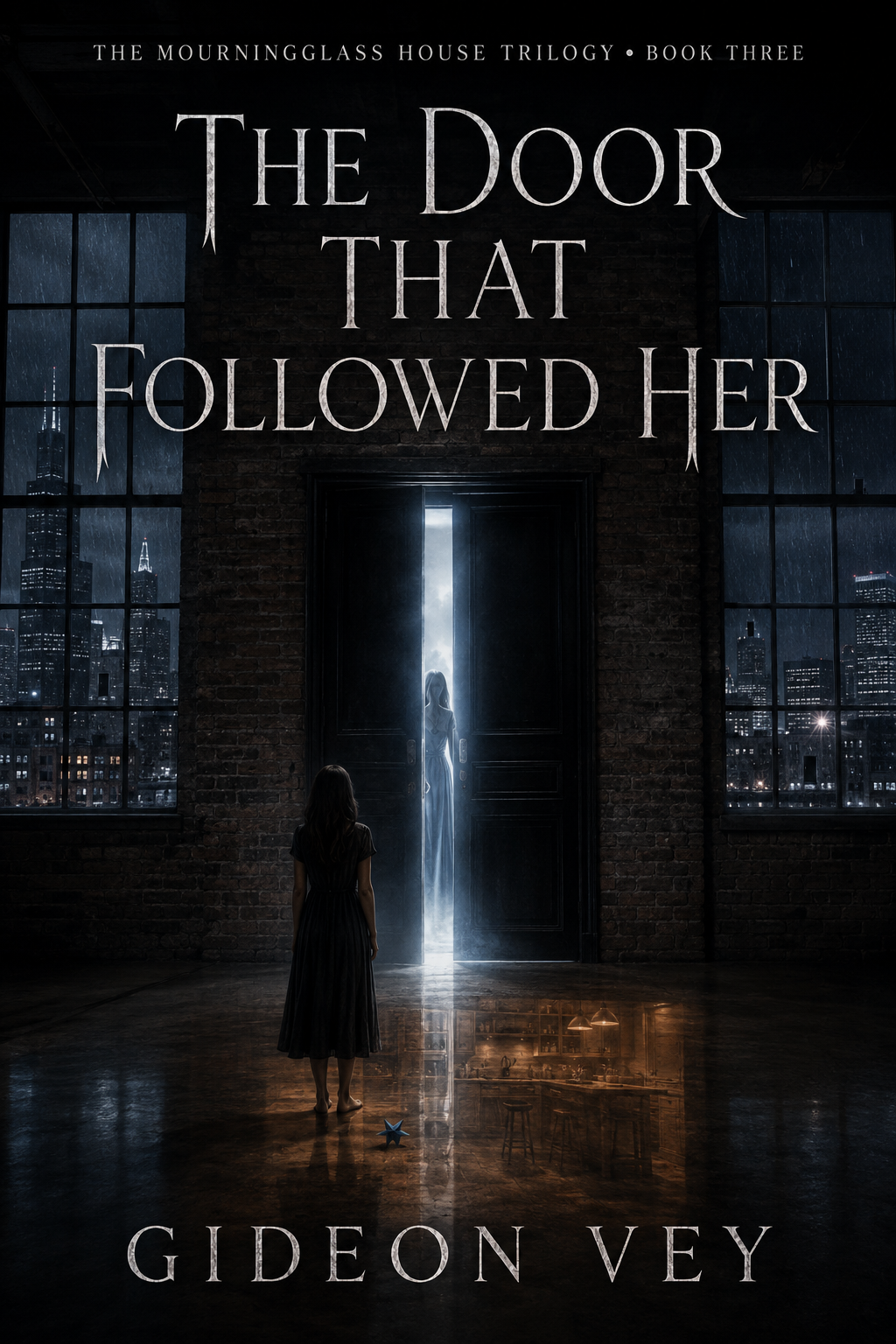
The Mourningglass House
The Door That Followed Her
GIDEON VEY
Chapter One
No Hinges
The woman behind Evelyn’s wall had her sister’s voice and twenty years of memories Lily had never lived.
“You brought us home.”
Five fingers pressed outward through the matte-black door.
Not against it.
Through it.
The surface stretched around each fingertip without tearing, warm and faintly translucent where the pressure thinned it. The hand was adult-sized. A narrow silver ring circled the middle finger—the same cheap ring Lily had won from a machine outside the Bellwether grocery store when she was eight.
She had worn it on her thumb.
Evelyn stood six feet away in the dark hallway of her Chicago loft and felt the scar beneath her left thumb split open.
Blood gathered in her palm.
Behind her, Jonah slept through the first knock.
One soft tap from inside the wall.
The five fingers withdrew.
“Evie?”
Adult Lily sounded uncertain.
That frightened Evelyn more than certainty would have.
Mourningglass replicas pleaded, accused, promised, and corrected. They knew what their rooms needed. Genuine fragments hesitated. They admitted damage. They gave answers that weakened the architecture holding them.
Or the house had learned to hesitate.
Evelyn backed toward the bedroom without turning away from the door.
The loft had been chosen for its open sightlines. One bedroom. One bathroom. No closets large enough to stand inside. Before tonight, the hallway had ended at uninterrupted brick laid in 1911.
Now the wall had divided itself around a door with no frame, hinges, knob, molding, or seam.
The black shape looked less installed than remembered.
“Lily,” Evelyn whispered.
The door inhaled.
Its center bowed inward. Warm air moved across Evelyn’s face carrying cut grass, dust warmed by sunlight, and Celia’s lavender soap.
Recognition entered before reason could stop it.
The scar opened wider.
A brass circle appeared where a knob should have been.
Not the knob itself.
Only its shadow beneath the black surface, waiting for enough agreement to become hardware.
Evelyn understood her mistake.
She had named the voice.
“Jonah.”
He woke at once.
No startled question. No fumbling for the lamp. After Bellwether, they had agreed that either of them speaking the other’s name in darkness meant get up now.
He entered the hallway barefoot, wearing yesterday’s shirt, one hand already reaching for the tape measure on the worktable.
Then he saw the door.
He stopped before crossing the bedroom threshold.
“How long?”
“Less than a minute.”
“Did you touch it?”
“No.”
“Speak to it?”
Evelyn showed him her bleeding palm.
His eyes moved to the faint circle beneath the black surface.
“What did you say?”
“Her name.”
The woman behind the door laughed softly.
Lily had laughed that way when she knew Evelyn was lying to an adult. Three quick breaths, the last one swallowed.
Jonah’s face changed.
He recognized it too.
The circle beneath the surface gained depth.
“Don’t give it anything else,” he said.
“That instruction contains a door,” Lily answered.
Jonah went still.
Evelyn had heard the phrase before. Thomas had written decisions as measurements. Wren had called vocabulary architecture. But Lily—eight-year-old Lily—had never spoken that way.
“Who taught you that?” Evelyn asked.
“You did.”
The black surface reflected nothing, yet Evelyn felt observed from the other side.
Jonah unrolled the tape measure without approaching. He anchored one end beneath the bedroom threshold and extended it along the floor.
“Wall was twenty-two feet, four inches from the west window,” he said.
“Don’t remember it aloud.”
“I’m not. I’m measuring what exists now.”
The metal blade reached the brick beside the door.
Twenty-one feet, three inches.
The loft had become thirteen inches shorter.
Jonah measured again.
Twenty-one feet, two and three-quarters.
While they watched, the hallway lost another quarter inch.
Something behind the door was not entering their home.
It was making room for itself.
Evelyn took her phone from the worktable.
“No photographs,” Jonah said.
“Calling Mara.”
The screen showed 2:14 a.m.
No service.
Their wireless network had disappeared. The router lights remained green, but its name no longer existed in the phone’s list. Evelyn tried the emergency number.
The call connected before she finished dialing.
No operator answered.
She heard a child breathing.
Then chalk scratched across the other end of the line.
“Sophie?”
Jonah caught Evelyn’s wrist.
Too late.
The shadow of the knob pushed outward.
A black spindle formed beneath it.
The child on the phone whispered, “Don’t let her finish growing up.”
The call ended.
Behind the door, adult Lily began to cry.
•
At 2:19 a.m., Evelyn’s neighbor knocked on the loft’s real front door.
Three ordinary knocks.
Evelyn and Jonah looked at each other.
The black door stood at the opposite end of the hallway, silent now. The brass circle remained trapped beneath its surface like hardware viewed through skin.
The front door received another knock.
“Evelyn?” Leah Park called from the building corridor. “Are you awake?”
Evelyn moved toward her.
Jonah blocked the way.
“We don’t know if that corridor still exists.”
“She used my name.”
“So did the door.”
Leah knocked again. “There’s water coming through my ceiling.”
The woman had lived across from Evelyn for four years. Forty-six, public-school librarian, worked late on Thursdays, grew herbs in the south stairwell despite repeated warnings from management. Her husband, David, had died eighteen months earlier after collapsing on the Blue Line.
Evelyn had photographed the memorial.
She had never told Leah what happened in Bellwether.
“Ask her something ordinary,” Jonah said.
Evelyn stood beside the front door without touching it.
“What did you leave in the stairwell yesterday?”
“Rosemary and basil. Mr. Lasko threw away the mint again.”
Annoyed, specific, current.
“Step back from the door.”
“Why?”
“Because I need you to.”
Leah muttered something in Korean that Evelyn had heard directed at broken elevators and city parking enforcement. Her footsteps retreated.
Jonah opened the front door.
The building corridor remained outside. Yellow light. Green carpet. Elevator alcove to the left. Leah stood ten feet away in a blue robe, holding a steel mixing bowl beneath a stream of water falling from the ceiling.
No water touched the carpet.
It vanished two feet above the floor.
“That seems bad,” Leah said.
Evelyn looked up.
The water did not come through a stain or broken pipe. It emerged from a perfect black circle in the ceiling.
Lake water.
The smell reached her before the cold did: weeds, iron, and the sweet rot beneath Lake Vesper’s winter shoreline.
Leah followed Evelyn’s gaze.
“Do you know what that is?”
“Move away from it.”
“I did. It followed me from my kitchen.”
The stream stopped.
The last drop remained suspended above Leah’s bowl.
Inside it, a house reflected against a bruised winter sky.
Evelyn seized the bowl and flung it down the corridor.
Water struck the wall. The suspended drop burst against Leah’s robe.
Every light went out.
From inside Leah’s apartment, a man called her name.
“Lee?”
Leah dropped the bowl.
It struck carpet without making a sound.
“David?”
Evelyn grabbed her arm.
Leah tried to pull free. “That was my husband.”
“I know.”
“You don’t know his voice.”
“I know what uses it.”
The man called again.
“Lee, the kettle’s boiling.”
Leah stopped fighting.
Her face emptied in a way Evelyn recognized. Not belief. The instant before belief, when desire removed every competing explanation.
Behind them, Jonah said, “Your apartment door is closed.”
It was.
David’s voice came through it anyway.
“I found the tea you like.”
Leah’s mouth opened.
Evelyn covered it with her hand.
“Do not answer him.”
Leah bit her palm.
Evelyn held on.
The black circle on the ceiling widened.
Warm sunlight spilled through it without illuminating the corridor. Beyond the impossible opening, leaves moved against a summer sky.
The loft’s black door began knocking.
Not from Evelyn’s hallway.
From inside Leah’s apartment.
Jonah heard it and turned.
The wall beside Leah’s closed door darkened in the shape of a tall rectangle.
No frame.
No hinges.
No knob.
“It copied,” Evelyn said.
“From what?” Leah demanded against her hand.
Evelyn looked at the black outline spreading through plaster.
Leah had never seen the door.
She had heard Evelyn tell Jonah not to photograph it. Heard them discuss the hardware. Heard Lily answer from the hallway.
The memory did not belong to Leah.
The grief did.
“From recognition,” Evelyn said.
The black rectangle became warm.
•
Mara arrived at 2:46 with Nia driving and Sophie asleep beneath a blanket in the back seat.
They had covered the three-hour distance from Bellwether in twenty-seven minutes.
Mara refused to explain how.
Her borrowed sedan stopped halfway through the brick wall beside Evelyn’s building entrance without striking it. The front half occupied the lobby. The rear remained at the curb. Both halves continued idling.
Nia opened the driver’s door onto the elevator.
“Nobody describe that,” she said.
Mara stepped out behind her, carrying a canvas equipment bag instead of a police case. Her badge was gone. The pale mark left by its clip remained on her belt.
“Status,” she said.
Evelyn gave her functions, not images.
“One primary threshold in my loft. One derivative threshold across the hall. A resident heard a familiar voice and recognized it. No confirmed crossing. The building is shorter inside than outside.”
“Names?”
“Mine, Jonah’s, resident Leah Park. Lily’s voice from primary. David Park’s from derivative.”
Mara’s jaw tightened at the use of the dead man’s name.
“You answered Lily?”
“Once.”
“Hardware?”
“Partial.”
Nia looked past Evelyn toward Leah, who sat against the corridor wall with strips of silver emergency blanket tied over her ears. Jonah had written NO ONE IS WAITING FOR YOU on the carpet in chalk.
“Does she understand?” Nia asked.
“She understands every third minute.”
“That’s enough to start.”
Sophie appeared inside the elevator before her body reached the lobby.
Her reflection stood in the mirrored rear panel, barefoot and awake, wearing a hospital gown.
The actual child remained asleep in the car.
Reflective Sophie lifted one finger to her lips.
Then the elevator doors closed on her.
Nia spun toward the entrance.
“She was in the back seat.”
“She still is,” Mara said.
The child’s reflection appeared in the lobby window. It walked beside Nia while the real sidewalk beyond remained empty.
Evelyn watched its eyes.
The left pupil contracted a heartbeat after the right.
“The joining held,” she said. “This is coming from her, not taking her.”
“You cannot know that from one delayed response.”
“No,” Evelyn said. “I can’t.”
Nia looked at her.
The admission mattered.
Outside, actual Sophie woke screaming.
Every window in the lobby reflected the same thing: adult Lily standing behind the child.
Nia ran to the car.
Mara caught Evelyn’s bleeding hand and examined the scar.
“It cooled,” she said.
“Until tonight.”
“What formed first?”
“The door.”
“Wrong answer.”
Evelyn met her eyes.
Mara had lost her badge, her evidence, and whatever protection the Bellwether department could have offered. She looked exhausted and entirely awake.
“The room formed first,” Mara said. “A door only divides places that already exist.”
Above them, every pipe in the building knocked once.
The lobby shortened.
Its front windows moved six inches closer to the elevator.
“Then what room did it build?” Jonah asked.
Sophie answered from the sidewalk.
“Ours.”
She stood beside Nia in an oversized coat, face pale, chalk clutched in one hand. She looked toward the building without examining any windows.
“What did you see?” Evelyn asked.
“Her growing up.”
“Lily?”
Sophie shook her head.
“The door.”
•
They turned the loft into a room no one described the same way.
Mara called the worktable a bed. Nia called it a barrier. Jonah rotated it twelve degrees and insisted it belonged to the apartment downstairs. Evelyn covered every photograph except the imperfect family picture she had placed upright hours earlier.
Sophie turned that one facedown herself.
“Why?” Evelyn asked.
“She keeps looking from it.”
The child would not say which she.
They marked a boundary six feet from the black door. No one crossed it. Jonah measured the hallway silently and wrote each dimension on separate cards rather than allowing one complete floor plan to exist. The loft continued shrinking at irregular intervals.
Twenty-one feet, one inch.
Twenty feet, nine inches.
Twenty feet, eight and seven-eighths.
The derivative threshold across the hall remained a warm black rectangle. Leah sat between both doors with Nia and answered questions about the present.
Name.
Date.
What she had eaten for dinner.
What she disliked about David.
That question made the derivative door cool.
“He folded wet towels,” Leah said. “Not once. Every time. He would pull them from the washer and fold them before putting them in the dryer.”
David’s voice answered through the wall.
“Because they wrinkled less.”
Leah began laughing.
The sound broke into a sob.
“That’s exactly what he said.”
“Would he want you inside?” Nia asked.
“Yes.”
The door warmed.
Leah closed her eyes.
“No. He would want to come out.”
The rectangle lost an inch of height.
Nia squeezed her hand.
“Stay with that answer.”
At the far end of Evelyn’s hallway, adult Lily began humming.
All Through the Night.
Celia’s song.
The melody entered the walls. Pipes carried it upstairs. The radiator repeated it in clicks. From the street below came the faint rhythm of car alarms joining one note at a time.
Sophie drew a door on the floor.
Not in chalk.
Her reflection drew from beneath the floorboards, white lines appearing backward through the wood.
Evelyn crouched beside her.
“Is that the primary threshold?”
“No.”
“The derivative?”
“No.”
“Then what?”
Sophie’s hand remained still while the reflected chalk continued moving.
It drew a rectangle around the entire loft.
Then another around Leah’s apartment.
Then the hallway, stairwell, and rooms above and below.
The building plan spread across the floor in white lines.
At its center stood the black door.
At its edge, beneath an apartment on the sixth floor, reflective Sophie drew a second building.
Then a third.
“Stop,” Nia said.
Sophie dropped the chalk.
The drawing continued.
It crossed the baseboard and climbed the wall.
Street grid. Alleys. Train line. Lake.
Chicago assembling around a room that had not existed forty minutes earlier.
Mara raised her radio.
“We evacuate without description. Functional terms only. No photographs, no video, no names of the dead.”
The radio answered in Wren’s voice.
“Detective Voss.”
Mara’s face hardened.
“I’m not a detective tonight.”
“Titles are rooms. You continue inhabiting yours beautifully.”
Every radio in the building activated.
Fire alarms spoke from empty housings. Phones lit on kitchen counters. A baby monitor on the fifth floor carried Wren’s breathing. His voice arrived through dozens of speakers with a fraction of a second between them, too many versions to sound singular.
“Residents,” he said, “welcome home.”
Doors opened throughout the building.
Ordinary apartment doors.
Closet doors.
Cabinets.
The elevator.
Each revealed the Cross family hallway.
Adult Lily stood at the far end of every copy.
Some wore the red mitten.
Some held it.
One had two bare hands and blood beneath her left thumb.
Evelyn looked at her own palm.
The black door in the loft acquired a keyhole.
“Evie,” Lily called.
Not from behind the door.
From Leah’s apartment.
Leah tore the emergency covering from her ears.
David spoke at the same moment.
“Lee, open the door.”
The derivative threshold formed a brass knob.
Leah lunged.
Nia caught her robe. Mara caught Nia. The corridor tilted beneath all three women.
Jonah grabbed the real front-door frame and shouted a measurement Evelyn refused to remember.
Sophie’s reflected chalk drew one final word across the floor.
CHOOSE.
Leah reached the black knob.
Evelyn seized her wrist.
For one second, both women held it.
The brass was hot enough to blister.
Leah looked at Evelyn with tears standing in her eyes.
“If there’s even part of him—”
“There may be.”
Leah stopped fighting.
Everyone stopped.
The house had expected denial.
Evelyn tightened her burned hand around the knob.
“There may be something that remembers loving you,” she said. “That does not make this what he chose.”
On the other side, David began pounding.
“Lee!”
Leah’s face collapsed.
“I have to know.”
“Yes.”
The door warmed beneath Evelyn’s palm.
“But you do not have to know tonight.”
Leah released the knob.
The hallway snapped level.
The derivative door did not disappear.
It opened by itself.
Beyond it waited Evelyn’s loft.
Not the room around them.
Another version.
In that loft, morning sunlight filled the windows. Jonah stood at the worktable twenty years older. Mara and Nia sat together on the couch. Sophie, grown, drew with a little girl on the floor.
Evelyn’s family photograph hung enlarged on the wall.
Five people stood in it now.
Celia.
Thomas.
Lily.
Evelyn.
Leah.
Leah stared at her own face inside a family she had never met.
“Why am I there?”
Adult Lily appeared behind the photographed glass.
“Because she brought us all home.”
A hand shot through the open doorway and caught Leah by the throat.
David’s hand.
His wedding ring cut into swollen flesh.
Evelyn grabbed Leah around the waist. Nia locked both arms around Evelyn. Mara braced against the wall.
The hand pulled.
Leah’s bare feet left the floor.
Jonah struck the brass knob with Thomas’s red carpenter pencil.
The pencil snapped.
The door slammed.
Leah vanished from Evelyn’s arms.
For one heartbeat, her robe remained clenched in Nia’s fist.
Then the fabric flattened into the black surface and disappeared.
Silence entered the building.
The derivative door lost its knob.
Its keyhole.
Its seam.
It became ordinary plaster.
Nia pressed both hands against the wall where Leah had been taken.
“Leah!”
No answer.
From the primary door inside Evelyn’s loft came one soft knock.
Then Leah’s voice.
“Evelyn?”
The black surface pushed outward around five adult fingers.
“I found your sister.”
Chapter Two
The Hallway Home
Leah Park spent ten years inside the door before Evelyn opened it.
David made tea the first morning.
He used the blue kettle they had thrown away after the handle cracked. He folded…
Keep reading The Door That Followed Her
You've reached the end of the free preview. Purchase this eBook for permanent access in your Novel Thunder Library.
Buy eBook — $6.99