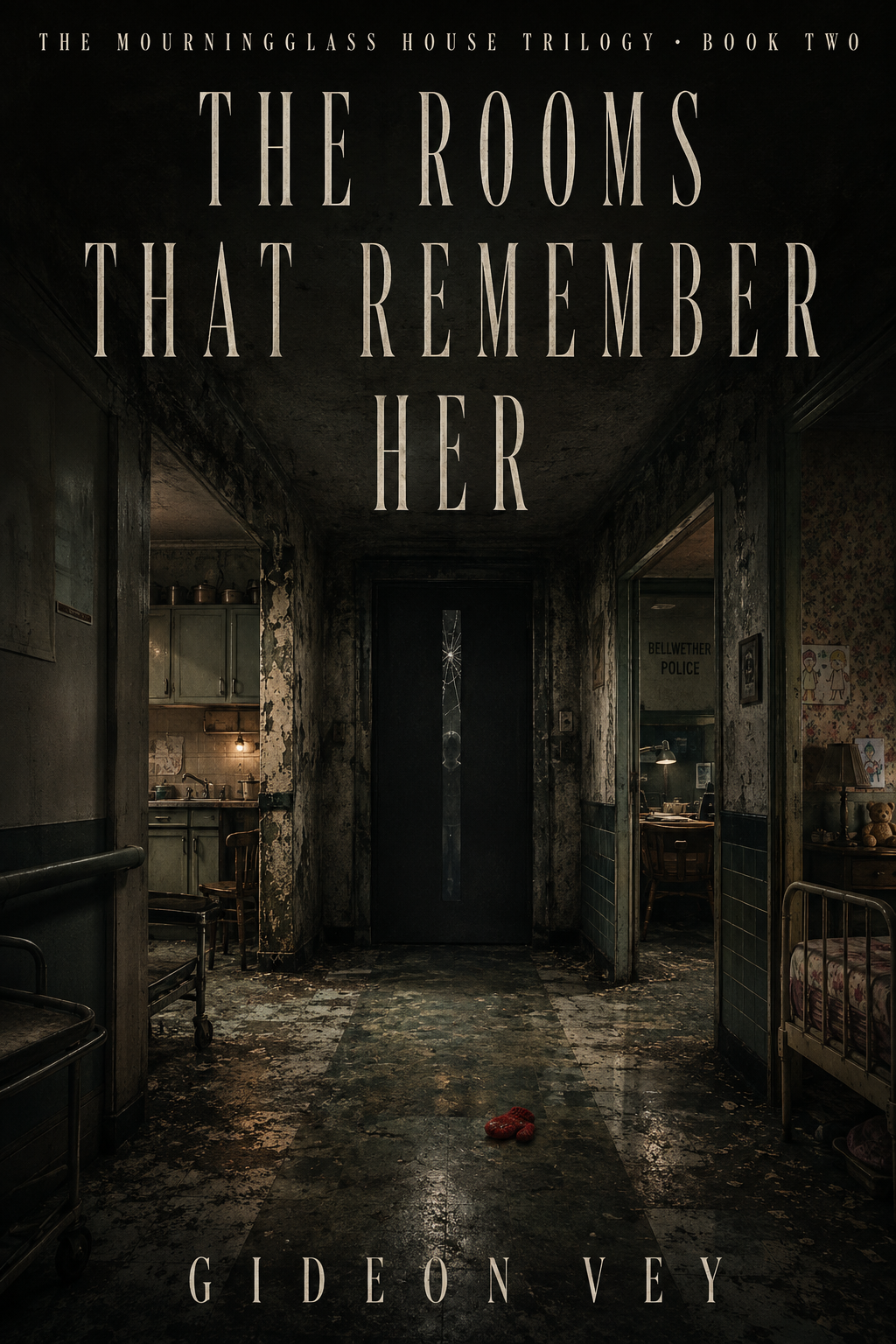
The Mourningglass House
The Rooms That Remember Her
GIDEON VEY
Chapter One
A Room in the Wall
Nora Bell heard her dead son moving behind the kitchen wall at 6:14 on a Thursday morning.
She knew the time because the microwave clock changed to 6:15 while she stood with the pry bar raised, listening to Eli drag his desk chair across a floor that did not exist.
The sound came from inside the wall separating the kitchen from the back porch.
That wall was six inches thick.
Nora had measured it twice before cutting.
She lowered the pry bar.
Behind the drywall, the chair legs scraped once more.
Then three quick knocks sounded from the other side.
Their old signal.
Three knocks meant Mom, come look.
Nora had not heard it in nine years.
She stepped backward until the counter caught her.
The kitchen around her remained aggressively ordinary. Plastic sheeting covered the cabinets. A shop light glared from an exposed ceiling hook. Her coffee cooled beside a box of screws. Through the glass door to the porch, the first snow of November drifted over Bellwether in dry white grains.
No one stood outside.
No one could stand inside the wall.
Three knocks came again.
Mom, come look.
Nora gripped the counter with both hands.
“No.”
The word disappeared beneath the hum of the refrigerator.
She had learned to say no to Eli’s voice in grocery aisles, where other boys complained about cereal. At traffic lights, when a teenager laughed from the next car. In the hour before sleep, when the pipes settled and made his particular two-note whistle.
Grief was a ventriloquist. It threw the dead into empty rooms and waited for the living to answer.
That was what Dr. Kessler had told her during the second year.
The dead did not knock back.
Behind the wall, a boy coughed.
Not any cough.
Eli’s.
It began with a catch low in his throat and ended in two dry barks because he always tried to suppress it. He had been embarrassed by the inhaler clipped inside his backpack. On the morning he died, Nora had found it on the bathroom sink and driven to school to deliver it.
She had arrived six minutes after the ambulance left.
The pry bar slipped from her hand and struck the subfloor.
“Mom?”
The voice came through plaster and insulation, muffled but unmistakable.
Nora’s knees weakened.
“I found something.”
He sounded fourteen.
Not the twenty-three-year-old man he would have been. Not a grown voice imagined from the shape of his father’s jaw. Fourteen forever, irritated and excited and trying not to cough.
Nora crossed the kitchen before she decided to move.
She pressed one palm to the drywall.
Warm.
The rest of the wall held the November cold that leaked from the porch. The rectangle beneath her hand felt sunlit.
“Eli?”
Silence.
Her reflection trembled in the dark microwave door.
Nora removed her hand.
In the microwave glass, a tall narrow opening stood behind her where the wall should have been.
She turned.
The wall remained unbroken.
In the reflection, Eli leaned around the opening.
His hair fell across one eye. He wore the gray Bellwether Track sweatshirt in which she had buried him.
“You said you’d come.”
Nora swung the pry bar.
The hooked steel punched through drywall.
Warm air breathed through the hole.
Not insulation. Not the hollow chill of a stud bay.
Summer.
Cut grass. Dust. The citrus deodorant Eli had used too heavily because a girl named Paige sat behind him in chemistry.
Nora tore the bar sideways.
Drywall split from stud to stud.
There should have been fiberglass and exterior sheathing. Instead, blue wallpaper showed beneath the broken gypsum.
Small white rockets climbed across it.
Nora stopped breathing.
She had bought that wallpaper when Eli was six and regretted it before the paste dried. By fourteen he had covered the rockets with band posters, track ribbons, and a hand-drawn map of a fantasy city whose streets all ended at the same black tower.
The wallpaper had been removed when they sold the old house.
That house stood in Aurora, two hundred miles south.
Nora widened the hole.
The kitchen wall broke inward without resistance. Pieces landed on beige carpet beyond it.
Not inside the wall.
Beyond it.
Eli’s bedroom waited in afternoon light.
The bed was unmade. One sock hung from the ceiling fan. His inhaler rested on the desk beside an unfinished geometry worksheet. A glass of orange soda sweated onto a paperback novel.
The room did not look preserved.
It looked interrupted.
“Eli?”
The closet door moved a fraction.
Nora forced herself to look at the window.
The bedroom had faced the alley behind their Aurora house. Its window should have shown garages, power lines, and the Morales family’s maple tree.
Instead it showed Lake Vesper under a bruised winter sky.
The water lay less than fifty yards away, though Nora’s Bellwether kitchen stood four streets uphill and faced west.
Something black rose through the lake fog.
The roofline of a house.
Nora knew the stories. Everyone in Bellwether did now, though no two people remembered the same version. A mansion had burned on the hill three weeks earlier. Or collapsed. Or never existed. Thirty-eight people had walked out of closets and crawlspaces across the county. The police called it a mass exposure event and asked residents not to share photographs.
Nora had watched every photograph she could find.
None remained online longer than a few minutes.
She looked away from the window.
“You’re not Eli.”
The closet door opened.
Eli sat cross-legged on the floor, trying to lace one track shoe. The lace shook between his fingers.
He looked up.
The left side of his face was fourteen. The right had aged nine years without him. Stubble darkened the jaw. A fine line creased the corner of his eye.
Nora covered her mouth.
“I couldn’t decide,” he said.
“Decide what?”
“How old you wanted me.”
The room darkened.
Beyond the window, the black roof rose higher from the lake.
Nora stepped back.
Eli’s young hand caught the broken edge of the wall.
“You came every year.”
“To the cemetery.”
“You talked to me.”
“You weren’t there.”
His older eye filled with tears.
“Then why did you keep asking me to answer?”
Nora had no defense against the truth spoken in his voice.
She climbed through the opening.
The beige carpet compressed beneath her bare feet.
Behind her, plastic sheeting snapped in the kitchen draft.
Eli rose.
He was fourteen again from every angle.
Nora did not touch him.
“Tell me something I didn’t tell the cemetery.”
His expression changed.
Not confusion.
Calculation.
“You found my inhaler on the sink.”
“Everyone knows that.”
“You hated Paige because she cried louder than you at the funeral.”
Nora’s eyes burned.
“I told you that.”
“You said you wished Dad had been driving.”
The room went still.
Nora had whispered those words once with her forehead against Eli’s headstone. Her husband had been drunk in another state when the school called. For one minute—one unforgivable minute—she had wished the highway had chosen differently.
Eli took her hand.
His palm was warm.
“I heard everything.”
Nora looked toward the hole in the wall.
Her kitchen had disappeared.
Blue rocket wallpaper stretched unbroken behind them.
From somewhere beyond it, the microwave changed to 6:16.
Nora ran to the place where the opening had been. Her palms struck wallpaper over solid plaster.
“No.”
She clawed at a rocket until the paper tore. Behind it lay another layer of the same paper, cleaner and bluer. She tore that too. Another rocket waited beneath it.
Eli watched from the center of the room.
“You always do that first.”
“First?”
“Every time you come back.”
The desk clock read 3:42. Its colon blinked once.
3:43.
Sunlight raced across the carpet. Dust shadows swept around the room and vanished beneath the bed. Outside the wrong window, winter crossed Lake Vesper in seconds. Ice formed, broke, and formed again.
Eli grew an inch.
His sweatshirt shortened at the wrists. Acne faded from his jaw. The track shoe became a work boot. A college brochure appeared beneath his geometry worksheet. Band posters became framed photographs. A wedding invitation developed on the desk.
ELI BELL AND PAIGE MORALES.
The date was three years from now.
“This didn’t happen.”
“It did here.”
“You didn’t live.”
The ceiling lowered. The window narrowed until black water filled it edge to edge.
“Don’t say that,” he whispered.
“You died.”
The desk lamp burst.
Eli seized her shoulders. For one heartbeat he was fourteen. For the next, he was a man older than she had ever been allowed to know.
“Then stay long enough to make it untrue.”
The room reset.
The lamp stood whole. The invitation vanished. The clock returned to 3:42.
Nora understood the bargain.
It did not offer Eli back.
It offered time—one afternoon repeating until she chose a future the room could hold.
She should have kept tearing the wall.
Instead, she asked, “What was the wedding like?”
The clock changed to 3:43.
Years began.
•
At 6:42, Nora Bell’s neighbor called the police because the screaming had moved into his pantry.
At 6:51, the first responding officer found Nora’s kitchen empty and a rectangle of fresh drywall dust on the floor.
At 7:03, the wall began knocking from the inside.
Mara Voss called Evelyn at 7:07.
Evelyn was already awake.
She sat on the floor of Wren’s stripped archive with thirty-four instant photographs arranged around her in transmission order. Not chronological order. Chronology had become unreliable after the fire.
The photographs formed a branching path from Mourningglass Hill to the police station, the hospital, the Mercer house, six surviving families, and three public phones no one remembered using.
Every route ended at a wall.
Young Evelyn sat inside the empty shelving outline across from her.
The child’s fist remained closed.
Evelyn had stopped asking for the splinter.
The child had started smiling more.
Her phone vibrated against the concrete.
“Where?” Evelyn asked.
Mara did not waste time on greeting. “Forty-eight Miller Avenue. Kitchen wall. Homeowner missing. We can hear her.”
“Direct contact?”
“None we can prove.”
“Photographs?”
“The responding officer took six. His phone now shows seven.”
Evelyn stood.
Young Evelyn stood with her.
“Do not send them.”
“I remember the rule.”
“You remember several versions of the rule.”
“Then get here and tell me which one is real.”
The call ended.
Evelyn placed the photographs into separate black envelopes. She did not stack them. Stacked images sometimes exchanged details: a doorway migrated, a face changed rooms, a person appeared in an image taken decades before birth.
Jonah slept in a folding chair beside Abel Mourning’s empty drafting table. His bandaged left hand rested against his chest. A red pencil lay behind his ear.
“Miller Avenue,” Evelyn said.
His eyes opened.
He looked first at the floor, then the walls, then Evelyn.
“How deep?”
“Six inches outside. Unknown inside.”
He rose and reached for his measuring case.
Young Evelyn slipped through the shelving outline and followed.
Outside, Bellwether had become winter while no one was watching.
Snow covered the courthouse steps. Police tape snapped across the entrance to the historical society. The town’s church bells rang seven times, paused, then rang an eighth.
Jonah looked toward the steeple.
“That started yesterday,” Evelyn said.
“I know.”
“Why didn’t you tell me?”
“You were counting photographs.”
“That isn’t an answer.”
“It’s the one you taught me.”
He opened the passenger door of Mara’s borrowed county vehicle.
Evelyn did not smile.
Young Evelyn climbed into the back seat.
•
Miller Avenue had been built for people who believed walls stayed where contractors put them.
Seven nearly identical bungalows lined each side of the street. Low roofs. Attached porches. Narrow driveways. In winter, the houses resembled closed mouths with snow packed between their teeth.
Number forty-eight stood behind three patrol cars, a fire engine, and an ambulance.
Mara met Evelyn at the tape.
She looked as if she had not slept since Mourningglass burned. Her coat remained unbuttoned despite the cold. A digital recorder hung from her neck beside a brass house key that belonged to no surviving lock.
“Time?” Evelyn asked.
“Knocking stopped at 7:19. Crying began at 7:22. At 7:31 she started saying somebody’s name.”
“Whose?”
Mara touched the doorframe before entering.
“Eli.”
Inside, the Bell house smelled of coffee, drywall dust, and cut grass.
The last scent did not belong to November.
Evelyn photographed the foyer before crossing it.
Four openings visible. Front door. Living room arch. Hallway. Coat closet.
In the camera display, five.
A narrow black door stood at the far end of the hallway.
Evelyn lowered the camera.
The wall was bare.
She did not photograph it again.
“You saw something,” Mara said.
“Later.”
“That word has become expensive.”
Jonah moved past them, naming materials softly. “Oak strip flooring. Gypsum board. Pine casing. Latex paint. Fiberglass batt.”
His voice steadied as the house failed to contradict him.
The kitchen did not.
Plastic sheeting billowed inward though every window was closed. A jagged rectangle had been opened between two studs, but ordinary pink insulation filled the cavity now. Drywall fragments lay on the floor with their painted faces down.
From behind the insulation came a woman’s voice.
“Eli, please.”
Then a boy laughed.
Evelyn’s scar warmed beneath her left thumb.
Jonah measured the wall from the kitchen side.
“Five and seven-eighths inches.”
He went through the glass door and measured the same wall from the porch.
“Seven and one-quarter.”
“Normal construction tolerance?” Mara asked.
“Only if the house was built by someone drunk enough to forget the studs.”
“People here call that historical character.”
Jonah measured again.
The laser displayed 7.25, flickered, and changed to 46.00 FEET.
He switched it off.
The insulation moved.
Not from airflow.
Something on the other side dragged fingertips down it.
Evelyn photographed the cavity at three exposures. In the first, insulation. In the second, blue wallpaper. In the third, Nora Bell stood inside a child’s bedroom with her back to the camera.
A boy faced her.
Young Evelyn stood beside him.
Evelyn lowered the camera too quickly.
Mara saw her face.
“What?”
Evelyn turned the display toward them.
Nora and the boy remained.
Young Evelyn had moved closer to the lens.
Her closed fist filled the lower corner.
Jonah looked over Evelyn’s shoulder toward the empty kitchen.
“Was she here when you took it?”
“She’s here now.”
Mara’s eyes sharpened. “Who?”
The child stood beside the refrigerator.
Her hair was wet from a rain that had ended three weeks ago. Black blood threaded from the scar in her palm.
Evelyn put the camera away.
“A version of me.”
Mara waited.
“Since the fire?”
“Since before it.”
“And you decided this was not operationally relevant?”
“I decided I didn’t know what it was.”
“We stopped requiring certainty around the time a house ate my brother.”
Behind the wall, Nora screamed.
The insulation bowed outward.
Mara drew her weapon.
Jonah seized the edge of the cut drywall. “If the room formed from her memory, forcing the wall may reinforce the threshold.”
“If we wait, what happens?” Mara asked.
“We get better measurements.”
“Wrong answer.”
Evelyn crouched beside the fragments on the floor.
One piece carried blue wallpaper on its hidden side.
She turned over the next.
Rockets.
The third held a strip of beige carpet glued to gypsum that had been part of Nora’s kitchen wall twenty minutes earlier.
The fourth held a photograph.
It had no business beneath the drywall. Fresh emulsion clouded its surface. Wren’s rectangular archive stamp marked the white border.
Evelyn lifted it with gloved fingers.
The image developed from gray.
Nora stood in Eli’s room beside the wrong window. Beyond the glass, Lake Vesper reflected a black house rising upside down from the water.
On the photograph’s back, someone had written:
ROUTE 4 / ROOM 1
“Wren,” Mara said.
“Or someone using his stamp,” Jonah replied.
“He took the archive.”
“Which means the distinction may no longer matter.”
Young Evelyn touched the insulation.
Her fingers passed through.
The scar beneath adult Evelyn’s thumb split open.
A bead of blood fell onto the photograph.
The wrong window changed.
Lake Vesper vanished from the image.
The view now showed Nora’s kitchen.
Nora stood inside the bedroom looking through the glass at Evelyn.
She began pounding from the other side.
The kitchen window remained unbroken.
The photograph’s window cracked beneath her fists.
•
They established three facts in the next six minutes.
The room could be seen through photographs but not directly.
Nora’s voice moved between the wall, the microwave reflection, and the photograph depending on who watched.
And the wrong window was becoming less wrong.
Evelyn searched the rest of Nora’s house with the camera held at her sternum.
Living-room photographs supplied the room’s raw material: Eli at six before rocket wallpaper, Eli at eleven with a track medal, Eli’s funeral portrait in the gray sweatshirt. Nora had arranged them toward the mantel’s empty center.
In Evelyn’s camera, the empty center contained a new picture.
Nora and Eli stood together at his wedding. Eli appeared twenty-six. Nora’s hair had gone gray at the temples. Paige wore blue and looked away from the lens.
At the photograph’s edge stood Silas Wren.
He wore both mourning cufflinks. His hand rested on Nora’s chair, and a white card pinned to his lapel carried one handwritten number.
4.
“Route four,” Evelyn said.
Mara came beside her. “The photograph in the wall said room one.”
Jonah studied the display. “He isn’t labeling manifestations after they happen.”
“He planned an assembly sequence.”
The front door opened. A patrol officer leaned inside without crossing the threshold.
“Neighbor says Mrs. Bell gave him something yesterday.”
Mara received a padded envelope. Inside lay a mini-cassette labeled ELI / LAST CALL.
Nora’s neighbor stood on the porch with his arms crossed against the snow.
“She found it in her mailbox,” he said. “No postage. Asked if I still had my old recorder.”
“Did you hear it?” Mara asked.
“Enough.”
“What did it…
Th…
Keep reading The Rooms That Remember Her
You've reached the end of the free preview. Purchase this eBook for permanent access in your Novel Thunder Library.
Buy eBook — $5.99