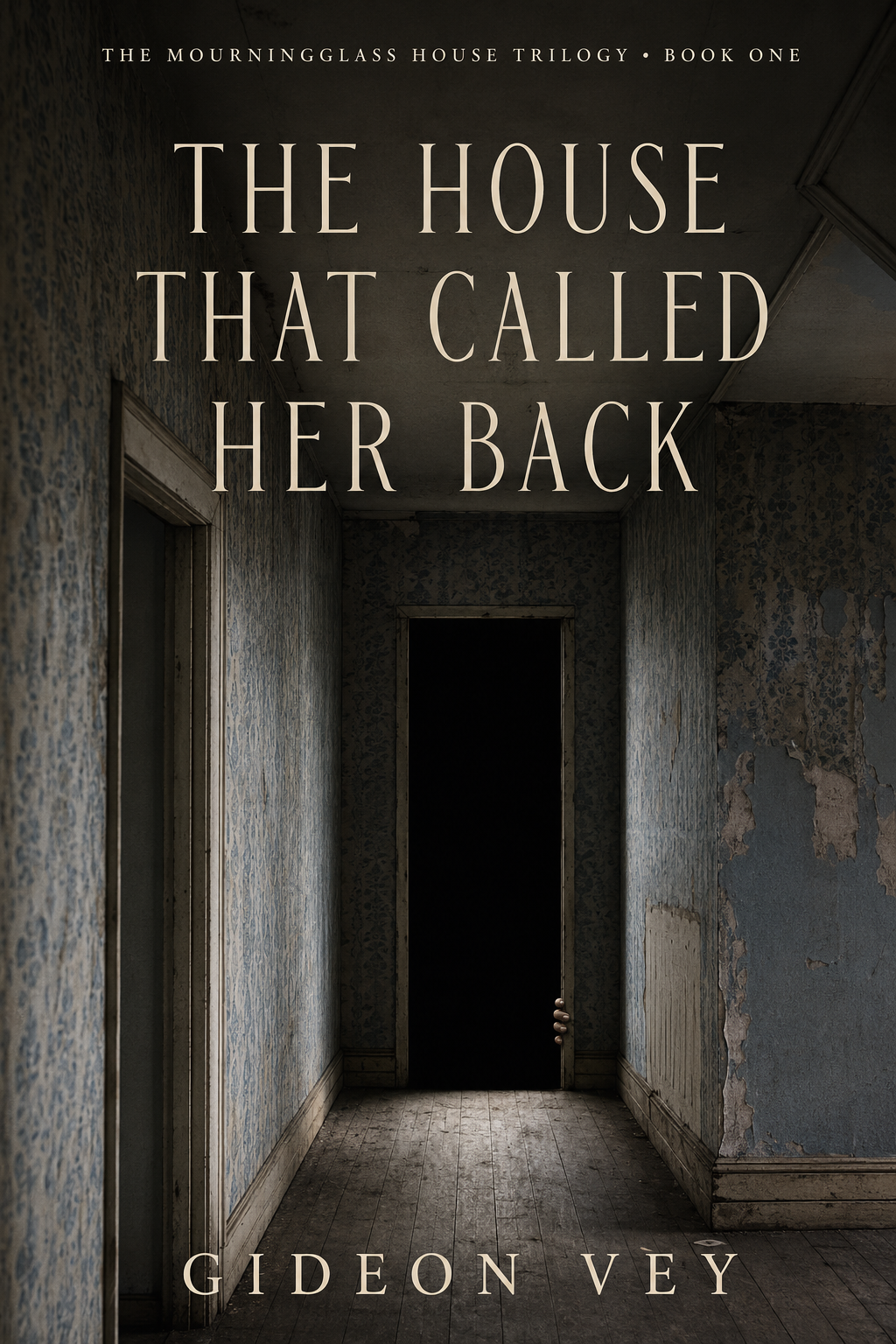
The Mourningglass House
The House That Called Her Back
GIDEON VEY
Chapter One
The Photograph
The door was not there when Evelyn Cross took the photograph.
She was certain because doors were the first things she counted.
One into the building. Two on the first floor. Six on the second. Four on the third, if she included the warped service door that had swollen shut inside its frame. Thirteen altogether. She had written the number at the top of the survey sheet clipped to her case: 13 DOORS. 27 WINDOWS. EAST STAIR UNSAFE.
Evelyn had built a career around the belief that a room could not lie if she measured every way out.
But on the screen of her camera, at the far end of the condemned hotel’s third-floor corridor, stood a fourteenth door.
It was tall and narrow and painted a black so complete it seemed to have been cut out of the image. The corridor’s gray daylight stopped at its edges. No knob. No hinges. No molding. Just a vertical slab of darkness where there should have been blistered wallpaper and the pale rectangular scar left by a missing radiator.
Her camera knew something her eyes did not.
Evelyn lowered the camera.
The wall at the end of the corridor was bare.
She raised it again.
The door waited on the screen.
Rain tapped the boarded windows behind her. Somewhere below, water dripped into water with the hollow patience of a clock.
Evelyn did not move.
Through the camera, the door remained perfectly centered at the end of the hall. Without the camera, there was only the wall.
She checked the image number. DSC_4419. Time stamped 4:12 p.m. She thumbed backward through the sequence.
4418: the damaged ceiling, the eastern wall, no door.
4417: a close view of the radiator scar.
4416: the corridor from the opposite angle.
No black door.
Forward again.
4419.
The door.
Evelyn enlarged the image until individual pixels softened its edges. The paint—or whatever the black surface was—held no reflection from the windows. It should have shown at least one line of washed-out light. Instead, the darkness seemed deeper near the center, as though the photograph had captured not a painted surface but a passage extending away from her.
She zoomed farther.
Something pale appeared near the bottom.
Five small fingertips curled around the door’s edge from the other side.
Not resting against it.
Pulling it open.
Evelyn’s thumb slipped off the control wheel.
The image returned to full frame.
She looked over the top of the camera.
Bare wall. Peeling paper. Radiator scar.
“No,” she said.
Her voice traveled down the empty corridor and came back smaller.
No.
Old buildings manufactured ghosts from reflections, sensor errors, and frightened pattern recognition. Evelyn knew every trick. A coat hanging from a pipe became a body. Water damage became a face. Two planes of glass made doors where no doors existed.
But tricks reflected light.
The black door swallowed it.
That was why she documented instead of interpreting. Facts survived fear.
Light. Angle. Distance. Material. Condition.
Facts first. Fear second.
The phrase entered her mind so cleanly that she almost heard a woman say it—and knew, with a stab of certainty, that she had remembered one word incorrectly.
Evelyn pressed her left thumb against the ridge of scar tissue beneath it. The skin there had gone warm.
“There you are.”
The voice behind her made her spin.
Mr. Ochoa, the city inspector, stood near the stairwell in a yellow rain shell, one hand braced on the cracked plaster. He was in his sixties and had spent most of the afternoon apologizing for a cough he blamed on the building. He looked from Evelyn to the empty wall.
“You all right?” he asked.
“Did you come down this hall?”
“Just now.”
“All the way to the end?”
“No. Floor gets soft past that last room.” He pointed to a doorway behind her. “Why?”
Evelyn looked at the camera, then back at him. “Did you see another door?”
“Another one where?”
She pointed.
Mr. Ochoa squinted at the wall. “There used to be a fire-hose cabinet down there. Building plans show a service shaft too, but it was bricked in before I was born.”
“A door,” Evelyn said. “Tall. Black.”
His expression changed—not much, but enough. His eyes left the wall and settled on her face.
“No,” he said. “I didn’t see that.”
Evelyn had learned to recognize the moment people decided she was no longer a professional asking a professional question. She closed the image review and let the camera hang against her chest.
“Probably a reflection.”
“Off what?”
She did not answer.
Mr. Ochoa glanced toward the stairwell. “Storm’s getting worse. We’ve got what we need for the condemnation packet. You can finish exterior shots tomorrow.”
“I need five minutes.”
“Cross.”
“Five.”
He hesitated, then nodded. “I’ll be at the landing. If you hear wood crack, don’t wait for me to come get you.”
When he was gone, Evelyn stood alone with the rain and the patient drip below.
She switched to live view.
The wall appeared on the screen exactly as it appeared to her eyes. No door.
She lifted the camera and took another photograph.
The shutter snapped.
The new image appeared.
The black door was closer.
It no longer stood at the end of the corridor. It occupied the place where the last guest-room doorway should have been, no more than twenty feet from her.
The pale fingers were gone.
In their place, a child’s face looked through a narrow opening.
Only one eye and part of a cheek were visible. Dark hair. Skin washed white by the flash. The child seemed to be hiding behind the door and peering around its edge.
Evelyn stopped breathing.
The visible eye was gray.
Her sister Lily had possessed eyes that color—gray when the sky was clear, almost blue when it rained.
No.
Lily would be twenty-eight now.
Lily had been eight forever.
Evelyn’s hand tightened around the camera until the plastic creaked.
The child in the photograph raised one finger to her lips.
Evelyn stared at it, and the impossible thing stared back.
Then, from the empty guest room twenty feet away, something knocked three times.
Not from the door.
From inside the wall.
Evelyn backed toward the stairs.
The knocking followed.
Three soft taps inside the wall beside her.
Then three more, closer to the stairwell.
Something was moving through the building with her.
“Mr. Ochoa.”
No answer.
She kept her eyes on the wall and moved faster.
“Mr. Ochoa?”
The stairwell opening waited ten feet behind her. She could see the yellow sleeve of his rain shell beyond the corner.
Three knocks sounded beside her ear.
Evelyn flinched away. Plaster dust sifted from a hairline crack.
For one instant, a child whispered on the other side.
Evie.
Nobody had called her that since the night Lily disappeared.
The name entered the corridor so quietly it might have been breath leaking through the wall.
Evelyn ran.
She nearly struck Mr. Ochoa at the landing. He caught her upper arms, boots sliding on grit.
“Easy. Jesus. What happened?”
“We’re done.”
“You hear something?”
She pulled free. “The floor shifted.”
He studied her. The lie was bad. They both knew it.
Behind them, at the far end of the third-floor corridor, a door slammed hard enough to shake dust from the ceiling.
Mr. Ochoa turned.
The bare wall remained visible from the landing.
“What the hell was that?”
Evelyn was already descending.
She did not look at the camera again until she was outside, locked inside her car with rain sliding down every window.
The second photograph still showed the child.
But the child’s finger was no longer pressed to her lips.
She was pointing behind Evelyn.
In the photograph, a woman’s hand rested on Evelyn’s shoulder.
•
At 5:03 p.m., Evelyn sat beneath the concrete overhang of the hotel’s loading entrance and tried to prove that her camera was broken.
She changed the battery. Removed and reseated the memory card. Checked the lens for moisture and the sensor for dust. She photographed the steering wheel, the rearview mirror, the wet brick wall beside the car, and her own open palm.
Every image was ordinary.
When she returned to 4419 and 4420, the black door remained.
She connected the camera to her laptop and opened the raw files. If the images had been altered, the metadata would show evidence: a changed file size, missing maker notes, inconsistent embedded preview, anything. She ran both through the verification software she used for legal documentation.
AUTHENTIC CAMERA ORIGINAL.
She checked the capture times.
The first had been taken at 4:12:09.
The second at 4:14:37.
Between them sat another file she had not seen on the camera.
DSC_4419A.
It had no thumbnail.
Evelyn stared at the filename. Her camera did not add letters to image numbers. It could not. When burst shots filled the numbering sequence, the counter simply advanced.
She opened the file.
The photograph had been taken from the other side of the black door.
Evelyn saw herself standing in the condemned corridor, camera raised, looking directly toward the lens. The angle was low, approximately the height of an eight-year-old child. Behind Evelyn, the hallway extended farther than the building allowed. Guest-room doors repeated into shadow on both sides.
At the distant end stood a woman in a pale blue dress.
Evelyn’s mind refused the figure before her eyes could understand it.
The woman was too far away for a face, but one hand rested against the wall, and blue thread was wound around two of her fingers.
Her mother used to repair torn book pages that way.
Not with clear tape, which she said yellowed and made a wound permanent. With needle, blue thread, and tiny careful stitches.
There were no surviving photographs of Celia Cross in a blue dress.
There were almost no surviving photographs of Celia at all.
Evelyn closed the laptop.
Her phone lit with a calendar reminder.
DINNER — 7:00 P.M.
Beneath it, in a note she had written to herself three weeks earlier: DO NOT CANCEL AGAIN.
She dismissed the reminder and hated the small rush of relief that followed. Whoever waited at the restaurant would receive another apology polished smooth enough to sound sincere.
Evelyn was excellent at documenting abandoned rooms. She was less skilled at noticing when she had made one around herself.
Rain hammered the roof of the car. Her breath came shallow and quick. She pressed both hands flat against her thighs and named what she could see.
Steering wheel. Dashboard. Parking receipt. Camera case. Water bottle. Red umbrella.
Five things.
She named four she could touch. Three she could hear. Two she could smell.
The panic did not leave, but it withdrew far enough for her to think around it.
Her phone vibrated in the cup holder.
UNKNOWN CALLER.
She watched it ring until it stopped.
A voicemail appeared.
Evelyn turned the phone facedown.
She stayed that way for nearly a minute, listening to the rain. Then she looked again.
The number had a Wisconsin area code.
Bellwether.
Her body recognized the place before thought did. The muscles along her ribs drew tight. Her left thumb throbbed against the scar.
She had not said the town’s name aloud in eleven years.
She had not been there in twenty.
The second statement was technically true and emotionally false. Part of her had never left Bellwether. Part of her remained twelve years old beside Lake Vesper, barefoot and bleeding, unable to explain where her parents and sister had gone.
Evelyn deleted the voicemail without listening.
The phone rang again.
Same number.
She declined it.
It rang a third time.
This time the caller identification changed.
MARA VOSS.
Evelyn knew the name.
Detective Voss had been a uniformed officer in 2006. She had sat across from Evelyn in a hospital room and asked the same questions in six different ways.
Which door did your mother open?
Where was your father when the lights went out?
Why were you the only one outside?
Evelyn accepted the call but did not speak.
For two seconds, neither did the woman on the other end.
Then Mara Voss said, “Is this Evelyn Cross?”
Her voice had changed. Rougher. Older. Still careful.
“You know it is.”
“I wasn’t sure you’d answer.”
“I almost didn’t.”
Rain hissed beneath the silence.
“Where are you?” Mara asked.
“Chicago.”
“Alone?”
Evelyn looked through the streaming rear window. The hotel’s loading entrance was empty.
“Why?”
“I need you to listen before you hang up.”
“That usually means someone knows I should.”
“A family disappeared last night.”
The words touched nothing at first. Chicago contained millions of people and endless ways to disappear.
Then Mara said, “They disappeared from Mourningglass House.”
The inside of the car seemed to contract.
Evelyn looked at the closed laptop on the passenger seat.
“That house is empty.”
“It was.”
“It’s condemned.”
“Yes.”
“The county sealed it.”
“Three times.”
“Then they’re trespassing. Search it.”
“We did.”
Evelyn waited.
Mara exhaled slowly. “Caleb and Ruth Vale bought the property at auction six months ago through a holding company. They planned to restore it as a hotel. They moved in two weeks back with their children, Sophie and Noah. Yesterday afternoon, a contractor saw all four of them inside. At eight twelve last night, Ruth called emergency services.”
“What did she say?”
“Nothing. The line stayed open for forty-seven seconds.”
“And?”
“A child was counting doors.”
Evelyn’s gaze moved to the survey sheet on the passenger floor.
13 DOORS.
Her handwriting looked unfamiliar.
“Children count things,” she said.
“She counted to thirty-three. Then she started again. Each time, she got one door farther.”
A pulse began behind Evelyn’s eyes.
“You said you searched.”
“Every accessible room. Thermal imaging. Dogs. We opened walls where the dogs alerted. No family.”
“Then they left.”
“Their vehicles are there. Shoes are there. Ruth’s purse, Caleb’s wallet, the children’s winter coats. There was fresh food on the table.”
“People stage disappearances.”
“You really want to do this?” Mara asked.
“Do what?”
“Make me convince you.”
Something lived beneath the detective’s controlled voice. Not impatience. Recognition.
“You got to leave Bellwether,” Mara said. “Some of us have been waiting twenty years for that house to give something back.”
Evelyn looked at the rain-blurred hotel, at the third-floor windows where no one stood.
“You haven’t told me why you’re calling.”
“We found a camera on the front lawn.”
Evelyn said nothing.
“Old instant camera,” Mara continued. “The kind that pushes the picture out the front. There was one photograph inside.”
“Of the family?”
“No.”
Mara’s next breath scratched across the connection.
“It was you, Evelyn.”
The knocking from the hotel wall seemed to begin again inside her memory.
Three taps.
Evie.
“That’s impossible.”
“It showed you at twelve. Hospital bracelet on your wrist. Blood on your nightgown. Same as the morning we found you.”
“You already have photographs from that morning.”
“Not like this one.”
“What does that mean?”
Mara was silent too long.
“In this photograph,” she said, “you’re standing inside the house.”
Evelyn’s hand closed around the phone.
“That picture was not taken twenty years ago,” Mara said. “The manufacturer code on the film places it in a batch shipped four months ago.”
“Someone reproduced an old image.”
“We thought so. Except there’s something behind you that wasn’t there in any of the old scene photographs.”
Evelyn knew before Mara said it.
She knew, and still the words struck like cold water.
“A black door,” Mara said.
On the passenger seat, Evelyn’s laptop opened by itself.
The screen came awake.
DSC_4419A filled the display.
The woman in the distant blue dress was no longer at the end of the photographed corridor.
She stood directly behind Evelyn.
Evelyn twisted in her seat.
No one occupied the car.
When she looked back at the screen, the woman was gone.
Only the blue thread remained, laid across the floor in the shape of a word.
HOME.
•
The package waited outside Evelyn’s apartment when she arrived at 6:41.
She saw it before the elevator doors finished opening.
Brown paper. White string. No postage.
It sat exactly in the center of her doormat.
Evelyn remained inside the elevator, one hand holding the doors apart.
The fifth floor of the converted warehouse contained four units and no blind corners. She had chosen it for that reason. Exposed brick ran from the elevator to the fire stairs. Motion-activated fixtures threw clean white light across every doorway. A camera above her apartment recorded the entire corridor.
No one could leave a package without being seen.
She let the elevator doors close, rode down to the lobby, and called building security.
The night guard, Henry, checked the fifth-floor feed while she watched over his shoulder. At 5:58, her doormat was empty. At 5:59, the video broke into gray static for a single frame.
At 6:00, the package was there.
No person entered or left the corridor.
“Camera glitch,” Henry said.
“A glitch tied string?”
He gave an uneasy laugh. “Maybe somebody came out of another unit.”
“Which one?”
They checked every feed from the elevator, fire stairs, lobby, loading entrance, and garage. No unknown person entered the building. None of Evelyn’s three neighbors left their apartments.
At 5:59, all seven camera feeds skipped the same frame.
“You want me to call the police?” Henry asked.
Evelyn thought of Mara Voss saying a family had vanished from Mourningglass House. She thought of explaining the door in her photograph to Chicago officers who would ask whether she had been sleeping.
“Not yet.”
Henry offered to carry the package downstairs. Evelyn refused. If it contained a device, moving it through the building would not improve anyone’s safety.
She returned upstairs with a fire extinguisher in one hand and Henry two steps behind her.
Up close, the paper looked old. Not decorative old—actually old. Fibers lifted from its surface. Damp had stained one corner the brown-yellow color of weak tea. The string was cotton, knotted twice.
Her name had been written across the top.
EVELYN CROSS.
The letters slanted sharply to the right. The E began with a loop too large for the rest of the word. The final S ended in a downward hook.
Her mother’s handwriting.
Evelyn had spent years forgetting it. The effort failed in an instant.
Celia labeling school lunches.
Celia writing notes on the bathroom mirror.
Celia stitching torn books and signing birthday cards and leaving a grocery list on the refrigerator door the last afternoon of Evelyn’s childhood.
Milk. Apples. Blue thread. Candles for Lily.
“Ms. Cross?” Henry asked.
Evelyn realized she was kneeling.
She did not remember lowering herself.
“Go downstairs,” she said.
“I don’t think I should leave you with—”
“If it’s dangerous, I need you away from it. If it isn’t, I need privacy.”
Henry looked unhappy with both possibilities. “Call me if you need anything.”
She waited until the elevator carried him away.
Then she photographed the package from every side.
Facts first. Fear second.
Her mother’s phrase again.
No. That was wrong.
Evelyn closed her eyes.
She could see Celia crouched in front of her, hands warm around Evelyn’s cold fingers. Not facts. Another word.
The memory blurred when she reached for it.
Truth first, something second.
She opened her eyes.
The package rested on the mat.
For a moment, she thought it had moved closer.
Evelyn cut the string with the small knife on her key ring. She unfolded the paper without tearing it and found a flat black box beneath.
Inside lay six instant photographs.
The first showed…
Evelyn had…
Keep reading The House That Called Her Back
You've reached the end of the free preview. Purchase this eBook for permanent access in your Novel Thunder Library.
Buy eBook — $4.99