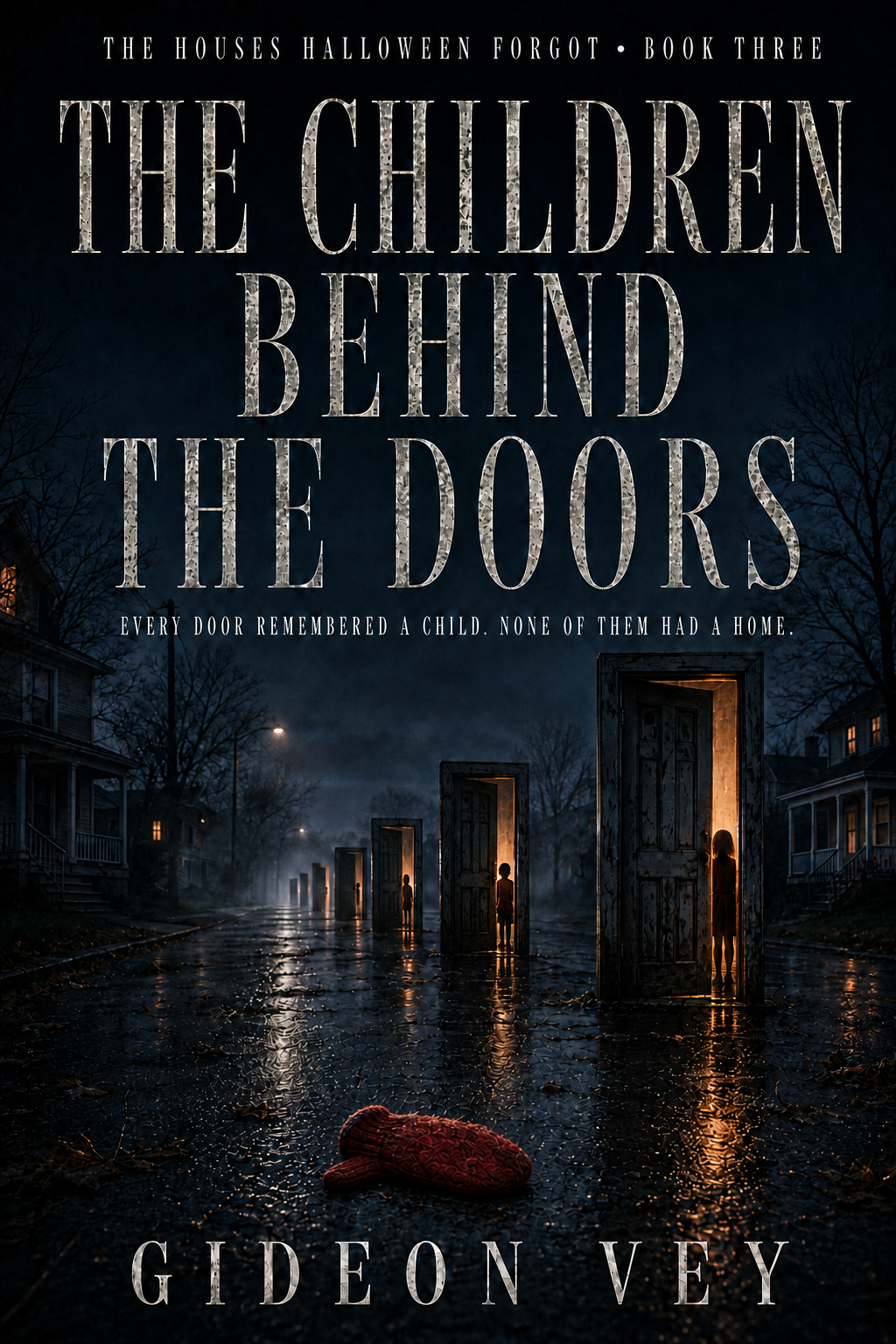
The Houses Halloween Forgot
The Children Behind the Doors
GIDEON VEY
Chapter One
The First Child Behind The Door
The children stopped knocking when Della touched the first door.
Silence traveled through the corridor in both directions.
It moved past the white bedroom doors, the orange front doors, the hospital doors with narrow windows, the closet doors covered in stickers, and the swollen cellar doors that leaked black water across the floor. Thousands of small fists became still at once.
Della held the brass key between two fingers.
It had been warm when Ione placed it in her hand.
Now it was hot enough to hurt.
“Why did they stop?” Mina whispered.
Della looked over her shoulder.
Her sister stood several feet behind her, wearing the red coat she had disappeared in when she was eight years old. The corridor’s weak ceiling lights left half her face in shadow. Beyond her, Ione watched the doors with the exhausted patience of someone who had spent too many years listening to them.
“They know she chose one,” Ione said.
“I didn’t choose anything.”
“You touched the door.”
Della looked at the white-painted wood beneath her palm. There was nothing remarkable about it. No number. No peephole. No scratches around the lock.
It looked like a child’s bedroom door.
A faded paper star had been taped near the top.
DELLA was written across it in purple crayon.
She pulled her hand away.
The name remained.
“That wasn’t there before,” she said.
“No,” Ione replied. “It wasn’t.”
Mina stepped closer. “Maybe it wants you to open it.”
“They all want to be opened.”
“No.” Mina studied the purple letters. “This one wants you.”
The brass key burned hotter.
Della tightened her grip rather than dropping it.
The corridor extended farther than she could see. Doors stood inches apart along both walls, some so narrow that no human body could have passed through them. Others rose two stories high, their upper frames disappearing into darkness. The ceiling lights flickered one after another, illuminating brief stretches of wallpaper that changed with every pulse.
Flowers.
Stripes.
Nursery animals.
Water stains.
Handprints.
The patterns belonged to different houses and different decades, joined together without seams.
“How many children are here?” Della asked.
Ione did not answer.
“How many?”
“More than the town remembers losing.”
“That isn’t a number.”
“The corridor doesn’t keep numbers the way we do.”
Della turned toward her. “You kept forty-five notebooks.”
“I kept what the town would allow me to remember.”
“And what does that mean?”
“It means every time I wrote down a child, another name disappeared from somewhere else. A birth certificate. A school photograph. A mother’s memory. The street does not erase people all at once. It removes them piece by piece until no one notices the space they left behind.”
Mina stared at the door bearing Della’s name.
“Then why do I remember her?” she asked.
Ione’s eyes shifted toward Della.
“Because you were taken together.”
Della felt the answer before she understood it.
“What?”
“You and Mina entered the first house together.”
“No. Mina disappeared. I came home.”
“That is what the house allowed you to remember.”
Della shook her head. “I remember walking home alone.”
“You remember being found alone.”
“I remember the sidewalk. The porch lights. My mother opening the front door.”
“You remember what the town built around the part it lost.”
Della looked at Mina.
Her sister had not moved.
“You said we went inside together,” Della said.
Mina’s expression tightened. “I thought we did.”
“You thought?”
“I remember your hand.”
Della looked down at her empty left hand.
For years, she had dreamed of holding someone’s fingers as she approached the orange door at the end of Vane Street. The hand had always been smaller than hers. Cold. Trembling. Each time she woke, she told herself it belonged to Mina.
Now another sensation surfaced beneath the dream.
A second hand holding hers from the opposite side.
Three children walking toward the house.
Della turned back to the white door.
The purple crayon letters had changed.
DELLA CAINE
Below her name, another word appeared one crooked letter at a time.
RETURNED
“What does that mean?” Mina asked.
“I don’t know.”
Ione did.
Della could see it in the way the old woman stepped backward.
“Ione.”
“We should choose another door.”
“You said touching it was choosing.”
“The corridor lies.”
“So do you.”
“I survived by learning when the difference mattered.”
The key pulsed against Della’s palm.
A child knocked once from the other side.
Not with a fist.
With one finger.
Tap.
Della lifted the key toward the lock.
Ione seized her wrist.
“Listen to me. Every door is attached to a house. Every house is attached to the child it kept. But the child is not always the only thing waiting inside.”
Della pulled against her grip. “Then tell me what else is there.”
“The part of the house that learned to look like them.”
Tap.
Mina moved beside Della.
“How can we tell which is which?”
“We can’t.”
The answer settled over them.
Tap.
Della looked at the brass key. “What happens if I open it?”
“One of three things.”
“Which are?”
“The child comes out. The house comes out. Or you go in and the corridor closes behind you.”
“That’s it?”
“No.” Ione released her wrist. “Sometimes the door opens somewhere else.”
Tap.
A crack appeared in the purple paper star.
The door swung inward half an inch.
Della had not inserted the key.
Cold air touched her face. It carried the smell of wet leaves, candle wax, and chocolate.
Halloween.
From inside the room, a girl whispered, “You took too long.”
Mina’s breath caught.
Della pushed the door open.
The corridor vanished.
She stood beneath a yellow porch light on a street she recognized.
Plastic skeletons hung from tree branches. Cotton cobwebs covered hedges. Carved pumpkins flickered along the sidewalks. Children in costumes moved from house to house, their voices overlapping beneath the dry rattle of October leaves.
Vane Street.
Not the Vane Street that had grown beyond Briar’s End.
The original street.
The one that had existed when Della was eight.
She looked down.
Her hand was small.
A black plastic witch’s cape covered her arm. Orange stars had been glued along its edge. She wore scuffed shoes and striped tights.
Mina stood beside her in a red coat.
She was eight again.
On Della’s other side stood a boy wearing a cardboard robot costume painted silver. A square box surrounded his chest. Aluminum dryer hoses covered his arms. His face appeared through a rectangular opening cut into a box over his head.
He held Della’s hand.
She remembered him.
The memory struck so hard that her knees weakened.
“Elliot,” she said.
The boy turned toward her.
His face was pale beneath the cardboard helmet. A crescent-shaped scar crossed his right eyebrow.
“You said you wouldn’t forget again.”
Della released his hand.
Elliot Vale.
He had lived three houses from hers. His father repaired watches in a narrow storefront downtown. His mother sang while she raked leaves. He collected dead batteries because he believed he could build a machine that brought them back to life.
He had been their friend.
He had entered the house with them.
And afterward, no one had ever spoken his name.
Della touched her mouth.
“I’m sorry.”
“You always say that here.”
The children on the street continued trick-or-treating without looking at them. Their costumes belonged to different decades. Homemade ghosts made from bedsheets walked beside plastic superheroes. A girl wore a paper nurse’s cap from the 1950s. Two boys carried metal lunchboxes instead of candy buckets.
None of their feet made a sound.
Mina stared at Elliot.
“I remember your basement,” she whispered.
“You broke my telescope.”
“You told your dad the cat did it.”
“He didn’t believe me.”
“You got grounded for two weeks.”
Elliot smiled.
For one instant, he was only a child happy to have been remembered.
Then every jack-o’-lantern on the street went dark.
The houses turned their porch lights off together.
Children stopped moving.
At the end of Vane Street, the last house waited.
Its orange front door stood open.
“Don’t let it see you remember me,” Elliot said.
A figure appeared in the doorway.
It was too tall to be the Carrier.
Its head brushed the top of the frame. Long arms hung beside a body hidden beneath a dark coat. It held a trick-or-treating bucket shaped like a white plastic skull.
The bucket was filled with brass keys.
Mina stepped behind Della.
“What is that?”
Elliot lowered his voice. “The First Parent.”
The figure tilted its head.
Every child on the street turned toward Della.
Their masks were empty.
The ghosts had black holes where faces should have been. The superheroes’ plastic masks bent inward over nothing. The nurse had no eyes beneath her paper cap.
The First Parent stepped onto the porch.
A deep voice passed through every house at once.
“Three children arrived.”
Della could feel the words vibrating through the sidewalk.
“One child returned.”
Elliot gripped her hand.
“Run.”
The children rushed toward them.
Della pulled Elliot and Mina from the porch. They ran between silent houses as dozens of costumed figures poured into the street. Their candy buckets swung from empty hands. Wrapped sweets spilled across the pavement.
The houses leaned inward.
Roofs stretched over the road. Windows opened like eyes. Front doors slammed in sequence behind them, each impact moving closer.
Della remembered this.
Not as a complete memory.
As flashes.
Mina screaming.
Elliot’s cardboard costume tearing beneath someone’s hand.
The orange door growing larger no matter which direction they ran.
A woman standing in the road and telling Della she could only carry one child home.
They reached the intersection.
There should have been a way off Vane Street.
Instead, the road curved and returned them to the last house.
The First Parent waited at the gate.
Its skull bucket hung from one hand.
“Three children arrived,” the houses repeated.
“One child returned.”
Della stopped.
Elliot tried to pull her forward. “You have to choose differently.”
“What did I choose before?”
He looked at Mina.
Della’s stomach twisted.
“No.”
“You didn’t understand.”
“No.”
“You were eight.”
“What did I do?”
Mina backed away from both of them.
The First Parent reached into the skull bucket and selected a brass key.
Della felt an identical key burning in her adult hand, somewhere beyond the memory.
The two places pressed against each other.
Past and corridor.
Child and woman.
Choice and consequence.
“What did I do?” Della demanded.
Elliot began crying.
“You chose yourself.”
The street opened beneath her.
Della fell through the memory and struck the corridor floor.
The white door slammed shut behind her.
She lay on her side, gasping. The brass key remained clenched in her fist. Smoke rose between her fingers.
Mina knelt beside her.
She was an adult again—or whatever version of her the corridor had returned.
“I saw it,” Mina said.
Della forced herself upright.
Ione stood several steps away.
“You knew,” Della said.
“I suspected.”
“Who is Elliot Vale?”
The name changed the corridor.
Lights burst overhead.
Doors rattled in their frames.
A hundred children began whispering from behind the walls.
Elliot.
Elliot.
Elliot.
Ione looked toward the darkness at the far end of the hall.
“You should not have said his name here.”
“Who is he?”
“The first child Briar’s End agreed to forget.”
“No. He was our friend.”
“He was more than that.”
A pounding began behind the white door.
Della stood.
The paper star had fallen to the floor. The purple letters on it faded until only one word remained.
RETURNED.
“He’s still inside,” Mina said.
Della inserted the key into the lock.
Ione grabbed her shoulder. “That was not Elliot.”
“I remembered him.”
“That does not make him real.”
“He knew things about us.”
“So does the house.”
The pounding grew stronger.
“Della!” Elliot screamed from the other side. “It knows you came back!”
Della turned the key.
The lock resisted.
She twisted harder.
Something metallic snapped inside the door.
The brass key broke.
Half remained in her hand.
The other half disappeared into the lock.
Every door in the corridor opened one inch.
Thousands of children inhaled.
Ione stared at the broken key. “What did you do?”
Della stepped away from the white door.
The thin black openings along both walls widened.
Small fingers curled around their edges.
A girl’s eye appeared behind a pink bedroom door. A boy wearing a hospital bracelet looked through a metal fire door. Two children pressed their faces into the opening beneath a closet door turned sideways in the wall.
None of them spoke.
They stared at Della.
At the far end of the corridor, bells began chiming.
One.
Two.
Three.
The sound continued until it had rung twelve times.
Then came a thirteenth.
The children pulled their doors shut.
Locks clicked one after another, racing down the corridor toward Della.
The white door did not close.
Its opening widened.
Darkness filled the room beyond it.
Elliot stood several feet inside.
He still wore the cardboard robot costume, but it had changed. Water darkened the silver paint. The box around his chest sagged with age. Mold climbed the dryer hoses covering his arms.
He had not aged.
Behind him stood the last house on Vane Street.
Not a memory of it.
The house itself had been folded inside the room.
Its upper story bent against the ceiling. The porch extended across a floor that could not have contained it. The orange door stood open beneath a light that illuminated nothing.
The First Parent waited inside.
Elliot reached toward Della.
“Please.”
Ione stepped between them.
“Do not cross the threshold.”
“Move,” Della said.
“You cannot save a child by entering the moment that took him.”
“I left him.”
“You were eight years old.”
“I chose myself.”
“You survived.”
“He didn’t.”
Elliot’s fingers trembled.
The First Parent moved closer to the orange doorway.
“Three children arrived,” the house said.
“One child returned.”
Mina came to Della’s side.
“Maybe that isn’t what it means.”
Della looked at her.
Mina stared into the room with a concentration that made her appear older.
“It didn’t say one child escaped,” she continued. “It said one child returned.”
Ione went still.
Della heard the difference.
Returned.
Not escaped.
Returned to whom?
She looked down at the broken half of the key.
The word on the paper star had not described her survival.
It had described what the house had done with her.
“You said I was found alone,” Della said.
Ione did not answer.
“You said the town built a memory around what it lost. What did it build around me?”
The corridor lights flickered.
For a heartbeat, Della saw herself reflected in every doorknob.
Not as she was.
As an eight-year-old girl in a witch costume, standing perfectly still behind hundreds of different doors.
“What came home?” Mina whispered.
The First Parent raised one long arm.
It pointed at Della.
The house answered through the floorboards.
“Our door.”
A crack split the corridor beneath her feet.
Black roots pushed through the carpet. They wrapped around Della’s shoes and climbed her ankles.
She tore one foot free.
Mina grabbed the other root and pulled. It twisted around her wrist.
The white door opened wider.
Wind rushed toward the room, dragging loose wallpaper, dust, and fallen scraps of paper with it. The paper star lifted from the floor and flew into the darkness.
Ione braced herself against the wall.
“The door is taking its return.”
Della seized Mina’s arm. “Help me!”
“I’m trying!”
The roots tightened.
A thin line opened along Della’s palm where the broken key had burned her. Blood filled the shape.
It did not form a wound.
It formed an address.
17 VANE STREET.
The number belonging to the last house.
Mina saw it.
“You’re registered.”
The roots pulled Della forward.
Her shoes crossed the threshold.
Cold October air surrounded her. The porch light above the impossible house flickered on.
Elliot stood close enough to touch.
“Don’t listen to it,” he said.
Della caught his wrist.
His skin was warm.
A pulse beat beneath it.
She pulled.
Elliot did not move.
The house held him from behind, though nothing touched his body.
“Help me!” Della shouted.
Mina wrapped both arms around her waist. Ione caught Mina’s coat. The three women pulled against the doorway.
Elliot’s cardboard costume ripped at the shoulder.
Beneath it, his body was covered in writing.
Addresses had been carved into his skin.
Hundreds of them.
Some were crossed out. Others were too faint to read. New numbers appeared across his chest while Della watched.
“What did they do to you?”
“I keep the doors.”
“You’re the key?”
He shook his head.
“I’m the lock.”
The First Parent stepped out of the orange doorway.
Della finally saw its face.
It had hers.
Not her adult face.
The face she had possessed at eight years old stared from the top of the long body. Purple glitter covered its cheeks. A pointed witch’s hat sat crookedly over dark hair. Its smile was too wide for the child’s jaw.
Della lost her grip on Elliot.
The thing wearing her childhood face crossed the porch.
“You returned when called,” it said.
Mina screamed Della’s name.
The roots jerked.
Della fell fully into the room.
The white door slammed between them.
Darkness swallowed the corridor.
Della rolled across wet leaves and struck the bottom porch step. The broken key flew from her hand.
She heard Mina pounding on the other side of a door that no longer existed.
The room had become Vane Street.
Halloween decorations moved in the wind.
Costumed children stood silently along both sidewalks.
Elliot watched from the curb.
The First Parent descended the porch steps wearing Della’s eight-year-old face.
“You are late,” it said.
“For what?”
The child’s smile widened.
“For your children.”
Every house on Vane Street opened its front door.
Mothers stepped onto the porches.
Some wore robes. Some wore winter coats. Some wore dresses from decades before Della was born. Their faces carried the same stunned terror.
Each woman held the hand of a missing child.
The children looked at Della.
There were hundreds of them.
The First Parent placed the skull-shaped bucket at Della’s feet.
Inside lay thousands of brass keys.
“You opened the corridor,” it said. “Now every house requires a mother.”
“I’m not their mother.”
“You are the one who returned.”
“That doesn’t mean anything.”
“It means you belong to both sides of the door.”
The children began walking toward her.
Della backed against the porch steps.
“What do you want me to do?”
“Choose who goes home.”
“And the others?”
The First Parent looked toward the last house.
The orange door waited behind it.
“They become doors.”
A cry rose from the gathered mothers.
Della looked at Elliot.
The addresses covering his skin seemed to move beneath the torn cardboard.
He had not merely been trapped in the house.
Every child who had disappeared after him had become another lock inside his body.
Della crouched beside the skull bucket.
The keys whispered when she touched them.
Each one spoke a name.
Ruby Alder.
Mina Caine.
Nori Venn.
Caleb Orr.
Simone Bell.
Children whose disappearances the town had explained, misplaced, or forgotten.
Names from Ione’s notebooks.
Names that had never reached the notebooks at all.
One key remained silent.
It lay at the bottom of the bucket, blackened with age.
Della reached for it.
The First Parent’s smile disappeared.
“That door is not yours.”
Della picked up the black key.
An address had been engraved along its shaft.
Not 17 Vane Street.
Not any address in Briar’s End.
The inscription read:
1 HALLOWEEN.
Beneath it was a date.
OCTOBER 31, 1692.
Della closed her fist around the key.
For the first time, the First Parent stepped away from her.
“What does this open?” she asked.
The houses groaned.
Elliot’s eyes widened behind his cardboard helmet.
“It opens the house that made the first door.”
The First Parent lunged.
Della drove the black key into the porch beneath her.
Wood split around it.
A lock appeared in the floorboards.
She turned the key.
The entire street tipped sideways.
Houses tore free from their foundations. Mothers pulled their children close. The sky cracked from horizon to horizon, revealing not stars but another corridor above them.
This corridor was older.
Its walls were made of packed earth and black timber. Candlelight leaked beneath doors built from rough planks. Symbols had been carved above every frame.
The orange house screamed.
Della held the key as the porch opened beneath her.
The First Parent caught her wrist.
Its child face peeled away.
There was no head beneath it.
Only a doorway filled with fire.
Della fell through.
She struck hard ground.
The black key remained in her hand.
Above her, the opening snapped shut.
The screams from Vane Street disappeared.
Della pushed herself onto her knees.
She was inside the older corridor.
The air smelled of smoke, damp soil, and something sweet cooking over a fire.
Doors stretched through the darkness.
No children knocked behind them.
Women did.
A candle flared at the end of the passage.
A woman stood beside it wearing a long black dress and a white linen collar. Gray hair hung loose around her face. A rope mark encircled her neck.
She held an infant against her chest.
The child had no shadow.
The woman looked at the key in Della’s hand.
“You came from the houses above,” she said.
Della rose slowly.
“Where am I?”
“The place beneath every address.”
“Who are you?”
The woman adjusted the sleeping infant.
“My name was removed before your town learned how to forget.”
A door opened behind Della.
Elliot stepped through.
His robot costume was gone.
He wore simple trousers and a shirt stained with soot. The addresses still covered his skin, glowing faintly in the candlelight.
The woman looked at him with sorrow.
“The lock has returned.”
Elliot seized Della’s hand.
“We have to go.”
“Why?”
A bell rang somewhere deep underground.
The woman carrying the infant turned toward the sound.
“Because the houses know she found their mother.”
Every wooden door opened.
Women filled the thresholds.
Some carried babies. Others held the hands of children dressed in clothing from different centuries. Rope burns marked their necks. Blackened wounds covered their hands. Names had been cut from the skin above their hearts.
They stared at Della.
Then, one by one, they bowed.
The infant in the woman’s arms opened its eyes.
Inside each pupil stood a tiny orange door.
The woman smiled.
“Welcome home, Della Caine.”
Behind Della, the passage sealed itself with brick.
The black key broke in her hand.
Chapter Two
The Women Beneath the Addresses
The broken key began bleeding.
Dark liquid gathered along the fracture and ran between Della’s fingers. It was warmer than blood and smelled faintly of burned sugar. When the first drop struck the packed-earth floor, a child cried behind one of the wooden doors.
The women stopped bowing.
Every face lifted.
“Do not let it touch the ground,” the woman with the infant said.
Della closed both hands around the broken key.
Another drop escaped.
It landed beside her shoe.
A second child began crying.
The women retreated into their doorways. Some pulled their children behind their skirts. Others covered babies’ mouths with their palms. Doors closed throughout the passage, shutting out the candlelight one narrow section at a time.
Elliot caught Della by the wrist.
“Hold it above your head.”
“Why?”
“Because the ground listens.”
The black liquid seeped through her fingers.
Della raised the key.
The crying stopped.
Not gradually.
Both children became silent in the middle of a breath.
The woman with the rope mark around her neck remained beside the candle. Her infant stared at Della with orange doors reflected in its pupils.
“What happens if more touches the floor?” Della asked.
“The soil remembers where the key has been.”
“And?”
“It grows a house there.”
The woman approached without making a sound. She held out her free hand.
Della did not give her the key.
“Who are you?”
The woman looked past Della at Elliot.
“You brought her without preparing her.”
“I didn’t bring her anywhere,” Elliot replied. “She opened the first lock.”
“She opened what the houses placed before her.”
“She found the black key.”
“Because they wanted it found.”
Della stepped between them. “Who are you?”
The woman examined her as though deciding which answer Della had earned.
“Before the town removed my name, I was called Mercy Wren.”
“Before which town?”
“All of them.”
“That doesn’t answer my question.”
“It answers more than you understand.”
Mercy reached for the broken key again.
Della pulled it away.
The infant smiled.
Its mouth contained a single tiny brass tooth.
“Your key is feeding the floor,” Mercy said. “You can surrender it to me or continue asking questions until this passage grows around you.”
Della looked down.
The black liquid had not stopped falling.
It no longer reached the ground because thin roots had climbed from the soil to meet it. They extended upward in twisting strands, drinking from her clenched fist.
A rectangular outline formed beneath her feet.
A foundation.
Della handed Mercy the key.
The roots collapsed.
Mercy wrapped both broken pieces in a strip of cloth torn from the hem of her dress. The black stain spread across the fabric but did not soak through.
The infant made a soft clicking sound.
Mercy looked down at it.
“No,” she whispered. “She is not ready.”
The baby clicked again.
Della stared at the brass tooth. “What is wrong with that child?”
Mercy’s expression hardened. “Nothing.”
“It has a key in its mouth.”
“So did you.”
Della touched her teeth.
“What?”
“When the house returned you, your mother found a brass tooth beneath your tongue.”
“That never happened.”
“Your mother forgot.”
“How would you know?”
“Because she came here to ask us what it meant.”
The passage seemed to narrow.
Della heard the soft movement of women behind closed doors. They were listening.
“My mother was here?”
“Once.”
“When?”
“The night after you returned.”
“That’s impossible.”
“Everything above us survives by calling this place impossible.”
Della looked toward the brick wall that had sealed behind her. There was no outline of a doorway. No crack. No sign that Vane Street had ever been on the other side.
“Mina is still in the corridor.”
“If the corridor still has her.”
“I need to get back.”
Mercy turned away.
“You have already gone back once.”
Della followed her. “I don’t know what that means.”
“You will.”
“That isn’t good enough.”
Mercy stopped.
The infant’s head rolled toward Della, although its body remained pressed against Mercy’s chest.
“Answers are doors,” Mercy said. “You have spent your life believing that opening them makes you free. Sometimes the thing behind the door was safer while you did not know its name.”
“I am done being protected by lies.”
“N…
Keep reading The Children Behind the Doors
You've reached the end of the free preview. Purchase this eBook for permanent access in your Novel Thunder Library.
Buy eBook — $6.99