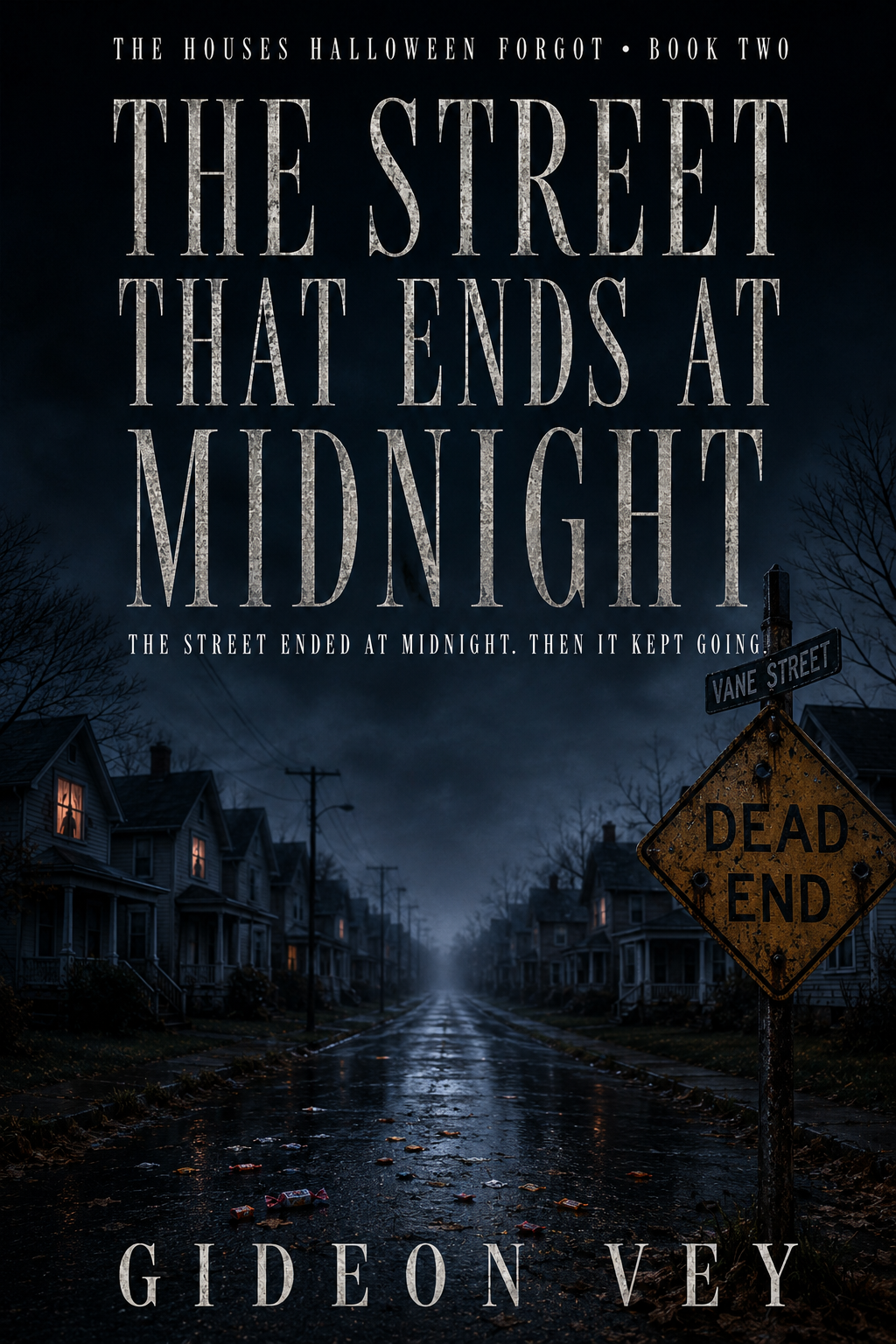
The Houses Halloween Forgot
The Street That Ends at Midnight
GIDEON VEY
Chapter One
The Address That Called Itself In
At 11:43 on the final night of January, Vane Street added a house.
Della Caine watched it happen on the municipal map.
A thin white property line extended beyond the dead end, cutting through three acres of protected woodland. A rectangular parcel appeared around it. Then a second. Then a third.
Numbers populated the parcels one at a time.
The cursor rested untouched beneath Della’s hand.
She leaned closer to the monitor.
Briar’s End maintained three separate address databases. The public map displayed roads, parcels, utilities, and municipal boundaries. The emergency map added hydrants, alarm boxes, access gates, and the fastest routes for police, fire, and ambulance crews. The archival system preserved properties that had been demolished, renumbered, annexed, or erased by clerical mistake.
Della had all three open.
Vane Street existed only on the emergency map.
It had not been there when she began her shift.
The road lengthened again.
The final parcel formed at the edge of the screen. Unlike the others, it had no visible boundary. Its address hovered over solid black woodland.
17 VANE STREET.
Della stopped breathing.
The number remained for three seconds.
Then the one disappeared.
7 VANE STREET.
She blinked.
The one returned.
17 VANE STREET.
A notification opened in the corner of her screen.
NEW RESIDENTIAL ADDRESS DETECTED.
“Not possible,” Della whispered.
New addresses did not detect themselves.
A developer submitted a plat. Planning reviewed it. Public works confirmed access. The fire department approved emergency numbering. The county recorded the parcels. Someone in Della’s office entered the data after receiving six signatures and a folder thick enough to stop a door.
Addresses did not appear at eleven forty-three on a Saturday night.
They especially did not appear inside protected woodland.
Della moved the cursor over the first parcel.
OWNER: UNAVAILABLE.
STRUCTURE: OCCUPIED.
BUILD DATE: UNAVAILABLE.
She selected the second.
OWNER: UNAVAILABLE.
STRUCTURE: OCCUPIED.
BUILD DATE: UNAVAILABLE.
The third parcel displayed the same information.
A telephone rang behind her.
Della turned.
The addressing department occupied the fourth floor of Briar’s End Municipal Services, a rectangular building designed sometime in the 1970s by a person who disliked windows. During business hours, twenty-three employees worked among gray partitions and metal filing cabinets. Tonight, every cubicle stood empty except hers.
The telephone rang again.
It was not her desk phone.
The sound came from the cubicle across the aisle.
That desk belonged to Malcolm Yarrow, who had left at five thirteen after spending twenty minutes complaining about his daughter’s destination wedding.
His telephone rang a third time.
Della stood.
“Municipal Addressing.”
Her voice sounded too loud in the empty office.
The telephone continued ringing.
She crossed the aisle and lifted Malcolm’s receiver.
“Briar’s End Municipal Addressing Department. This is Della.”
Static whispered against her ear.
“Hello?”
A child breathed on the line.
Della glanced at the caller display.
The screen showed an address instead of a telephone number.
1 VANE STREET.
“Who is this?”
The breathing stopped.
A girl said, “Our house is facing the wrong way.”
Della lowered herself into Malcolm’s chair.
“Are your parents there?”
“My mother is upstairs.”
“Can you put her on the phone?”
“She can’t find the stairs.”
Della looked toward her monitors.
The new parcels remained on the emergency map.
“What’s your name?”
“Ruby.”
“Ruby what?”
The girl hesitated.
A faint knocking traveled through the connection.
Three slow impacts.
Then three more.
“Ruby?”
“Someone is at the back door.”
“Don’t open it.”
“It used to be the front door.”
Della pulled a notepad toward her.
“Tell me your last name.”
The line disconnected.
She stared at the receiver.
The dial tone did not return.
Instead, a recorded voice said, “This address is no longer occupied.”
Della set the telephone down.
For several seconds, she listened to the fluorescent lights buzz above the cubicles.
Then her own desk phone rang.
She crossed the aisle quickly and answered.
“Municipal Addressing. Della Caine.”
Static.
A different child said, “There’s a house in our driveway.”
Della sat.
The caller display read:
3 VANE STREET.
“What is your name?”
“Peter.”
“How old are you, Peter?”
“Ten.”
“Are you inside your house?”
“I think so.”
“What do you mean?”
“The rooms are ours, but the windows aren’t.”
Della opened the emergency communications directory and searched for Vane Street. The system found no residents, telephone accounts, permits, utility connections, or tax records.
On the map, the parcel at Number Three pulsed orange.
“Are your parents with you?”
“My dad went outside.”
“When?”
“He heard someone moving the garage.”
“Is your mother there?”
“She’s looking for my dad.”
“Listen carefully, Peter. Stay inside and lock every door. Do not go into the driveway.”
The boy became quiet.
“Peter?”
“He came back.”
“Your father?”
“No.”
Della heard a door open.
A man spoke somewhere behind the child.
His words were too distorted to understand.
Peter began crying.
The line went dead.
Della dialed emergency dispatch.
The call failed before it rang.
She tried again.
NO ROUTE AVAILABLE.
She reached for her cell phone. It showed full signal, but the emergency number would not connect. Neither would the police department’s direct line.
Every outgoing call returned the same message.
The number you have reached does not exist.
The telephone in the next cubicle began ringing.
Then another.
Four desks away, a third joined them.
Della looked down the aisle.
Red lights flashed beneath the receivers.
5 VANE STREET.
7 VANE STREET.
9 VANE STREET.
The phones rang together.
She answered the nearest.
“Tell me your name and what is happening.”
An elderly woman whispered, “My children came home.”
Della pressed the receiver against her ear.
“What address are you calling from?”
“You know the address.”
“Please confirm it.”
“Five Vane Street.”
The parcel marked Five pulsed orange on Della’s map.
“What is your name?”
“Agnes Vale.”
Della typed it into the residential database.
No result.
“How old are your children, Agnes?”
“Daniel is six. Margot is eight.”
“Are they with you?”
“They’re standing at the end of my bed.”
The woman sounded old enough to have adult grandchildren.
“Do you recognize them?”
“I buried Daniel in 1963.”
Della’s fingers stopped over the keyboard.
“And Margot?”
“Margot was never found.”
Something scraped across the woman’s floor.
Agnes inhaled sharply.
A child began humming.
The melody consisted of four notes repeated slowly.
Della knew it.
She had heard it through a bedroom wall when she was twelve.
She had heard it coming from the back seat of her father’s car, although no one had been sitting there.
She had heard it for weeks after Mina disappeared.
“Agnes, leave the room.”
“They want me to read to them.”
“Do not touch them.”
“They brought their book.”
The humming stopped.
A little girl spoke directly into the receiver.
“Your sister remembers this song.”
Della dropped the phone.
It swung against the side of the desk.
“Della?”
The girl’s voice emerged from the receiver.
“Della Caine?”
She backed away.
All the telephones stopped ringing.
Silence passed through the office from one cubicle to the next.
Then the printer awakened.
Della turned.
The industrial laser printer stood near the records room. Its green power light blinked as a sheet of paper slid into the output tray.
A second followed.
Then a third.
Della approached cautiously.
The pages were maps.
The first showed Vane Street as it had existed five minutes ago: a short road terminating at a circular dead end.
The second showed the road continuing through the woods.
The third added six houses.
The fourth added seven.
On the fifth sheet, Vane Street extended beyond the municipal boundary, crossed the river without a bridge, and continued into the next county.
A sixth page emerged.
The road curved north.
A seventh followed.
It turned east.
On the eighth, it reentered Briar’s End from the opposite side of town.
Della laid the pages across an empty desk and aligned their edges.
Together, they formed a loop.
Vane Street had wrapped itself around the entire municipality.
Numbers appeared along both sides of the road.
Hundreds of addresses.
Most had been crossed out.
Thirteen remained.
Della studied them.
1 VANE STREET.
3 VANE STREET.
5 VANE STREET.
7 VANE STREET.
9 VANE STREET.
11 VANE STREET.
13 VANE STREET.
17 VANE STREET.
44 CANDLE ROAD.
9 WIDOW’S WALK.
1 HOLLOW STREET.
113 OCTOBER WAY.
17 HARROW LANE.
The final address had been circled in orange.
Della knew Harrow Lane.
Everyone in Briar’s End did, although no one agreed on why.
The road appeared on maps printed before 1979. It had been removed after the house at Number Seventeen was condemned and demolished. No structure had stood there for nearly half a century.
Three months ago, a Halloween disturbance had brought police, ambulances, and utility crews to Bellweather Road. Reports described an electrical failure, a gas leak, a neighborhood panic, and several children suffering from exposure.
The incident file had been corrected seventeen times.
Each version contradicted the one before it.
One version claimed two children had been rescued.
Another claimed three.
A third reported that no children had been present.
Della had reviewed the address after an investigator requested historical parcel maps. She remembered his name because he had refused to complete the standard access form.
Hollan Rusk.
Two weeks later, someone had altered every municipal record connected to Harrow Lane.
Not deleted.
Altered.
The condemned lot became a drainage easement. The drainage easement became private woodland. The woodland became an unrecorded residential parcel. Each time Della corrected the database, it changed again.
Eventually, her supervisor told her to stop touching it.
The printer produced one final page.
This one was not a map.
It was a list of names.
RUBY ALDER — AGE SEVEN.
PETER WYNN — AGE TEN.
DANIEL VALE — AGE SIX.
MARGOT VALE — AGE EIGHT.
Nine more names followed.
Della read to the bottom.
MINA CAINE — AGE NINE.
Her knees weakened.
The page trembled between her hands.
Mina’s name had been typed in the same clean municipal font as the others. Beside it appeared an address.
13 VANE STREET.
Della had been twelve when her sister disappeared.
Mina was nine.
Their father had driven them to a friend’s birthday party on the north side of town. A winter storm closed the main road, forcing him through an unfamiliar neighborhood. He later claimed they had stopped because a fallen tree blocked the street.
Della remembered houses on both sides of the car.
She remembered snow suspended in the air without falling.
She remembered Mina unbuckling her seat belt.
She remembered a woman standing beneath a streetlamp.
After that, every memory became disputed territory.
Their father said Della fell asleep.
Police said Mina opened the door at a gas station twenty miles away.
The gas station’s security cameras had not recorded their car.
No one found footprints in the snow.
No one found Mina’s red coat.
No one explained why Della woke the following morning holding one of her sister’s mittens.
The mitten was still in a locked box beneath Della’s bed.
She read the address again.
13 VANE STREET.
The wall clock clicked to 11:49.
Eleven minutes before midnight.
A fire alarm sounded somewhere below her.
Della flinched.
It rang once and stopped.
The elevator indicator illuminated at the far end of the office.
No one had called the elevator.
The number changed.
Della picked up her cell phone and moved toward the stairwell.
She tried emergency dispatch again.
The call connected.
A woman answered in a whisper.
“Briar’s End Emergency Communications.”
“This is Della Caine in Municipal Addressing. I need police at the Services Building and units sent to Vane Street.”
The dispatcher remained silent.
“Did you hear me?”
“Which Vane Street?”
“There’s only one.”
“Not tonight.”
The elevator indicator changed to 1.
The woman lowered her voice.
“How many houses do you see?”
“Seven.”
“Then don’t look again.”
“What?”
“Every time someone counts them, the street adds another.”
Della turned toward her monitors.
The map had refreshed.
Eight parcels now lined Vane Street.
A new address appeared between Thirteen and Seventeen.
15 VANE STREET.
The dispatcher exhaled.
“You counted.”
“Who is this?”
“My name is Veda Sorrell. I have received twenty-six calls from Vane Street in the last nine minutes. Some are coming from children reported missing before this building had telephones.”
“Send the police.”
“I did.”
“Where are they?”
“They keep arriving at different ends of the street.”
The elevator began rising.
Della pushed through the stairwell door.
“Tell them not to enter the houses.”
“I can’t reach them anymore.”
The elevator reached the fourth floor.
A bell chimed inside the office.
Della pulled the stairwell door almost closed but left a narrow gap.
The elevator doors opened.
A little girl stepped out.
She wore a red winter coat buttoned to her throat.
Snow covered her dark hair.
One mitten hung from her left hand.
Her right hand was bare.
Della forgot how to stand.
The girl looked nine years old.
She had remained nine for twenty-nine years.
“Mina.”
Her sister turned toward the sound.
Della pushed open the stairwell door.
Veda shouted through the phone.
“Do not let her hear you say her name.”
Too late.
Mina smiled.
The expression was almost correct.
Her left cheek lifted before her right, just as it had when she was alive. The dimple near her mouth appeared. Her front tooth remained slightly crooked from the summer she fell off Della’s bicycle.
Almost correct.
But Mina had always squinted when she smiled.
This child’s eyes remained wide and still.
“Della,” she said.
Della stepped into the office.
Snow melted beneath Mina’s boots. The water ran across the carpet in thin black lines.
“Where have you been?”
“Waiting for the street to come back.”
Veda’s voice crackled from the cell phone.
“Della, get inside the stairwell.”
Mina glanced at the phone.
“Who are you talking to?”
“No one.”
“People always say that when they mean someone the house hasn’t met.”
Della stopped.
“The house?”
Mina tilted her head.
Behind her, the elevator interior had disappeared.
A narrow residential hallway stretched beyond its doors.
Faded wallpaper covered the walls. Family photographs hung in mismatched frames. At the far end stood a white door with a brass number thirteen.
The hallway could not fit inside the elevator shaft.
A woman crossed the distant opening.
Della saw gray hair, an orange coat, and something pale covering half the woman’s face.
Then she disappeared.
“Mina, come away from there.”
“I can’t.”
“Why?”
“We haven’t reached the end.”
“The end of what?”
“The street.”
Mina extended her bare hand.
“Come see.”
Della looked at her sister’s fingers.
They were blue from cold.
Snow clung to her sleeve without melting.
Della had imagined this moment until it became another kind of childhood memory. Mina found alive. Mina running into her arms. Mina explaining where she had been. Their father apologizing for every accusation he had thrown at Della afterward.
You were supposed to watch her.
You let her open the door.
You came back without her.
Della had constructed hundreds of reunions.
None included an impossible hallway inside a municipal elevator.
She tightened her grip on the phone.
“What happened the night you disappeared?”
Mina’s smile faded.
“You already know.”
“I remember a woman beneath a streetlamp.”
“She wasn’t a woman.”
“What was she?”
“A place that wanted to be a person.”
The wall clock moved to 11:52.
Eight minutes.
“What is at Thirteen Vane Street?”
“My room.”
“You don’t have a room there.”
“I do now.”
“Mina, that street didn’t exist ten minutes ago.”
“It existed when Dad drove onto it.”
“He said we stopped at a gas station.”
“Dad said lots of things after the street let him leave.”
Mina’s bare fingers curled.
“Come with me before it closes.”
“What closes?”
“The way back.”
Della took one step toward her.
Veda shouted, “She is not your sister.”
Mina’s head snapped toward the cell phone.
The fluorescent lights went out.
Emergency lamps flooded the office with red light.
Every monitor displayed the same image.
A street at night.
Thirteen houses stood beneath thirteen orange streetlamps. The road continued between them until darkness swallowed it.
At the bottom of each screen, a digital clock counted backward.
00:07:41.
00:07:40.
00:07:39.
Mina began humming the four-note melody.
The printers started again.
Pages poured into their trays and spilled across the floor. Each contained a photograph of a missing child. Some wore antique clothing. Others appeared in school portraits, passport photographs, or grainy police bulletins.
Della recognized faces from cases she had studied after Mina vanished.
Children lost in parks.
Children taken from bedrooms.
Children who stepped off school buses but never reached home.
Beneath every photograph, the same address had been printed.
VANE STREET.
The house numbers differed.
The dates spanned more than a century.
Mina walked backward into the elevator.
Della followed.
“Della,” Veda said, “listen to me. The street is using someone you remember.”
“What if it’s really her?”
“It will be real enough to hurt you.”
“That isn’t an answer.”
“It’s the only one I have.”
The elevator doors began closing.
Mina stood between them.
For an instant, Della saw fear replace the unnatural calm in her sister’s eyes.
Not a performance.
Not an imitation.
Fear.
“Please.”
Della thrust her arm between the doors.
They reopened.
Cold air moved from the impossible hallway.
It smelled like wet wool, extinguished candles, and the peppermint shampoo Mina had used as a child.
Della stepped across the threshold.
The phone signal disappeared.
Veda’s voice cut off.
Behind Della, the municipal office remained visible through the elevator doors. Maps covered the screens. Photographs poured from the printers. The wall clock showed 11:53.
Mina took her hand.
Her fingers were painfully cold.
“You came.”
“I’m taking you home.”
“This is home.”
“No.”
“It can be.”
The doors closed behind them.
Della turned.
The elevator was gone.
A framed photograph hung where the doors had been.
It showed the Caine family standing on the front steps of an unfamiliar house.
Her father appeared thirty years younger. Mina stood beside him in her red coat. Their mother, dead since 2018, held a birthday cake with nine candles.
Della was missing from the picture.
She lifted it from the wall.
The glass felt warm.
“Why am I not here?”
Mina continued down the hallway.
“You didn’t stay.”
Della followed.
Doors lined both sides of the corridor.
Each bore a different number.
The knocking Della had heard during Ruby’s call came from behind Number One.
A little girl cried behind Number Three.
At Number Five, an elderly woman read a bedtime story in a trembling voice.
Della stopped outside Number Thirteen.
The brass numerals were tarnished. Scratches covered the paint around the knob.
Some had been made by fingernails.
“Mina?”
Her sister stood at the far end of the hall beneath an orange light.
The distance between them had doubled.
“Don’t open any door until we reach the last one,” Mina said.
“What happens if I do?”
“The street learns where you would rather live.”
The hallway lengthened.
More doors appeared.
Numbers rose past seventeen.
Nineteen.
Twenty-one.
Twenty-three.
Some doors were painted in bright modern colors. Others had been carved from dark wood and fitted with iron latches. One resembled the bedroom door from Della’s childhood home.
Her name was still written across it in purple marker.
DELLA — KEEP OUT.
The knob turned.
She backed away.
Someone scratched the other side.
“Dell?”
Her mother’s voice.
Della closed her eyes.
Her mother had called her Dell only when frightened.
“Baby, open the door.”
Della kept walking.
The scratching followed inside the wall.
“Your father brought Mina back.”
Della’s steps slowed.
“He said he was sorry.”
The bedroom door opened an inch.
Warm yellow light crossed the floor.
Her mother began crying.
“We’re all here except you.”
Mina appeared beside Della and slammed the door shut.
The hallway shook.
Dust fell from the ceiling.
“You said not to open them,” Della whispered.
“You didn’t.”
“Something did.”
“It knows you better now.”
The countdown appeared on the wall in glowing orange numbers.
00:05:02.
Five minutes before midnight.
“What happens when that reaches zero?”
Mina looked toward the darkness ahead.
“The street chooses an end.”
“What does that mean?”
“For some people, it ends where they entered.”
“And everyone else?”
“At the house they wanted most.”
“That doesn’t sound dangerous.”
“It is if the house wants them too.”
Della pulled her sister to a stop.
“Why did you call me?”
“I didn’t.”
“My office received calls from every occupied address.”
“We don’t have telephones.”
“The calls came from children inside these houses.”
Mina’s eyes widened.
“What did they say?”
“One girl said her house was facing the wrong way. A boy said another house appeared in his driveway.”
Mina pulled free.
“We have to go.”
“Go where?”
“The last door.”
She began running.
The hallway changed around them.
Wallpaper peeled back to expose black roots threaded through the plaster. Family photographs turned inside their frames. Behind the glass, figures shifted between pictures, searching for places to stand.
Della ran after Mina.
They passed Door Forty-Four.
Something heavy struck it from the other side.
A child screamed, “Don’t let the witch count us.”
Door One Hundred Thirteen opened and closed repeatedly, revealing a different room each time.
A kitchen filled with candles.
A hospital nursery.
A classroom with names scratched from every desk.
A dining room set for six.
On the final opening, Della saw a woman in a gray suit standing beside two boys.
The woman turned.
For one second, she and Della looked directly at each other.
“Stop!” the woman shouted.
The door slammed.
Della grabbed the knob.
Mina pulled her away.
“That room belongs to someone else.”
“Who was she?”
“The one who opened all the houses.”
The countdown reached four minutes.
They ran until the numbered doors ended.
A municipal street sign stood in the center of the hallway.
VANE STREET.
An arrow pointed left.
Another pointed right.
Both directions led into darkness.
Beneath the sign sat a man in a dark coat.
His wrists were bound with a plastic child’s chain.
Della slowed.
The man lifted his head.
One side of his face was bruised. Blood had dried beneath his nose. A police badge hung from his neck.
H. RUSK.
“Mina, stay behind me.”
The man laughed without humor.
“If she were behind you, you would already be dead.”
Mina stood several feet to Della’s right.
She looked offended.
“Who are you?” Della asked.
“Hollan Rusk.”
She recognized the name.
“You requested the Harrow Lane records.”
“And you told me they had never existed.”
“The system kept changing.”
“It wasn’t the system.”
Hollan struggled to stand.
The plastic chain tightened around his wrists and pulled him back to the floor.
“What happened to you?”
“I tried to follow Merrick.”
“Who is Merrick?”
“My brother.”
Mina shook her head.
“He doesn’t have a brother.”
Hollan looked at her.
“That is what the house used to say.”
The countdown appeared above the street sign.
00:03:31.
Hollan saw it and pulled harder against the chain.
“You have to decide which direction you entered from.”
“I came through an elevator.”
“There are no elevators on Vane Street.”
“There aren’t any houses either.”
“Not until someone needs one.”
Della examined the arrows.
“How do we get out?”
“You don’t get out. You choose the version of the street that lets you leave.”
“What is the difference?”
“One takes you back to the life you had.”
“And the other?”
“The life you believe you should have had.”
Della looked at Mina.
Her sister stood beneath the orange light in her red coat, still nine years old, still holding the mitten Della had spent twenty-nine years keeping in a locked box.
A life with Mina.
A life without the guilt.
A life in which their mother died knowing both daughters had survived.
The right-hand corridor brightened.
At its end, snow fell around a small suburban house.
Their father’s car waited in the driveway.
Through the front window, Della saw her family gathered around a birthday cake.
Mina was there.
So was their mother.
A second version of Della sat between them.
She looked happy.
The left-hand corridor remained dark.
Far away, elevator doors stood open to the empty municipal office.
The wall clock inside showed 11:58.
Hollan followed Della’s gaze.
“The right side is lying.”
“What is on the left?”
“Everything that happened.”
“That isn’t much of a choice.”
“It never is.”
Mina took Della’s hand.
“Please don’t leave me again.”
Della looked into her sister’s face.
“What happened after you got out of Dad’s car?”
Mina’s fingers tightened.
“The woman called me.”
“What did she call you?”
“My name.”
“What name?”
Mina stared at her.
“You know my name.”
“I want you to say it.”
The…
Behin…
Keep reading The Street That Ends at Midnight
You've reached the end of the free preview. Purchase this eBook for permanent access in your Novel Thunder Library.
Buy eBook — $5.99