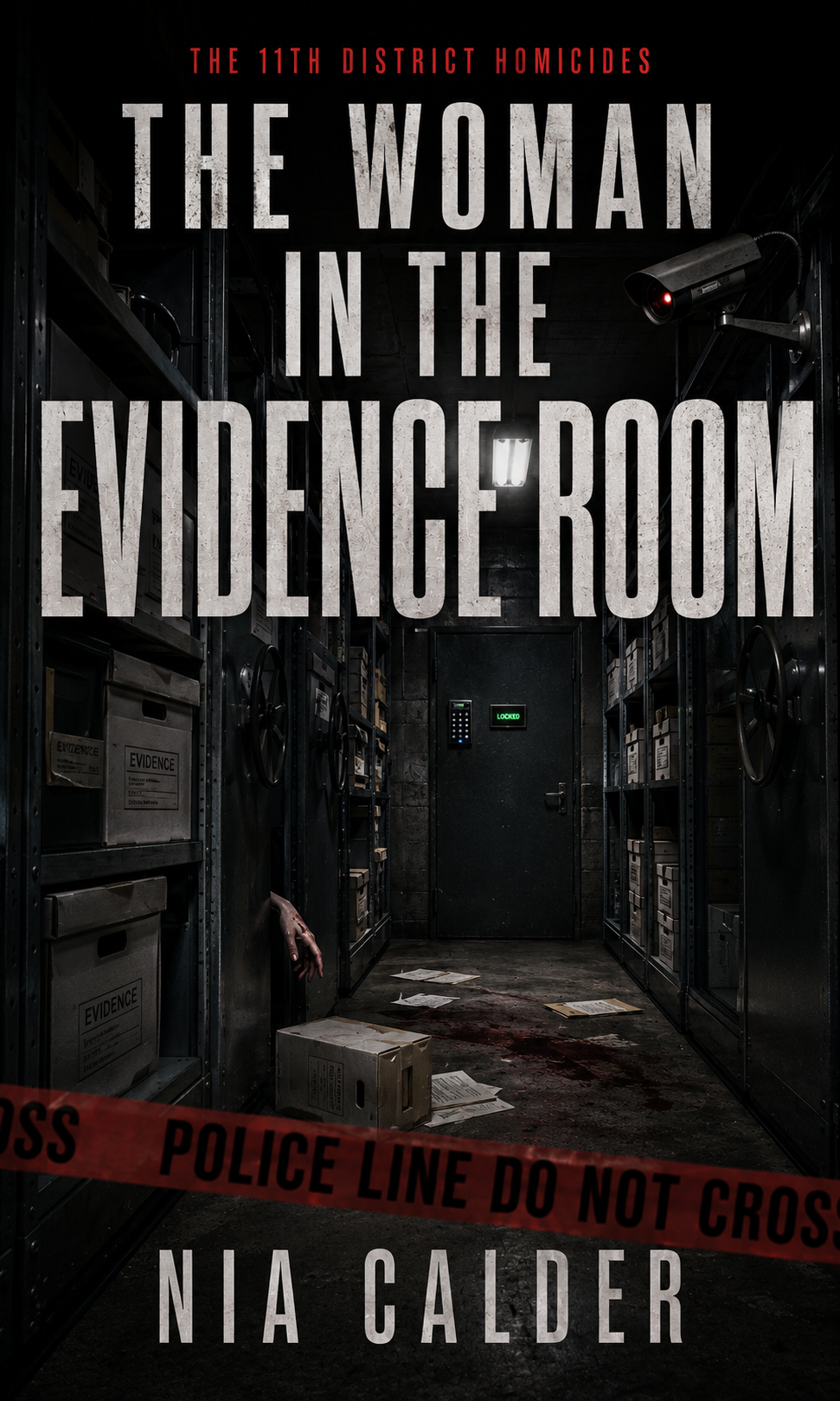
THE 11TH DISTRICT HOMICIDES
The Woman in the Evidence Room
NIA CALDER
Chapter One
The Camera Lied
Naomi Bell had been dead for less than ten minutes, and someone inside police headquarters was already trying to erase the proof.
Kim Moore saw it happen on the security monitor.
The screen above the evidence-room door flickered once. Naomi’s body disappeared beneath a wash of gray static. The image returned two seconds later, but the timestamp had changed.
10:17:42.
10:14:03.
Three minutes and thirty-nine seconds had vanished.
“Gary.”
Her partner looked up from Naomi’s phone. “What?”
“The recording jumped backward.”
Lieutenant Celeste Bryant stood outside the sealed room with one hand pressed against the wall. Her face had gone still in the way people’s faces did when grief arrived before they were ready to show it.
“What do you mean, backward?” she asked.
Kim pointed at the monitor. “The timestamp was ten seventeen. Now it’s ten fourteen.”
Gary stepped into the corridor and looked through the narrow glass panel beside the door. Naomi remained between the shelves where they had found her. Blood darkened the floor beneath her head. The white evidence box resting on her chest bore the name of her murdered mother.
LORRAINE BELL
HOMICIDE EVIDENCE
CASE 04-7719
Nothing inside the room had moved.
Only the recording had changed.
Gary turned to the uniformed supervisor stationed beside the emergency access panel. “Disconnect that monitor from the network.”
The supervisor, Sergeant Ellis Park, stared at him. “I can’t disconnect one monitor. The system is centralized.”
“Then shut down the entire floor.”
“I don’t have that authority.”
Kim looked at the camera above the evidence-room entrance.
“Someone does.”
Park reached for his radio.
Kim stopped him. “Don’t announce it.”
“We have a dead officer inside central evidence.”
“And the person who killed her may be listening to departmental radio.”
Park lowered the device.
Kim looked down the corridor. Four uniformed officers stood near the elevator. Two more guarded the stairwell. A crime-scene technician waited with unopened equipment, and Deputy Chief Renee Rivers was approaching from the far end of the floor.
Any one of them could have heard the alert.
Any one of them could have arrived before Kim.
Any one of them could be watching her now.
Rivers crossed the final twenty feet without asking anyone to move. People moved anyway.
“What happened to the recording?” she asked.
Kim had learned never to be surprised by how quickly Rivers gathered information. “Someone altered the timestamp after we entered.”
“Can they alter the live feed?”
“If it was ever live.”
Rivers looked through the glass at Naomi.
The deputy chief’s expression did not change, but her right hand closed slowly at her side.
Naomi Bell had been assigned to the independent evidence review that morning. She had entered central storage twenty minutes before Kim and Gary received the security alert. According to the access log, Naomi had entered alone. According to the corridor footage, nobody followed her. According to the room’s motion sensors, no other person had been inside.
Now Naomi was dead.
“What did she send you?” Rivers asked.
“She didn’t send it.” Kim held up Naomi’s phone inside a clear evidence sleeve. “She typed a message but never completed it.”
THE CAMERA LIED.
“Nothing else?”
“Not that we’ve found.”
Rivers turned to Park. “Who has administrative control over surveillance?”
“Technical Services.”
“Names.”
“Director Malcolm Voss and three systems administrators.”
“Where are they?”
“I don’t know.”
“Find out without using the radio. Lock every exit from this building. Nobody leaves—not command staff, not civilian personnel, not custodial workers. Shut down the elevators and place officers at every stairwell.”
Park hesitated. “Deputy Chief, there are more than eight hundred people in headquarters.”
“There are eight hundred people inside a building with a murderer.”
The hesitation disappeared.
Park hurried toward the officers near the elevator.
Rivers looked at Kim. “You and Hernandez are not officially assigned.”
“She died investigating my case.”
“That is exactly why you’re not officially assigned. You found the body. You knew the victim. Your daughter was recently targeted by people connected to this investigation, and Internal Affairs has not completed its review of your conduct beneath Westgate.”
Kim understood every reason.
She rejected all of them.
“Who are you assigning?”
“I haven’t decided.”
“Decide quickly. Somebody is deleting time.”
Rivers’s gaze hardened. “You think I don’t know that?”
“I think whoever did this expected the room to stay sealed longer.”
Gary stepped between them without appearing to. “The security alert brought us here. If the killer triggered it, they wanted Naomi found.”
“Or the system triggered automatically,” Rivers said.
“It didn’t,” Kim replied.
Both of them looked at her.
Kim pointed through the glass toward a red sensor mounted inside the room above the door.
“The emergency alert identified a security failure. That light should be flashing if the room detected one. It isn’t.”
Park had said the supervisor restored emergency access after the room sealed. Kim had accepted the explanation because Naomi had been lying on the floor.
She had entered before asking what had caused the door to lock.
That was the danger of urgency. It turned assumptions into facts before anyone noticed the difference.
Rivers followed Kim’s stare. “Someone sent a false alert.”
“To bring us here,” Gary said.
“Not us,” Kim replied.
She looked at Naomi’s phone.
The unsent message had been addressed specifically to her.
The killer could not have known Kim would receive an alert intended for evidence personnel. But someone had delivered an anonymous envelope to Kim’s desk minutes earlier, telling her Naomi was inside central evidence storage.
The envelope had led Kim to Naomi.
The false alert had opened the door.
Two separate actions had placed her inside the room beside the body.
“They wanted me to find her,” Kim said.
Rivers’s eyes moved toward the blood on Kim’s fingers.
Kim had checked Naomi’s pulse twice. She had touched her neck, shifted her wrist and moved the phone far enough to read the screen.
She had entered the most secure evidence room in police headquarters without gloves because a woman she knew might still have been alive.
Now her DNA was on the victim.
Her fingerprints were on the phone.
And the security footage showed no killer.
Gary understood at the same moment.
“This isn’t only a murder,” he said. “It’s a frame.”
The lights went out.
Darkness swallowed the corridor.
Someone screamed near the elevator.
Kim reached for her weapon and stepped backward until her shoulder touched the wall. The building’s emergency lights should have activated immediately. They did not.
“Don’t move,” Rivers ordered.
Footsteps struck the floor.
Not running.
Walking.
Three measured steps from inside the evidence room.
Kim turned toward the open doorway.
“Gary?”
“I’m beside you.”
Another step sounded between the shelves.
Someone was inside with Naomi.
Kim raised her weapon. “Police. Show me your hands.”
No answer.
The darkness felt complete enough to have weight. Kim listened past the breathing in the corridor, the rustle of uniforms and the distant pounding of fists against an elevator door.
A metal latch clicked.
Then something shattered.
Gary’s hand touched Kim’s elbow.
“Left side,” he whispered.
She heard it—a faint scrape behind the wall opposite the evidence room.
The emergency lights flashed on.
The corridor returned in red.
Kim entered the room with Gary beside her.
Naomi lay exactly where she had been.
The aisles between the shelves were empty.
At the far wall, a metal evidence container had fallen from the fourth shelf. Its clear lid had cracked against the floor. Several sealed bags were scattered around it.
Kim moved toward them.
“Don’t touch anything,” Gary said.
“I wasn’t going to.”
“That statement has a poor recent history.”
Under different circumstances, she might have looked at him.
Instead, she studied the fallen container.
It had not been near the edge. A clean rectangle in the dust showed where it had rested nearly six inches back on the shelf.
Something had pushed it.
Gary swept his flashlight across the wall.
There was no door. No vent large enough for a person. No visible panel.
Kim crouched without touching the floor.
One of the scattered bags contained a bloodstained woman’s blouse. Another held a broken wristwatch. The third contained a brass house key attached to an evidence tag.
CASE 04-7719.
Lorraine Bell’s case.
“These were inside Naomi’s mother’s box,” Gary said.
“The box is still on her chest.”
“Then someone removed them before placing it there.”
Kim examined the cracked container. Its printed label belonged to another homicide entirely, but the items scattered around it all came from Lorraine Bell’s file.
They had been concealed inside the wrong case.
For thirteen years, evidence connected to Lorraine’s murder had sat six shelves away from the box bearing her name.
The overhead lights returned.
Every bulb illuminated simultaneously, bright enough to make Kim’s eyes ache.
Behind them, Rivers stood in the doorway.
“Building power was interrupted for eleven seconds,” she said. “Technical Services claims it was an internal command.”
“From where?”
“They’re tracing it.”
“They won’t find the killer at a keyboard,” Kim said. “The outage was prepared in advance.”
Rivers looked at the broken container.
“That fell during the blackout?”
“We heard footsteps first,” Gary said.
“Inside the room?”
“Yes.”
Rivers surveyed the empty aisles. “You’re sure?”
“No,” Kim said.
Gary looked at her.
Kim pointed to the shelves. “We heard four impacts with the rhythm of footsteps. That doesn’t mean a person made them.”
She walked along the left wall, examining each shelf without touching it.
The evidence racks were mounted on tracks recessed into the floor. A hand crank at the end of each row allowed authorized personnel to move the shelves together, closing unused aisles and opening new ones. The system maximized storage inside a confined space.
It also created narrow cavities between rows.
Kim stopped at the third crank.
A thin strand of black cord had been tied around its handle.
The cord ran along the bottom of the shelf, almost invisible against the dark metal, before disappearing behind the next row.
Gary followed it with his flashlight.
Four metal washers had been attached at evenly measured intervals. When the shelves moved, each washer would strike the frame separately.
Four false footsteps.
At the end of the cord, a loop had been secured around the cracked evidence container.
“When the power failed, one of the shelves moved,” Gary said. “It pulled the cord, made the sounds and knocked the container down.”
“To make us believe the killer was still here,” Rivers said.
Kim examined the nearest track.
A dark smear marked the recessed groove.
“Or to make us look at the wrong trick.”
She crouched lower.
Something pale protruded beneath the mobile shelving unit.
At first it resembled a strip of paper. Then Kim recognized the curve of a fingernail.
“Everybody out,” she said.
Gary saw it. “Is that—”
“Out. Now.”
Rivers ordered the corridor cleared while Gary pulled Kim backward. Crime-scene technicians positioned lifting equipment beneath the shelf. The mobile unit weighed several thousand pounds when filled. If someone had been caught beneath it during the blackout, no one could safely move it by hand.
Kim remained at the doorway while the technicians raised the bottom edge less than two inches.
A gloved hand reached into the gap.
The fingers were rigid.
“That isn’t Naomi,” Gary said.
“No.”
The technicians lifted the shelf higher.
A human arm appeared, followed by a shoulder dressed in a gray maintenance uniform. The body had been compressed beneath the storage unit, face turned against the floor.
A technician checked the exposed neck.
“No pulse.”
Kim looked back at Naomi.
Two bodies inside a room that had recorded one person entering.
The second victim wore a headquarters identification badge clipped to his shirt.
THOMAS VALE
FACILITIES ENGINEERING
Gary read the badge. “Do you know him?”
“I’ve seen him.”
“Alive?”
“This morning.”
Thomas Vale had been repairing a light outside homicide when Kim arrived for her first day back. She remembered him because his ladder had blocked the hallway and because he had apologized three times for making her walk around it.
He had been carrying a red metal toolbox.
Kim searched the visible space beneath the shelf.
No toolbox.
A crime-scene technician photographed Vale’s body before examining the mechanism.
“The track motor was activated remotely,” she said. “It would have crushed him almost instantly.”
“When?” Rivers asked.
“Can’t tell yet.”
Kim looked at the bloodless floor around the shelf. Vale’s body had released little visible blood, and the room’s temperature was kept several degrees below the rest of the building to preserve stored material.
He could have been dead before Naomi entered.
Someone had hidden a body beneath the evidence racks and then sent Naomi into the room alone.
Gary moved toward the access panel. “The log only shows Naomi.”
“Then Vale entered another way,” Rivers said.
“Or his entry was deleted.”
Kim considered the altered timestamp.
“What if Naomi wasn’t the only person erased?”
A man in a navy suit approached the sealed perimeter. He was in his late forties, with silver beginning at his temples and a headquarters credential hanging from his belt.
Sergeant Park intercepted him.
The man displayed his badge. “Malcolm Voss, Technical Services.”
Rivers waved him through.
Voss looked past them at the bodies. His face tightened, but he did not appear surprised by the security failure.
“You’re responsible for this surveillance system?” Rivers asked.
“I oversee the department that maintains it.”
“Can your employees alter access records?”
“With administrative authorization.”
“Can they do it without leaving a record?”
“No.”
Kim watched him.
Voss noticed. “What?”
“That answer came quickly.”
“Because it’s a simple question.”
“It wasn’t. She asked whether your employees could alter a record without creating another record. You answered that they could not. Either you have complete faith in every person who designed this system, or you’ve been asked before.”
Voss’s mouth flattened. “Every administrative action generates an audit entry.”
“Where are those entries stored?”
“On a protected server.”
“Inside this building?”
“No.”
“Who can access it?”
“Three administrators and me.”
“Names.”
Voss looked at Rivers rather than Kim. “Am I being questioned as a suspect?”
“Everybody in this building is being questioned as a suspect,” Rivers said.
Voss removed a tablet from beneath his arm and entered a security code.
“Evelyn Shaw, Curtis Lane and Priya Desai.”
“Where are they?”
“Shaw is in the network operations center. Desai is working remotely. Lane called in sick.”
“When did you last speak to him?”
“Yesterday.”
“Find him,” Rivers told Park.
Voss looked through the evidence-room door. “You said the recording changed?”
Kim nodded toward the monitor.
He studied the timestamp for several seconds.
“This isn’t the live feed.”
“We know.”
“No, you don’t understand. That monitor should not be capable of displaying stored footage. It receives a direct local signal from the camera.”
“Then how are we watching the past?”
Voss stepped closer without crossing the threshold. “Someone installed a physical relay between the camera and the monitor.”
“A recording device?”
“A loop injector. It captures a section of video and repeats it while the real feed continues elsewhere.”
“Where would it be?”
“Near the camera, inside the wall or above the ceiling.”
Kim looked at the ceiling tiles.
Thomas Vale worked in Facilities Engineering.
Someone with his credentials could open walls and ceilings without attracting attention.
“He installed it,” Gary said.
“Or discovered it,” Kim replied.
Voss glanced at Vale’s body. “He didn’t have access to surveillance components.”
“He had access to the places hiding them.”
A crime-scene technician called from inside the room.
“Detective, you need to see this.”
Kim put on gloves and shoe coverings before entering again.
Naomi’s body had not been moved, but the technician had carefully photographed and lifted the hand covering her phone. Beneath her palm, someone had written three digits in blood.
4 1 6.
Gary crouched beside Kim. “An area code?”
“Toronto.”
“Do we have a Toronto connection?”
“Not that I know.”
Kim studied Naomi’s fingers.
Blood coated the tip of her index finger. The first digit was sharply formed. The second tilted slightly. The six trailed at the bottom, as if Naomi had lost strength while completing it.
“She wrote this herself,” the technician said.
“What blood did she use?”
“Likely her own, but the lab will confirm it.”
Kim examined the wound behind Naomi’s right ear. The killer had struck her once with a narrow blunt object. The placement suggested control rather than rage. Naomi may have remained conscious for several seconds after falling.
Long enough to type a message.
Long enough to write three numbers.
Not long enough to send either warning.
“Four-sixteen could be a time,” Gary said.
“Or a date. April sixteenth.”
“Locker number?”
“Evidence location?”
Rivers remained outside the room. “Could it be part of a longer number?”
Kim looked at the fading curve of the six.
“Yes.”
A technician began photographing the evidence box on Naomi’s chest.
The box was sealed with red tamper tape applied during the federal processing that followed the Westgate investigation. Its chain-of-custody label documented the recent recovery from Evidence Room C, along with an older entry showing that Paul Danner had accessed the file six years earlier.
Danner was currently under federal guard at St. Drake Medical Center.
Kim leaned closer.
The tape had been cut and resealed so precisely that the break was visible only when the light struck it from the side.
“Open it,” she said.
Rivers answered from the doorway. “Not here.”
“If the killer placed something inside—”
“Then we document and transport it to a controlled examination room.”
Kim looked around at the sealed room containing two dead bodies, hidden evidence, altered cameras and remotely moving shelves.
“Where exactly is controlled?”
Rivers had no immediate answer.
Gary’s phone vibrated.
He checked the screen.
The color left his face.
“What?” Kim asked.
He turned the phone toward her.
A photograph filled the display.
Kim recognized the scene because she was standing inside it.
The image showed her crouched beside Naomi’s body. It had been taken from above and behind her, no more than thirty seconds earlier.
A message appeared beneath it.
YOU ALWAYS TOUCH THE EVIDENCE FIRST.
The sender was listed as Naomi Bell.
Kim looked at the dead woman’s phone sealed inside the clear bag.
“Is that her number?” Rivers asked.
“Yes.”
Gary called it.
The phone beneath Naomi’s hand did not ring.
Instead, a sound came from inside Lorraine Bell’s evidence box.
One electronic vibration.
Then another.
A phone had been sealed inside it.
“Bomb squad,” Rivers ordered. “Clear the floor.”
Nobody argued.
Officers moved personnel toward the stairwells while the bomb unit brought in portable imaging equipment. Kim and Gary waited two floors below with Rivers, Voss and Sergeant Park.
No one was allowed to use a phone.
No one was permitted to leave.
Kim watched Voss closely.
He appeared irritated rather than afraid. He kept checking a watch he had been ordered not to connect to the network.
“You’re waiting for something,” Kim said.
“I have an operations center responsible for every camera and secure door in this building. I’d like to know whether it has been compromised.”
“It has.”
“To what extent.”
“Enough to put two bodies in a room that recorded one person entering.”
Voss glanced toward Gary. “You said two bodies?”
Rivers looked at him. “Who told you there were two?”
“I saw the maintenance worker.”
“You saw part of an arm.”
“I heard the technicians.”
“They never identified it as a separate body.”
Voss’s face changed almost imperceptibly.
Not fear.
Calculation.
Kim stepped closer. “You knew Thomas Vale was under that shelf.”
“That’s absurd.”
“Then tell me when you last saw him.”
“I don’t know the man.”
“You looked directly at his badge.”
“I oversee technical infrastructure. Facilities personnel work in the same areas.”
“You said he lacked access to surveillance components. How would you know what access a man you don’t know had?”
Voss looked toward Rivers again. “If Detective Moore intends to accuse me—”
“I’m asking you to explain your own answers.”
“I explained the access structure.”
“You also arrived with a tablet containing the names of every administrator before anyone told you what kind of breach occurred.”
“I received an alert.”
“What did it say?”
“Central evidence surveillance failure.”
“The alert sent to evidence personnel said security failure. It did not mention surveillance.”
For the first time, Voss stopped looking irritated.
Gary moved between him and the stairwell.
Rivers extended her hand. “Your badge, phone and tablet.”
“Deputy Chief—”
“Now.”
Voss surrendered the badge first, then the phone. He held the tablet a second longer than necessary.
Kim saw his thumb move.
The screen went black.
At the same instant, fire alarms erupted throughout the building.
Red lights strobed along the corridor.
A recorded voice ordered immediate evacuation.
Voss ran.
Gary caught his jacket, but Voss twisted free and drove his shoulder into Gary’s chest. Kim moved to block the stairwell. Voss reached inside his suit.
Kim drew her weapon.
“Hands!”
Voss froze.
His right hand emerged holding a small black device no larger than a car remote.
He pressed the button.
Every secured door on the floor unlocked.
The stairwell filled with people evacuating from the levels above. Uniformed officers, civilian employees and visitors surged through the doorway, separating Kim from Voss.
“Stop him!” Gary shouted.
Voss disappeared into the crowd.
Kim holstered her weapon and pushed forward. She caught glimpses of his navy jacket as he descended, then lost it behind two officers helping an elderly civilian down the stairs.
The alarm continued ordering them out.
Kim reached the landing below.
A navy jacket lay on the floor.
No Voss.
“He changed appearance,” Gary said behind her.
Kim looked over the railing.
Hundreds of people moved through the stairwell.
Voss could have removed his tie, turned his shirt inside out or taken a uniform from an unlocked room. He had designed access systems for a building filled with disguises.
Rivers’s voice sounded from above.
“The alarm is false. Seal the exits.”
Kim ran downward.
At the ground floor, the emergency doors stood open. Employees spilled onto the plaza in front of headquarters while officers struggled to contain them.
Rain had begun falling.
Kim reached the sidewalk and searched the crowd.
No navy suit.
No silver hair.
Gary joined her, breathing hard.
“He couldn’t have gone far.”
“He doesn’t need to.”
Kim pointed across the street.
Three news vans were already parked at the curb.
Camer…
Keep reading The Woman in the Evidence Room
You've reached the end of the free preview. Purchase this eBook for permanent access in your Novel Thunder Library.
Buy eBook — $5.99