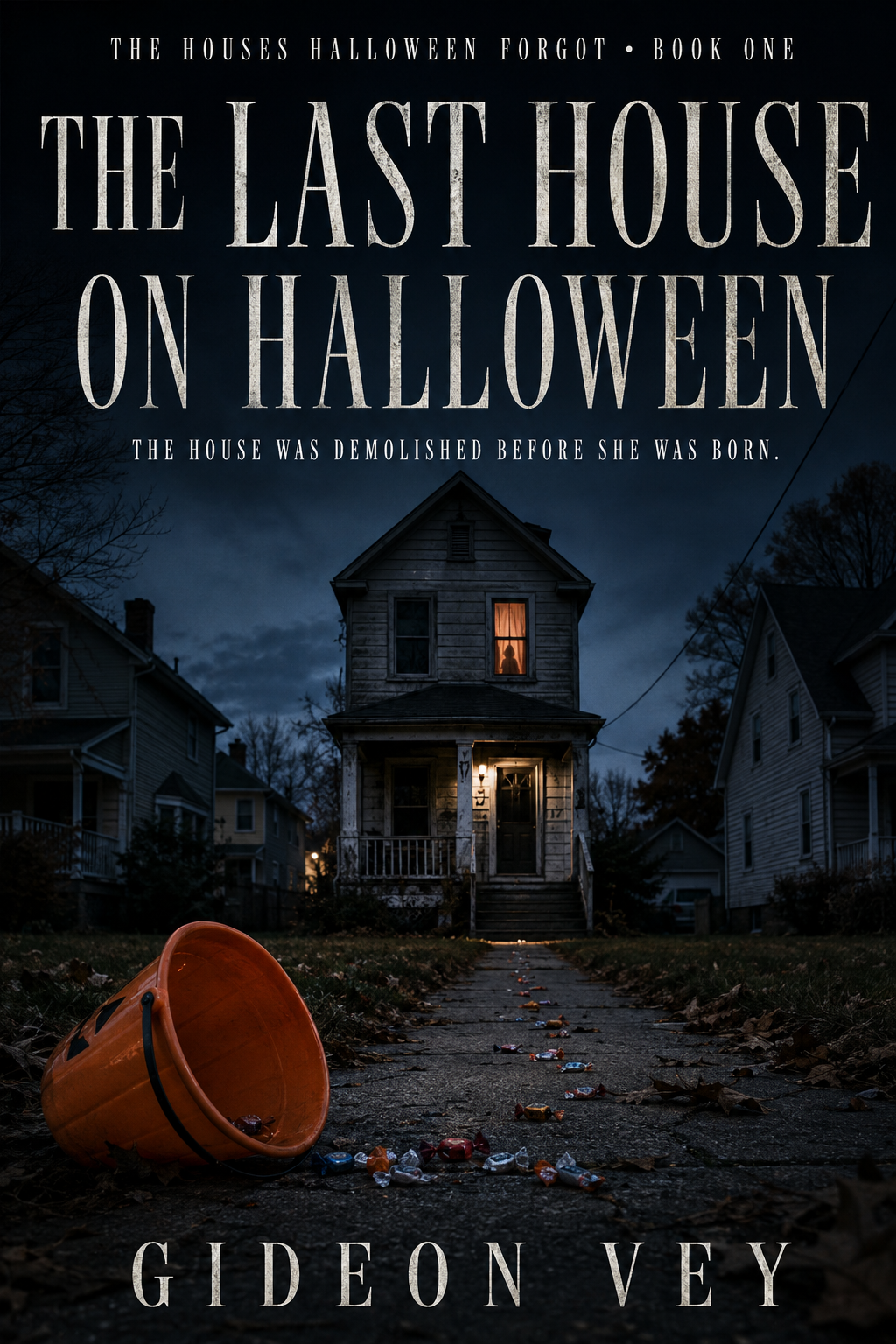
The Houses Halloween Forgot
The Last House on Halloween
GIDEON VEY
Chapter One
One More House
The first time Owen asked to visit the last house on Halloween, Audra Kessell was driving past the place where it had never stood.
“Slow down,” he said from the back seat. “I want to see it.”
Audra kept her foot on the accelerator.
Rain ticked against the windshield, too light for the wipers and too persistent to ignore. The road ahead narrowed between old maples whose branches met overhead like black fingers. Beneath them, children in bright costumes moved from porch to porch while their parents waited along the curb.
Briar’s End looked smaller than Audra remembered.
The sidewalks were narrower. The houses stood closer together. Even the stone entrance bearing the neighborhood’s name seemed to have shrunk, its engraved letters softened by moss and thirty years of weather.
Only Harrow Lane remained exactly as she remembered it.
Audra watched its entrance pass on her left.
The street was empty.
No trick-or-treaters. No decorations. No porch lights glowing through the rain. A temporary municipal barrier stretched across the intersection, accompanied by a crooked orange sign:
ROAD CLOSED
LOCAL ACCESS ONLY
Beyond the barrier, Harrow Lane descended between two rows of dark houses before disappearing into fog.
Owen twisted around in his booster seat.
“You passed it.”
“We’re going to Grandma’s.”
“I know.”
“She lives on Bellweather Road.”
“I know.”
“Then what am I supposed to slow down for?”
“The last house.”
Audra looked at him in the rearview mirror.
Owen wore a silver astronaut costume beneath his unfastened coat. The plastic helmet rested beside him, its tinted visor reflecting the gray sky. His dark curls were flattened against one side of his head where he had slept during the drive.
He continued staring through the rear window.
Callum sat beside him with earbuds in, apparently absorbed in his phone. At twelve, he had declared himself too old to wear a costume. He had nevertheless brought a rubber skull mask that protruded from his coat pocket.
“What last house?” Audra asked.
“The one at the end.”
“There isn’t a house at the end of Harrow Lane.”
“Yes, there is.”
“You couldn’t even see the end from here.”
“I saw enough.”
Audra tightened both hands around the steering wheel.
The rain had started twenty minutes earlier, almost precisely when they crossed into Larkspur. It blurred the neighborhood’s edges and transformed familiar yards into places she recognized only through instinct.
A red mailbox.
A cracked birdbath.
A narrow driveway where she and Nori had once drawn a city in chalk.
Audra looked away from it.
“Grandma’s neighborhood has a lot of houses,” she said. “You probably saw one of those.”
“No.”
“Owen.”
“The last house is different.”
Callum removed one earbud. “Can we not start with this?”
“Start with what?” Audra asked.
“He’s been talking about that house all week.”
Owen kicked the back of Callum’s seat.
“Stop.”
“You stop telling people.”
“You’ve been drawing it everywhere,” Callum said. “It isn’t exactly classified.”
Audra glanced at Owen again.
“What have you been drawing?”
“Nothing.”
“The house,” Callum answered.
“I asked him.”
“And he’s lying.”
“Shut up.”
“Both of you, stop.”
Callum returned his attention to the phone.
Owen folded his arms and stared out the side window.
Audra turned onto Bellweather Road.
Almost every house was decorated. Inflatable ghosts bowed in the wind. Orange lights wound around porch railings. Plastic skeletons climbed gutters and crouched behind hedges. The neighborhood association had tied artificial cobwebs between the streetlamps, and the wet fabric sagged over the road in pale curtains.
Children crowded the sidewalks here.
Audra relaxed slightly.
This was why she had agreed to come.
Estelle was selling the house in the spring. After avoiding Halloween in Briar’s End for most of her adult life, Audra had run out of acceptable excuses. Her mother wanted one final holiday in the place where Audra had grown up. The boys wanted the larger candy bars wealthy neighborhoods were rumored to distribute. Callum wanted to frighten younger children. Owen wanted everything orange.
One evening could not hurt them.
They would eat dinner, visit the busiest streets, and leave before nine.
They would not go near Harrow Lane.
Audra had not told the boys that final part because rules without explanations became invitations.
She turned into her mother’s driveway.
Estelle’s house was a narrow two-story colonial with faded blue siding and white shutters. Two wooden ghosts stood on the porch exactly where they had stood every October of Audra’s childhood.
Her father had made them before she was born.
One was tall and thin, with an oval mouth and raised arms. The other was smaller, its round eyes painted slightly unevenly. Time had stripped much of the white paint from their bodies, exposing gray wood beneath.
Audra had asked Estelle to throw them away years ago.
Her mother always refused.
The front door opened before Audra turned off the engine.
Estelle hurried onto the porch wearing a purple sweater decorated with tiny embroidered pumpkins. At sixty-seven, she remained a slender woman, though the past year had bent her slightly at the shoulders. She waved both hands as if the car had arrived from another country.
Owen was outside before Audra could stop him.
“Coat,” she called.
He ran toward the porch without listening.
Estelle met him at the steps and wrapped him in her arms.
“My astronaut.”
“I’m Commander Kessell.”
“Forgive me, Commander.”
“We passed the last house.”
Estelle’s smile vanished.
Only for a second.
Then she kissed the top of Owen’s head and looked toward Audra.
“The what?”
Owen pointed behind them. “On the closed street.”
Audra stepped out of the car.
“He means Harrow Lane.”
The change in her mother’s expression was nearly imperceptible. A slight tightening around the mouth. A pause before she breathed again.
“Did you drive down there?” Estelle asked.
“The road is blocked.”
“I know that. I asked whether you went down it.”
“No.”
“Why is it closed?” Callum asked as he climbed from the car.
“Water-main break,” Estelle answered.
“There weren’t any construction trucks.”
“They’ll probably come tomorrow.”
“On Saturday?”
“Callum, bring your bag inside.”
“That means you don’t know.”
“It means your grandmother doesn’t need an interrogation in her driveway,” Audra said.
Callum lifted his backpack from the trunk.
Owen remained pressed against Estelle.
“Grandma, do you still have my mom’s Halloween box?”
Estelle stared down at him. “What box?”
“The one from when she was little.”
Audra closed the trunk.
“What are you talking about?”
“The girl said Grandma kept it.”
Every sound around them seemed to withdraw.
Children laughed somewhere farther down the street. A dog barked behind a fence. Rainwater dripped from the gutters.
Audra heard each noise separately.
“What girl?” she asked.
Owen looked toward the house.
Estelle’s hands remained on his shoulders.
“What girl, sweetheart?” she asked.
“The one who knows Mom.”
Audra walked toward him. “What is her name?”
Owen shrugged.
“You just said she knows me.”
“She does.”
“From where?”
“The old neighborhood.”
“This is the old neighborhood.”
“I know.”
“Owen, look at me.”
He did.
“When did you speak to this girl?”
“I didn’t.”
“You said she told you about a box.”
“She wrote it down.”
“Where?”
He reached into the pocket of his astronaut costume.
The folded paper he removed was old and yellowed, with a ragged edge along one side. It looked as if it had been torn from a school notebook that had spent years inside a drawer.
Audra took it.
The message was written in orange crayon.
MRS. KESSELL KEPT EVERYTHING
EXCEPT MY NAME
Below the words was a drawing of two girls holding hands.
One had brown hair.
The other had yellow pigtails.
Audra stopped breathing.
Rain struck the paper, darkening it in small circular spots.
“Where did you get this?”
“It was in my lunch box.”
“When?”
“Monday.”
“Why didn’t you show me?”
“She said I wasn’t supposed to until we got here.”
The paper trembled between Audra’s fingers.
Estelle stepped backward.
“I need to sit down.”
Audra looked at her. “You recognize this?”
“No.”
“You haven’t even seen the drawing.”
“I don’t recognize it.”
“Then why do you need to sit down?”
“I’m cold.”
“You’re not wearing a coat,” Callum said.
Estelle turned and hurried into the house.
Audra followed.
The entryway smelled of cinnamon, furniture polish, and the roast Estelle had promised to make for dinner. Family photographs covered the wall beside the staircase. Audra appeared in nearly all of them: Audra as an infant, Audra missing her front teeth, Audra at her high-school graduation.
There were no photographs from the year she turned eight.
Estelle moved into the living room and began adjusting objects that required no adjustment. She straightened a stack of magazines. Moved a candle two inches to the left. Folded a blanket that was already folded.
Callum carried the bags upstairs without being asked.
Owen removed his wet shoes and left them in the middle of the entryway.
Audra held out the note.
“What box?”
“I don’t know.”
“He specifically called it my Halloween box.”
“Children invent things.”
“He didn’t write this.”
“You don’t know that.”
“He prints in block letters. These are written in cursive.”
“Callum could have done it.”
“Callum doesn’t know anything about her.”
Estelle looked toward Owen.
The boy stood at the foot of the stairs, examining the photographs.
“Take Owen into the kitchen,” Estelle said.
“He’s not going anywhere until someone tells me what’s happening.”
“Nothing is happening.”
“You recognized the drawing.”
“I said I didn’t.”
“You didn’t have to.”
Audra lowered her voice.
“Who is the girl?”
Her mother’s face hardened. “Not in front of the boys.”
That was an answer.
Audra turned toward Owen.
“Go help Callum unpack.”
“I want to see the box.”
“There is no box.”
“Yes, there is.”
“Upstairs, Owen.”
His face tightened. “You never listen.”
“I am listening. That’s why I need you to go upstairs.”
“You’re going to talk about the girl.”
“What girl?” Callum asked from the landing.
“No one,” Estelle said.
“The one outside our window,” Owen answered.
Audra looked at Callum.
He stopped halfway down the stairs.
“What does he mean?” she asked.
Callum’s hand tightened around the railing.
“It was probably a branch.”
“What was probably a branch?”
“He thought someone was outside our bedroom.”
“When?”
“A few nights ago.”
“Our bedroom is on the second floor,” Audra said.
“I know.”
“Why didn’t you tell me?”
“Because there wasn’t anyone there.”
“There was,” Owen insisted.
“Then how was she standing outside the window?”
“She wasn’t standing. She was hanging.”
Estelle gripped the back of a chair.
Audra forced her voice to remain level. “Hanging from what?”
“She wouldn’t show me.”
“What did she look like?”
“She had yellow hair.”
Audra’s gaze moved to the orange drawing.
“Was it in pigtails?”
Owen nodded.
“How old was she?”
“My age. Maybe eight.”
“Did she tell you her name?”
Owen looked toward the photographs again.
“No.”
“Did she ask you to do something?”
“She wanted me to open the window.”
Callum hurried down the remaining stairs. “I locked it. He didn’t open anything.”
Audra pressed her fingers against her mouth.
The room seemed smaller than it had when she was a child. Lower ceiling. Narrower doorways. Too many photographs watching from the walls.
“You did the right thing,” she told Callum.
“It was nothing.”
“You still did the right thing.”
Owen turned toward the dining room.
“Why is that girl in Grandma’s house?”
Audra followed his gaze.
A framed photograph stood on the sideboard beneath the mirror.
Audra recognized the picture. It had been taken during a neighborhood picnic when she was seven. She stood between her parents, holding a red balloon. The photograph had sat in the same frame for decades.
Owen pointed toward its glass.
“She’s right there.”
Audra crossed the room.
The photograph showed three people.
Her father on the left. Estelle on the right. Audra between them.
No other child appeared in the picture.
“Where?” Audra asked.
Owen came beside her and tapped the glass.
“There.”
His finger touched a small empty space beside Audra.
“There’s no one there.”
“She moved.”
“Photographs don’t move.”
“This one does.”
Estelle abruptly took the frame and placed it facedown.
“Enough.”
Audra stared at her.
“Turn it back over.”
“No.”
“Mom.”
“I said enough.”
Estelle carried the photograph into the kitchen.
Audra followed.
Her mother opened a drawer and placed the frame inside.
“What are you doing?”
“Putting it away.”
“Why?”
“Because it’s upsetting him.”
“It’s upsetting you.”
Estelle slammed the drawer closed.
For a moment, neither spoke.
Owen and Callum remained in the dining room. Audra could hear Callum quietly telling his brother that there had been no girl in the photograph.
Estelle moved closer.
“We should cancel tonight,” she whispered.
“You begged us to come.”
“I changed my mind.”
“Because Owen drew a girl?”
“Because the weather is getting worse.”
“It’s drizzling.”
“The road could flood.”
“Bellweather Road hasn’t flooded since I was ten.”
“Then stay for dinner and leave before dark.”
“You wanted one final Halloween with them.”
“I don’t anymore.”
Audra unfolded the note.
“Who wrote this?”
“I don’t know.”
“Who is the girl?”
“No one.”
“Stop saying that.”
“There was no one.”
“You’re lying.”
Estelle looked toward the dining-room doorway.
When she answered, her voice was barely audible.
“Some things disappear more completely if you let them.”
The words struck Audra with the force of a memory.
A candlelit room.
A little girl crying.
A voice asking Audra to choose.
Then the image was gone.
“What does that mean?”
Her mother shook her head.
“What did you keep?” Audra asked. “What’s in the box?”
“There is no box.”
“The message says you kept everything except her name.”
“It is a child’s prank.”
“A prank using details my children couldn’t know?”
“They heard you talking in your sleep.”
“I don’t talk in my sleep.”
“You did when you were little.”
“What did I say?”
Estelle turned away.
Audra caught her wrist.
“What name did I say?”
“Let go of me.”
“What was her name?”
“I don’t remember.”
“You do.”
Owen appeared in the doorway.
“Nori.”
Audra released her mother.
Estelle closed her eyes.
The name seemed to remain in the room after Owen spoke it.
Audra had not heard it aloud in years.
Lenora Pike.
Nori to everyone except her mother.
Yellow hair. Crooked pigtails. A gap between her front teeth. A homemade angel costume with one bent wing.
Audra could see her standing beneath the streetlight on Harrow Lane.
“Where did you hear that name?” Audra asked.
Owen pointed toward the ceiling.
“She told me.”
“When?”
“Just now.”
Callum appeared behind him. “He was standing with me the whole time. Nobody said anything.”
Owen continued pointing upward.
“She’s in the room with the boxes.”
Estelle’s face went gray.
“No,” she whispered.
“What room?” Audra asked.
“The little one upstairs.”
There were three bedrooms on the second floor. Estelle slept in the largest. The second had belonged to Audra. The third was barely large enough for a bed and dresser.
Audra’s father had used it for storage.
The door had remained locked throughout her childhood.
Estelle pushed past them and started up the stairs.
Audra followed.
“Mom.”
“Stay downstairs.”
“You just said there was no box.”
“There isn’t.”
“Then what are you afraid he found?”
Estelle reached the second-floor landing.
The narrow door at the end of the hall stood open.
Audra had never seen it open.
Not once.
Even after her father died, Estelle had refused to unlock it. She claimed the hinges were warped and the room contained nothing but insulation and old plumbing.
Cold air drifted through the doorway.
Estelle stopped several feet away.
“I locked that door this morning.”
Owen squeezed between Audra and the wall.
“The girl opened it.”
Audra caught him by the shoulder.
“You’re staying here.”
“But she wants to show you.”
“I don’t care what she wants.”
“She says you promised.”
The hallway light flickered.
Once.
Twice.
Then it went out.
A soft humming came from inside the room.
Audra knew the tune before she consciously remembered hearing it.
Four notes rising.
Three notes falling.
A pause.
Then the same seven notes again.
Nori used to hum it while jumping rope.
Audra moved toward the doorway.
Estelle grabbed her arm. “Don’t.”
“It’s a storage room.”
“Then there’s no reason to enter it.”
“Which is it? Is the room empty, or is there something in there I shouldn’t see?”
The humming stopped.
Audra turned on her phone’s flashlight.
Its beam entered the room.
Cardboard boxes were stacked from floor to ceiling. Some had collapsed beneath the weight of those above them. Dust covered everything except a narrow trail leading toward the back wall.
Tiny wet footprints marked the trail.
Bare feet.
A child’s feet.
Audra stepped inside.
Behind her, Estelle whispered her name.
Audra ignored her.
The air smelled of wet leaves and candle smoke. Neither scent belonged inside the house.
She passed boxes labeled TAX RECORDS, WINTER CLOTHES, and FRANK’S TOOLS. The trail continued deeper than the room should have allowed. From the hallway, the room appeared no more than eight feet wide.
Audra walked at least fifteen feet before reaching the back wall.
A single box waited there.
Unlike the others, it bore no dust.
Orange construction paper covered its lid. Black cats, pumpkins, and crescent moons had been cut from paper and glued around the sides. The decorations were faded but familiar.
Audra remembered making them.
Her knees weakened.
A name had once been written across the top in purple marker. Someone had scratched it away so violently that the cardboard had torn.
Only the final letter remained.
A.
Audra knelt.
“What is it?” Callum called from the hallway.
She didn’t answer.
A thin brass lock held the box closed, but its clasp had already been opened.
Audra lifted the lid.
Inside lay a folded white sheet, a plastic princess mask, two friendship bracelets, and a photograph facedown against the cardboard.
The sheet had once been part of a ghost costume. Estelle had cut eyeholes into it and sewn around the edges with orange thread.
Audra had worn it on Halloween when she was eight.
Except Audra remembered dressing as a witch that year.
She touched the plastic mask.
It belonged to Nori.
Audra knew that with complete certainty, although she also remembered Nori wearing angel wings.
Two incompatible memories occupied her mind at once.
In the first, Nori stood beside her dressed as an angel.
In the second, Nori wore the smiling princess mask while Audra wore the white sheet.
One of the memories had been placed there later.
Audra picked up the friendship bracelets.
One was threaded with purple beads spelling AUDRA.
The other used orange beads.
Its letter beads had been removed.
“Mom?” Callum called again.
“I’m fine.”
She turned over the photograph.
Two girls stood at the entrance to Harrow Lane beneath a wooden street sign.
Audra recognized herself on the left. Brown hair, white ghost costume, black sneakers visible beneath the sheet.
Nori stood beside her wearing the princess mask.
Someone had scratched across Nori’s face with a sharp object.
The damage extended through the photograph, but it had not destroyed everything.
Behind the girls, at the distant end of Harrow Lane, stood a tall black house with nine narrow windows.
Audra brought the photograph closer to the phone’s light.
The house appeared wrong.
Not blurred. Not distorted.
Wrong.
Its roof seemed to lean in two directions. The front steps descended into the lawn rather than rising toward the porch. Light shone from the nine windows, yet the house cast a shadow toward the setting sun.
Audra remembered holding Nori’s hand.
She remembered walking toward that porch.
She remembered the orange door opening before they knocked.
After that, nothing.
She lowered the photograph.
On the back, someone had written a date:
OCTOBER 31, 1996
Below it was a sentence in Estelle’s handwriting.
AUDRA RETURNED AT 12:17 A.M.
A second line had been written and then crossed out so heavily that the paper had nearly torn.
Audra tilted the photograph beneath the light.
A few words remained visible through the ink.
OTHER GIRL DID NOT.
Audra stood.
Her head struck a box behind her.
Several cartons shifted. Something small rolled from the top of the stack and landed at her feet.
A pink plastic watch.
Its face had cracked. Both hands had stopped at seventeen minutes past twelve.
Audra picked it up.
A child screamed outside.
The sound tore through the house.
Owen ran from the doorway before Audra could stop him.
“Owen!”
She dropped the watch and chased him.
He raced down the stairs, pulled open the front door, and ran into the rain.
Audra followed without her coat.
Children and parents stood motionless along Bellweather Road.
Every porch light had gone out.
The inflatable decorations lay collapsed across…
Keep reading The Last House on Halloween
You've reached the end of the free preview. Purchase this eBook for permanent access in your Novel Thunder Library.
Buy eBook — $4.99