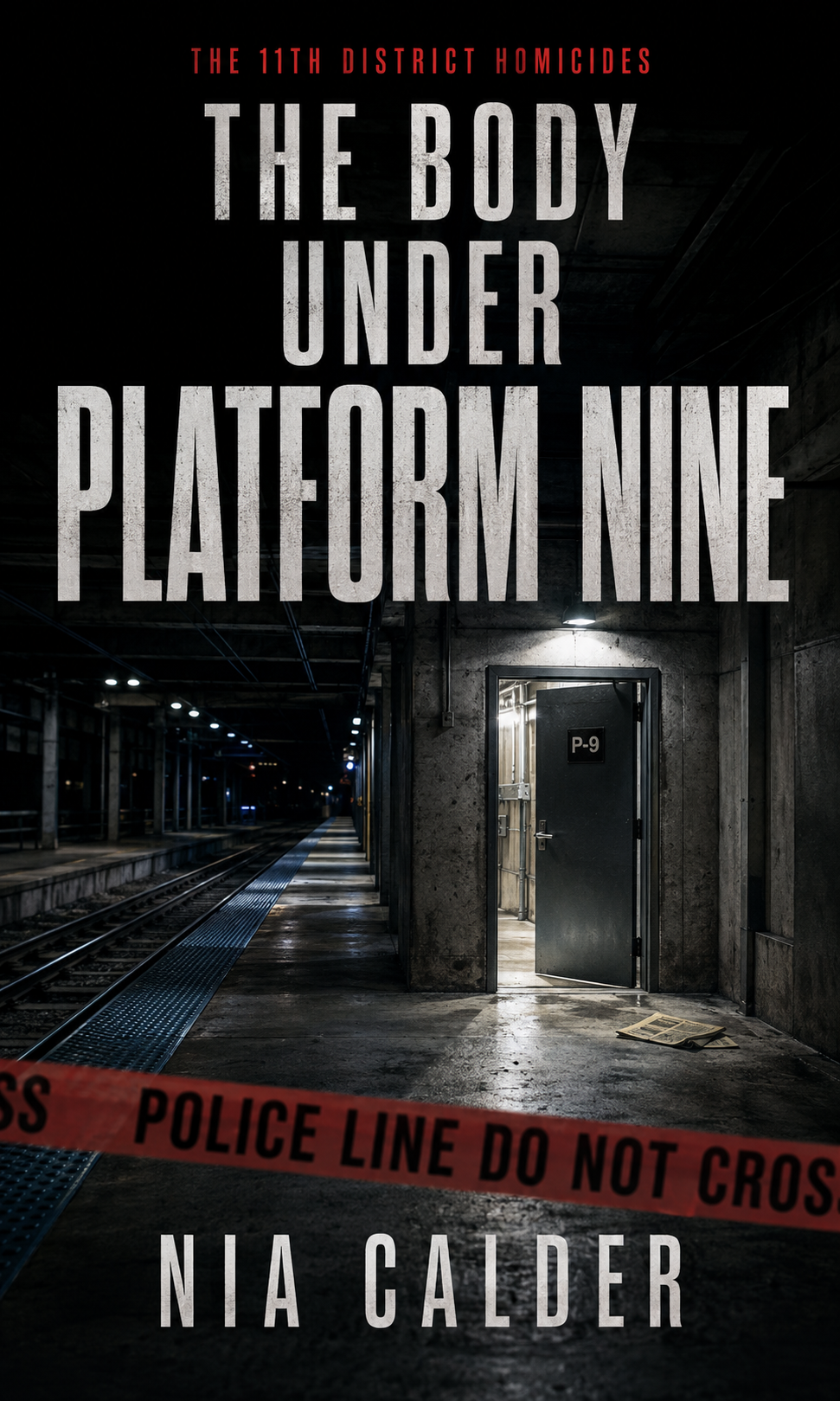
THE 11TH DISTRICT HOMICIDES
The Body Under Platform Nine
NIA CALDER
Chapter One
The Room Beneath Platform Nine
At 5:12 on Monday morning, Leon Booker found a door that was not supposed to open.
He stood alone beneath Westgate Terminal with one gloved hand wrapped around the corroded handle and the other holding a flashlight that had begun flickering ten minutes earlier. Somewhere beyond the concrete walls, the first commuter trains of the morning groaned through the darkness. Their vibrations traveled through the floor and into his knees.
The passageway smelled of wet stone, rust, and the mineral dust that collected in places daylight never reached. Leon had worked maintenance beneath Chicago for twenty-seven years. He knew the sounds old buildings made. Pipes knocked. Rails screamed. Concrete shifted when winter surrendered to spring.
What he heard behind the door was none of those things.
Three slow knocks.
A pause.
Then three more.
Leon aimed his flashlight at the faded warning painted across the metal.
AUTHORIZED PERSONNEL ONLY
CHAMBER P-9
SEALED BY ORDER OF TRANSIT SAFETY
A length of chain hung through the latch.
The padlock lay on the floor.
Its shackle had been cut cleanly through.
Leon stared at it.
Chamber P-9 had been sealed after the Westgate fire twelve years earlier. He remembered the morning after the fire—smoke climbing from street vents, commuters gathered behind barricades, reporters shouting questions nobody wanted to answer.
Officially, an electrical failure had filled a lower passageway with smoke and killed three overnight contractors.
Unofficially, men in expensive coats had arrived before firefighters finished removing the bodies.
By the end of that week, every maintenance worker had been instructed to forget the chamber existed.
Leon had been very good at forgetting.
The knocking came again.
This time it was faster.
Leon stepped back.
“Hello?”
No answer.
He raised his radio and pressed the call button.
“Central, this is Booker. Lower west service corridor. Do you copy?”
Static answered.
A train passed somewhere overhead. Dust sifted from the ceiling. The unlocked door trembled inside its frame.
He should have gone upstairs. He knew that. He should have found his supervisor, reported the broken seal, and waited for someone with a higher salary to decide what happened next.
Then something scraped across the other side of the door.
Not a knock.
A dragging sound.
Leon remembered the rats.
Westgate had rats big enough to drag food containers, gloves, and once an entire work boot into their nests. One could have slipped into the chamber after someone cut the lock. It could be trapped in there, throwing itself against the metal.
That was the explanation Leon chose because it was the only one that allowed him to move.
He set his toolbox down and slipped the chain from the latch.
The hinges resisted when he pulled. Rust broke free in brittle flakes. The gap widened by inches, releasing a breath of colder air that smelled faintly sweet.
Leon stopped pulling.
He knew that smell too.
Not from the terminal.
From the two weeks he had spent cleaning his older brother’s apartment after paramedics carried him out.
Leon covered his nose with his sleeve and aimed his flashlight through the opening.
The beam found concrete walls, obsolete electrical boxes, and lengths of cable hanging like vines from the ceiling. A rolling maintenance cart stood on its side near the center of the chamber. One wheel continued to turn.
That was the knocking.
The wheel struck a broken pipe whenever the vibrations from a passing train traveled through the floor.
Leon nearly laughed.
Then the light reached the man sitting against the far wall.
For one irrational second, Leon thought the man was waiting for a train.
He sat with his legs extended and his hands resting neatly on his thighs. His gray overcoat was buttoned to the throat. His chin had fallen against his chest, hiding most of his face.
A dark stain covered the front of his shirt and disappeared beneath the coat.
On the floor beside him rested a folded newspaper.
Leon’s flashlight shook across the date printed beneath the masthead.
Twelve years earlier.
The man’s head lifted.
Leon’s breath locked in his chest.
The movement was slight, barely more than a tremor caused by the train overhead, but it exposed a face the color of old candle wax. His eyes remained open. A narrow black line circled his throat.
Leon stumbled backward and struck the door with his shoulder.
His flashlight fell. It rolled across the floor, its beam sweeping over the dead man, the newspaper, and the concrete wall behind him.
Names had been carved into the wall.
Eleven of them.
Leon saw only the last one clearly before the flashlight went dark.
KIM MOORE.
Another train moved somewhere above him.
The dead man’s open eyes seemed to tremble in the rolling beam.
Then the knocking began again.
Detective Kim Moore was awake when her daughter came home.
She sat at the kitchen table in a robe, drinking coffee that had gone cold while she watched the numbers change on the microwave clock.
4:36.
4:37.
4:38.
At 4:41, a key turned carefully inside the front lock.
Talia entered sideways, as though making herself smaller might keep the hinges from squeaking. She wore ripped jeans, white sneakers, and the black coat Kim had told her not to take because it was too thin for the weather. Her braids were gathered into a loose knot, and silver glitter from somebody’s birthday decorations clung to one sleeve.
She closed the door without looking toward the kitchen.
“You have eight seconds,” Kim said.
Talia froze.
The silence between them lasted long enough for the refrigerator motor to shut off.
“Before what?”
“Before I decide how angry I am.”
“You’re already angry.”
“Seven seconds.”
“I texted you.”
“At one fifteen. You said you were leaving.”
“We were.”
“Apparently by way of Milwaukee.”
Talia dropped her purse on the counter. “Maya’s cousin got sick.”
“Then Maya’s cousin has a telephone.”
“She was throwing up.”
“Which makes it difficult to speak but not impossible to drive you home.”
“Maya had been drinking.”
Kim stared at her.
Talia’s face changed as she realized what she had admitted.
“You got into a car with someone who had been drinking?”
“No. That’s why I’m late.”
The answer stopped Kim’s anger before it could become a lecture.
Talia saw the opening and rushed into it.
“We stayed until her brother came. I wasn’t going to let her drive. I tried calling you, but your phone went straight to voicemail.”
Kim looked at the personal phone lying beside her coffee.
The battery had died shortly after midnight.
“You could have called the precinct.”
Talia gave a humorless laugh. “Right. I should call a police station and ask them to find my mother.”
“I would rather you do that than disappear for three hours.”
“I didn’t disappear. You knew where I was.”
“I knew where you were supposed to be.”
“And I knew where you were supposed to be Friday.”
Kim felt the conversation turn.
Talia folded her arms. “You disappeared too.”
“That was work.”
“It always is.”
“A man was killed.”
“Somebody is always dead.”
The words came out harder than Talia intended. Regret flashed across her face, but she did not take them back.
Kim pushed her chair away from the table. “Go to bed.”
“I have school.”
“You have two hours before you need to get ready.”
“I have a chemistry test.”
“Then you should have considered that before staying out until almost five.”
“I did the right thing.”
“You did one right thing after making several bad decisions.”
“Why can’t you ever just say I did something right?”
Kim opened her mouth.
The department phone vibrated beneath her personal one.
Talia looked at the phones, then at her mother.
“Go ahead,” she said. “Your real family is calling.”
“Talia.”
Her daughter was already walking down the hall.
The bedroom door slammed.
Kim let the phone ring twice more before answering.
“Moore.”
“Kim, it’s Bryant.”
Lieutenant Celeste Bryant did not waste time on greetings before sunrise.
Kim looked toward the hallway. “What happened?”
“We have a body beneath Westgate Terminal.”
“You called me for a body?”
“I called because of where they found it.”
Kim stood and carried the phone toward her bedroom. “Where?”
“A sealed maintenance chamber beneath Platform Nine.”
The name tightened something beneath her ribs.
She stopped in the bedroom doorway.
“Platform Nine was closed after the fire.”
“It was supposed to be.”
Kim looked back toward Talia’s room. Light appeared beneath the door.
“Who’s the victim?”
“No identification yet. Male, approximately fifty. Transit security has restricted access, but half the morning shift knows something happened. We have maybe an hour before somebody posts a photograph and every news truck in Chicago descends on Westgate.”
“You called the Area team?”
“I called you.”
“That isn’t what I asked.”
A pause.
Kim could picture Bryant standing in her office, already dressed, already holding information she had decided not to share.
“Your new partner is meeting you there,” Bryant said.
“My what?”
“Detective Gary Hernandez.”
“I told you I didn’t want a new partner.”
“And I told you homicide detectives do not work alone.”
“I’ve been managing.”
“You’ve been disregarding policy while frightening every detective temporarily assigned to you.”
“They frighten easily.”
“Hernandez doesn’t.”
“You sound confident.”
“I read his file.”
“That is not the same as working with him.”
“No, but you’re going to correct that deficiency this morning.”
Kim reached into her closet and pulled down a dark suit.
“Why me, Celeste?”
Bryant went quiet again.
Kim lowered the jacket.
“You know something about that chamber.”
“I know we need an experienced detective controlling the scene.”
“This city has more than one.”
“I want you.”
“You never say that unless I’m going to hate the reason.”
“Get to Westgate, Kim.”
The call ended.
Kim stared at the phone.
Twelve years earlier, the Westgate fire had killed three men, closed two sections of the terminal, and placed Kim’s name on the front page of every Chicago newspaper for the first time.
Not because she investigated the fire.
Because the man accused of causing it disappeared before she could arrest him.
Aaron Weller’s abandoned car had been discovered beside the Chicago River. His blood was found inside. His coat was recovered downstream.
His body never surfaced.
After eighteen months, a judge declared him dead.
Kim had closed the case.
She dressed in seven minutes.
When she returned to the kitchen, Talia stood beside the refrigerator in sweatpants, pouring orange juice. She had removed the glittering coat but not the anger.
“I have to leave,” Kim said.
“Obviously.”
“There’s food in the refrigerator. I’ll call Aunt Denise and ask if she can take you to school.”
“I can take the bus.”
“Not after being awake all night.”
“You’re leaving after being awake all night.”
“I’m not taking a chemistry test.”
“No. You’re carrying a gun.”
Kim slipped her phone into her coat.
Talia placed the juice carton down harder than necessary.
Kim wanted to return to the argument. She wanted to explain that work was not a family she preferred. It was a door that never stopped opening. If she ignored it, someone else’s worst morning remained unanswered.
But every explanation sounded like an excuse when offered to a daughter who had spent years waiting for her mother to come home.
“I’m glad you didn’t let Maya drive,” Kim said.
Talia looked at her.
“You made the right decision.”
For a moment, some of the anger left her daughter’s face.
“Was that so difficult?”
“Yes.”
Talia almost smiled.
Then Kim’s department phone vibrated again.
The small opening between them closed.
“Go,” Talia said.
Kim hesitated.
“Mom,” Talia said more quietly. “Just go.”
Kim did.
Rain had polished downtown Chicago into a landscape of black pavement and reflected lights.
Westgate Terminal occupied two blocks between aging office buildings and a glass tower whose top disappeared into the morning fog. Its limestone facade had been scrubbed and restored above street level. Below it, generations of repairs had created a maze of tunnels, abandoned platforms, electrical chambers, forgotten storage rooms, and passageways that appeared on no current blueprint.
Commuters were already gathering behind temporary barricades when Kim arrived.
Employees in reflective vests directed passengers toward alternate entrances. Uniformed officers stood beneath the terminal clock, ignoring questions shouted by early-morning reporters. Someone had already posted a photograph online. Kim could tell from the number of people holding phones above the crowd.
She parked behind a line of emergency vehicles and stepped into the rain.
A man stood beneath the awning with two cups of coffee. He watched her approach with the stillness of someone accustomed to noticing how people moved.
He was younger than Kim expected, though not young. Mid-thirties. Medium height, lean beneath a charcoal overcoat. His dark hair was trimmed close at the sides, and he had the kind of carefully neutral face that frightened witnesses might trust before realizing how much they had revealed.
“Detective Moore?”
“Depends.”
“On what?”
“Whether you’re selling coffee or introducing yourself.”
He extended one cup.
“Gary Hernandez.”
Kim looked at the coffee but did not take it.
“You don’t know how I drink it.”
“Lieutenant Bryant said black, no sugar.”
“Then Bryant bought me coffee.”
“I paid for it.”
“Bryant told you what to put in it.”
Hernandez considered the distinction. “Do you want it?”
Kim took the cup.
“Thank you.”
His eyebrows lifted slightly, as though gratitude had not appeared in the warnings he had received about her.
Kim looked toward the terminal entrance. “How long have you been here?”
“Twenty-three minutes.”
“And?”
“Male victim, probably late forties to mid-fifties. Found by maintenance worker Leon Booker at approximately five twelve. Chamber was sealed following the Westgate fire. Lock was cut recently. No obvious route in or out except the main corridor, but the old plans are incomplete.”
“Cause of death?”
“Possible ligature strangulation. There’s blood on his shirt, but the medical examiner hasn’t moved him.”
“Who entered the chamber?”
“Booker, two responding officers, one transit supervisor, and a patrol sergeant before the scene was secured.”
“Too many.”
“I counted five too.”
Kim looked at him.
Hernandez sipped his coffee.
“Anything missing?” she asked.
“From a room sealed for twelve years?”
“From your report.”
“The victim has a newspaper beside him dated the morning after the fire. Eleven names are carved into the wall.”
He stopped there.
Kim waited.
“Yours is one of them,” he finished.
The rain struck the awning between them.
“Did Bryant tell you about the old case?” Kim asked.
“She told me you were involved.”
“That isn’t an answer.”
“No. She didn’t give me details.”
“And you didn’t look them up?”
“I arrived twenty-three minutes ago.”
“You had time to buy coffee.”
“That required less paperwork.”
Kim studied him.
Detectives usually reacted to her reputation in one of three ways. Some became defensive before she criticized them. Others performed competence so aggressively that they missed what was directly in front of them. The worst tried to charm her.
Hernandez appeared to be doing none of the three.
That made him harder to categorize.
“Where did you work before homicide?” she asked.
“Eleventh District patrol. Then Area Four robbery. Violent crimes task force for eighteen months.”
“You know the neighborhood.”
“I know parts of it.”
“That’s a careful answer.”
“It’s a large neighborhood.”
Kim handed him her untouched coffee.
“I changed my mind.”
“About the coffee?”
“About needing it.”
Hernandez accepted the cup without comment.
Inside, the main concourse echoed with announcements directing passengers away from the west platforms. The familiar morning machinery of the city continued despite the police tape: shoes striking marble, rolling luggage rattling over seams, train brakes crying somewhere beyond the gates.
Death rarely stopped Chicago for long.
A transit security director met them near a service elevator.
“Richard Cole,” he said. “We’ve restricted lower access, but this building will be full within the hour.”
“Who has keys to the chamber?” Kim asked.
“No one should.”
“That wasn’t the question.”
Cole’s mouth tightened. “Transit Safety maintains master access. Engineering may have duplicates. Half the locks beneath this building are older than my staff.”
“This lock wasn’t opened with a key.”
“No.”
“Where is it?”
“Bagged outside the chamber. We didn’t touch anything else once we saw the wall.”
Once we saw your name, Kim translated.
Cole inserted a key beside the elevator controls.
“The maintenance worker is upstairs with paramedics,” he continued. “His blood pressure spiked after he found the body.”
“Did he recognize the victim?”
“Says he didn’t.”
“Did anyone ask whether he recognized the names?”
Cole looked at her.
“No.”
Hernandez removed a notebook from his coat.
Kim stepped into the elevator.
The doors closed, sealing them inside a scratched metal box barely large enough for three people. Cole pressed a button with no label.
The elevator descended.
“Cameras?” Kim asked.
“Operational in passenger areas. Limited coverage in the lower corridors. None near the chamber.”
“How convenient.”
“The chamber was sealed. There was nothing to monitor.”
“There is now.”
The elevator shuddered to a stop.
Cold air entered before the doors finished opening.
A uniformed officer recorded their names at a temporary scene-control station. Kim signed the log, pulled protective coverings over her shoes, and accepted gloves from a crime-scene technician.
The lower corridor narrowed as they moved west. Exposed pipes ran across the ceiling. Old paint curled from the walls in damp strips. Every few seconds, the concrete trembled beneath a passing train.
Hernandez examined the pipes and cable conduits as they walked.
“What are you looking for?” Kim asked.
“Another way inside.”
“You think the killer crawled through a pipe?”
“I think sealed rooms make people focus on doors.”
Kim glanced at him.
“Keep doing that.”
“Looking at pipes?”
“Not believing the room.”
They reached the cut chain first.
The severed padlock rested inside a clear evidence bag on the floor. A crime-scene photographer knelt beside it.
Kim crouched without touching the bag.
The cut surfaces were bright silver. No rust. No grime.
“Bolt cutters?” Hernandez asked.
“Possibly,” the technician said. “Clean pressure marks. We’ll know more at the lab.”
“Any metal filings?” Kim asked.
“None visible.”
“Meaning it may have been cut elsewhere and placed here.”
The technician nodded. “Possible.”
Kim studied the chain. Rust coated every link except the two that had rested inside the padlock. Those links showed fresh scrape marks.
“The chain was removed recently,” she said. “The lock may not have been cut here, but someone used it.”
Hernandez looked down the corridor behind them.
“Anybody could carry bolt cutters through the terminal inside a toolbox.”
“Especially someone dressed like maintenance.”
The chamber door stood open.
White crime-scene lights now illuminated the interior, destroying whatever darkness had protected it for twelve years.
Kim stopped at the threshold.
She remembered standing in almost the same place at thirty-four, wearing a borrowed respirator while smoke stained the walls and firefighters searched for bodies. She remembered a transit inspector shouting that emergency doors had been locked. She remembered Aaron Weller’s name appearing in three separate reports before a supervisor ordered everyone out.
Most of all, she remembered Celeste Bryant taking her aside.
This is bigger than a fire, Bryant had warned. Decide now whether you want the truth or a career long enough to find it.
At the time, Kim believed she had managed to keep both.
The dead man sat against the far wall.
His coat was too clean for the chamber. No dust coated the shoulders. No debris clung to the fabric. Whoever positioned him had taken care with his appearance.
His hands rested palms down on his thighs.
No defensive wounds were visible from the doorway.
Dr. Amara Okafor knelt beside him. Her white protective suit contrasted sharply with her dark skin. She looked over one shoulder when Kim entered.
“You took your time.”
“I stopped for breakfast.”
Okafor glanced at Hernandez.
“He must be new. The old partners knew better than to let you eat before seeing my work.”
“Detective Gary Hernandez,” Kim said. “Dr. Amara Okafor.”
Hernandez nodded. “Doctor.”
“Detective.”
Kim approached the body carefully.
The victim appeared to be in his early fifties. Dark hair threaded with gray. Several days of beard growth. A healed scar crossed his right eyebrow. The black line around his throat was narrow and deep.
The stain on his shirt had dried almost brown.
“Cause?” Kim asked.
“Ask me after the autopsy.”
“Your first impression.”
“Ligature compression contributed. Whether it killed him is another question.”
Okafor gently indicated the victim’s shirt.
“The blood isn’t coming from a visible wound. It may not be his.”
“Time of death?”
“Body temperature and lividity suggest between midnight and three, but this chamber is colder than the terminal above. That range may change.”
“He was killed here?”
“I doubt it.”
“Why?”
Okafor pointed toward the victim’s shoes.
The soles were clean.
“This floor is covered in mineral dust, rust, rodent droppings, and debris. He didn’t walk to that wall.”
“Dragged?” Hernandez asked.
“No marks on the coat. No disrupted dust between the entrance and body.”
Hernandez looked toward the center of the chamber. “Carried on something.”
“Or rolled,” Kim said.
They turned toward the overturned maintenance cart.
One wheel rotated slightly as another train passed overhead.
The cart’s flat surface had been wiped clean, but a dark fiber clung to one corner.
Hernandez moved closer without touching it.
“Same color as the coat.”
“Good,” Kim said.
Okafor gave her a sideways look.
“Were you expecting him to be bad?”
“I wasn’t expecting him.”
“You should try that with people more often.”
Kim ignored her and examined the victim’s hands.
The fingernails were trimmed. The knuckles carried old scars. A pale band encircled the left ring finger, suggesting he had recently removed a wedding ring—or worn one long enough that the skin had never completely matched.
“Pockets?” she asked.
“Wallet…
Keep reading The Body Under Platform Nine
You've reached the end of the free preview. Purchase this eBook for permanent access in your Novel Thunder Library.
Buy eBook — $4.99