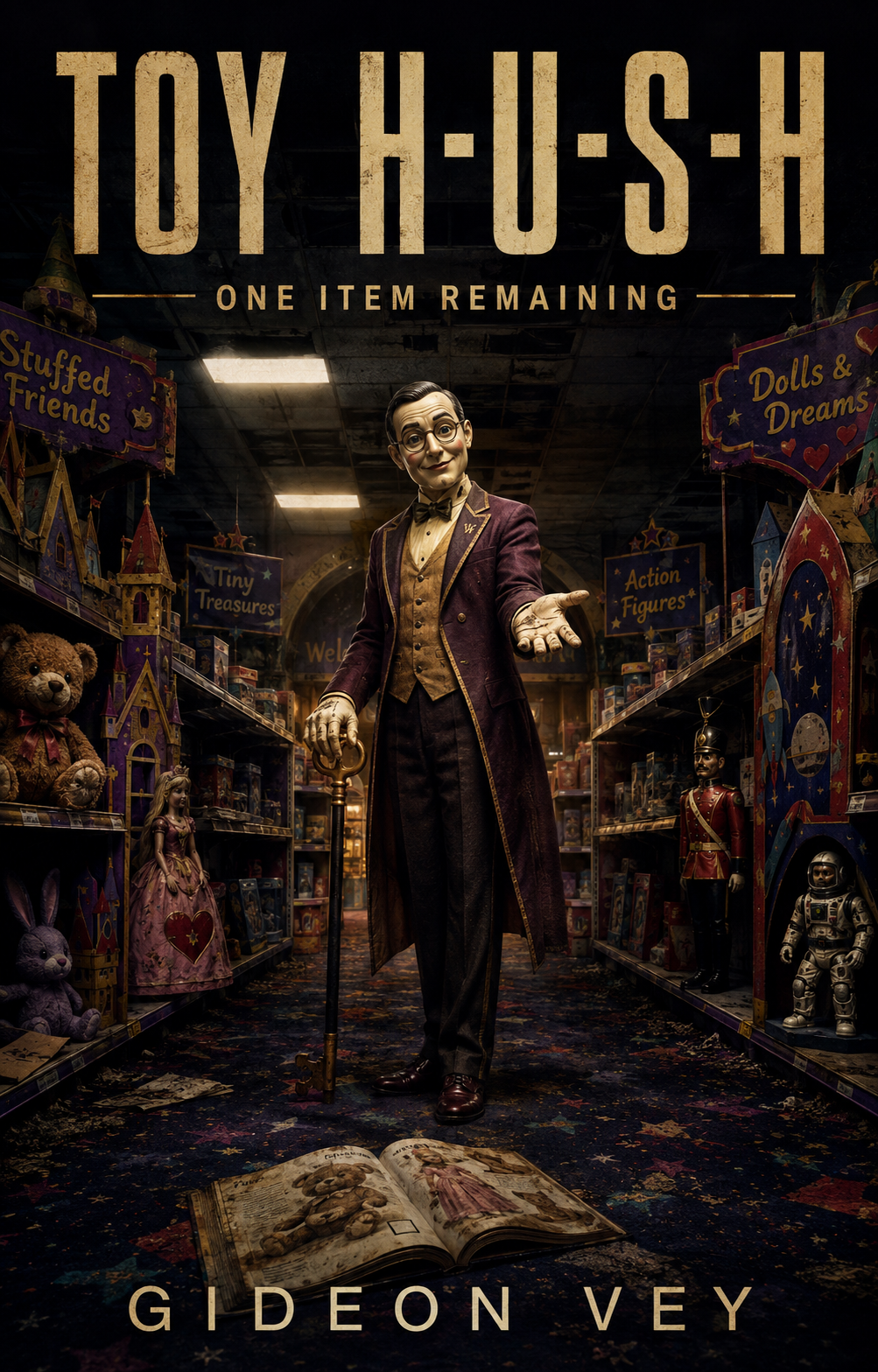
Chapter One
The Package
The little girl on Nora Vossane’s monitor had been dead for eighty-three years, but every time the film jumped, she smiled again.
Nora stopped the footage on the clearest frame she could find.
The girl stood beside a lake in a white summer dress, one hand lifted against the sunlight. Age had reduced the water behind her to a trembling field of silver scratches. A burn scar consumed the lower corner of the image, and mold damage had eaten through part of the girl’s face.
Nora enlarged the frame until individual grains of film became visible.
“You’re still in there,” she murmured.
She adjusted the restoration mask around the girl’s left eye. Software could rebuild the missing shapes, but Nora disliked letting it invent anything without supervision. Programs were excellent at producing what a face probably looked like. Her job was preserving what had actually been there.
She borrowed detail from three neighboring frames, reconstructed the curve beneath the eye, and softened the result until it matched the surviving grain. The repaired section appeared only briefly before the footage advanced and the girl became a blur of white dress and sunlight again.
Nora played the sequence twice.
The restoration was not perfect. Perfect usually meant dishonest.
But the girl had her face back.
Nora leaned away from the desk and rubbed the stiffness from her neck. Beyond the glow of her monitors, her apartment had fallen into late-afternoon shadow. Archival boxes occupied most of the second bedroom she used as a workspace. Film reels, videotapes, photographs, and obsolete playback equipment filled the metal shelving along the walls. Several machines had been dead longer than some of her clients had been alive. Nora kept them anyway. Old media rarely surrendered its contents willingly. Sometimes the only device capable of recovering a memory was the one built to hold it.
Her phone vibrated beside the keyboard.
The restoration company’s project manager had sent another message.
How is Bellweather Lake coming? Family is hoping for Friday.
Nora watched the little girl wave again.
Friday is fine, she replied.
She saved the corrected sequence in three locations, recorded the changes in the project ledger, and closed the file. The monitor went black.
For a fraction of a second, her reflection looked like someone else’s.
Dark hair pinned carelessly behind her head. Tired eyes. A narrow face made paler by the screen. Thirty-one years old, though exhaustion occasionally tried to add another decade.
Then the monitor’s standby light came on, and she was only herself again.
Nora reached for the coffee she had forgotten sometime before noon. The surface had gone flat and gray. She carried it toward the kitchen, stepping around two padded shipping cases waiting to be returned to clients.
Something scraped against the other side of her apartment door.
She stopped.
A soft thump followed.
Nora set the mug on the nearest shelf.
No one knocked.
She crossed the living room quietly and looked through the peephole. The hallway was empty. Late sunlight stretched through the window at the far end, catching dust above the worn carpet. Mrs. Barron’s television murmured behind the door across the hall.
A package sat directly beneath Nora’s peephole.
She waited.
The elevator indicator remained dark. No footsteps sounded from the stairwell. Whoever had left it had already gone.
Nora opened the door without removing the security chain.
The box was too large to be an ordinary envelope but too thin to contain anything substantial. Its corners were perfectly square. No crushed edge, no torn label, no gray film from the floor of a delivery truck. It looked as if someone had carried it carefully from a store counter and placed it outside her apartment.
Bright purple tape crossed the cream-colored cardboard.
Nora stared at the lettering printed along it.
TOY H-U-S-H
The letters were playful without being childish, each separated by a small gold diamond. Beneath them, in curling green script, was a slogan Nora had not seen since elementary school.
Every Aisle Has an Adventure.
For several seconds, she remained crouched behind the partly opened door.
The logo struck something buried deeper than conscious memory. She saw catalog pages spread across the living-room carpet. Christmas ornaments reflected in enormous store windows. Her mother’s handwriting beside circled toys. Eli bouncing on his toes because he could never wait for the automatic doors to finish opening.
A sweet, powdery smell seemed to drift from the box.
Cake frosting.
Nora shut the door.
The chain snapped taut.
She looked down the empty hallway again.
TOY H-U-S-H had not existed for more than twenty years.
Not as a functioning retailer, at least. The company’s surviving trademarks had passed through holding groups and asset sales. Old merchandise still appeared online. Collectors traded catalogs, employee badges, promotional displays, and sealed character toys at increasingly ridiculous prices. Someone had even attempted a nostalgic clothing line several years earlier, although the licensing dispute had killed it before launch.
None of that explained why a package bearing pristine store branding was outside her door.
Nora released the chain and brought the box inside.
There was no shipping label.
She turned it over. No postage, tracking number, return address, or courier mark appeared anywhere on the cardboard. Her name had been printed directly across the top in purple block letters.
NORA VOSSANE
No apartment number. No street. Only her name.
She carried it into her workspace and placed it beneath the articulated examination lamp.
The tape was not vintage. Its adhesive remained clear, and the surface showed no yellowing or brittleness. The box was equally new. Whatever this was, someone had manufactured it recently.
Probably a collector.
Her father had received things from TOY H-U-S-H obsessives during the final years of his life: photographs, copied security tapes, maps covered in handwritten theories, pieces of shelving people claimed came from the flagship. Most had been useless. Some had been cruel.
After his death, Nora had closed his message boards, disconnected the old post-office box, and refused every interview request. Anyone familiar with the case could still find her name, but sending something to her home required more effort.
That was likely the point.
Someone wanted her to know they had found her.
Nora photographed every side of the package before touching the tape. She considered calling the police, then imagined explaining that a dead toy-store chain had left an unmarked box in her hallway.
She retrieved a narrow preservation knife from her desk.
The tape separated cleanly.
Inside the box lay a single catalog wrapped in white tissue paper. A round sticker sealed the tissue.
Mister Wondleby smiled from its center.
Nora’s fingers tightened around the knife.
The character’s face was smaller than a coin, but every detail remained familiar: circular spectacles, sweeping coat, gold vest, gloved hand raised in greeting. His key-shaped cane rested against one shoulder. He looked exactly as he had in the old commercials—warm, dignified, and delighted that someone had arrived.
Around the sticker’s edge ran his signature phrase.
THERE’S ALWAYS ROOM FOR ONE MORE!
Nora put down the knife.
For years after the flagship closed, she had been unable to look at Wondleby without hearing her mother cry. That response had eventually dulled. Everything dulled if given enough time and enough refusal.
She broke the sticker.
The tissue opened with a dry whisper.
The catalog beneath it was thick and glossy, nearly three hundred pages by Nora’s estimate. Its cover showed a TOY H-U-S-H store at night, every window glowing with impossible abundance. Stuffed animals crowded the displays. Dolls waved from a cardboard castle. Rockets hung above the entrance while children raced shopping carts beneath strings of colored lights.
Mister Wondleby stood at the center with both arms extended.
Across the top, foil lettering announced:
TOY H-U-S-H HOLIDAY WISH BOOK
Below it:
2026 EDITION
Nora stared at the date.
She picked up her phone and photographed the cover, then enlarged the image as though distance might reveal an obvious flaw. The print alignment was clean. The foil reacted naturally to the examination lamp. Nothing suggested the cover had been altered after production.
She opened to the copyright page.
Published by Merrivault Toy Company. Holiday Catalog Division.
The listed address belonged to a building Merrivault had not officially used in decades.
A barcode occupied the bottom corner. Above it was a copyright date of 2026.
Nora turned several pages.
The catalog was not a simple reproduction.
It contained modern toys.
Packaging displayed current safety warnings. Prices were printed beside scannable codes. A tablet designed for young children appeared in Electronics & Demo Play. The accompanying photograph showed a smiling family gathered around a kitchen Nora recognized from a recent furniture advertisement.
Other pages recreated departments from TOY H-U-S-H’s golden years. Plush & Comfort. Dolls & Storybook Worlds. Action & Adventure. Science, Space & Discovery. Each section combined new merchandise with Merrivault characters that had disappeared after the chain collapsed.
Bramblebunk offered enormous patchwork arms to a frightened child.
Princess Lumerelle stood before a crystal mirror beneath the words YOUR HEART ALWAYS KNOWS THE TRUTH.
Major Brasswick raised his command baton over ranks of action figures.
Cosmo Rindle pointed toward a field of cardboard stars.
The images looked newly photographed.
Nora turned faster.
No web address appeared anywhere in the catalog. No telephone number. No order form. Every product carried one purchasing instruction:
PICKUP AVAILABLE IN STORE.
“What store?”
Her voice sounded too loud in the apartment.
A foldout map near the back listed dozens of TOY H-U-S-H locations, including properties demolished years ago. Some addresses now belonged to apartment buildings, medical offices, and parking lots. Every store was marked TEMPORARILY CLOSED.
Nora returned to the front.
The pages resisted slightly beneath her thumb, as if the catalog had already been opened to one section often enough to weaken its binding. She let the book fall where it wanted.
The center spread opened across her desk.
Balloons filled the background. A frosted cake sat beneath strings of purple and gold flags. At the top of the first page, cheerful lettering announced:
ELI’S BIRTHDAY WISH LIST
Nora stopped breathing.
A photograph occupied most of the opposite page.
The man in it appeared to be in his late twenties. He had dark hair, a lean face, and one eyebrow raised slightly higher than the other. A pale mark crossed the underside of his chin—the exact place Eli had split it falling from his bicycle when he was five.
He was smiling.
Not like a model. Not like someone following a photographer’s direction.
He smiled with one corner of his mouth first.
The way Eli had always smiled when he was trying not to laugh.
Nora touched the edge of the photograph but could not make herself touch his face.
Eli had been six years old when he disappeared.
If he were alive now, he would be twenty-eight.
The man in the catalog looked directly at her.
And Nora knew her brother.
Knowing did nothing to make it possible.
Nora pulled her hand away from the photograph.
The man’s smile remained unchanged. A photographer had caught him sitting at a long birthday table with his shoulders angled toward the camera. Purple and gold streamers hung behind him. A paper crown rested crookedly on his head, caught in dark hair that curled slightly above his ears.
Eli’s hair had done that whenever it grew too long.
Nora closed the catalog.
The glossy cover struck the desk with a flat, decisive sound.
For several seconds, she kept both palms pressed against it. Her pulse beat hard enough to move the skin between her fingers.
A photograph proved nothing.
Faces could be generated. Childhood pictures could be manipulated. Enough images of Eli had appeared in newspapers, missing-person reports, and her father’s endless online campaigns for someone to construct a convincing adult version.
The scar beneath the chin could have been copied.
The smile could have been studied.
Even the eyebrow could have been deliberate.
Whoever created the catalog wanted her to believe. That meant the image’s accuracy was evidence of preparation, not truth.
Nora repeated that to herself until she could breathe normally again.
Then she opened the catalog.
The center spread returned immediately, as though the binding had been trained to reveal it.
The left page resembled the birthday-club inserts TOY H-U-S-H once mailed to children before their birthdays. Eli’s name appeared above a column of neatly printed information.
BIRTHDAY GUEST: ELI VOSSANE
AGE: 28
PARTY STATUS: INCOMPLETE
REGISTERED STORE: MERRIVAULT FLAGSHIP 001
Below that was a list of toys.
Most of the entries had been covered by gold star stickers marked RECEIVED. The products were drawn from different periods of Eli’s life—some he had owned, some he had wanted, and several that had not existed in 2004.
Nora recognized a Cosmo Rindle explorer helmet their parents had bought him for his fifth birthday. A bright plastic dinosaur appeared beneath it. He had carried the dinosaur everywhere for almost a year, including to bed, until one leg snapped off beneath his pillow.
Beside the dinosaur was a building set Nora remembered circling for him in a Christmas catalog.
That Christmas had never arrived for Eli.
Farther down the list were products meant for older children. A telescope. A remote-controlled aircraft. A beginner’s robotics kit.
After those came adult items that did not belong in a toy catalog at all: a camera, a leather messenger bag, a set of drafting pencils, a record player with wooden speakers.
The list constructed a life through birthday presents.
Six.
Seven.
Eight.
Ten.
Thirteen.
Sixteen.
Twenty-one.
Twenty-eight.
Every year Eli had missed had been given an object.
Nora studied the adult photograph again. The messenger bag hung from the back of his chair. The camera rested beside the cake. A record sleeve protruded from a gift box at his feet.
Someone had not merely aged his face.
Someone had imagined him growing up.
At the bottom of the page, a final line appeared inside a purple-bordered box.
ONE ITEM REMAINING
The space beneath it had been covered by an opaque gold panel. It resembled the scratch-off fields used on old promotional cards, but the surface was smooth beneath Nora’s fingertip. No product name or image showed through when she held it beneath the lamp.
Under the panel, smaller lettering read:
PICKUP AVAILABLE IN STORE
Nora turned the page.
A full-page advertisement showed Mister Wondleby standing beside a customer-service counter. Behind him, shelves extended into a soft golden blur. He held a cream shopping bag with purple handles.
SOME WISHES ARE TOO IMPORTANT TO SHIP.
Beneath the slogan was a printed pickup record.
ORDER HOLDER: ELI VOSSANE
AUTHORIZED GUEST: NORA VOSSANE
PICKUP LOCATION: FLAGSHIP 001
A square code appeared at the bottom.
Nora stared at her own name before raising her phone.
The camera recognized the code immediately.
A map opened.
The screen displayed a commercial road running through an older industrial district. Most of the surrounding businesses had changed, but Nora did not need the building label. She recognized the location before the satellite image finished loading.
The original TOY H-U-S-H flagship occupied the center of the screen.
Or what remained of it.
The map showed a vast, dark roof surrounded by cracked parking lots and encroaching vegetation. The store had been condemned after the 2004 disaster. Merrivault announced plans to demolish it several times, but lawsuits, ownership disputes, environmental studies, and redevelopment failures kept the structure standing.
Her father had called that deliberate.
He believed Merrivault wanted the property inaccessible without destroying whatever remained beneath it.
Nora had stopped listening before he found evidence.
She tried closing the map. A white box appeared instead.
PICKUP WINDOW RESERVED
OCTOBER 16, 2026
ARRIVAL RECOMMENDED BEFORE CLOSING
Today was October 12.
Four days.
Nora touched the screen again.
The message disappeared, leaving the satellite view. A red location marker stood over the building. It was shaped like one of Mister Wondleby’s old key emblems.
Her phone vibrated.
The map application reported that the destination was closed permanently.
“No kidding.”
She closed it and examined the code printed in the catalog. There was no visible URL beneath it. When she scanned it a second time, the same map opened with the same reservation.
She switched her phone to airplane mode.
The code still worked.
That should not have been possible. The map’s basic data could have been cached after the first scan, but the reservation screen should have required an external connection. Nora cleared the application, disabled wireless service completely, and tried once more.
PICKUP WINDOW RESERVED
OCTOBER 16, 2026
The minute displayed at the bottom matched the current time.
Nora lowered the phone.
October 16 was not simply a convenient deadline.
Eli had disappeared on October 16, 2004.
Twenty-two years to the day.
She looked toward the doorway of her workspace. The apartment beyond it remained unchanged: half-finished coffee on the shelf, shipping cases beside the wall, late sunlight fading across the rug.
The catalog no longer looked like an object someone had left outside.
It looked like something that had arrived.
Nora searched the building before calling anyone.
She checked the stairwell, lobby, mailroom, rear entrance, and the narrow service corridor beside the laundry room. The building’s exterior camera covered part of the front walkway, but tenants could not access the recording. The property manager promised to review it in the morning, sounding more concerned about an unauthorized courier than the package itself.
“Did they leave anything dangerous?” he asked.
“I don’t know.”
“Is it leaking?”
“No.”
“Making noise?”
Nora glanced at the catalog lying beneath the examination lamp.
“No.”
“Then don’t open it any further.”
She nearly laughed.
“I’ll wait for your call.”
Back upstairs, she locked the deadbolt and hooked the security chain.
She placed the catalog inside a clear archival examination sleeve. The sleeve was intended to protect fragile material from contamination. Tonight, the thin barrier felt more like a way of keeping the object from touching anything else.
Nora photographed each page of the Eli spread.
She imported the adult portrait into her restoration software and opened the highest-resolution childhood photograph she possessed.
Eli stood between Nora and their mother outside the flagship on a summer afternoon. He was five, Nora eight. The store’s huge purple letters rose above them. Mister Wondleby banners hung from the light poles, and shopping carts formed bright silver rows behind the family.
Their mother had taken the picture using the camera’s timer. She was caught mid-laugh, one hand stretched toward Eli because he had started running before the shutter clicked.
Nora barely remembered the day.
She remembered the photograph.
There was a difference, although people rarely admitted it. A memory repeated through pictures eventually flattened into the image. Everything outside the frame disappeared—the temperature, the drive, the arguments, the minutes before and after. The photograph became the event.
She isolated Eli’s face and positioned it beside the catalog portrait.
The resemblance was extraordinary.
She measured the distance between his eyes, the slope from nose to upper lip, the asymmetry of the jaw. Childhood proportions changed unpredictably, but the adult man’s underlying structure was plausible. More than plausible. The software’s age-progression tools produced three possible adult versions of Eli. Two looked like strangers. The third resembled the man in the catalog, but not closely enough to explain the image.
Nora searched for signs of digital generation.
The man’s hands were correctly formed. Reflections in the pupils matched the apparent lighting. Hair crossed the edge of one ear naturally. Fabric texture remained consistent through the folds of his shirt. The cake’s lettering curved correctly across the frosting.
She enlarged the gold paper crown.
The words printed along its lower edge were almost too small to read.
BIRTHDAY GUEST SINCE 2001
Eli had joined the TOY H-U-S-H birthday club in 2001.
That information might have survived inside customer databases. Merrivault’s assets had passed through enough companies for old records to surface anywhere. A determined person could have found it.
Nora examined the background.
Three framed character posters hung on the wall behind Eli. Princess Lumerelle occupied the first. Bramblebunk filled the second.
Mister Wondleby stood in the third.
His poster face was turned slightly to the side.
Not toward the camera.
Toward Eli.
Nora increased the brightness. The effect remained subtle enough to be an illusion of perspective. Wondleby’s printed eyes should have looked straight ahead, but his head appeared angled within the frame.
She checked the wider image.
The party table had been set for eight people.
Only Eli was present.
Seven empty chairs surrounded him, each wearing a paper guest badge.
Nora could read two of the names.
MARNIE
NORA
She closed the image.
The apartment had grown completely dark around her.
Nora switched on every light.
She found the family tape in the third box.
The cardboard container had been sealed for six years. Her father’s handwriting covered the top.
HOME VIDEO—1999–2004
Beneath that:
NORA + ELI. DO NOT DISCARD.
As if she would.
Nora carried the box to her desk and lifted the flaps. Eighteen videocassettes stood in two careful rows. Her father had numbered them, dated them, and added short descriptions.
ELI’S 4TH BIRTHDAY
CHRISTMAS MORNING
NORA SCHOOL PLAY
SUMMER—BACKYARD/LAKE
The final cassette had a red evidence sticker wrapped around its spine.
TOY H-U-S-H—OCT. 16, 2004
The original tape had spent years with the police before being returned to the family. Her father made multiple copies and sent them to private investigators, journalists, forensic analysts, and anyone claiming they could recover damaged footage.
None found anything useful.
Nora had watched the recording twice.
The first time, she was nine years old and surrounded by adults asking what she remembered.
The second time, she was twenty-five and clearing her father’s house after his death.
She had promised herself there would not be a third.
Nora set the cassette beside the catalog.
Adult Eli smiled from the open page.
“I know what this is,” she told him.
A weapon did not become less dangerous because someone understood how it had been constructed, but understanding helped.
Whoever sent the catalog expected her to compare it with family material. They had probably built the adult image from the same public photographs Nora was examining now. The next step was obvious: disprove the illusion by finding a mistake.
She retrieved a combination VHS deck from the bottom shelf and connected it to her capture system. The machine had been professionally serviced the previous year, but the cassette mechanism still made a heavy mechanical clunk when it accepted the tape.
A blue screen appeared on the monitor.
The counter advanced.
Static rolled upward, followed by an image of the flagship parking lot.
The footage trembled with handheld movement. Nora’s mother had been carrying the camera while walking. Cars filled nearly every row. Searchlights swept across the darkening sky above the building, advertising TOY H-U-S-H’s annual October event.
THE LONG PLAYTIME
The words appeared on a banner above the entrance.
At the time, it was merely the name of an overnight promotional celebration. The store remained open late for costume appearances, demonstrations, birthday events, holiday previews, and the launch of its newest character lines.
Afterward, the name became shorthand for everything Merrivault claimed had gone wrong that night.
Electrical failure.
Fire.
Panic.
Structural damage.
Eleven deaths confirmed.
Nine children and adults never recovered.
Eli was one of them.
Nora pressed play.
Her mother’s voice came through the speakers.
“There it is. Eli, move away from the cars.”
The camera swung.
Six-year-old Eli raced ahead in a blue jacket. A cardboard Cosmo Rindle helmet sat crookedly over his hair.
Nora appeared several steps behind him.
Nine years old. Purple coat. Impatient expression. One hand raised to block the camera.
“Mom, stop.”
“You’ll want to remember this.”
“No, I won’t.”
Her mother laughed.
Nora paused the tape.
The frozen image showed her childhood self looking directly into the lens.
She had forgotten the purple coat.
She had not forgotten the irritation. At nine, being recorded had felt like an indignity. Every moment her mother considered precious seemed designed to embarrass her.
Nora advanced frame by frame.
Eli ran back and grabbed her hand.
The motion caused the camera to blur, but for three frames the siblings stood together beneath the enormous illuminated sign. Nora looked annoyed. Eli looked ecstatic.
The catalog photograph waited on the desk below the screen.
The same chin.
The same eyebrow.
The same smile beginning at one corner.
Nora restarted the tape.
The family entered the flagship through revolving doors decorated with gold stars. Sound changed immediately. Music echoed through the Grand Entry, accompanied by hundreds of voices, rolling cart wheels, demonstration noises, and announcements from the PA.
The camera moved across a store built to overwhelm children.
Seasonal displays rose nearly to the ceiling. A cardboard castle marked the entrance to Dolls & Storybook Worlds. A suspended spaceship flashed above Science, Space & Discovery. Plush animals filled a landscape of artificial trees. Character footprints painted on the floor promised to lead children through every department.
Nora remembered none of it looking frightening.
That was the worst part.
TOY H-U-S-H had been wonderful.
Even on the tape, with knowledge of what happened only hours later, she could feel the pull of it. Every aisle promised transformation. A child could become an astronaut, monarch, soldier, magician, scientist, parent, explorer, or hero simply by choosing which direction to run.
Mister Wondleby’s voice filled the store.
“Welcome, adventurers! There’s always room for one more!”
Children cheered.
The camera found the main display in Seasonal Court.
Wondleby stood at the top of a short staircase, surrounded by balloons and wrapped presents. This was not a costume performer. It was one of Merrivault’s large promotional figures, built to move through a limited sequence during store events.
His head turned.
One gloved hand rose.
The key-shaped cane tapped the platform three times.
Eli waved both arms.
“He sees me!”
“He sees everybody,” nine-year-old Nora said.
“No, he sees me.”
On the recording, Wondleby lowered his hand.
His circular spectacles flashed beneath the lights.
Then his head turned several degrees past the limit of the programmed movement.
Toward Eli.
Nora stopped the tape.
She remembered her father showing that moment to investigators. Merrivault claimed the display’s rotation mechanism had slipped. Police technicians found nothing conclusive because the figure disappeared during the emergency.
The footage continued into the store.
Their mother filmed only fragments. Eli trying a Cosmo Rindle wrist scanner. Nora holding a Princess Lumerelle doll before noticing the camera and putting it back. Both children sitting at a demonstration table while an employee showed them a Merrivault story projector.
Ordinary moments.
The timestamp advanced toward six thirty.
Nora knew what came later. The power fluctuations began after eleven. Emergency calls followed. The surviving footage ended before midnight, shortly after the family became separated in the Celebration Zone.
But the tape was damaged long before then.
Sections disappeared into static. Tracking errors folded the image. Audio dropped for minutes at a time. The most important portion—approximately forty-seven minutes surrounding Eli’s disappearance—had been recorded over by a field of gray interference.
Nora navigated to the damaged segment.
The screen filled with static.
She reduced the playback speed and activated the capture system. Modern restoration tools were significantly more powerful than those available during the original investigation. Her father had asked her to try again repeatedly.
She always refused.
Not because she believed nothing could be recovered.
Because some part of her feared something could.
Nora began with frame stabilization. The tape contained a weak control track beneath the interference. She rebuilt timing from the surviving pulses, separated the color channels, and mapped recurring noise patterns.
The first recovered image was barely an image at all.
A vertical strip of purple.
A patch of yellow light.
Three pale shapes that might have been balloons.
Nora continued.
Minutes passed. Then an hour.
She forgot the catalog temporarily, which might have been why she did not notice when its pages moved.
A soft rustle came from the desk.
Nora turned.
The center spread lay open exactly as before. Air from the equipment fan could have lifted the page. Nothing else had changed.
She placed a metal film canister on the catalog’s corner and returned to the footage.
The damage had structure.
That unsettled her more than random corruption would have. Static repeated in intervals, almost like something layered deliberately over the recording. Nora isolated the dominant pattern and subtracted it.
A figure appeared.
Eli stood near the edge of the Celebration Zone.
The image lasted for a fraction of a second.
Nora moved backward and played it again.
Eli faced away from the camera. His explorer helmet was gone. One hand hung at his side.
The other appeared to be holding someone’s hand.
Whoever stood beside him had been lost outside the surviving frame.
Nora expanded the image.
A narrow sliver of cream-colored fabric appeared near Eli’s shoulder. Above it, something caught the light in two perfect circles.
Spectacles.
“No.”
The word escaped before she could stop it.
Compression artifacts could form patterns. Human perception was dangerously eager to find faces, bodies, and familiar objects inside damaged images. Nora taught junior restoration technicians never to begin with the answer they wanted. Expectation contaminated judgment.
She reset the process and rebuilt the frame using a second method.
The cream-colored sliver remained.
So did the circles.
She processed the neighboring frames.
In the first, Eli was looking toward the unseen figure.
In the second, he had begun stepping out of view.
In the third, only the sleeve of his blue jacket remained.
Nora searched the audio track.
Mostly static.
She increased the gain, removed the electrical hum, and separated frequencies by range. Store music emerged first, warped and slow. Beneath it were voices. A woman shouting. Children crying. A PA chime repeating every thirteen seconds.
Then Nora heard herself.
“Eli?”
Nine-year-old Nora sounded close to the camera.
She remembered holding it after her mother pushed it into her hands. She remembered the strap wound around her wrist. Red emergency lights. Adults moving in contradictory directions.
“Eli, wait.”
The recording cracked.
A child answered, but the words disappeared beneath a burst of noise.
Nora leaned toward the speakers.
She replayed the section.
Again.
On the fourth attempt she isolated three syllables.
“—wants me.”
It might have been he wants me.
Or someone wants me.
Or nothing at all.
Nora found the PA chime and used its stable frequency as a reference point. Once corrected, the voices became slightly clearer.
“Eli, come back.”
That was her.
A second voice answered from farther away.
“You said—”
Static swallowed the rest.
Nora’s chest tightened.
She had said something to Eli before they separated. For years she had possessed only the shape of the memory: his hand in hers, alarms sounding, a crowd pressing around them. He wanted to go in one direction. She pulled toward another.
Then she was alone.
Nora advanced the audio.
Her childhood voice called his name twice more.
The damaged tape clicked inside the deck.
A new sound emerged beneath the static.
Music.
Soft brass and bells played the closing melody from Mister Wondleby’s commercials. Nora remembered the tune because every advertisement ended with it. Wondleby would lower his hat and remind children that every good adventure ended at home.
The melody should not have been playing during an emergency.
She removed another layer of noise.
A man’s voice appeared.
Warm. Patient. Theatrical.
Mister Wondleby’s store voice.
“Adventurers, please remain with your party.”
A burst of interference followed.
“Every guest will be—”
The remainder vanished.
Nora watched the waveform. Another announcement was buried farther down the track. Its pattern differed from the…
She…
Keep reading TOY H-U-S-H: One Item Remaining
You've reached the end of the free preview. Purchase this eBook for permanent access in your Novel Thunder Library.
Buy eBook — $4.99